
Why Latter-day Saints Are Leaving: What the Torn Study, Pew Research, and LDS Retention Data Reveal
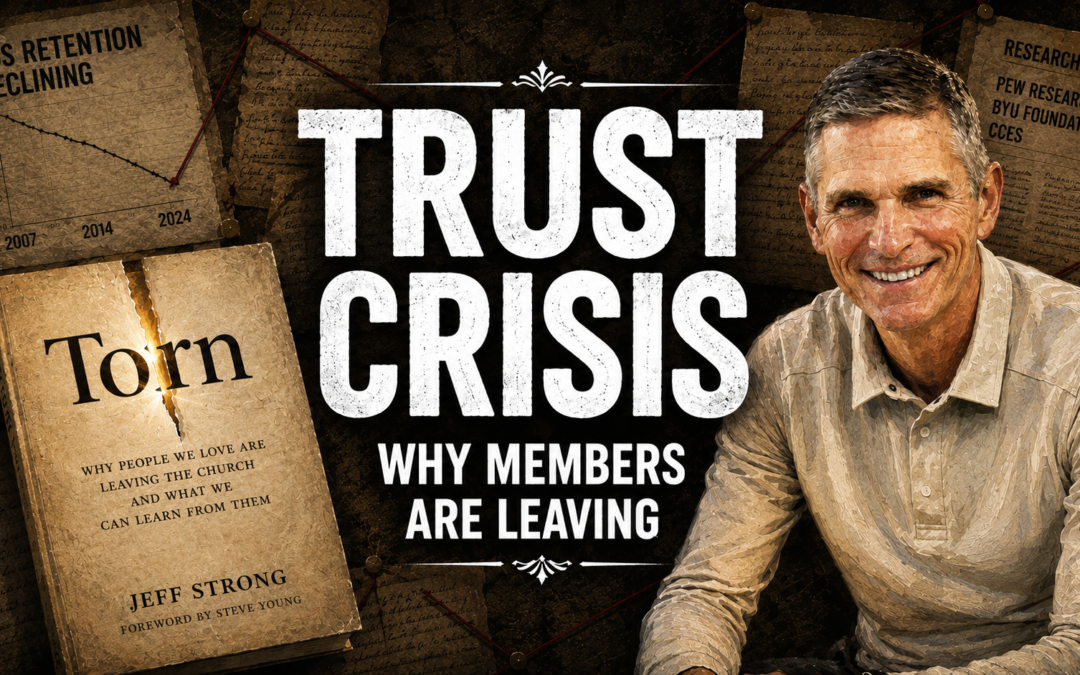
Jeff Strong’s Torn argues that nearly 40% of once-active Latter-day Saints have stepped away from the Church during the past 25 years. While Sunday Musings raises legitimate methodological concerns about the study, independent research from Pew Research Center, BYU, the Cooperative Election Study (CCES), and other sources points in a remarkably similar direction.
This article examines the Torn study, evaluates Sunday Musings’ critique, and compares both with independent probability-sampled research. More importantly, it explores a central question many believers and former believers continue to wrestle with: Is the growing trend of LDS disaffiliation primarily a crisis of faith, or is it a crisis of trust in Church institutions?
Key Findings at a Glance
- Pew Research found that approximately 54% of people raised LDS still identify as Latter-day Saints in adulthood.
- Jeff Strong’s Torn study estimates that roughly 40% of once-active members have left.
- BYU research reports retention rates near 50% across multiple national datasets.
- CCES data analyzed by Widow’s Mite shows declining indicators of active LDS participation.
- The Torn study found that many former members reported maintaining belief in God while losing trust in Church institutions.
About This Episode and Its Context
Sunday Musings is a podcast run by faithful Latter-day Saint Connor Boyack. He maintains a strong testimony of the Restoration while openly criticizing some LDS institutional practices and cultural trends. He reviews Jeff Strong’s 2026 book Torn: Why People We Love Are Leaving the Church and What We Can Learn From Them. Strong is a former bishop, mission president, BYU faculty member, and Church advisor. His study surveyed more than 20,000 current and former LDS members. It may be the largest public study of LDS disaffiliation ever conducted.
This analysis is different from any other in this series. Sunday Musings is a faithful LDS voice making largely good-faith arguments. The host’s methodological critique of the Strong study is substantive and partially correct. But independent research from Pew, CCES, BYU, and the GSS corroborates the core finding he dismisses. And his own frank accounting of institutional failures near the episode’s end is one of the most candid passages in faithful LDS commentary this series has encountered.
What Independent Probability-Sampled Research Shows Before We Evaluate the Strong Study
The host argues the Strong study’s methodology is too flawed to trust its 40% finding. First, here is what three independent well-designed research programs — with no LDS affiliation — show:
54%of those raised LDS still identify as LDS in adulthood — meaning ~46% have disaffiliated. Down from 70% (2007) and 64% (2014). Nationally representative, 36,908 respondents.
↓Active LDS membership indicators declining 2016–2024 across 3 independent metrics: member donations (5 countries), CCES surveys, and male missionary service rates.
~50%Retention rate confirmed by BYU’s own research team across five national datasets — consistent with Pew, declining from prior decades.
Pew’s 46% finding independently supports Strong’s 40% disaffiliation estimate. The methodology critique is valid; however, independent evidence does not support dismissing the figure.
What Sunday Musings Gets Right
The Strong study’s non-probability self-selected sample limits how confidently readers can interpret specific findings
Valid and Well-Founded — Strong Himself Makes the Same Points.
The host’s methodological critique is substantive and largely accurate.The survey recruited participants through Faith Matters, LDS Facebook groups, podcast appearances, and email lists. As a result, it likely over-represents people with strong opinions about the Church and active involvement in online LDS discussions. While under-representing rural or less connected members, international members (most of the global Church), and those who left quietly years ago and no longer participate in LDS-adjacent online spaces.
Social psychologists have documented voluntary self-reporting bias for decades. People often attribute decisions to principled external factors rather than to personal motivations that may seem less flattering. Strong himself acknowledges this explicitly, writing that “the way any of us explain our decisions or motives to others is sometimes subject to our own biases and perceptions and our deep need for inner congruency.” The host’s Trafalgar polling analogy — people answering more honestly when asked about their neighbor than about themselves — is a genuinely insightful parallel.
The host is also right that the acceleration multipliers (3x, 6x, 11x increasing departure rates across successive five-year periods) are almost certainly overstated due to survivorship bias. People who left before 2010 are far less likely to have encountered a 2023-25 survey circulating in current LDS online communities — so the survey systematically under-counts early leavers and over-represents recent ones.
These are real limitations. Strong acknowledges them. The host is right to flag them and right that the specific multipliers for acceleration are unreliable.
Strong identifies a trust crisis rather than a faith crisis, making it the book’s most important contribution
The Strong study’s most important finding is clear. Fifty-one percent of former members report that their relationship with God remained positive or unchanged. In contrast, 88% report a negative impact on their relationship with the institutional church. This divergence — God positive, church negative — is the book’s central finding and the host is right to give it prominent treatment.
It tells a very different story than the standard “they lost their faith” narrative. Most people who leave the LDS Church are not abandoning God. They are withdrawing institutional trust. The 2013 faith crisis report found a similar pattern: members were often less disturbed by the historical problems themselves than by concluding that church leaders had handled them with incomplete disclosure or institutional self-protection.
The host’s theological response — anchor testimony in Christ directly, not in culture or leadership — is coherent and honest. His scriptural citations (Jeremiah 17:5, 2 Nephi 4, D&C 1:19) on trusting in the arm of flesh are genuinely relevant and do not require dismissing the institutional concerns to make the point. This is the episode’s most pastorally useful contribution.
Strong’s divergence data (God positive, church negative) changes how disaffiliation should be understood. The host’s scriptural response is honest and doesn’t require dismissing the concerns to be valid.
Where the Analysis Goes Too Far
Valid methodological concerns do not justify dismissing a finding corroborated by three independent research programs
The Critique Is Valid — The Dismissal Is Not Warranted by the Evidence.
Although Sunday Musings raises methodological concerns that deserve serious consideration, those concerns do not automatically invalidate the study’s central conclusion. When independent research repeatedly arrives at similar estimates, the broader trend becomes difficult to dismiss.
Religion News Service analyzed Pew’s 2023–24 Religious Landscape Study in December 2025. The nationally representative survey included 36,908 respondents. It found that approximately 54% of people raised LDS still identify as LDS in adulthood. This means roughly 46% of those raised LDS no longer identify as LDS in adulthood. That is not from a podcast-recruited self-selected sample. That is from a gold-standard probability survey. It directly corroborates Strong’s 40% figure from the opposite direction.
The Widow’s Mite project’s analysis of CCES data shows active LDS membership indicators declining across three independent metrics from 2016 to 2024. BYU’s own research team confirms approximately 50% retention. The GSS shows consistent long-term declining retention. When multiple well-designed independent studies with no connection to each other, Faith Matters, or the LDS discourse community arrive at similar conclusions, the conclusion becomes more reliable — not less — regardless of any single study’s limitations.
Readers should treat Strong’s specific percentages cautiously. The directional finding — that a large proportion of once-active LDS members have disaffiliated — is robustly confirmed by independent probability-sampled research.
Self-serving attribution bias is real — but the host applies it so broadly it dismisses rational responses to documented institutional failures
The Psychological Point Has Validity — The Scope of Application Does Not.
The “external locus of control” argument — that people who leave attribute their departure to principled external causes rather than internal lifestyle preferences — is psychologically valid and documented. Voluntary self-reporting will genuinely over-represent doctrinal concerns relative to lifestyle factors. The host’s point has real merit as a partial explanation.
However, the host applies the argument too broadly. As a result, it becomes a near-comprehensive dismissal of the concerns driving disaffiliation. And the host’s own evidence undermines this application. Near the episode’s close, he lists approximately twenty documented institutional failures — the SEC fine, D&C 132 being altered before publication, Brigham Young altering Joseph’s journals,church leaders taught the priesthood ban as a divine commandment and later disavowed that teaching, Adam-God, blood atonement, the First Presidency denying a document that later surfaced. These are not rationalizations or societal stain. They are documented facts confirmed by the Church’s own publications, the Joseph Smith Papers, and secular reporting.
Genuine distrust produced by genuine documented institutional failures is not external locus of control. It is a rational response to institutional behavior. The argument blurs an important distinction. Some people may use institutional failures to justify an existing preference. However, that does not mean every expression of institutional distrust is a rationalization.
Attribution bias affects voluntary self-reporting. It does not account for rational institutional distrust produced by documented failures the host himself confirms are real.
Labeling departing members as captured by “postmodern secular leftism” substitutes a rhetorical frame for engagement with documented substantive concerns
The “societal stain / postmodern leftism” framing is the episode’s weakest analytical move. Because the framing suggests that cultural pressures influenced those who leave, without engaging the substantive content of what they’re responding to.
Someone who leaves because they read the Church’s own Gospel Topics Essay on the Book of Abraham and concluded Joseph Smith’s translation claims cannot be sustained is not responding to postmodern leftism. Someone who encounters the documented reality that Joseph Smith married a 14-year-old — confirmed in the Church’s own Gospel Topics Essay on Plural Marriage — is responding to a primary source historical fact, not secular cultural pressure. Strong’s own data shows these people wrestle for an average of nearly a decade before leaving. That is not the profile of someone being casually carried along by cultural currents.
The host’s own sympathy earlier in the episode — “I can sympathize with this is a very hard wilderness to traverse when you don’t have a lot of support” — is far more honest than the closing “societal stain” framing. Both cannot be equally true. Either these people are navigating a genuinely difficult wilderness of real historical questions, or they are simply being stained by leftist culture. The host’s best analysis recognizes the former.
The societal stain label does not engage the substantive concerns. It also contradicts the earlier sympathy in the same episode for people navigating a genuinely difficult historical wilderness.
The Most Important Moment in the Episode
The Host’s Own List of Institutional Failures.
The rapid-fire acknowledgment of approximately twenty documented institutional problems is one of the most candid passages in faithful LDS media
Near the end of the episode, the host rapidly lists about twenty institutional failures. He describes them as real, documented, and understandable sources of concern. The list includes: D&C 132 altered before publication and released years after Joseph’s death; leaders withheld the William Clayton journals from members; church representatives first denied the 1886 John Taylor polygamy revelation and later released it; church leaders substantially re-recorded a General Authority’s General Conference address; the SEC fine for using shell companies to hide Ensign Peak’s scale; Brigham Young and others editing Joseph’s journals; faith-promoting myths taught as truth; church leaders taught the priesthood and temple ban as a divine commandment and later stated that it did not originate from God; interracial marriage taught as eternal law; Adam-God; Brigham Young taught blood atonement for decades, and President Kimball later described it as false doctrine.
The host’s stated purpose in listing them is to say: despite all of this, he maintains a strong testimony. That is his genuine experience and it deserves respect. But the list has a secondary effect: it is the most comprehensive, candid acknowledgment of documented institutional failures available from a faithful LDS media voice in this entire series. Every item is documented. Several are issues this rebuttal series has covered in depth.
Why This Acknowledgment Matters
Truth seekers who have been told that concerns about LDS institutional history reflect weak testimony, societal stain, or external locus of control will find something important in this list: a believing, active, well-researched member confirms these concerns are real and legitimate. The dispute is not about whether the problems exist. It is about whether a properly grounded testimony in Christ can withstand them. That is a genuine and honest disagreement worth having on its own terms.
The host validates the substantive reality of the concerns driving disaffiliation. His response — anchor in Christ not in culture — is genuine and deserves engagement on its own terms, not as a dismissal of whether the problems are real.
Frequently Asked Questions
Why Are Latter-day Saints Leaving?
According to the Torn study, Pew Research data, BYU research, and CCES surveys, the primary reasons many Latter-day Saints leave include concerns about Church history, institutional transparency, social issues, trust in leadership, and personal spiritual experiences. While individual circumstances vary, multiple studies suggest that many former members retain belief in God even after losing trust in Church institutions.
Is it true that 40% of once-active Latter-day Saints have left the church?
Jeff Strong’s study estimates approximately 40% disaffiliation with a non-probability self-selected sample that has real limitations. But independent probability-sampled research corroborates the core finding. Pew Research Center’s 2023-24 study found LDS retention of childhood members at 54% — meaning roughly 46% no longer identify as LDS in adulthood, down from 70% in 2007 and 64% in 2014. The Widow’s Mite’s CCES analysis shows active LDS membership declining across three metrics 2016-2024. BYU’s own research team confirms approximately 50% retention across five national datasets. Strong’s 40% figure is directionally consistent with all of these independent sources.
What are the four main reasons Latter-day Saints leave the church?
Strong identifies four patterns that heavily overlap. Church history and truth claims (42% primary): Book of Abraham, Joseph Smith’s polygamy including marriages to teenage girls, priesthood ban, First Vision accounts, Book of Mormon DNA and anachronism problems. Church social positions (33%): LGBTQ+ treatment, financial transparency, gender inequality, handling of abuse. Church experience and spiritual depletion (18%): feeling the church is institutional rather than Christ-centered, lack of belonging. Lifestyle factors (6%): demands becoming unsustainable. Strong’s central finding: 51% of those who left report their relationship with God remained positive, while 88% report a negative relationship with the institutional church — suggesting this is primarily a trust crisis, not a faith crisis.
Is leaving the LDS Church a faith crisis or a trust crisis?
Both Strong and the Sunday Musings host argue that the issue is primarily a trust crisis. The key data: 51% of those who stepped away report their relationship with God remained positive or improved; 88% report a negative impact specifically on their relationship with the institutional church. This divergence — God positive, church negative — is the most significant finding in the study and is consistent with the 2013 faith crisis report’s similar pattern. Most people who leave the LDS Church are not abandoning God. They are withdrawing institutional trust following specific experiences of institutional failure or perceived deception.
What does Pew Research say about LDS retention rates?
Pew Research Center’s 2023-24 Religious Landscape Study — nationally representative, probability-sampled, 36,908 respondents — found that approximately 54% of those raised LDS still identify as LDS in adulthood. This means roughly 46% have disaffiliated, directly corroborating Strong’s 40% estimate. LDS retention has declined significantly from 70% in Pew’s 2007 study and 64% in 2014. Religion News Service’s Jana Riess analyzed this data in December 2025. BYU’s own research team confirms approximately 50% retention using five national datasets. The CCES data shows active membership indicators declining across three metrics from 2016 to 2024.
What institutional failures does Sunday Musings acknowledge as real?
The host lists approximately twenty documented institutional failures near the episode’s close, including: D&C 132 altered before publication; William Clayton journals withheld from members; the 1886 John Taylor polygamy revelation first denied then quietly released; the First Presidency denying a document that later surfaced; a General Conference address required to be substantively re-recorded; the SEC fine for shell companies hiding Ensign Peak’s scale; Brigham Young altering Joseph’s journals; faith-promoting myths taught as fact (the transfiguration anecdote, the Thomas Marsh milk-stripping story); church leaders taught the priesthood and temple ban as a divine commandment and later disavowed that teaching; interracial marriage as eternal law; Adam-God; and blood atonement characterized as false doctrine by a later prophet. He frames these as real but survivable for those anchored in Christ rather than in institutional culture.
What is the “external locus of control” argument about why people leave?
The argument holds that people who leave the LDS Church systematically attribute their departure to external factors — history, leadership failures, policies — rather than internal ones like lifestyle preferences. The argument has genuine psychological validity: self-serving attribution bias in voluntary self-reporting is well-documented. But Sunday Musings applies it so broadly it functions as dismissal of rational responses to documented failures. The SEC fine, Joseph Smith marrying a 14-year-old (confirmed in the Gospel Topics Essay), the Book of Abraham Essay’s Egyptological concessions — these are documented facts, not rationalizations. Genuine institutional distrust produced by documented institutional failures is not a character deficiency. The host’s own rapid-fire list of acknowledged failures undermines the comprehensive application of this argument.
The Honest Summary
Sunday Musings offers one of the most intellectually serious faithful LDS commentaries in this series. The host has done substantial historical research, is openly critical of LDS institutional failures, and brings genuine analytical tools to a difficult topic. His methodology critique of the Strong study is valid and well-presented. His trust-crisis framing — and his scriptural call to anchor testimony in Christ rather than in culture — is the episode’s most pastorally valuable contribution.
Three things need correcting. Pew’s 46% finding, together with CCES and BYU data, supports the broader trend identified by Strong, valid methodology critique does not justify dismissing a finding this robustly confirmed. The external locus of control argument is a partial truth applied as a comprehensive explanation, in a way that is undermined by the host’s own acknowledged list of real institutional failures. And the “postmodern leftist stain” framing substitutes a label for engagement with documented historical concerns that the host himself confirms are real.
The episode’s most important contribution is inadvertent: the host’s rapid acknowledgment of approximately twenty documented institutional failures — the SEC fine, polygamy with minors, Brigham Young altering Joseph’s journals, Adam-God, the priesthood ban disavowal — is the most candid faithful-member validation of these concerns in this entire series. It tells truth seekers something essential: these are documented facts, acknowledged even by well-researched believing members. The dispute is not about whether the institutional problems exist. It is about whether a testimony grounded in Christ can withstand them. That is a genuine and honest disagreement worth engaging on its own terms — without dismissing the data, the concerns, or the people who act on both.