
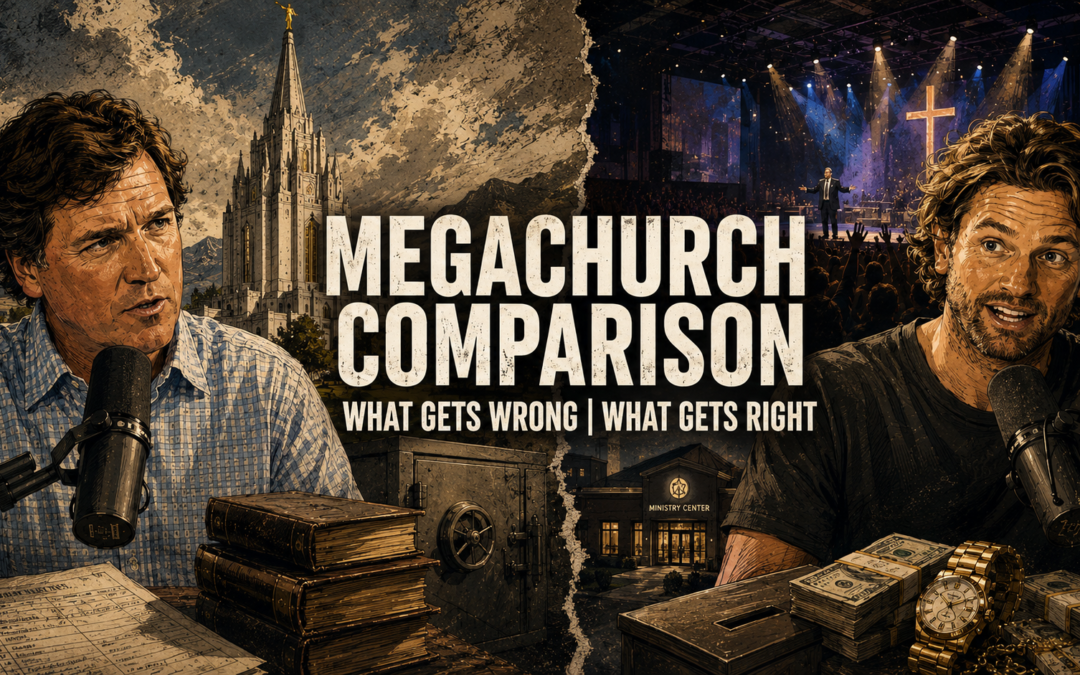
Tucker Carlson, The Religion Business, and the LDS Church: What the Megachurch Comparison Gets Wrong — and What It Gets Right
Tucker Carlson made comments about the LDS Church that sparked debate over the Church’s finances, wealth, and tithing practices. However, the discussion with Nathan Turner, host of The Religion Business, contains several factual errors. In addition, it overlooks important structural differences between the LDS Church and independent American megachurches. Furthermore, neither host has documented LDS expertise, the discussion overstates several financial figures, and the megachurch comparison fails on five fundamental dimensions. At the same time, three financial criticisms raised during the conversation are legitimate, well documented, and deserve honest engagement from Latter-day Saints.
About This Conversation
Tucker Carlson interviews Nathan Turner, creator and host of The Religion Business — a watchdog podcast that documents financial corruption, personal enrichment, and institutional abuse in American megachurches. The conversation begins with Israeli government geofencing campaigns targeting American evangelical churches. It then examines megachurch financial opacity, Kenneth Copeland’s estimated $700 million personal wealth, and Greg Laurie’s orphanage abuse scandal. Finally, Tucker briefly raises the LDS Church as an aside. Turner addresses the LDS Church for approximately three to four minutes before returning to the megachurch analysis that occupies most of the episode.
Neither Tucker Carlson nor Nathan Turner is LDS, ex-LDS, or has publicly documented expertise in LDS doctrine, governance, or finances. Turner’s five years of research is focused on independent non-denominational American megachurches. The LDS segment applies a framework built from studying Kenneth Copeland and Greg Laurie to an institution with fundamentally different architecture.
The Bias — Framework Without Expertise Applied to the Wrong Subject
Nathan Turner’s megachurch analysis is valuable and documented. The corruption model he describes is real and well documented. It includes single-pastor enrichment, financial opacity, little external accountability, and treating congregations as revenue sources. The bias in this conversation is not that Turner has an agenda against the LDS Church. It is that he applies a framework built entirely from studying independent non-denominational churches to an institution that differs structurally on almost every dimension that makes megachurches corrupt.
Next, Tucker introduces the LDS Church with: “The Mormon LDS Church is one of the biggest land owners in the United States.” That is the entirety of his LDS knowledge on display. He then asks Turner — a megachurch watchdog with no documented LDS expertise — to explain it. As a result, Turner applies a megachurch corruption framework to the LDS Church. However, the Church is not a megachurch, is not independently governed, and is not structured to allow the same financial abuses Turner has spent five years documenting.
The result is an analysis that gets the general concern right (large institution, financial opacity, continued tithing while wealthy) while getting the mechanism, the comparison, and the specific figures significantly wrong.
The Five Structural Differences the Conversation Ignores
Before evaluating specific claims, it helps to identify the fundamental structural difference. The entire conversation’s corruption analysis rests on pathologies specific to the independent non-denominational megachurch model. The LDS Church differs on every one of those pathologies.
| Dimension | American Independent Megachurch | LDS Church |
|---|---|---|
| Local Clergy | Professional paid pastor; salary depends on congregation revenue | Unpaid volunteer bishops, stake presidents, ward leaders — all hold regular jobs |
| Leader Personal Wealth | Kenneth Copeland ~$700M; Joel Osteen ~$100M personal accumulation | General Authorities receive a living allowance estimated at ~$150-200K/year; no personal ownership of Church assets |
| Financial Accountability | Often zero external oversight; no required filings; single person controls assets | Presiding Bishopric oversees finances; independent audit committee; annual audit report at General Conference; files required disclosures in UK, Australia, Canada, NZ |
| Empire Building | Pastor can register thrift stores, consulting firms, TV networks as “church” entities; all benefit pastor personally | Church-owned enterprises (farms, City Creek Center, Deseret Book) are institutionally owned, not individually; leaders cannot personally extract wealth from them |
| Governance Structure | “One person at the head” — typically one pastor or family controls entire institution | Collective governance — First Presidency (3) plus Quorum of the Twelve (12) as governing council; no single person controls institution |
Three Specific Financial Figures That Need Correction
1. “Net assets are about 350 billion” — overstated by approximately $60-85 billion
The Widow’s Mite Report provides the most credible independent estimate of LDS Church net assets. It relies on SEC filings, public financial disclosures, church reports, and professional financial modeling. Their 2024 analysis estimates total LDS Church net assets at approximately $265-293 billion — significant, but meaningfully lower than $350 billion.
Likewise, the Salt Lake Tribune’s independent analysis corroborates this range. The Christian Post cited a 2023 report that put total net worth at approximately $236-265 billion. None of the credible independent analyses supports $350 billion. Turner’s figure appears to be an estimate that has circulated online but exceeds what the actual evidence supports.
More importantly, this distinction matters. Inflated figures allow the Church’s defenders to dismiss the broader criticism. However, the underlying concern about accumulated wealth and continued tithing is legitimate and does not require exaggeration.
Use $265-293 billion (Widow’s Mite) or the Salt Lake Tribune’s “$200B+ in investment reserves” framing for accuracy.
Widow’s Mite Report — $265-293B total net assets estimate (2023-2024) ·
Salt Lake Tribune — $200B+ investment reserves now exceed yearly costs (April 2025)
2. “Over 300 billion in the market” — conflates total net assets with the equity portfolio, which is ~$53-58 billion
— Nathan Turner, approximately 00:54:35
This is a significant category error. Ensign Peak Advisors — the Church’s US-based investment arm — holds approximately $53-58 billion in publicly disclosed US equities per its SEC 13F filings as of 2024-2025. This is the figure that appears in SEC-required disclosures because it represents direct US equity holdings above the $100 million reporting threshold.
Widow’s Mite estimates the total Ensign Peak investment portfolio at approximately $179–206 billion. That estimate includes non-U.S. holdings, bonds, real estate, private equity, and investments that do not appear in Form 13F filings. The KTVZ/Stacker analysis corroborates this range.
Turner appears to confuse the Church’s total estimated net assets ($265–293 billion) with its market investments. In reality, the publicly disclosed equity portfolio is only about one-fifth of that amount. The distinction matters. Total Church wealth also includes real estate, operating assets, educational institutions, and other holdings that are not publicly traded investments.
Turner conflates total net assets with market-held investments. The equity portfolio is roughly one-quarter to one-third of the total asset base.
3. Equating the LDS tithing structure with megachurch “demanding” money conflates two fundamentally different models
The Tithing Concern Is Legitimate; The Mechanism Is Mischaracterized.
At first glance, this statement raises a legitimate concern, that the LDS Church continues requiring tithing from members while its investment returns already exceed operating costs. But the mechanism is mischaracterized in ways that matter.
What is accurate
Full tithe payer status is required for a temple recommend. A temple recommend is required for temple endowment and sealing ordinances. LDS theology teaches these ordinances are necessary for the highest degree of celestial glory. Elder David Bednar acknowledged at the National Press Club that “the Church doesn’t need their money” while simultaneously defending the continued tithing requirement on grounds that “the pathway out of poverty is keeping the commandments of God, including tithing.” The Widow’s Mite has confirmed that estimated investment earnings from $179-206 billion in reserves now exceed annual Church operating costs — meaning the Church is financially self-sustaining without tithing.
What is mischaracterized
By contrast, LDS members do not face the same type of financial pressure common in many megachurches. In those churches, a charismatic pastor often controls both the community and access to it. LDS members can attend all weekly meetings (sacrament meeting, Sunday school, all public worship) without paying tithing. They can hold callings, participate fully in ward life, and maintain standing in their community without tithing. What they cannot do without tithing is enter the temple — which is a real and significant consequence, particularly for attending family weddings, but structurally different from the megachurch model where the pastor controls the congregation’s entire social and spiritual environment and financial pressure is personal, not doctrinal.
More importantly: in the megachurch model Turner documents, tithing money flows to a pastor who personally benefits from it. In the LDS model, tithing flows to a central institutional fund managed by the Presiding Bishopric. LDS bishops are unpaid volunteers. No local leader personally profits from your tithing. This is a fundamental structural difference that changes the moral character of the comparison.
The LDS Church requiring tithing while investment earnings exceed costs is a genuine concern. Framing it as equivalent to a megachurch pastor extracting personal wealth from his congregation mischaracterizes both the structure and the mechanism.
Three Legitimate LDS Financial Criticisms That Survive the Analysis
1. The LDS Church does not file 990s in the United States — members have no federally required financial disclosure
Confirmed and Legitimate.
The financial opacity concern is real. The LDS Church uses the religious organization exemption to avoid filing IRS Form 990 in the United States — the federal disclosure that enables the public to see revenue, expenses, executive compensation, and program spending for most nonprofits. American members have no federally required documentation showing how their tithing is used.
However, the Church does file financial reports in the United Kingdom, Australia, Canada, and New Zealand. Those countries require charities to disclose their finances. In the UK, charity financial reports are publicly available and show revenue, expenses, and activities for UK operations. This difference creates a legitimate transparency concern. The Church complies with disclosure laws abroad but relies on the U.S. religious exemption at home.
Even so, the annual audit report presented at General Conference states that tithes were “used for their intended purposes” — but gives members no actual financial data on what those purposes cost, what the investment portfolio earned, or how the funds are allocated between programs.
The Church files financial reports where law requires it. In the US, it does not. Members giving tithing have no federally required disclosure showing where that money goes.
2. The 2024 SEC fine for using shell companies to hide Ensign Peak’s portfolio is real and documented
Confirmed by SEC Settlement.
In February 2023, the Church of Jesus Christ of Latter-day Saints and Ensign Peak Advisors agreed to pay a combined $5 million to settle SEC charges. According to the SEC, Ensign Peak used approximately 13 shell companies to conceal the true size of its investment portfolio between 1999 and 2019. The SEC’s cease-and-desist order documented that Ensign Peak had falsified its Form 13F filings for two decades, deliberately fragmenting its portfolio across shell entities to prevent the public from learning that the Church was managing what the IRS whistleblower in 2019 alleged had grown to over $100 billion.
This is confirmed, documented, and significant. An institution claiming to be a beacon of transparency and honesty was using shell companies to hide its financial activities from the federal regulator with jurisdiction over investment managers. This is the kind of institutional deception that Turner’s megachurch analysis legitimately criticizes — and it applies directly to the LDS Church.
The shell company scheme that hid Ensign Peak’s scale from regulators for 20 years is documented, settled, and represents institutional behavior inconsistent with the Church’s stated values.
3. The Church continues requiring tithing while investment earnings now exceed total operating costs — and Elder Bednar acknowledged “we don’t need their money”
Confirmed by Widow’s Mite Analysis and Bednar’s Own Statement.
Widow’s Mite estimates the Church’s investment portfolio at $179–206 billion. It also concludes that annual investment earnings now exceed estimated operating costs of roughly $7–8 billion. The Salt Lake Tribune confirmed in April 2025 that “estimated earnings from over $200 billion in investment reserves held by the Church now exceed the faith’s yearly costs.”
Elder Bednar at the National Press Club was asked whether members in abject poverty should be exempted from paying tithing. His response: “The Church doesn’t need their money, but those people need the blessing that comes from obeying God’s commandments. The pathway out of poverty is keeping the commandments of God, including tithing.” This statement is documented, confirmed, and raises the exact question Turner identifies: a Church that acknowledged it doesn’t need member tithing continues requiring it as a condition of temple access.
Therefore, this is the strongest and most honest version of the criticism Turner makes, and it is confirmed by the Church’s own leader’s statement and independent financial analysis. The Church could, as Turner argues, fund itself in perpetuity from investment returns and release members from the tithing requirement. It has chosen not to.
This is the strongest argument from the conversation that applies specifically and accurately to the LDS institutional model. Does the blessing of paying tithing mean anything to these guys? Does Malachi’s promise mean anything to them? Does the widow’s mite story mean anything to them?
Frequently Asked Questions
Is the LDS Church comparable to American megachurches in how it handles finances?
No. Structural differences are fundamental. The LDS Church has a lay clergy (unpaid local bishops and stake presidents), General Authorities who receive a living allowance rather than personal wealth accumulation, a centralized accountability structure through the Presiding Bishopric, an annual audit report at General Conference, and legally required financial disclosures in four countries. The megachurch corruption model Turner documents — single pastor personal enrichment, no external accountability, congregation as personal revenue source — does not describe the LDS institutional architecture. The appropriate comparisons are the Catholic Church or mainline Protestant denominations, not Kenneth Copeland.
What is the LDS Church actually worth?
The Widow’s Mite Report provides the most credible independent estimate. Based on SEC filings, public disclosures, and financial modeling, it places total LDS Church net assets between $265 billion and $293 billion. The Salt Lake Tribune independently confirms the Church holds over $200 billion in investment reserves. Turner’s “$350 billion” figure overstates the best available estimates by approximately $60-85 billion. Ensign Peak Advisors’ publicly disclosed US equity portfolio is approximately $53-58 billion per SEC filings — not the $300 billion Turner states.
Do LDS General Authorities get rich like megachurch pastors?
No. This is the most important structural difference the conversation misses. General Authorities receive a modest living allowance estimated at approximately $150,000-$200,000 per year. They do not personally own Church assets, receive royalties from Church products, or build personal business empires. Local bishops, stake presidents, and most ward leaders are unpaid volunteers. This contrasts directly with the megachurch model where Kenneth Copeland has an estimated $700 million personal net worth accumulated from his ministry. LDS leaders cannot personally extract wealth from the institutional model in the way megachurch pastors can and do.
What legitimate financial criticisms of the LDS Church does the conversation identify?
Three survive the structural and factual problems. First, the Church does not file 990s in the US (using the religious exemption), leaving American members with no federally required financial disclosure. Second, the SEC fine: the Church and Ensign Peak settled for $5 million in 2023 after using shell companies to hide the portfolio’s size from regulators for 20 years. Third, Elder Bednar acknowledged at the National Press Club that “the Church doesn’t need their money” while the Church continues requiring full tithe payer status for temple recommend — even though independent analysis confirms investment earnings now exceed total operating costs.
Is it true that LDS members can’t enter the celestial kingdom without paying tithing?
The relationship is more complex than Turner presents. Full tithe payer status is required for a temple recommend. Temple endowment and sealing ordinances require a temple recommend. LDS theology teaches these ordinances are necessary for the highest degree of celestial glory. So the chain is: tithing → temple recommend → temple ordinances → celestial exaltation. However, LDS members can attend all regular church meetings and participate fully in ward community without tithing — the consequence is specifically the loss of temple access, not community membership. And critically, tithing goes to a central institutional fund, not to a local pastor who personally benefits from it.
What is the “Bednar paradox” in LDS Church finances?
At the National Press Club, Elder David Bednar was asked whether members in abject poverty should be exempted from paying tithing to the Church. He responded: “The Church doesn’t need their money, but those people need the blessing that comes from obeying God’s commandments. The pathway out of poverty is keeping the commandments of God, including tithing.” This statement — combined with independent analysis confirming that investment returns from the Church’s $179-206 billion portfolio now exceed total operating costs — creates what might be called the Bednar paradox: the Church acknowledged it does not need tithing to function financially, while defending the continued tithing requirement on doctrinal grounds. This is the most honest and specific version of the criticism Turner raises, and it is the one most squarely supported by evidence.
The Honest Summary
What Tucker Carlson and Nathan Turner Got Wrong
Nathan Turner’s megachurch analysis is valuable. It is also accurate for the subjects he has spent five years studying. The corruption model he documents — independent non-denominational pastor enrichment, financial opacity, no accountability, congregation as revenue stream — is real and harmful in those contexts. However, the problem begins when Tucker Carlson introduces the LDS Church as an example. Turner then applies a megachurch framework to an institution with a very different structure. Those differences include lay clergy, centralized accountability, international financial disclosures, and collective leadership.
Where the Financial Claims Fall Short
The financial figures Turner uses are overstated or mischaracterized. “$350 billion in net assets” is approximately $60-85 billion above the best independent estimates. “$300 billion in the market” conflates total estimated net assets with Ensign Peak’s publicly disclosed US equity portfolio of $53-58 billion. The “demand” framing mischaracterizes a conditional access system as equivalent to the direct personal extraction documented in megachurch contexts.
The Strongest Case for LDS Financial Reform
Nevertheless, three legitimate criticisms remain. First, the Church uses the U.S. religious exemption to avoid filing Form 990, leaving American members without detailed financial disclosures. Second, the SEC documented a 20-year shell-company scheme that concealed Ensign Peak’s investment portfolio. Third, the Bednar paradox remains unresolved: the Church says it does not need members’ money while continuing to require tithing for full temple participation, including from members living in poverty. These three concerns do not require the megachurch comparison framework to be compelling. Instead, they stand on their own as documented institutional behavior inconsistent with the transparency and honesty the Church proclaims as its values. The strongest argument for LDS financial reform is not “the LDS Church is like Kenneth Copeland.” It is “Elder Bednar told us you don’t need our money, and the Widow’s Mite confirmed it. So why are we still required to pay it?”