
Findings 1
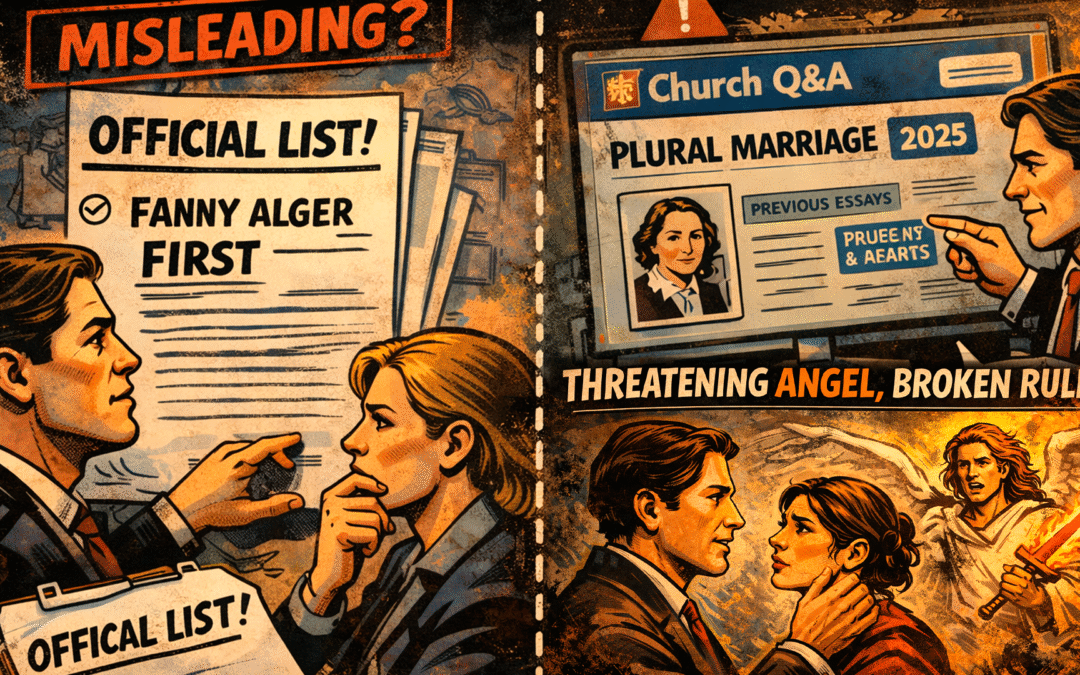
The Church finally published an official list of Joseph Smith’s wives in late 2025.
“Up until late 2025, the LDS church had never actually published an official list of Joseph Smith’s wives… then the church did publish a list… it lists Fanny Alger as his first plural wife.”
What the record actually shows
-
In July 2025, the Church published Q&A‑style resources about translation, Joseph’s character, and plural marriage. They answer common questions and point to prior material; they’re not introduced as a definitive roster.
-
The Church’s Topics & Questions: “Plural Marriage” (2025) summarizes history and links to existing Church History Topics pages (e.g., Fanny Alger), which long pre‑date 2025 and already reported that several Latter‑day Saints later said Fanny married Joseph, becoming his first plural wife. That’s context—again, not a new, signed “official list.”
-
Earlier background essays (2014) like “Plural Marriage in Kirtland and Nauvoo” also provided historical framing years before 2025.
Calling the 2025 pages an “official list” overstates what they are. They’re Q&A resources that point to already‑available historical write‑ups (including the standing page on Fanny Alger). “Fanny as first” reflects a common 19th‑century recollection summarized for years—not a brand‑new 2025 proclamation.
Evaluation Table
| Claim in a sentence | Verdict | Why we say that | Sources |
|---|---|---|---|
| “The Church published an official list in late 2025; it puts Fanny first.” | Partial / Misleading | 2025 pages are Q&A resources linking to pre‑existing history pages; they’re not presented as a definitive list. Fanny Alger’s being “first” reflects long‑noted recollections already summarized earlier. | Church Newsroom Q&A; Topics & Questions “Plural Marriage”; Church History Topics “Fanny Alger”; Gospel Topics essay. |
Findings 2
Joseph violated his own revelation (D&C 132) by not telling Emma.
“I don’t think there’s evidence that he broaches the subject with Emma until May of 1843.”
“So he violates the rules of the revelation that he ends up producing later.” — “I think that’s fair.”
Core claim
Because Emma wasn’t informed early, Joseph broke D&C 132’s rules.
What the record actually shows
-
D&C 132 was recorded July 12, 1843—after early Nauvoo sealings began. Reading it like a rulebook retroactively applied to 1841 behavior is anachronistic.
-
The text itself is complex: it expects discussion with the first wife, but also contains an exception clause (vv. 61–65) alongside teaching on priesthood keys (v. 7). Latter‑day Saint sources consistently note monogamy as the standing law unless the Lord commands otherwise; the 2014 essays explain that context.
It’s fair to say Emma learned late and that created serious personal strain. But calling that a violation of a revelation not yet recorded (and whose own wording is nuanced) is over‑simple and time‑shifted.
| Claim in a sentence | Verdict | Why we say that | Sources |
|---|---|---|---|
| “He violated his own revelation by not telling Emma early.” | Oversimplified / Anachronistic | D&C 132’s recording date (July 12, 1843) postdates early sealings; its wording is nuanced, not a simple “tell first or it’s invalid” rule. | D&C 132; Institute/Seminary commentary; Essay “Plural Marriage in Kirtland and Nauvoo.” |
Findings 3
Topic: “The Louisa Beaman sealing was done in disguise and consummated; a witness ‘saw them in bed.’”
Word‑for‑word quotes
“According to one source, Louisa disguised herself with a coat and a hat….”
“The sealing was consummated afterwards… I saw him in bed with her.”
“That statement is in the 1890s… decades later… he may be over‑emphatic.”
Core claim
The first Nauvoo sealing involved a disguise and sex that night, witnessed by Joseph B. Noble.
What the record actually shows (summary)
-
Disguise under a tree: presented as from a single late source (“one source”). Good historians flag that as possible but not firm. The show itself notes it’s unusual.
-
“Saw them in bed” comes from Joseph B. Noble’s Temple Lot deposition decades later; the Q&A shows hedging under cross‑examination (he alternates between that night vs. “two or three nights after”). Treat as late, contested evidence, not a contemporaneous diary entry.
Bottom line:
A sealing to Louisa Beaman (April 5, 1841) is well attested; details like disguise and same‑night consummation rely on late and not‑fully‑consistent recollections. Caution is warranted.
Evaluation Table
| Start | End | Claim in a sentence | Verdict | Why we say that | Sources |
|---|---|---|---|---|---|
| 00:22:20 | 00:25:29 | “Disguise + same‑night sex witnessed first‑hand.” | Partly supported / Heavily contested | The sealing is solid; “disguise” and immediate consummation rest on late testimony with internal hedging. | JSPolygamy (Louisa Beaman; Evidence of Sexuality); B. H. Roberts transcript page. |
Findings 4
Topic: “There was a quid pro quo: Noble performs the Beaman sealing (1841); exactly two years later Joseph seals Noble to Sarah B. Alley (1843).”
Word‑for‑word quotes
“Exactly two years after Noble seals Joseph Smith to Louisa Beaman, Joseph Smith sealed Noble to a woman named Sarah Alley… could be coincidence or quid pro quo.”
“I mentioned the reward later… Do we know about a threat or a promise in this case?”
Core claim
The timing proves a “you help me, I’ll get you a wife” deal.
What the record actually shows (summary)
-
Sarah B. Alley did become Noble’s plural wife on April 5, 1843 (biographical databases and academic work record it). The date matches the “two years later” observation.
-
But evidence of an explicit trade (“you get me a wife, I’ll get you wives”) is not documented. The show itself admits the tie “could be coincidence.” Correlation ≠ contract.
-
Nauvoo records do show tight trust networks (loyal men, kin ties, intermediaries). That context can explain timing without positing a transactional “swap.”
Bottom line:
Dating aligns; quid‑pro‑quo intent is not proven. It’s an inference—one possible reading, not the only one.
Evaluation Table
| Claim in a sentence | Verdict | Why we say that | Sources |
|---|---|---|---|
| “Two‑years‑to‑the‑day = quid pro quo.” | Speculative / Not proven | The marriage date is attested; no primary source confirms a deal. The show itself notes it might be coincidence. | CHD entry “Sarah B. Alley”; UVA Nauvoo projects; Dialogue analysis listing early polygamists. |
Findings 5
Topic: “Joseph used the ‘angel with a drawn sword’ and promises of salvation to pressure women (e.g., Mary Rollins Lightner).”
Word‑for‑word quotes
“An angel with a drawn sword… he doesn’t have any choice… ‘this marriage will ensure her salvation. All that God gives me, I shall take with me, for I have that authority and that power.’”
“Joseph uses the justification that an angel appears to him three times threatening to slay him.”
Core claim
Joseph invoked a threatening angel and eternal promises to push women into plural marriage.
What the record actually shows (public summary)
-
The “angel with a drawn sword” motif appears in later reminiscences (not in an 1841 diary entry). A 1905 BYU talk by Mary Elizabeth Rollins Lightner is the best‑known source; the line is widely reproduced in collections. That makes the story late, but it does exist in first‑person reminiscence.
-
Lightner also remembered promises framed in salvation terms. Those statements reflect her words about Joseph later in life; others described personal spiritual confirmations, while some declined proposals. FAIR summaries point out that agency remained and not all accepted.
Bottom line:
Yes—late sources do record Joseph invoking an angel and speaking in eternal‑salvation terms, and that language could feel heavy to listeners. Historically, these are late recollections that must be weighed with care, alongside cases where women declined or reported their own spiritual witnesses.
Evaluation Table
| Start | End | Claim in a sentence | Verdict | Why we say that | Sources |
|---|---|---|---|---|---|
| 01:31:36 | 01:33:12 | “Angel with sword + promise of salvation used as pressure.” | Partly supported / Based on late sources | The angel account and salvation promise are chiefly from late reminiscences (e.g., 1905 Lightner). Powerful language? Yes. Contemporaneous proof of systematic coercion? Mixed record; some accepted, others declined. | BYU 1905 remarks; BHRoberts/compilations; JS‑Polygamy summaries; FAIR overview. |
Legal & Logic Notes
-
Anachronism risk: Applying a July 1843 text (D&C 132) as if it governed 1841 behavior is a timing error.
-
Inference vs. proof: The “quid pro quo” point is interpretation built on timing, not on an explicit written deal.
-
Late testimony caution: Claims like “I saw him in bed” and angel narratives rest on decades‑later accounts; that doesn’t erase them, but it does lower evidentiary weight compared with contemporary records.
-
Defamation/false‑light flags: Strong language such as “violated his own revelation” or “quid pro quo wife‑swaps” is opinion/inference, not established fact; labeling it as fact could mislead. (🟠 Moderate false‑light risk if presented as proven.)
Sources
-
Church Newsroom Q&A (July 30, 2025) — overview including plural marriage FAQs.
-
Topics & Questions: “Plural Marriage” (2025) — Q&A resource hub.
-
Church History Topics: “Fanny Alger.” (Longstanding page; summarizes 19th‑century reports that she became Joseph’s first plural wife.)
-
Gospel Topics Essay: “Plural Marriage in Kirtland and Nauvoo” (2014).
-
D&C 132 (recorded July 12, 1843).
-
JosephSmithsPolygamy.org (Louisa Beaman; Evidence of Sexuality) — excerpts of the Temple Lot deposition (late, contested).
-
B. H. Roberts transcription hub — Noble deposition excerpts.
-
Church History Biographical Database: Sarah B. Alley (married Joseph B. Noble Apr 5, 1843).
-
UVA Nauvoo database / Dialogue articles — early Nauvoo plural marriage dating.
-
Mary E. Rollins Lightner remarks (1905) & compilations — angel‑sword wording in late reminiscences.
-
FAIR overviews — agency/consent discussions (balanced apologetic summaries).
Transcript citations map
-
“Official list… Fanny first.” — 00:06:34–00:07:15
-
“Didn’t broach with Emma until May 1843.” — 00:11:56–00:12:40
-
“Violates his own revelation… ‘that’s fair.’” — 00:14:13–00:14:53
-
“Disguise; ‘I saw him in bed with her.’” — 00:23:50–00:25:29
-
“Two years later—Sarah B. Alley.” — 00:34:16–00:35:51
-
“Angel appears three times threatening to slay him.” — 02:09:45–02:10:24
-
“Ensure her salvation… ‘All that God gives me, I shall take with me…’” — ~01:31:36–01:33:12
Quick “public‑read” wrap‑up
-
The 2025 Church pages aren’t a master list; they’re Q&As pointing to earlier materials (including Fanny Alger as commonly considered first).
-
Saying Joseph “violated” D&C 132 assumes a rulebook was in force before it was recorded and ignores its internal complexity.
-
Louisa Beaman: sealing strong; disguise and same‑night consummation are late/contested details.
-
Noble–Alley timing fits; explicit quid‑pro‑quo is unproven.
-
Angel/salvation language comes mainly from late reminiscences; powerful, yes—but late. Some women declined; others reported confirmations.