
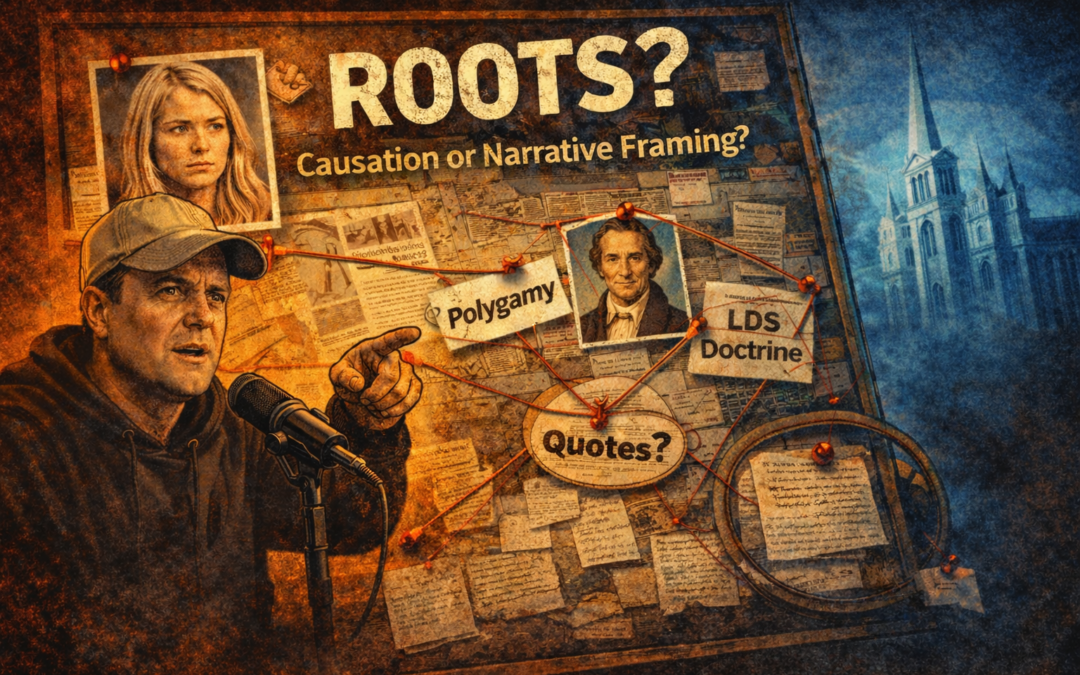
Mormon Stories Episode 2109 – Elizabeth Smart
Finding 1 — “Very much a Mormon story”
Misleading Core Claim
| Claim Summary | Category | Evaluation | Sources (verified hyperlinks) |
|---|---|---|---|
| Kidnapping is “very much a Mormon story” linked to Mormonism/Joseph Smith | Misleading | “Mormon” can be a descriptive label (victim identity, regional context), but the quote shifts into implied causation (“influenced by Joseph Smith”) without establishing a primary-source doctrinal or institutional causal chain. This is a classic identity→causation slide. |
Church Newsroom statement rejecting “doctrinal connection” framing (Mar 24, 2003) Doctrine & Covenants 132 (official LDS scripture page; includes plural marriage material) Joseph Smith Papers — D&C 132 original revelation context |
Core Findings
- Stewardship Doctrine: Even where LDS belief includes personal revelation, LDS structure distinguishes personal guidance from “command authority” over others. A kidnapper’s claim “God told me” is not authorized priesthood stewardship.
- Authorized Priesthood Use: In LDS doctrine, binding directives for others come through authorized channels, not self-appointed prophets. This matters because the transcript’s framing invites the reader to see LDS belief as a causal license rather than a violated boundary.
- Reputational Precision: If “Mormon story” means (a) Utah context + (b) victim identity + (c) perpetrators’ prior affiliation, that can be stated precisely. But “roots in Joseph Smith” is a separate causal claim requiring primary documentation.
The transcript’s opening frame is rhetorically powerful but analytically imprecise: it blends descriptive “Mormon” context with unproven doctrinal causation.
Finding 2 “Roots in Joseph Smith / founding of Mormonism”
00:05:02
"...I think this story very much fits alongside those in terms of it being not just Mormon crime and Mormon true crime, but Mormon true
crime that has its roots in Joseph Smith, in Mormon doctrine, Mormon history, and in the founding of Mormonism."
| Claim Summary | Category | Evaluation | Sources |
|---|---|---|---|
| Smart case “roots” in Joseph Smith and LDS founding | Misleading | This is a broad causal claim. The transcript does not provide primary-source linkage (scripture, policy, institutional directive) connecting LDS founding to kidnapping/rape. Similarity of themes (e.g., revelation language) is not proof of “roots” without defined mechanism. |
LDS Church statement on “erroneous connections” Joseph Smith Papers (primary sources hub) |
Core Findings
- Covenant Layering: LDS history includes contested practices (e.g., plural marriage), but “roots” must be specified: What text? What instruction? What direct causal chain?
- Category Discipline: “Religious delusion” is cross-tradition. To claim “roots” in Joseph Smith, the analysis must show reliance on Joseph-era texts or rites as causal drivers—not merely rhetorical parallels.
“Roots in Joseph Smith” is asserted as a narrative conclusion rather than proven with a primary-source chain.
Finding 3 — “God allowed it / God told me” parallel to Joseph Smith
00:11:47
"...the night he came to kidnap me, if he couldn't find a way in, then that was God's will not to do it."
00:12:16
"...Joseph Smith, everything that he did, he said, 'Oh, God God told me I had to marry this 14-year-old...'"
| Claim Summary | Category | Evaluation | Sources |
|---|---|---|---|
| Mitchell’s “God’s will” framing parallels Joseph Smith’s “God told me” pattern | Partial Truth | It is fair to note rhetorical similarity (divine-authorization language). It is not automatically fair to convert similarity into doctrinal causation. LDS doctrine and policy condemn coercion and abuse; a “God told me” claim can be framed as unauthorized, delusional, and contrary to stewardship. |
LDS General Conference: “Healing the Tragic Scars of Abuse” (Elder Richard G. Scott, 1992) D&C 132 (plural marriage scripture text) Joseph Smith Papers (context for D&C 132) |
Core finding
- Authorized vs. Unauthorized Revelation: LDS systems claim revelation is constrained by stewardship. A kidnapper’s private “revelation” to harm others is doctrinally invalid and disciplinable.
- Precision Move: A valid critique is “revelation language can be weaponized.” An invalid leap is “therefore LDS doctrine caused kidnapping.”
Similar rhetorical form is real; converting that into institutional culpability requires stronger evidence than the transcript provides.
Finding 4 — “Polygamy is obviously Mormon” as blueprint for kidnapping
00:36:06
"...polygamy is obviously Mormon. The idea of an already married man wanting to take not just a second wife but seven other wives..."
| Claim Summary | Category | Evaluation | Sources |
|---|---|---|---|
| Mitchell’s multi-wife aim links to Joseph-era polygamy and thus “Mormon story” causation | Misleading | Polygamy is historically associated with early LDS practice and remains present in LDS scripture (D&C 132). However, kidnapping/rape are distinct crimes not endorsed by LDS policy; equating “plural marriage doctrine exists” with “kidnapping blueprint” is a category collapse unless direct instruction is shown. |
D&C 132 (official LDS text) Joseph Smith Papers — D&C 132 LDS Church newsroom statement (Mar 24, 2003) |
Core Finding
- Covenant Layering: The existence of a contested doctrine does not establish that a separate crime (kidnapping/rape) is doctrinally directed.
- Reputational Discipline: Critique the doctrine on its own terms (history, ethics, theology). Don’t “smuggle” kidnapping into the same bucket without proof.
“Polygamy is Mormon” can be historically true; “therefore kidnapping is Mormon-rooted” is an evidentiary leap.
Finding #5 — “Sex sin next to murder” scriptural framing used as interpretive engine
00:51:53
"...The first is from the Book of Mormon itself in the Book of Alma chapter 39..."
"...'these things are an abomination in the sight of the Lord. Yay, most abominable above all sins, save it be the shedding of innocent blood or denying the Holy Ghost.'"
| Claim Summary | Category | Evaluation | Sources |
|---|---|---|---|
| Alma 39 “abominable above all sins” positions sexual sin near murder and shapes harmful purity culture | Not Provable (as direct causation) | Alma 39:5 text exists and is often interpreted as placing sexual sin among the “most abominable” sins. That can contribute to purity culture dynamics, but direct causal linkage to an individual victim’s internal shame requires clinical evidence and personal testimony beyond what’s established here. |
BYU Religious Studies Center discussing Alma 39:5 Scripture Central on Alma 39:5 |
Core Finding
- Truth discipline: Alma 39:5 is real text. The transcript’s use is interpretive.
Scripture exists; causation is not proven by citation alone.
Finding #6 — “Better dead than unclean” leadership quotes applied to rape/purity shame
00:54:27
"...Marion G. Romney saying, 'We would rather come to this station and take your body off the train in a casket than to have you come home unclean...'"
"...Heber J. Grant... 'There is no true Latter-day Saint who would not rather bury a son or a daughter than to have him or her lose his or her chastity...'"
"...Bruce R. McConkie... 'better dead clean than alive unclean'..."
"...Spencer W. Kimble... 'It is better to die in defending one's virtue than to live having lost it without a struggle'..."
"...Gordon B. Hinckley said... 'She'd rather have me come home dead than unclean.'"
| Claim Summary | Category | Evaluation | Sources |
|---|---|---|---|
| Historical LDS leadership rhetoric elevates “virtue” over life and can intensify rape-related shame | Partial Truth | The quotes cited in the transcript are verifiable in multiple sources. It is reasonable that such rhetoric can intensify sexual shame culture. However, LDS doctrine also contains explicit statements that victims are not responsible for abuse; therefore “the church teaches rape victims are unclean” is not a fair summary. The more accurate critique is: leadership rhetoric historically promoted extreme chastity messaging that can be harmful. |
Marion G. Romney, “Trust in the Lord” (Apr 1979) — “casket” quote Conference Report PDF (Apr 1967) — Hinckley “come home dead than unclean” (archived primary PDF) McConkie quote with scan link to Mormon Doctrine PDF (Archive.org) Richard G. Scott (1992): victims “not responsible” (official GC page) |
Core Finding
- Truth + precision: The rhetoric exists and is harmful in many real-world settings, especially when stated without context. But The Church of Jesus Christ of LDS also states abuse victims “are not responsible.” Both are true and must be held together honestly.
- Risk note: Doctrinal critique should target the rhetoric’s potential negative implications without falsely claiming the Church endorses rape.
Verified historical chastity rhetoric can plausibly amplify shame if used as a fear tool—but it is not the same as official endorsement of victim guilt.
Finding #7 — Richard G. Scott “degree of responsibility” statement
01:08:27
"...Richard G. Scott ... said in general conference ... 'At some point in time, however, the Lord may prompt a victim to recognize a degree of responsibility for abuse.'"
| Claim Summary | Category | Evaluation | Sources |
|---|---|---|---|
| GC messaging includes victim responsibility framing (victim-blame risk) | True (re: existence of the talk) / Harmful (implication) | The referenced General Conference talk exists and includes language that has been widely criticized as victim-blaming. Notably, the same talk also affirms victims “are not responsible” when harmed against their will—creating internal tension in messaging. |
Official GC text: “Healing the Tragic Scars of Abuse” (Apr 1992) |
Legal & Logic Analysis
- Defamation/false light relevance: When evaluating blame assignment in abuse contexts, public statements can shape institutional reputation and survivor expectations. This is a reputationally sensitive category. The quote from Elder Scott is rational and does not in any way say that victims have a degree of responsibility generally.
The leadership messaging is verifiable and contains language that can be interpreted as victim-blaming; this is one of the transcript’s strongest “institutional messaging harm” evidentiary points. Elder Scott’s quote is clearly NOT intended to victim shame or tell victims they are responsible. John again takes any statement and uses it for his purposes without context.
Finding #8 — “Consent wasn’t taught” and sexual vocabulary suppression
00:47:45
"...no one had discussed with me the difference between consensual sex and intimacy versus rape. I had a lot of shame..."
| Claim Summary | Category | Evaluation | Sources |
|---|---|---|---|
| Consent education absent; purity framing dominates; shame increases | Partial Truth | The transcript asserts a common dynamic in conservative purity cultures. However, “uniquely Mormon” is not established. LDS official materials do condemn abuse and affirm victim innocence (see Scott 1992), yet local culture/practice can differ widely. |
Scott (1992) — official condemnation of abuse + “not responsible” language |
Consent gaps are plausible and common in purity systems, but exclusivity (“Mormon only”) is not proven.
Finding #9 — Library encounter + religious deference
01:53:51
"...their religion forbids her to show her face..."
"...And the police officer said fine."
| Claim Summary | Category | Evaluation | Sources |
|---|---|---|---|
| Investigator backed off due to claimed religion; implies systemic over-deference to religion | Not Provable (intent/motive) | The event is described in transcript as a religious claim leading to non-escalation. The deeper claim—“excessive religious legal protections caused this outcome”—requires case-specific documentation of the officer’s reasoning, departmental policy, and legal constraints. |
(Case-history sources vary; this packet focuses on verified doctrinal/policy sources and transcript fidelity.) |
The narrative is emotionally compelling, but a systemic legal conclusion requires more primary documentation than the transcript supplies.
Finding #10 — “Mitchell/Barzee LDS affiliation” and Church public response
02:06:54
"...David Mitchell and Wanda did not belong to the Church of Jesus Christ of Latter-day Saints... technically true, but is misleading..."
"...he definitely believed Joseph Smith was inspired..."
| Claim Summary | Category | Evaluation | Sources |
|---|---|---|---|
| Debate over whether affiliation status negates “Mormon influence” framing | True (re: public dispute exists) | The LDS Church publicly addressed media “erroneous connections” soon after the arrest, emphasizing that Mitchell’s writings/doctrines were not LDS doctrine. This is the proper “institutional rebuttal baseline.” |
Official LDS Church Newsroom: “Erroneous Reporting of Elizabeth Smart Case” (Mar 24, 2003) |
Whatever one concludes about cultural influence, the Church’s official position rejecting doctrinal linkage is verifiable and must be included for fair analysis.
Sources
- LDS Church Newsroom — “Erroneous Reporting of Elizabeth Smart Case” (Mar 24, 2003)
- Doctrine and Covenants 132 (official LDS scripture page)
- Joseph Smith Papers — Revelation, 12 July 1843 (D&C 132), Page 1
- General Conference — Richard G. Scott, “Healing the Tragic Scars of Abuse” (Apr 1992)
- General Conference — Marion G. Romney, “Trust in the Lord” (Apr 1979)
- Conference Report (Apr 1967) PDF (Archive.org) — contains Hinckley quote as cited in transcript
Supporting scripture commentary sources
Note on non-primary sources: Where the transcript references quotes attributed to books like The Miracle of Forgiveness or compilations like Gospel Standards, this packet prioritizes primary LDS-hosted sources and primary PDFs when available (e.g., conference report PDFs). Where only secondary index pages exist, they are not used as sole proof unless accompanied by a primary scan link.