
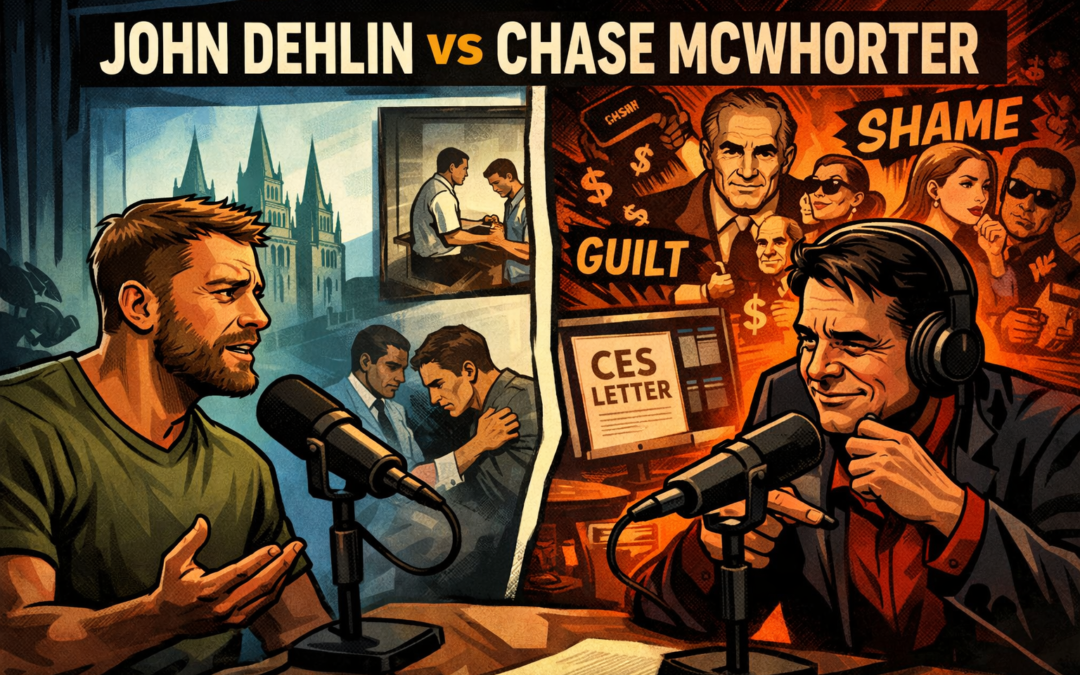
John Dehlin Mormon Stories Analysis: Did He Lead the Narrative?
(Mormon Stories Analysis)
This John Dehlin Mormon Stories analysis examines how the interview was framed and what it reveals about storytelling, faith, and interpretation.
John Dehlin Mormon Stories Analysis: Framing the Interview
The Secret Lives of Mormon Wives is no longer niche content. According to Hulu, Season 4 premiered on March 12, 2026, and the show quickly became one of the most-watched unscripted premieres of 2024.
That matters.
When millions of viewers engage with content connected to Mormonism, they are not just consuming drama. They are, consciously or not, learning how to interpret deeper human experiences.
They are forming impressions about:
- Faith
- Shame
- Family
- Belief itself
And those interpretations don’t stay on the screen — they shape real-world perceptions.
Who Was More Honest in the Interview?
That is why the recent Mormon Stories episode with Chase McWhorter deserves a careful response.
To be fair from the beginning: Chase is often the more honest — and more respectful — voice in the room.
His views are clearly “Ex-Mormon,” but he does not hide behind performance or exaggeration. He is open about his doubts and grounded in his own experience.
For example, he tells a moving story about a man named Carlos from his mission. He explains, with noticeable care:
“We’re not going to baptize him,”
and later reflects:
“One of the best things I ever did on my mission was not baptize that guy.”
Moments like this matter. They show restraint, not cynicism.
Later, when asked whether he still loves Mormon people, he answers simply:
“I do.”
That is not the language of someone trying to tear down believers for sport. It reflects something more complex — a mix of regret, distance, and genuine affection.
Even where Chase makes claims that are doctrinally inaccurate, or where his understanding of the Atonement feels shallow, his tone remains grounded. He comes across less as an aggressor and more as someone navigating a confusing personal landscape.
John Dehlin, on the other hand, appears to be operating with a clearer agenda.
A Rare Trait: Self-Awareness
Chase also deserves credit for something else that is rare in these conversations: self-correction. At one point he admits:
“I went through a stage of like anger where I was vocally upset with the church,”
and then adds,
“I didn’t like that version of myself either.”
That kind of honesty matters. It shows self-awareness, not just grievance.
The Core Issue: Interview Framing
But that is exactly why John Dehlin’s role stands out. The main issue in this interview is not that Chase told his story, even from an ex-mormon standpoint. The issue is that John kept trying to tell the audience what Chase’s story meant before Chase had fully said it himself.
That pattern shows up early.
Instead of asking neutral questions, John frames the Church as either protective or psychologically harmful—then nudges toward the negative:
“They’re preventing normal healthy experiences… building shame.”
This is not a neutral question. It is a preloaded interpretation.
A few minutes later, John sharpens the frame even more: “It almost sounds like the fear and the shame was like more powerful than your actual belief or faith.”
Notice the structure: he suggests the conclusion first, then invites agreement.
This is a classic leading-question technique.
The same thing happens when John brings up the internet, podcasts, and the CES Letter. He says, “I don’t want to put that into your story,” immediately after listing the exact influences he wants the audience to see as explanatory. The disclaimer softens the move, but it does not change the move. He is still putting it into Chase’s story.
And then the interview shifts from leading questions into open caricature. John escalates from difficult history to sensational analogy with, “can I say Joseph Smith has so many parallels to Jeffrey Epstein like honestly.” Later, he flatly declares, “Mormon atonement is guilt trip theology.” At that point, this is no longer an interview designed to understand. It is an argument designed to steer.
What Does LDS Doctrine Actually Teach?
To evaluate that claim, we need clarity.
The Church’s official Gospel Topics page on the Atonement of Jesus Christ teaches that the Atonement is about reconciliation with God through Jesus Christ—not emotional manipulation.
Elder Dale G. Renlund’s talk, Repentance: A Joyful Choice, emphasizes that repentance is “joyful” and “will never be imposed on us.”
In addition, the Church’s message Worthiness Is Not Flawlessness directly rejects the idea that gospel living is about perfectionistic self-loathing.
None of this erases painful experiences members may have had. But it does show that describing Mormon doctrine as “guilt trip theology” is an oversimplification—not an accurate summary.
What About Race and Church History?
The same need for accuracy applies to race. It is completely fair to raise the priesthood and temple restriction as a painful and serious historical issue. It is not fair to discuss it as if the Church today still teaches the racial theories once used to defend it. The Church’s current Race and The Church of Jesus Christ of Latter-day Saints page says that all people are equal children of God, and the Church’s historical topic on Priesthood and Temple Restriction says the Church “disavows” past racial theories and “unequivocally condemn[s] all racism, past and present, in any form.” That does not make the history disappear. It does mean the history should be discussed honestly, not flattened into an evergreen smear.
There is also a subtler dynamic in the episode: John does not only steer; he rewards. Near the end, after Chase has echoed many of the interview’s strongest anti-Church themes, John tells him, “I love all your spiritual insights. I feel like we’re aligned.” That is revealing. The warmth is real, but it comes after a long stretch of interpretive nudging and escalating rhetoric. The message is hard to miss: once Chase lands in the preferred frame, he is affirmed as wise, honest, and spiritually insightful.
Final Verdict
So the fairest conclusion is this: Chase McWhorter is not the main problem in this episode. He is candid. He is often disarmingly honest. He shows flashes of real respect, especially when speaking about agency, family, and ordinary Latter-day Saints. He is not above criticism, and at points he joins in on unfair or overstated claims. But John Dehlin is the one repeatedly setting the frame, loading the language, and guiding the emotional interpretation. Chase tells a story. John tells viewers how to hear it.
This is not a rebuttal of questions or painful experiences.
It is a critique of how the story was framed.
Because in this interview:
👉 Chase told a story.
👉 John told the audience how to interpret it.
And that distinction matters.
Helpful links
-
Hulu Press: The Secret Lives of Mormon Wives — official Season 4 page.
-
TheWrap: Hulu viewership report — reported Disney data on the show’s breakout performance.