
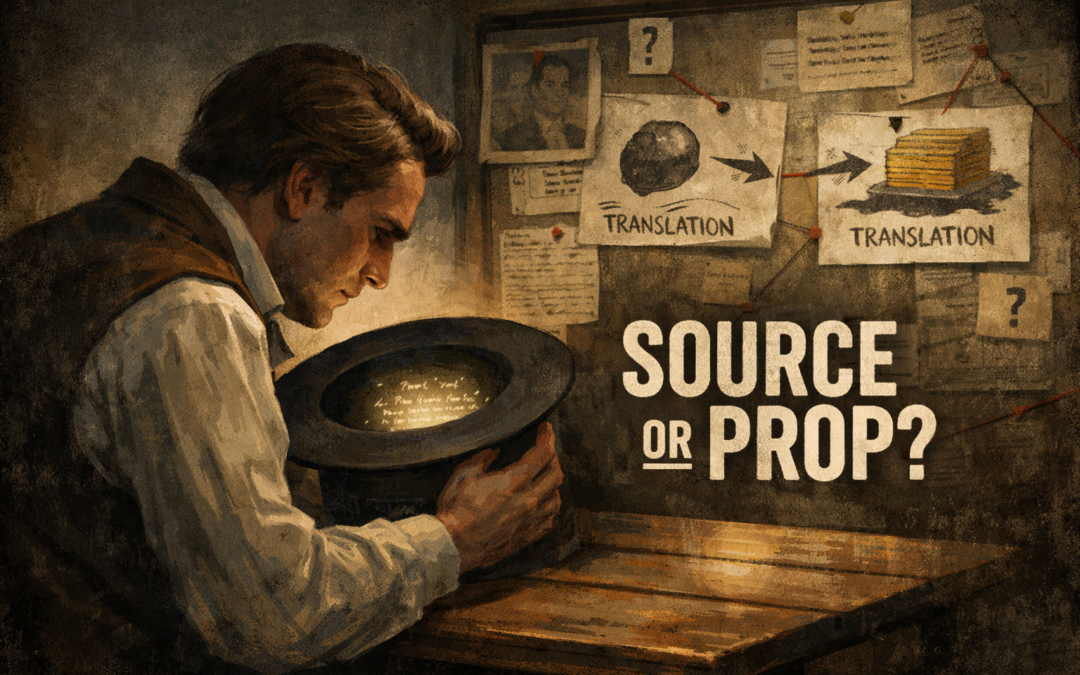
Book of Mormon Translation
Bill Reel is most persuasive when he anchors his argument in a genuine historical foundation. Many Latter-day Saints did, in fact, inherit a simplified narrative of the translation process—one that emphasized direct plate-reading. Additionally, multiple eyewitness accounts describe Joseph Smith dictating with a seer stone placed in a hat.
However, the argument begins to break down in its next step. It moves from accurate historical observations to broader claims about the source of the text—and ultimately to an implication of fraud. Official and primary sources consistently maintain a more complete picture: they affirm both the ancient plates as the source record and divine means as the mechanism of translation.
Sources: Church and Gospel Questions: Book of Mormon Translation; Gospel Topics Essay: Book of Mormon Translation; Church History Topic: Book of Mormon Translation.
I grouped repeated lines into 8 claim clusters so the repeated “plates were unnecessary / prop / not involved” assertions are answered once rather than three times.
Evaluation Table
| # | Start–End | Claim Summary | Category | Evaluation | Sources |
|---|---|---|---|---|---|
| 1 | 00:00:01–00:00:36 | The “official story” was direct plate-reading, with plates as the immediate source of words. | Partial Truth / Historically Incomplete | Many members were taught a simplified version, but the fuller record includes both interpreters-at-plates accounts and seer-stone-in-hat accounts. | Church and Gospel Questions: Book of Mormon Translation Gospel Topics Essay: Book of Mormon Translation |
| 2 | 00:00:36–00:01:14 | Eyewitnesses describe stone-in-hat dictation; plates were sometimes covered or elsewhere. | Partial Truth | Multiple sources strongly support this, especially for part of the translation, but it overstates uniformity across the whole process. | Gospel Topics Essay: Book of Mormon Translation Church History Topic: Seer Stones |
| 3 | 00:01:14–00:02:32 | Joseph used the same seer stone from treasure seeking; therefore the plates were unnecessary. D&C 10 implies “tight translation.” | Misleading | The treasure-seeking background is real. The inference that plates were therefore unnecessary is not. D&C 10 identifies the source record, not a mandatory modern “tight translation” theory. | Church History Topic: Seer Stones Doctrine and Covenants 10 BYU Studies: The Book of Mormon Translation Process BYU Studies: Towards a Critical Edition of the Book of Mormon |
| 4 | 00:02:32–00:03:10 | If God gave words through the stone, the plates added nothing. | False Dilemma / Misleading | The argument confuses medium with source. LDS texts present preserved plates plus divine interpretation together, not as rivals. | Joseph Smith Papers: Book of Mormon, 1830, Page i (Title Page) Mosiah 8 Joseph Smith Papers: Translate |
| 5 | 00:03:10–00:04:30 | Because Joseph resumed dictation after interruptions, the plates were not being referenced and were unnecessary. | Partial Truth / Overstated | Emma’s statement supports miraculous dictation and lack of manuscript dependence, but not total plate irrelevance. Joseph also said he copied characters and translated some by Urim and Thummim; official history preserves plate-view accounts too. | Gospel Topics Essay: Book of Mormon Translation Joseph Smith—History 1 Joseph Smith Papers: Urim and Thummim Church History Topic: Book of Mormon Translation |
| 6 | 00:03:52–00:04:30 | Same tool, same method, same supernatural sight: Book of Mormon translation just resembles folk magic. | Partial Truth / Misleading Analogy | Shared instrument history is real; reducing the translation to treasure-seeking repackaged is a guilt-by-association leap that ignores plates, interpreters, and witnesses. | Church History Topic: Seer Stones Ensign: Joseph the Seer Church History Topic: Witnesses of the Book of Mormon |
| 7 | 00:04:30–00:05:49 | If the plates were not needed in the mechanics, preserving them was excessive; they were effectively props. | False / Category Error | The Book of Mormon’s own title page joins physical preservation and miraculous interpretation. The plates function as source record, covenant artifact, and witness object. | Joseph Smith Papers: Book of Mormon, 1830, Page i (Title Page) Church History Topic: Witnesses of the Book of Mormon Testimony of Three Witnesses Testimony of Eight Witnesses |
| 8 | 00:05:49–00:08:59 | “The plates were not even involved,” “maybe it was just a prop,” and critics have the rational side. | False / Not Provable / Opinion | “Not even involved” contradicts the Church’s historical synthesis. “Prop” and “who were the folks being fooled?” shift from history to fraud-insinuation without proving intent or falsity. The closing is persuasion and book marketing, not evidence. | Church and Gospel Questions: Book of Mormon Translation Church History Topic: Book of Mormon Translation Cornell LII: False Light Cornell LII: Defamation |
1) The setup creates a narrower “official story” than the historical record actually supports
“The official story that most people grew up hearing is simple. Joseph Smith translated the Book of Mormon by reading characters engraved on gold plates using sacred instruments called the Yuran Thumbum, but known as the Nephite spectacles. The plates were physically present. They were the source of the words. Joseph’s role was to translate what was written”
Core claim: Latter-day Saints were taught a straightforward plate-reading model.
Claim type: Historical framing
Classification: Partial Truth / Historically Incomplete
Logical questions: Is he describing what many Saints remember being taught, or the full historical record? Are direct-plate and stone-in-hat accounts mutually exclusive?
Core rebuttal: He is partly right about the pedagogy. The Church now says many twentieth-century accounts and artworks reflected a partial understanding that emphasized the interpreters and minimized the seer stone. But that concession does not rescue the larger setup. The fuller historical record includes both accounts in which Joseph used a seer stone in a hat and accounts in which he used the interpreters with the plates. The problem is not that the Church had one “official story” and now another; it is that Reel defines the older simplified retelling as if it were the whole record and then attacks that narrowed version.
Bottom line: This is a fair opening against simplified folk memory, but not against the full historical evidence.
Sources: Church and Gospel Questions: Book of Mormon Translation; Gospel Topics Essay: Book of Mormon Translation.
2) Stone-in-hat is real history, but “therefore the plates were absent from the process” is too broad
“Joseph did not read directly from the plates. Instead, he placed a small stone into a hat, put his face into the hat to block out light, and dictated the words that appeared to him. The plates were often not even in the room. Sometimes they were covered. Sometimes they were hidden elsewhere”
Core claim: Eyewitnesses describe stone-in-hat dictation, often without direct visual reference to the plates.
Claim type: Historical claim
Classification: Partial Truth
Logical questions: Does this describe some sessions, most sessions, or the whole translation? Does “often” prove “always”?
Core rebuttal: The stone-in-hat description is well supported by multiple firsthand accounts. Emma Smith described Joseph with his face in the hat, and the Church’s historical essays preserve that evidence. LDS historical summaries also say that after the loss of the 116 pages Joseph primarily used a seer stone. However, the same official record also confirms that in other cases he looked through the interpreters at the plates. So the claim is strongest as a correction to oversimplified retellings, and weakest when it quietly becomes an absolute statement about the entire process.
Bottom line: The historical core is real; the totalizing version is not.
Sources: Gospel Topics Essay: Book of Mormon Translation; Church History Topic: Seer Stones; Church History Topic: Book of Mormon Translation.
3) The transcript slips from a true background fact into an unsupported conclusion
“It was the same sear stone that he had previously used while working as a treasure digger. He claimed it helped him locate buried treasure underground. Now, this creates an obvious question. If the words appeared in the stone and the plates were not being consulted, what role did the plates actually play? If Joseph could produce the text without physically referencing the plates, then the plates were not necessary for the translation itself. The stone alone was sufficient.”
“In fact, scribes and witnesses to the translation along with DNC, Doctrine and Covenants section 10 imposed that Smith was doing a literal translation of reformed Egyptian characters into English in what is described as a tight translation method.”
Core claim: Because Joseph previously used the stone in treasure seeking, and because D&C 10 implies a literal/tight translation, the plates were unnecessary.
Claim type: Historical + inferential claim
Classification: Misleading
Logical questions: Does a shared instrument prove a shared source? Does D&C 10 define the mechanics, or just the record being translated?
Core rebuttal: The Church explicitly acknowledges Joseph’s pre-1827 use of a seer stone for finding missing objects or searching for buried treasure. That historical background is real. However, that conclusion does not logically follow from the evidence. The same official source says Joseph later used both the interpreters and his seer stone interchangeably in translation. And D&C 10 does not “impose” a modern tight-translation theory; it says Joseph should translate the engravings on the plates of Nephi. Importantly, the “tight vs. loose control” framework emerges from later scholarly debate rather than the original text itself, and LDS scholarship itself says there is evidence argued on both sides.
Tactic identified: Guilt by association + smuggling a later scholarly model into scripture.
Bottom line: True background fact, overstated doctrinal conclusion.
Sources: Church History Topic: Seer Stones; Doctrine and Covenants 10; BYU Studies: The Book of Mormon Translation Process; BYU Studies: Towards a Critical Edition of the Book of Mormon.
4) “If God gave the words, the plates added nothing” is a false dilemma
“If God was providing the words directly through the stone, well then the plates were not needed to produce the translation. and their physical presence added nothing to the process.”
Core claim: Divine mediation makes the plates unnecessary.
Claim type: Logical/theological inference
Classification: False Dilemma / Misleading
Logical questions: Why must the source record and the revelatory instrument be competitors? Does Joseph Smith’s usage of “translate” require ordinary, unaided visual decoding?
Core rebuttal: This argument contains a central logical flaw. Joseph Smith’s own world does not force a choice between an ancient record and a revelatory mechanism. The Book of Mormon title page says the record was written, sealed, and hid up to come forth by the gift and power of God unto the interpretation thereof. Mosiah 8 also defines translation through interpreters as a gift of God given to a seer. And the Joseph Smith Papers glossary notes that in Joseph’s usage, “translate” was most often through divine means. Reel’s argument only holds if we assume that “translation” must mean… modern scholarly plate-reading with no revelatory mediation. That is not the scriptural or Joseph Smith usage.
Tactic identified: False dilemma between source and mechanism.
Bottom line: The plates can be the source record while God mediates the English text.
Sources: Joseph Smith Papers: Book of Mormon, 1830, Page i (Title Page); Mosiah 8; Joseph Smith Papers: Translate.
5) Emma’s “resume exactly where he left off” supports inspired dictation, not plate irrelevance
“Witnesses consistently report that Joseph dictated with his face buried in the hat without looking at the plates. They were said to have been covered or in a different location altogether. And yet he could walk away and come back and resume dictation exactly where he left off without even looking at the plates. The plates were not being read. They were not even being referenced.”
Core claim: The resumption-after-interruption evidence proves the plates were not functionally relevant.
Claim type: Historical inference
Classification: Partial Truth / Overstated
Logical questions: What does Emma’s statement actually prove? Does “not reading from a manuscript” equal “no source record exists”?
Core rebuttal: Emma’s statement is important and authentic: she said Joseph had “neither manuscript nor book” and could resume after interruptions without seeing the manuscript. This strongly challenges any theory that the text was memorized or prewritten. However, it does not demonstrate that the plates were irrelevant to the process. Joseph also said he copied characters from the plates and translated some of them by means of the Urim and Thummim, and the Church’s current synthesis preserves accounts where he looked through the interpreters at the plates. So the better conclusion is that the dictation was revelatory, not that the plates vanished from the event’s meaning or source.
Tactic identified: Over-reading one witness statement into a universal rule.
Bottom line: This evidence undercuts a conventional scholarly translation scene, not the existence or relevance of the plates.
Sources: Gospel Topics Essay: Book of Mormon Translation; Joseph Smith—History 1; Joseph Smith Papers: Urim and Thummim; Church History Topic: Book of Mormon Translation.
6) “Same stone, same method, same sight” is rhetoric, not proof
“He had used the same stone to search for buried treasure years before producing the Book of Mormon. Those treasure seeking efforts, well, they never produce treasure, but they did produce the Book of Mormon. And seen this way, the translation method of the Book of Mormon closely resembles Joseph’s earlier folk practices. Same tool, same method, same claim of supernatural sight. The only difference was the outcome.”
Core claim: Book of Mormon translation was basically Joseph’s earlier folk practice in a new setting.
Claim type: Historical analogy
Classification: Partial Truth / Misleading Analogy
Logical questions: Does shared instrumentality establish shared cause? What facts remain if the guilt-by-association move is removed?
Core rebuttal: Yes, the stone had an earlier history. However, using the same instrument does not establish the same source or cause, claim, or event. Joseph’s own claims tie the Book of Mormon to an angelic recovery of plates, interpreters prepared for the purpose of translation, and a translation accomplished by the gift and power of God. The historical record also includes multiple witnesses who said they saw or handled the plates. Reel’s analogy does not demonstrate that the Book of Mormon event is reducible to treasure-seeking; it only shows that Joseph’s prophetic career emerged from a culture where material aids and supernatural claims were already thinkable.
Tactic identified: Guilt by association.
Bottom line: Context matters, but context is not collapse.
Sources: Church History Topic: Seer Stones; Ensign: Joseph the Seer; Church History Topic: Witnesses of the Book of Mormon.
7) The plates were not pointless just because the mechanics were revelatory
“If the Book of Mormon was translated from ancient plates, the plates should have been necessary to produce the translation. But according to witnesses, well, they weren’t. And this also raises a practical question about the plates themselves. According to the Book of Mormon, generations of Nephite recordkeepers labored to engrave, preserve, protect, and pass down these metal plates at great personal cost. They carried them through wars, hid them from enemies, and ultimately buried them to be found centuries later. But if Joseph Smith did not need to read the plates to produce the text, if the words appeared directly in the stone independent of the plates, then the plates were not functionally necessary to the translation. And that makes the effort to create and preserve them, well, strangely excessive.”
Core claim: If Joseph did not read visually from the plates, ancient recordkeeping and preservation become excessive and irrational.
Claim type: Historical/theological inference
Classification: False / Category Error
Logical questions: Why assume the only purpose of plates is real-time visual consultation during dictation? What do the text and witnesses say the plates were for?
Core rebuttal: The Book of Mormon’s own title page already answers this: the record was written, sealed, hid up, and preserved so it could come forth by the gift and power of God unto the interpretation thereof. In other words, preservation and miraculous translation are paired, not opposed. Current Church history also says the plates were tangible evidence of an ancient record and the basis of the testimony of the Three and Eight Witnesses and others who handled or felt them. Reel assumes that the plates served only one possible function—visual reference during dictation was to sit open on a desk while Joseph visually decoded them; the text and sources assign them a larger covenant and witness function.
Tactic identified: Category error.
Bottom line: The plates were not merely a reading aid. They were the preserved source record and witness artifact.
Sources: Joseph Smith Papers: Book of Mormon, 1830, Page i (Title Page); Church History Topic: Witnesses of the Book of Mormon; Testimony of Three Witnesses; Testimony of Eight Witnesses.
8) “Prop” and “who were the folks being fooled?” is an insinuation of fraud, not a demonstrated conclusion
“In that scenario, the plates serve more as a prop than a source, which complicates the claim that the Book of Mormon is a translated ancient record rather than a revealed text through other means. The words came from the stone. The stone was placed in the hat and the plates were not even involved. Maybe it was just a prop. And if it was, who were the folks being fooled?”
Core claim: The plates were merely theatrical props, implying deception.
Claim type: Reputational insinuation
Classification: False / Not Provable
Logical questions: Where is the evidence for deliberate deception? Does the historical record actually permit “not even involved”?
Core rebuttal: “The plates were not even involved” goes beyond the evidence and contradicts the Church’s current synthesis, which says that in some cases Joseph used a seer stone in a hat and in other cases looked through the interpreters at the plates. It also erases the plates’ witness function, despite formal testimony from the Three Witnesses and Eight Witnesses and family members who handled or felt the plates. The move from disputed mechanics to “prop” and “fooled” is not a historical demonstration; it is a rhetorical escalation meant to plant fraud without proving it. In legal terms, false-light and defamation theories turn on false public assertions and intentional or reckless falsity; this section offers insinuation, not that level of proof.
Tactic identified: Loaded question + fraud insinuation + false-light style framing.
Bottom line: This section makes its strongest rhetorical claim here — but also the weakest in terms of supporting evidence.
Sources: Church and Gospel Questions: Book of Mormon Translation; Church History Topic: Book of Mormon Translation; Church History Topic: Witnesses of the Book of Mormon; Testimony of Three Witnesses; Testimony of Eight Witnesses; Cornell LII: False Light; Cornell LII: Defamation.
Final classification of the section
This section contains a real historical core wrapped in a false dilemma. The real core is that Joseph Smith did use a seer stone in a hat in at least part of the translation, and many Saints inherited simplified artwork and retellings that obscured that fact. The false dilemma is the claim that if God mediated the English words, then the plates were unnecessary props. LDS primary and official sources do not force that conclusion. They present the plates as the preserved ancient source record and witness object, while describing the translation itself as occurring by divine means.
Sources: Church and Gospel Questions: Book of Mormon Translation; Gospel Topics Essay: Book of Mormon Translation; Church History Topic: Book of Mormon Translation; Joseph Smith Papers: Book of Mormon, 1830, Page i (Title Page); Mosiah 8.
Rhetorical / logic tags for this section
This section combines a legitimate historical foundation with a misleading logical conclusion. On one hand, it correctly highlights that Joseph Smith used a seer stone in a hat during at least part of the translation process, and that many Latter-day Saints inherited simplified retellings that obscured this detail.
On the other hand, it introduces a false dilemma: the assumption that if God mediated the English text, then the plates must have been unnecessary or merely symbolic. However, both primary and official sources consistently reject this conclusion. Instead, they present a coherent model in which the plates function as the preserved ancient source record, while the translation itself occurs through divine means.
Sources: Church and Gospel Questions: Book of Mormon Translation; Gospel Topics Essay: Book of Mormon Translation; Church History Topic: Seer Stones; Church History Topic: Book of Mormon Translation.
Sources consulted
- Church and Gospel Questions: Book of Mormon Translation
- Gospel Topics Essay: Book of Mormon Translation
- Church History Topic: Book of Mormon Translation
- Church History Topic: Seer Stones
- Joseph Smith Papers: Translate
- Joseph Smith Papers: Urim and Thummim
- Joseph Smith Papers: Book of Mormon, 1830, Page i (Title Page)
- Doctrine and Covenants 10
- Joseph Smith—History 1
- Mosiah 8
- Church History Topic: Witnesses of the Book of Mormon
- Testimony of Three Witnesses
- Testimony of Eight Witnesses
- BYU Studies: The Book of Mormon Translation Process
- BYU Studies: Towards a Critical Edition of the Book of Mormon
- Ensign: Joseph the Seer
- Cornell LII: False Light
- Cornell LII: Defamation
Notes
This HTML package preserves the prior rebuttal’s substantive analysis, upgrades the transcript attribution to exact timestamps and transcript line numbers from the uploaded file, and converts every cited source into a live hyperlink.