
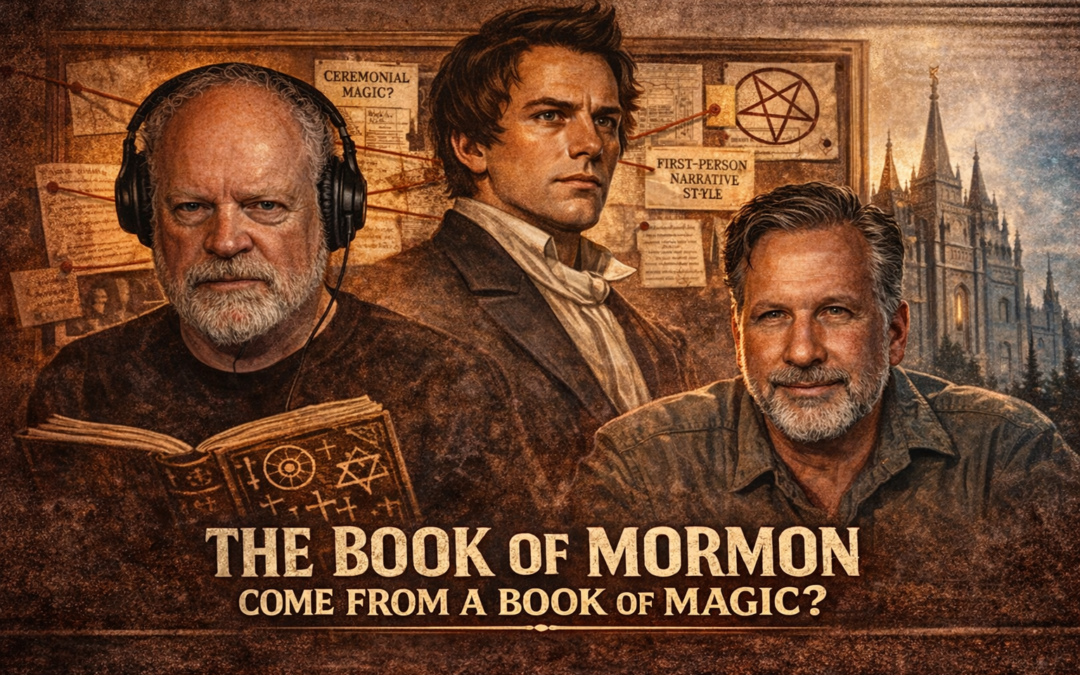
Does the Book of Mormon Come From a Grimoire?
Mormon Discussion Inc. recently invited Dr. John Lundwall to argue that Joseph Smith’s involvement in ceremonial magic—not ancient revelation—produced both the rhetorical style of the Book of Mormon and the structure of the temple endowment. However, when we examine the evidence carefully, a more nuanced picture emerges.
About This Episode
In this episode, Radio Free Mormon (RFM) interviews Dr. John Lundwall, who proposes a provocative hypothesis. Specifically, he suggests that the Book of Mormon’s first-person narrative style originates not from ancient authorship, but from Joseph Smith’s exposure to ceremonial grimoire magic.
A grimoire, in this context, refers to a book of magic containing instructions for rituals, invocations, and spiritual practices. According to Lundwall, this influence extends beyond language and into temple structure, which he argues resembles a modified treasure quest.
While the discussion is intellectually engaging and grounded in real historical data, it consistently blends established facts with speculative conclusions. As a result, the episode often presents hypotheses with a level of certainty they have not yet earned.
The Central Argument
Lundwall constructs his case in four stages. First, he claims the Book of Mormon lacks authentic ancient colophons. Second, he argues that its dominant first-person narrative proves modern oral composition. Third, he attributes this style to Joseph Smith’s exposure to grimoire magic. Finally, he concludes that the temple endowment mirrors a grimoire treasure ritual.
At first glance, this progression appears logical. However, a closer look reveals a pattern: each step builds on assumptions introduced in the previous one. Although Lundwall himself labels his ideas as hypotheses, the discussion gradually treats them as established conclusions.
Consequently, by the end of the episode, a speculative framework is presented as a comprehensive explanation. This rhetorical escalation—moving from possibility to certainty—is critical to recognize.
The Claims — and the Full Picture
There are no real colophons in the Book of Mormon — the apologists are wrong
Partial Truth — Missing Context
Lundwall argues that no true colophons exist in the Book of Mormon because they do not match strict Mesopotamian definitions. Under that narrow definition, his claim is technically correct.
However, this definition is highly selective. LDS scholars such as Hugh Nibley and John Tvedtnes have never argued for Mesopotamian-style colophons. Instead, they point to broader Near Eastern traditions, including colophonic elements and subscriptio.
For example, structures like Words of Mormon 1:1–11 reflect these patterns. Furthermore, even scholars Lundwall cites acknowledge that colophons can appear at the beginning of texts.
Therefore, the issue is not the absence of evidence—it is the restriction of definitions.
Bottom Line
The claim only holds under a narrow framework. When broader ancient practices are considered, the evidence for colophonic structures becomes more substantial.
The Book of Mormon’s first-person dominance proves it’s a modern oral composition by Joseph Smith
First-person dominance proves modern oral composition
Interesting Observation — Weak Conclusion
Lundwall’s statistical observation is genuinely valuable. The Book of Mormon contains an unusually high percentage of first-person narrative compared to ancient texts.
However, the conclusion does not logically follow.
Royal Skousen’s manuscript research demonstrates that Joseph Smith dictated the text with remarkable precision. For instance, he could pause mid-sentence and later resume without repetition or drift—something inconsistent with improvisational speech.
Moreover, the text contains grammatical structures from Early Modern English that were already obsolete in Joseph Smith’s time.
Therefore, while the statistical anomaly is real, the explanation remains contested.
Bottom Line
The data is meaningful. Nevertheless, the conclusion—that the text was orally improvised—fails to account for the manuscript evidence.
Joseph Smith’s grimoire magic training is the true source of the Book of Mormon’s style and early modern English
— Dr. John Lundwall, ~01:33:03
Here the episode is at its most careful and its most misleading simultaneously. Lundwall honestly says “this is my hypothesis” — and that intellectual honesty deserves acknowledgment. But the surrounding conversation elevates the hypothesis to a near-conclusion, and most listeners will walk away with the impression the case has been made.
What is genuinely established: Joseph Smith possessed a Jupiter Talisman matching designs in the 1801 grimoire The Magus. Hyrum’s descendants preserved a Mars Dagger with occult inscriptions. The Smith family participated in treasure-seeking. The LDS Church acknowledges all of this in its own Gospel Topics Essays. These are facts, and faithful members should know them.
What is not established: that Joseph performed formal Solomonic ceremonial magic specifically (as opposed to the widespread frontier folk magic of his era); that he memorized and repeatedly recited thousands of grimoire invocations before dictating the Book of Mormon; that any specific grimoire was in his possession pre-translation; or that this practice functioned as a “linguistic register” training him to speak in early modern English idioms. FAIR LDS notes that the evidence for Smith drawing formal magic circles comes primarily from antagonistic sources, not from LDS-friendly documentation.
Lundwall’s most specific claim — that a magic circle was sewn inside the crown of Joseph’s hat — is presented as his own theory with no documentary support. That’s the mechanism by which the entire grimoire-to-Book-of-Mormon pipeline supposedly works. When the key link in a causal chain is explicitly speculative, the chain doesn’t hold.
Joseph Smith’s involvement in the magic worldview of his era is historically real and openly acknowledged by the Church. But the specific causal claim — that grimoire invocations trained the rhetorical style of the Book of Mormon — involves multiple inferential leaps with no documentary support. The theory is interesting; it is not evidence.
The temple endowment is structurally just a modified grimoire treasure quest
— Dr. John Lundwall, ~02:07:32
This is the episode’s most vivid claim and its weakest argument. Lundwall maps the endowment onto a treasure-quest template: purification = washing and anointing; secret name = protection against spirit control; tokens and signs = invoking four directional spirits; prayer circle = magic circle; receiving power at the veil = obtaining the boon from the summoned divine. It’s a compelling surface narrative.
But the structural pattern he’s describing — purification, preparation, covenant oath, climactic divine encounter, reception of power — is not unique to grimoire magic. It is the universal structure of initiation and covenant across virtually every ancient religious tradition. It appears in Israelite temple worship, Mosaic covenant ritual, early Christian baptismal theology, Greco-Roman mystery religions, and Egyptian funerary rites — all of which predate grimoire magic by centuries or millennia.
LDS scholar Hugh Nibley and non-LDS scholar Margaret Barker have both documented extensively that ancient Israelite temple ritual involved washing, anointing, receiving a new divine name, taking sacred oaths, and approaching God through successive veils. This is not apologetic stretching — it is mainstream scholarship on ancient Near Eastern temple theology. The endowment’s structural resonance with those traditions is, from a faithful perspective, exactly what you’d expect from a restored ancient ordinance.
Lundwall’s quip that “the endowment is just a modified treasure dig” is the kind of line that sticks in memory — which is precisely why it’s worth examining carefully. It reduces the theological content of the endowment (covenants, atonement, eternal family sealing, the Abrahamic covenant) to a treasure-hunt schema in a way that is rhetorically vivid but analytically empty. Two rituals sharing a structural template does not mean one derived from the other, any more than every story with a hero’s journey derived from the same source.
Structural parallels between the endowment and grimoire magic exist — but the same structure appears in ancient Israelite temple theology and other traditions that predate grimoire magic by millennia. That’s the more historically grounded framework, and it’s the one LDS scholarship has documented in depth. “They share a structure” does not prove “one came from the other.”
The Truth Summary
Dr. Lundwall is a genuine scholar presenting a thoughtful theory, and Radio Free Mormon is an intelligent host. This episode is not sloppy — which makes it more important to engage carefully, not less. The historical facts about Joseph Smith’s magic worldview are real, acknowledged by the Church, and shouldn’t surprise faithful members. What the episode gets wrong is the move from “these historical facts are real” to “therefore the Book of Mormon and the temple are human inventions.” That leap is not demonstrated. It is assumed, escalated through four connected claims, and delivered with the confidence of a conclusion.
The Book of Mormon’s textual evidence — particularly Skousen’s decades of manuscript analysis — points toward a word-for-word received text, not an improvised oral performance. The temple’s structural parallels to ancient Israelite worship are deeper and older than any grimoire. Truth seekers deserve to know both sides of this conversation.