
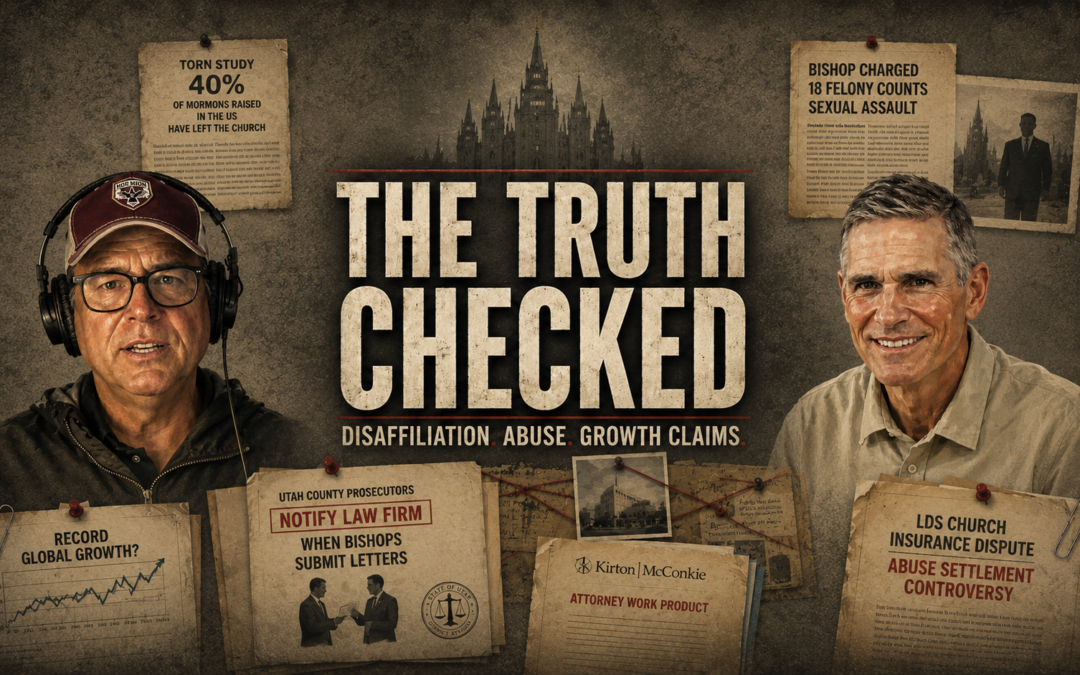
“40% of Mormons Raised in the US Have Left the Church”: Jeff Strong’s Torn Study, Record Global Growth, and the Abuse Coverage — Six Claims Fact-Checked
Mormon Stories Episode 2151 covers real and important stories, including the Torn disaffiliation study and the claim that 40% of Mormons have left the Church. The episode also examines a Livermore bishop abuse case, the Utah County prosecutors arrangement, and record LDS growth numbers. Some claims are well-supported. Others omit critical context or overstate what the data shows. Here is what the record actually says.
About This Episode
Mormon Stories Episode 2151, co-hosted by John Dehlin and Megan from “Generally Unquotable,” covers five major stories. These include:
• A former Livermore bishop charged with 18 felony counts of sexual assault.
• Utah County prosecutors alerting Kirton McConkie when bishops submit character letters.
• The LDS Church’s insurance dispute over an abuse settlement.
• Jeff Strong’s new book Torn and its disaffiliation research.
• Charlie Bird’s announcement that he and his husband are pursuing parenthood through IVF.
Credit Where It’s Due — Dehlin Acknowledges His Own Potential Errors Mid-Episode
In an unusual and creditable moment, Dehlin pauses during his presentation of Strong’s disaffiliation acceleration data to read out a real-time correction from Strong himself: “I’m getting real-time feedback from Jeff. He’s urging me to say that the 3x and then 6x and then 11x disaffiliation data has to be very cautiously interpreted because there could be a response by us that overstates the numbers.”
He then adds: “Don’t take these numbers as gospel. They’re suggesting possible findings or possible trends that may be overstated that could have other explanations.” This caveat is important and applies beyond just the acceleration multipliers. Multiple data sources support the broader 40% figure, but the episode’s tone of certainty throughout deserves the same caution the author himself urged.
What Mormon Stories Gets Right About 40% of Mormons Leaving the Church
Conceded — Substantially Accurate
Multiple independent data sources support the 40% disaffiliation finding
✓ Confirmed by CCES, Pew, and Religion News Service
Strong describes the 40% figure as a “reasonable midpoint.” He bases that estimate on multiple independent data sources. These include his survey of more than 20,000 current and former members, the Harvard Cooperative Election Study (CCES), and the Pew Religious Landscape Study.
Religion News Service covered the study and confirmed the finding. However, it also noted an important limitation. Strong recruited participants through social media, email lists, and personal networks. Those channels may over-represent disaffiliated members. Readers should treat the 40% figure as directionally meaningful. It confirms significant and widespread disaffiliation, rather than as a precise national census figure.
Independent CCES data confirms the US self-identification trend: only 0.9% of US adults now identify as LDS, down from approximately 2% two decades ago. Religion News Service analyzed Pew’s 2023–24 Religious Landscape Study. It found that LDS retention among people born since 1980 is about 49%. In other words, roughly half of those raised in the faith have already left.
Multiple independent data sources confirm significant, accelerating US disaffiliation from the LDS Church. Strong presents 40% as a reasonable midpoint. The actual range may fall between 30% and 50%. The direction is not in serious dispute.
Religion News Service — Strong’s book and methodology (April 29, 2026)
Religion News Service — LDS Gen Z and millennial retention data (December 2025)
Religion News Service — How the LDS Church is growing and shrinking (April 2026)
Conceded — Accurately Reported
Active members are systematically wrong about why people leave — the gap between their assumptions and actual reasons is well-documented
✓ Confirmed by Strong’s Study and Prior Research
Strong found that 75% of active members attribute disaffiliation to sin, worldliness, or spiritual failure. They are less likely to point to doctrinal concerns or institutional issues. This is one of the book’s most important findings. Independent reporting also supports it. Religion News Service quoted Strong directly: “Devout members also tended to attribute disaffiliation to personal inadequacies or religious failings. They chose answers like ‘They sinned and lost the Spirit’ or ‘They were led away by the things of the world.'”
Former members most commonly cite three reasons for leaving: (1) 42% cite problematic church history — encountering information about Joseph Smith’s polygamy, the Book of Abraham, or the seer stone that contradicted what they were taught. (2) Social issues including LGBTQ treatment, child abuse coverups, gender inequality, and racism. (3) Not feeling a sense of belonging or experiencing the promised happiness. Strong’s research found that most people wrestle with their concerns for nearly a decade before leaving. This pattern does not support the idea of impulsive departures driven by offense.
The empathy gap between believing members’ assumptions about why people leave and the actual reported reasons is one of the study’s most consequential findings. Religion News Service’s independent reporting confirms this finding.
Conceded — Accurately Reported
The Livermore bishop arrest and the broader pattern of institutional protection of abusers over victims
✓ Confirmed by KTVU Fox 2 and Court Records
The episode accurately covers the case of 76-year-old Michael Delar Morris. Prosecutors charged him with 18 felony counts involving four boys between 1991 and 2000. KTVU Fox 2 reported the details. Morris led the young men’s group and was a Boy Scout leader at the time. He was subsequently excommunicated and later rebaptized, which the episode correctly frames as a systemic concern.
Floodlit.org documents many cases that resemble the pattern Dehlin and Megan describe. The site chronicles situations where Church leaders handled abuse allegations through ecclesiastical channels. Critics argue that these approaches sometimes protected institutional interests more than victims. Prior reporting also documents the connection to the Wade Christofferson (brother D. Todd Christofferson) case. The concern about the Church’s elimination of Young Men’s presidencies creating more one-on-one bishop/youth access is contextually relevant and fair to raise.
KTVU accurately reported the Livermore case details. Floodlit.org’s documentation supports the broader institutional pattern Dehlin describes and prior reporting. This is the episode’s strongest section.
Three Claims About Mormon Disaffiliation That Need More Context
Claim 1 of 3
The LDS Church is the fastest-declining major religion in the United States — and Quentin Cook is running fraudulent “baseball baptisms” to hide this with inflated global numbers
US Decline Real — “Fraudulent Baptisms” Allegation Unsupported; Critical Context Omitted
What is accurate:
US LDS self-identification has declined sharply. The CCES shows 0.9% of US adults identify as LDS, down from approximately 2% two decades ago. Religion News Service confirmed the LDS Church saw its US adult identification drop below 1% for the first time in 2025. Among the major Christian traditions tracked, LDS shows the sharpest percentage-point decline.
What the episode critically omits:
The LDS Church’s 2025 Annual Statistical Report recorded 385,490 convert baptisms in 2025. That figure represents the highest annual total in Church history. It surpassed the previous record of 330,877 set in 1990 by nearly 17%.Independent researcher Matt Martinich spoke with the Salt Lake Tribune. He said the growth appears widespread rather than concentrated in a few regions. Elder Cook reported that new convert sacrament meeting attendance increased even faster than baptism totals. Supporters point to that trend as a sign of stronger convert retention. Converts per missionary reached 4.9, the highest since 2011 but still well below the 6–8 of the 1970s–90s era when the documented baseball baptism scandals occurred.
On the “fraudulent baptisms” allegation:
Dehlin’s claim that Cook is intentionally replicating baseball baptism fraud is a serious allegation presented without current evidence. The historical problems in Chile, the Philippines, and Latin America that Dehlin describes are real and documented. Jeffrey Holland and Dallin Oaks were indeed called to address them. But applying that same characterisation to the 2024-2025 growth surge requires evidence of comparable practices, which Dehlin does not provide.Church leaders set the 1990 record under less-strict baptismal standards than those used today. The current record comes after years of stricter standards. Calling the current growth “fraudulent” without documented evidence of the specific practices Dehlin describes is an assertion, not a finding.
The Two-Track Reality the Episode Doesn’t Fully Present
- US track (declining): 0.9% adult self-identification (CCES 2025), down from ~2%; 49% retention among those born since 1980 (Pew 2023-24 RLS); LDS shows sharpest US decline among major Christian groups.
- Global track (growing): 385,490 converts in 2025 — all-time record; every world region up 20%+; 17.9 million total members; new convert attendance rates also increasing; converts per missionary at 4.9 (highest since 2011).
- The tension: Total membership grew by only 377,431 despite 385,490 conversions, meaning net losses through death, resignation, and discipline offset gains.
Dehlin is right that the US picture is one of significant decline. He is not justified in characterising the 2024-2025 global growth as fraudulent without evidence of the specific practices he describes. And the episode simply does not tell listeners that the Church just set an all-time record for conversions — information that is directly relevant to evaluating his claims.
Salt Lake Tribune — LDS Church reports record membership growth (April 2026)
LDS Church Newsroom — Record global growth statement (July 2025)
Religion News Service — How the LDS Church is growing and shrinking
Claim 2 of 3
The disaffiliation rate is accelerating 3x, then 6x, then 11x in successive time periods — this is a confirmed trend
Directionally Likely True — But Dehlin’s Own Author Corrects Him: “Cautiously Interpret”
Why the 3x, 6x, and 11x Numbers Require Caution
Credit to Dehlin for reading this correction aloud — it is an unusual and creditable moment of transparency. But it means this analysis has Strong’s own authority for saying these specific multipliers should not be treated as precise findings. The broad direction — that disaffiliation accelerated significantly between the pre-2010 period and the 2015-2019 period and again through 2023 — is likely real, given the documented events: the November 2015 exclusion policy, the CES Letter’s spread, the Gospel Topics Essays, and COVID.
Measuring acceleration presents a major challenge. If researchers recruited participants through ex-Mormon social media networks, they may have under-sampled earlier periods. They may also have over-sampled later periods. This creates the appearance of acceleration even if the underlying rate was more stable. The Religion News Service analysis of the LDS statistical picture confirms the US trend is real but notes the complexity of measuring it precisely.
Strong himself urged listeners not to treat the 3x/6x/11x figures as established data. Known events support the overall acceleration trend. Researchers may revise these multipliers as additional data becomes available.
Claim 3 of 3
The Utah County prosecutors/Kirton McConkie arrangement is primarily about protecting the Church’s image, not about protecting victims
Plausible Motivation — But the Story Is More Nuanced Than Presented
The Controversy Explained
The Salt Lake Tribune accurately reported the Utah County arrangement. For more than a decade, some prosecutors informed Kirton McConkie when Church leaders submitted character letters for criminal defendants. The firm then reminded those leaders that the General Handbook discourages such involvement. In addition, the county’s top prosecutor said he didn’t know about it and may move to stop it.
Where the framing is incomplete
The episode presents the arrangement almost entirely as reputation protection. But the episode itself also accurately notes that the General Handbook does discourage bishops from getting involved in members’ criminal cases — meaning the Church has a stated policy against exactly what these bishops were doing. Alerting Kirton McConkie so they can remind bishops of existing policy is, at minimum, a mixed-motive action: it protects reputation, but it also potentially prevents Church leaders from providing the kind of institutional backing that makes judges look more leniently at serious offenders.
Megan’s more nuanced observation deserves to stand: “I don’t think it’s ethical because I think everyone deserves a character witness even if we don’t like the way that character witness presented their argument.” That is a fair civil liberties point. The more substantive concern the episode raises — and does so effectively — is that in a predominantly LDS judicial community, letters from BYU deans and bishops carry institutional weight that effectively provides religious community backing for serious offenders, and that this is qualitatively different from any private citizen writing a character letter.
The episode is right that the arrangement raises serious questions. The framing as purely reputation protection oversimplifies a dual-motive arrangement. Religious influence within a predominantly LDS judicial system raises the more substantive concern.
Frequently Asked Questions
Is it true that 40% of Mormons raised in the US have left the church?
Strong describes the 40% figure as a “reasonable midpoint.” He bases that estimate on several independent sources. These include his survey, the Harvard Cooperative Election Study, and the Pew Religious Landscape Study. Religion News Service confirmed the finding in its April 2026 reporting.
Important caveats: Strong’s survey was recruited via social media and email lists that may over-represent the disaffiliated population. The CCES confirms US adult LDS self-identification at 0.9%, down from about 2% two decades ago. Pew’s 2023-24 Religious Landscape Study shows LDS retention at roughly 49% for those born since 1980. Independent studies support both the direction and scale of the trend; readers should view the 40% figure as a reasonable estimate within a 30-50% range.
Did the LDS Church set a record for convert baptisms in 2025?
Yes. The LDS Church’s 2025 Annual Statistical Report reported 385,490 convert baptisms. That’s nearly 25% increase over 2024 and the highest single-year total in the Church’s 195-year history. This was confirmed by the Salt Lake Tribune, Religion News Service, and the Church’s own newsroom. Elder Quentin Cook reported that every world region saw at least a 20% increase. Independent researcher Matt Martinich told the Salt Lake Tribune the growth appears widespread and is not limited to Africa.
However, total Church membership grew by only 377,431 meaning the Church lost more members through death, resignation, and discipline than it gained through natural increase. US self-identification continued to decline. The record global growth and US domestic decline are both real and simultaneously true.
What does Jeff Strong’s Torn study say about why Latter-day Saints leave?
Strong’s study found three primary patterns: (1) 42% cite problematic Church history — encountering information about Joseph Smith’s polygamy, the Book of Abraham, or the seer stone translation that contradicted what they were taught in Church; (2) social issues including LGBTQ treatment, child abuse coverups, gender inequality, and racism; and (3) not feeling a sense of belonging or experiencing the promised happiness of the gospel.
Strong also found that 75% of active members are wrong about why people leave — most assume it is sin, worldliness, or spiritual failure when the actual reasons are doctrinal and institutional. Most people wrestle for nearly a decade on average before stepping away. Strong wrote the book for believing members and Church leaders. He aims to build empathy and encourage cultural change.
Is the LDS Church really declining faster than any other US religion?
Among major Christian traditions, the LDS Church shows the sharpest decline in self-identified membership. Researchers have observed this trend since roughly 2009. The CCES data Strong’s study draws on confirms this. However, important context the episode omits: the Pew Research Center’s 2023-24 Religious Landscape Study found the overall decline of Christianity in the US has slowed and may be leveling off. The share of American “nones” actually declined for three consecutive years from a 2022 peak. The LDS US decline is real, but it is occurring alongside a broader but slowing religious landscape shift.
What is the Utah County prosecutors and Kirton McConkie arrangement about?
The Salt Lake Tribune reported that some Utah County prosecutors quietly informed Kirton McConkie when Church leaders submitted character letters for criminal defendants. This practice continued for more than a decade. In response, Kirton McConkie contacted those leaders and reminded them that the General Handbook discourages such involvement. The county’s top prosecutor said he didn’t know about it and may move to stop it.
The arrangement appears to serve two purposes: it protects the Church’s reputation by preventing embarrassing letters (like a BYU dean supporting a child pornography defendant), and it potentially discourages Church leaders from providing institutional backing that might influence sentence outcomes in a predominantly LDS judicial environment. Both motivations are probably at play.
Who is Jeff Strong and why does his disaffiliation research matter?
Jeff Strong is a former LDS bishop, mission president, and BYU faculty member. He also served as a special advisor to the Church and consulted with at least one member of the Quorum of the Twelve Apostles. His book Torn (2026), with a foreword by Steve Young, draws on surveys of over 20,000 current and former members plus hundreds of interviews. It is written for believing members and Church leaders to build empathy for those who leave.
His research matters because he is an insider rather than a critic. He has access to both the data and the institutional networks that could influence Church culture. His finding that active members systematically misunderstand why people leave is particularly important, as are his calls for a less legalistic, more love-centred Church community. Whether the Church will act on his findings remains to be seen.
The Honest Summary
Mormon Stories Episode 2151 covers several real and significant stories. The episode accurately reports the abuse cases. These cases raise serious concerns that deserve the attention the episode gives them. Jeff Strong’s disaffiliation research is among the most rigorous studies yet conducted on why Latter-day Saints leave. Multiple sources support its core findings. Many members continue to leave the Church. Active members often misunderstand their reasons. High social costs keep some non-believers in the pews.
The Missing Context
Three specific areas needed correction or context. Strong himself flagged the 3x/6x/11x acceleration multipliers and urged caution — a caveat that applies more broadly to the certainty with which the data is sometimes presented. The “fraudulent baseball baptisms” allegation against Elder Cook is a serious charge. Dehlin accurately describes historical problems from earlier decades. However, the episode does not provide evidence that similar practices explain the 2024–2025 growth surge. And the episode simply omits the most directly relevant counterpoint to Dehlin’s narrative: the LDS Church reported a record 385,490 convert baptisms in 2025 — the most in its entire history — confirmed by the Salt Lake Tribune and Religion News Service, with growth in every world region. The episode never mentions that fact during its nearly two-and-a-half-hour runtime.
Reality is more complex than either “the Church is in freefall” or “the Church is thriving”: US disaffiliation is real, significant, and accelerating among younger generations; global growth is simultaneously at a historic high. Understanding both halves is essential for any truth seeker trying to evaluate what is actually happening to the LDS Church in 2026.
Content is for educational purposes. Sources are cited. Corrections are welcome.