
An Objective Guest, a Conflicted Host: What TrevAnon’s LDS–Scientology Comparison Actually Reveals — Including About Mormon Stories Itself
John Dehlin’s Mormon Stories has rarely featured a guest as objectively positioned as Corey Tlausen. A never-Mormon Dutch atheist with 18 years of Scientology research, he has no skin in this game. His analytical comparison of LDS and Scientology yields real insight. But his objectivity also exposes something he cannot see from the outside: the systematic way John Dehlin uses individual experiences to indict an entire institution — while being paid substantially to do it.
About This Episode
Mormon Stories Episode 2155 (May 7, 2026) is a three-and-a-half-hour interview with Corey Tlausen (“TrevAnon”). He is a Dutch IT professional, lifelong atheist, and anti-Scientology researcher with 18 years of experience. He also serves as a volunteer YouTube moderator for Mormon Stories. He applies a 4P marketing framework to compare Scientology and LDS organizational structures. Co-host Brooklyn (Dehlin’s UK-based editor) joins throughout. Dehlin frames the episode as a move from “anti-Scientologist to anti-Mormon.” Corey does not use that label for himself.
First, this rebuttal evaluates Corey’s analytical framework, which deserves serious engagement. Second, it evaluates Dehlin’s framing of that framework which reveals patterns that truth seekers need to understand about how Mormon Stories operates.
The Core Distinction This Episode Demands
Corey Tlausen is a genuinely objective outside observer. He has no testimony to mourn. He has no family in the Church and no identity investment in being right about Mormonism. He spent 18 years researching documented institutional abuse in Scientology — forced abortions, billion-year contracts for children, fair-game harassment of critics. When he says the LDS Church shares structural features with Scientology, it comes from a man who knows what the worst version of an institutional high-demand religion actually looks like. And critically — he repeatedly says the LDS Church is “not as bad,” “better than Scientology,” and more capable of reform. His objectivity is the episode’s most valuable feature.
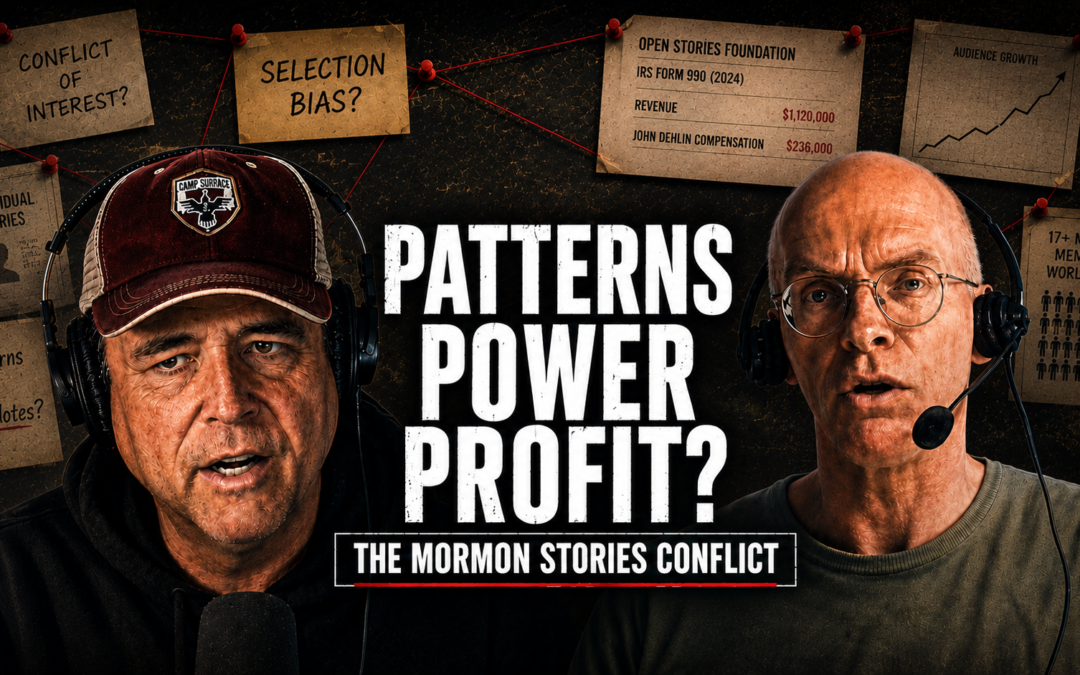
By contrast, John Dehlin is not an objective observer. He is the founder and paid employee of a $1.12 million/year operation whose entire business model depends on an audience of people who are dissatisfied with or leaving the LDS Church. He draws a salary of approximately $236,000 annually from that operation. This does not make every claim he makes false — but it means his framing choices, omissions, and emphases deserve the same scrutiny he applies to LDS leaders. That scrutiny is largely absent from the episode itself.
The Undisclosed Conflict of Interest
Dehlin never discloses to his audience, in this episode or generally, that his livelihood depends on maintaining a large audience of current and former members who view the LDS Church negatively. Religion News Service reported that the Open Stories Foundation’s 2024 IRS Form 990 documented $1.12 million in annual revenue. The filing also listed Dehlin’s compensation at approximately $236,000. A media entity whose revenue model is built on one side of a story has a structural incentive to present that side more forcefully than the other — regardless of whether the individual doing so intends to. Any journalist, commentator, or podcaster operating under this kind of structural conflict is expected by basic journalistic standards to disclose it. However, Dehlin does not.
The Four Structural Problems in How Mormon Stories Operates
1. Individual experiences are systematically presented as evidence of church-wide patterns — without representative data to support the extrapolation
Systematic Overgeneralization — The Selection Bias Problem
Mormon Stories’ method is to interview people who had harmful experiences in the LDS Church and then use the accumulation of those interviews as evidence of institutional-level patterns. The problem is not that the individual experiences are false — many are documented and real. In other words, the problem is the inferential leap from “this happened to this person” to “this is what the LDS Church does.”
How Selection Bias Shapes the Narrative
Consider how this works in practice. For example, a bishop who failed to report abuse becomes evidence that the LDS Church protects abusers. A ward that shunned a gay member becomes evidence that the LDS Church harms LGBTQ people at the institutional level. A stake president who committed fraud becomes evidence that LDS prosperity theology enables corruption. Each individual story may be entirely true. But the show never interviews the bishop who did report abuse, the ward that rallied around its gay member, or the stake president who served faithfully for thirty years. By design it cannot — because those stories don’t attract an audience of people processing religious disillusionment.
Why Representative Data Matters
The result is a portrait of the LDS Church built largely from the worst cases the show can find. Those cases are important and deserve attention. However, presenting them without base rates or broader membership data can create a misleading impression of how common those experiences are. The LDS Church has over 17 million members across 180+ countries. The fraction of bishops, stake presidents, and ward members represented on Mormon Stories is vanishingly small and non-randomly selected for negative outcomes.
However, individual experiences can be real and important without being representative. Mormon Stories consistently presents selected negative cases as evidence of institutional norms without the data to support that inference. Corey’s outsider framework actually exposes this — his comparison identifies structural parallels that exist at the organizational level, not the individual experience level. Thus, that is the right analytical move. Dehlin applies it to produce wholesale condemnation.
2. The half-truth technique: accurate facts selected and presented without the context that would change their meaning
A half-truth is a statement that is factually accurate in isolation but produces a false impression through omission. For instance, this episode contains several visible examples.
Example 1: Growth Context and Scientology Comparisons
Dehlin draws heavily on Corey’s Scientology comparison. As a result, he suggests the LDS Church is structurally similar to one of the most widely condemned organizations in the modern world. What the episode does not mention: the LDS Church recorded 385,490 convert baptisms in 2025 — the most in its 195-year history, confirmed by the Salt Lake Tribune — with growth in every world region and increasing rates of new convert attendance. By contrast, Scientology’s worldwide membership is estimated at 20,000–40,000 and declining. An organization that people are joining in record numbers globally is not behaving like one that is coercing and trapping members through the mechanisms Corey describes in Scientology. The parallel has analytical value in specific areas. However, using it without growth context produces a false picture.
Example 2: Measuring Harm Without Measuring Benefits
Dehlin argues that the LDS Church is “more dangerous than Scientology” because its scale means its harms affect more people. However, he counts harms at scale. He does not count the community support, moral formation, educational motivation, family stability, and charitable infrastructure the Church provides at the same scale. His own words in the closing segment — crediting LDS with his high school honors, his summa cum laude degree, his career at Bain and Microsoft — are the most direct evidence against the framing he spent three hours constructing. He counts his costs from leaving without crediting the benefits he received from staying.
Example 3: Temple Access and OT Levels
The episode compares LDS temple secrecy with Scientology’s OT (Operating Thetan) levels. It presents both as examples of restricted information. What it does not say: Scientology charges tens of thousands of dollars in escalating fees for each OT level, gating spiritual access behind financial extraction. Meanwhile, LDS temple access requires a worthiness interview and tithing compliance but not escalating direct payments. These are structurally different in a way that matters — one is a financial extraction scheme, the other is a covenant commitment system. Presenting them as parallel without this distinction is misleading by omission.
Mormon Stories repeats the half-truth pattern throughout this series. The show selects and frames accurate facts to create impressions that full context would not support. This episode provides three visible examples in a single three-hour conversation.
Salt Lake Tribune — LDS record 385,490 convert baptisms 2025 ·
Lawrence Wright, Going Clear — Scientology financial structure of OT levels
3. Dehlin uses Corey’s genuine objectivity as borrowed credibility — without allowing it to constrain Dehlin’s conclusions
The Guest’s Objectivity Does Not Transfer to the Host’s Framing.
One of the most instructive moments in Episode 2155 is the gap between what Corey actually concludes and what Dehlin’s framing implies. Corey says the LDS Church is “better than Scientology,” “not as bad,” and more capable of reform. He says he doesn’t want religion to go away. He says his objection is to abuse, not to belief. He explicitly frames his comparison as analytical — identifying structural features that may help the Church improve — not as a condemnation.
Dehlin nonetheless concludes from the same three-hour conversation that the LDS Church may be “more dangerous than Scientology.” He presents Corey’s 18-year Scientology research background as lending credibility to this conclusion — yet Corey did not reach that conclusion. As a result, Dehlin invokes the guest’s objectivity to support a position the guest does not hold.
The Limits of Borrowed Credibility
Furthermore, this is a recurring feature of Mormon Stories’ guest strategy. The show often brings in credentialed or experienced guests to provide objective analysis. Their insights are often genuine and valuable. But Dehlin’s editorial commentary consistently pushes further than the guests’ own conclusions, using their credibility as a launching pad for inferences they did not draw. A truth seeker should listen to what the guests actually say — and notice how often the host’s framing goes further.
The guest’s genuine credibility as an outside observer is the best reason to engage this episode seriously. It is not a licence for the host to use that credibility to reach conclusions the guest himself rejected.
4. The “we just want the Church to be better” framing functions as protective cover for a platform that does not present both sides
To be fair, this statement is genuine and deserves credit. Dehlin means it. He credits the LDS Church with his own formation in the same breath. And it is the right vision: institutional accountability is not the same as institutional destruction, and the LDS Church’s problems — financial opacity, abuse coverup patterns, harm to LGBTQ members — are real problems that deserve exposure regardless of the exposer’s motivations.
The Challenge of Balanced Coverage
But the statement also functions as protective cover for a platform that, by its own editorial choices, does not present both sides. In 21 years of podcasting, Mormon Stories has built its entire content library around what the Church does wrong. The audience that pays Dehlin’s $236,000 salary is there because they are dissatisfied with the Church or have left it. A platform focused on balanced coverage would also feature thriving LDS families. It would highlight bishops who handled abuse well, stake presidents who served with integrity, and the community benefits of active membership. These topics would appear regularly rather than as occasional disclaimers. Those episodes do not exist because they would not serve the audience Dehlin has built and depends on financially.
Saying “I want a healthier Church” while running a platform that exclusively documents its pathologies is a form of having it both ways. It provides moral cover while the practical effect of the platform — shaking faith, accelerating disaffiliation, sustaining an audience of the disillusioned — continues unaffected by the disclaimer.
Dehlin genuinely believes he wants a better Church. His platform’s structure, audience, and funding model do not pursue that goal through balanced journalism. Both things are true, and the tension between them is never addressed.
What Corey Gets Right — Credited Fairly
Corey’s 4P framework identifies real structural parallels — particularly doubt management, exit costs, and financial opacity
Separating Corey’s analytical findings from Dehlin’s framing of them, the following structural parallels hold up to scrutiny: both organizations use systematic doubt-management mechanisms (Scientology’s Doubt Formula / LDS “doubt your doubts”); both inflate membership statistics and resist financial transparency; both use the label of critic-as-threat to immunize members against outside information; both have high exit costs including social and family consequences (Scientology’s disconnection policy / LDS shunning culture); and both restrict certain information to initiates (OT levels / temple endowment).
Moreover, these are legitimate organizational observations that LDS members and leaders would do well to engage seriously rather than dismiss. Nevertheless, some Mormon Stories episodes use these observations manipulatively. The observations themselves can still be valid. Corey’s 18-year background in Scientology research gives him a calibrated sense of what these patterns look like at their worst — and his consistent message is that the LDS Church has not reached that worst case and has more capacity for reform than Scientology ever did.
Where the Comparison Remains Measured
His Gödel’s Incompleteness Theorems description is essentially accurate for a lay audience. The Netherlands’ placement in the top 5 of the World Happiness Report is confirmed. Scientology’s worldwide membership at 20,000–40,000 is the correct independent estimate range. And his honest acknowledgment throughout — that the LDS Church is better than Scientology, that religion provides genuine goods, that he does not want religion to disappear — is the most intellectually honest position taken by anyone in the episode.
A truth seeker can engage Corey’s analysis seriously and benefit from it. Likewise, a truth seeker should notice that Corey’s conclusions are more charitable than Dehlin’s framing.
World Happiness Report 2025 — Netherlands 5th globally ·
Tony Ortega, The Underground Bunker — Scientology membership 20,000–40,000
Frequently Asked Questions
Who is TrevAnon and is his comparison of LDS and Scientology objective?
TrevAnon is Corey Tlausen, a 57-year-old Dutch atheist and IT professional who spent 18 years as an anti-Scientology researcher and serves as the volunteer YouTube moderator for Mormon Stories. He has never been Mormon and has no personal stake in either organization. His 18-year research into Scientology — a genuinely harmful organization — gives him a calibrated sense of what high-demand religion looks like at its worst. His comparison of LDS and Scientology is the most analytically honest element of the episode. Critically, he explicitly says the LDS Church is “not as bad” as Scientology, that he doesn’t want religion to disappear, and that his objection is to abuse, not belief. His objectivity is genuine and is the episode’s primary value.
Does John Dehlin have a financial incentive to criticize the LDS Church?
Yes — and this is documented fact. The Open Stories Foundation’s 2024 IRS Form 990 reported approximately $1.12 million in revenue and Dehlin’s annual compensation of approximately $236,000. Mormon Stories’ entire funding model depends on maintaining an audience of people who are dissatisfied with or leaving the LDS Church. Without a continuous supply of LDS problems to cover, the platform’s reason for existence and its revenue would diminish. Furthermore, this structural conflict of interest is never disclosed to the audience. It does not make every claim Dehlin makes false, but it is a relevant factor in evaluating his framing choices, omissions, and emphases.
Is the Mormon Stories method of using individual stories to indict the Church as an institution valid?
Individual stories can be real, important, and worth documenting without being representative of the institution as a whole. The LDS Church has over 17 million members across 180+ countries. Mormon Stories selects for negative experiences by design — that is its audience. As a result, its content library cannot show how common those experiences are. It systematically excludes bishops, stake presidents, and ward communities that do not fit the narrative. A bishop who handled abuse faithfully does not get an episode. A ward that supported its LGBTQ member does not become a headline. Presenting the worst-case selection as institutional evidence produces systematically false impressions of base rates. The individual experiences are real; the institutional indictment they are used to support is not supported by the methodology.
Is it fair to compare the LDS Church to Scientology?
Corey built the comparison and knows Scientology’s harm record better than most outside observers. He explicitly says the LDS Church is “better than Scientology” and “not as bad.” His comparison identifies real structural parallels in doubt management, exit costs, and financial opacity. It does not support moral equivalence. Scientology has documented forced abortions, billion-year contracts for minors, physical isolation facilities, and systematic harassment of critics. By contrast, the LDS Church has no institutional equivalent to any of these. Using the Scientology comparison analytically, as Corey does, yields insight. Using it rhetorically, as Dehlin does, leverages the reputational damage of the association without the analytical constraint that the association requires.
Does Dehlin’s “want a healthier Church” disclaimer resolve the one-sidedness of the platform?
No. The disclaimer is sincere — Dehlin demonstrably means it and credits the Church with his own formation. But it does not resolve the structural contradiction between saying “I want a healthier Church” and running a platform that exclusively documents its pathologies. A platform genuinely committed to a healthier Church would dedicate substantial content to what the Church does well — thriving families, bishops who handle abuse correctly, communities that support LGBTQ members, institutional charitable work. Those episodes do not exist because they would not serve the audience of the dissatisfied that Dehlin depends on financially. However, the disclaimer provides moral cover. The platform’s editorial choices tell a different story.
What should a truth seeker actually take from this episode?
Take Corey’s analysis seriously — it is the most structurally honest element of the episode. The organizational parallels he identifies between LDS and Scientology in doubt management, exit costs, and financial opacity are real and worth LDS members engaging.He consistently argues that the LDS Church is better than Scientology and more capable of reform. He also says he does not want religion to disappear. Those conclusions are more charitable than much of the content produced by Mormon Stories. Then apply the same skeptical lens to Dehlin’s framing that Dehlin applies to LDS leaders: who benefits from this framing? What is being left out? What would the full picture include? Asking those questions about any media source — including this one — is what genuine truth-seeking looks like.
The Honest Summary
Episode 2155 contains something genuinely valuable. A never-Mormon Dutch atheist with 18 years of Scientology research carefully compares two organizations. Corey Tlausen’s outsider perspective provides genuine insight. He argues that the LDS Church is not as bad as Scientology. He objects to abuse rather than belief and advocates reform instead of dissolution. As a result, his conclusions are more measured than Dehlin’s throughout the episode. Therefore, truth seekers should engage his analysis.
Nevertheless, this episode also makes visible the structural problems that run through Mormon Stories as a platform. Individual experiences are systematically extrapolated into institutional indictments without the representative data to support that inference. Accurate facts are presented with the context removed that would change their meaning. The guest’s genuine objectivity is used to lend credibility to conclusions the guest himself did not reach. And the “we just want a healthier Church” disclaimer functions as moral cover for a platform whose entire funding model depends on an audience of the disillusioned.
John Dehlin earns $236,000 annually from a platform built on LDS criticism. That fact does not disqualify his reporting or make every claim false. But it means he is not a disinterested observer, and his framing choices deserve the same scrutiny he applies to LDS leaders who have their own institutional interests to protect. Corey Tlausen, with no financial stake and no personal history in the Church, is paradoxically the more trustworthy voice in this conversation. The episode is worth watching precisely because his analysis and Dehlin’s framing diverge in ways that expose how Mormon Stories operates. Ultimately, truth seekers deserve to see both.