
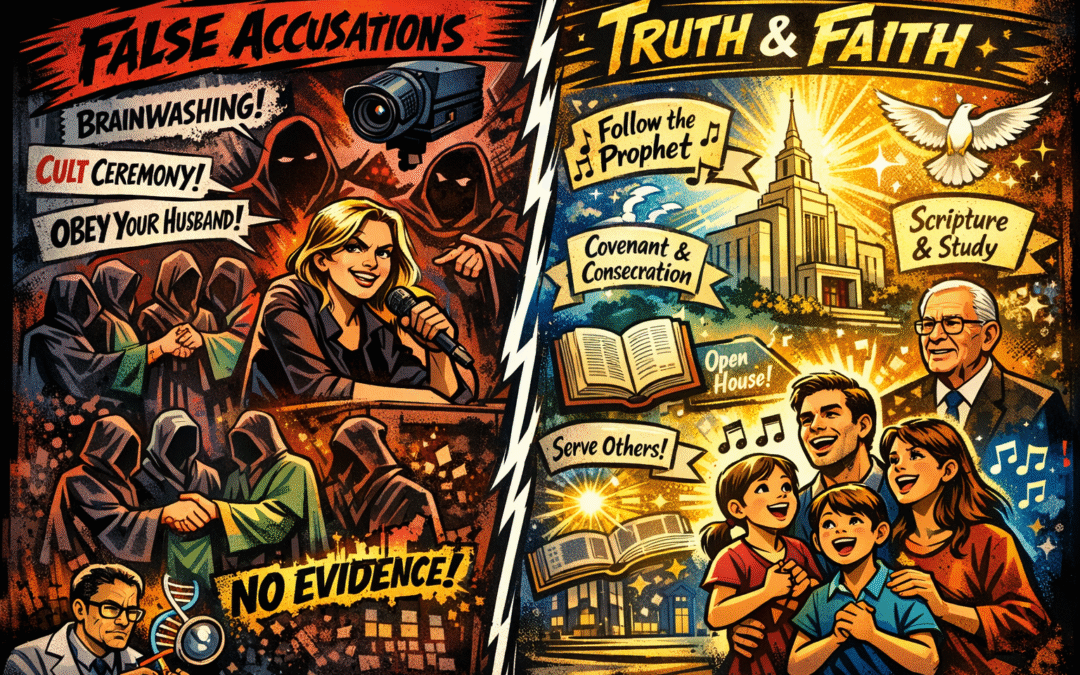
“Mormon Music Is More MESSED UP Than You Think.”
Rebuttal 1 — “Follow the Prophet” = “brainwashy chanting”
“Our first song is going to be Follow the Prophet… Kids start going to primary when they turn three years old… Follow the prophet… He knows the way… now the reason I wanted to start with this specific song is first because it’s very uh hypnotic… the idea of three-year-olds chanting follow the prophet… I don’t know what’s more brainwashy than chanting in my opinion.”
Core Claim
Primary song “Follow the Prophet” constitutes manipulative “chanting” and “brainwashing.”
Core Rebuttal
- What the song teaches: Latter‑day Saint songs are designed to teach doctrine simply and invite the Holy Ghost; Church materials explicitly frame children’s music as a means to learn and feel truth, not to override agency. See “The Power of Primary Songs” (Liahona, 2024).
- Parents encouraged to use hymns at home: The hymnbook preface invites families to sing in homes to bring “beauty and peace,” not coercion. Hymns Preface (see also Primary Songbook prefaces).
- Modern‑prophet context stated correctly: The host notes President Nelson’s passing and President Oaks’s calling; this is accurate.
Labeling core worship practices of a minority faith (children’s singing) as “brainwashy chanting” uses derogatory stereotyping and imputes lack of agency to believers. Such pejoratives generalize and demean adherents’ sincerity.
Evaluation Table
| Start | End | Claim Summary | Category | Evaluation | Sources |
|---|---|---|---|---|---|
| 00:00:54 | 00:03:04 | “Follow the Prophet” is hypnotic “chanting” that “brainwashes” three‑year‑olds. | Opinion Unsupported / Misleading | Song invites faith and discipleship; Church teaches parents to use music to invite the Spirit, not to override agency. | Liahona 2024 Hymns Preface (quoted in‑episode) |
Rebuttal 2 — “Secretly recorded temple video proves it’s a ‘cult ceremony’”
“a secretly recorded video of what you actually do once you get inside the temple… here I am chanting in a circle while wearing a green apron and doing secret handshakes… it’s just a cult ceremony.” Alyssa shows a video of the sacred temple worship inside an LDS Temple. At Mormon Truth, we don’t care if a sacred ceremony is LDS or a different religion altogether. This is disrespectful, even potential hate speech.
Core Claim
Because a hidden‑camera clip exists and includes symbolic gestures, the temple is a “cult ceremony.”
Core Rebuttal
- What the endowment is: The Church publicly explains the endowment’s purpose—covenants to follow Jesus Christ and learn God’s plan. ; About the Temple Endowment
- Transparency via open houses: Before dedication, every temple holds a free public open house; after dedication, the interior is reserved for members. Open Houses; Newsroom.
MTOPS Evaluation Table
| Start | End | Claim Summary | Category | Evaluation | Sources |
|---|---|---|---|---|---|
| 00:35:25 | 00:38:21 | Hidden‑camera clip proves the temple is a “cult ceremony.” | Misleading | Symbolism ≠ secrecy for deception; the Church publicly explains ordinances and invites the world inside before dedication. | Temple Open Houses Gospel Topics: Endowment |
Rebuttal 3 — “In the temple you ‘promise to obey my husband’”
“…I did promise to obey my husband… someday I will enter a temple and I’ll promise to obey my husband…”
Core Claim
The current temple endowment requires women to promise to “obey” their husbands.
Core Rebuttal
- Historical shifts: The “obey” wording was removed in 1990; in 2019, women and men make the same covenants, with “hearken” language removed. Documented by mainstream and Church‑adjacent outlets reporting the January 2019 update. Biblical language, interpreted with contemporary standards and trends, is not so easily interpreted lacks context.
Salt Lake Tribune;
Famili Is the Endowment? LA Times (1990). - Today’s language: Official summaries describe covenants to follow Jesus Christ (laws of obedience, sacrifice, chastity, gospel, consecration)—not spousal subordination. About the Temple Endowment.
Evaluation Table
| Start | End | Claim Summary | Category | Evaluation | Sources |
|---|---|---|---|---|---|
| 00:38:21 | 00:41:24 | Women covenant to “obey my husband.” | Misleading (Outdated) | 1990: “obey” removed; 2019: gender‑equal covenant language; current endowment does not require women to obey husbands. | SL Tribune (2019) LA Times (1990) Temple Endowment (overview) |
Rebuttal 4 — “You covenant to give everything you possess to the Church”
“…in the temple you will promise and covenant with God to give everything you possess to the Church of Jesus Christ of Latter‑day Saints…”
Core Claim
The law of consecration is a pledge to transfer one’s property to the institutional Church.
Core Rebuttal
- Actual covenant summary: Members covenant to dedicate their “time, talents, and everything with which the Lord has blessed [them]” to building up Jesus Christ’s Church—a personal discipleship commitment, not a blanket legal transfer of assets. Official handbook/temple pages:
General Handbook 27;
About the Temple Endowment. - Doctrinal framing: Consecration is primarily about self‑offering and service to God and neighbor, not compulsory divestment. See official study guides. Gospel Topics: Consecrcite”>:contentReference[oaicite:27]{index=27}
MTOPS Evaluation Table
| Start | End | Claim Summary | Category | Evaluation | Sources |
|---|---|---|---|---|---|
| 00:39:22 | 00:39:58 | Consecration = giving all possessions to the Church. | Partial Truth / Misleading | Consecration is comprehensive devotion to God’s work; no blanket property assignment is required by the modern endowment. | General Handbook 27 Temple Endowment |
Rebuttal 5 — “Temple open houses”
“…there’s a short period of time called a temple open house where the general public is allowed to go in… young kids can go through and see what the interior of the temple looks like… we would drive for hours just to walk through.”
Core Claim
Public open houses allow anyone (including children) to tour a temple before dedication.
Evaluation
True — This description matches the Church’s stated practice. See: Temple Open Houses; Newsroom explainer.
Rebuttal 6 — “Ages: baptisms for the dead at 12; endowment ~18”
“…to enter the temple to do baptisms for the dead, you can’t do that till you’re 12. And then you can’t do your endowment ceremony till you’re around 18 to a little older.”
Evaluation
- True (with nuance) — Youth recommends for proxy baptisms/confirmations begin in January of the year one turns 12 (with worthiness/recommend). Proxy Baptism overview.
- Generally true — Endowments are available to adult members who are prepared; many receive the endowment around missionary/service or marriatps://www.churchofjnual/gospel-topics/endowment?lang=eng” target=”_blank” rel=”noopener”>Gospel Topics: Endowment.
Rebuttal 7 — “Don’t criticize the Lord’s leaders—even if true”
“…there’s a lot of quotes that modern leaders have given… one of which is that you should not criticize the Lord’s leaders even if the criticism is true.”
Core Claim
A standing rule exists: it is wrong to criticize leaders “even if the criticism is true.”
Core Rebuttal
The oft‑quoted line is associated with then‑Elder Dallin H. Oaks in a 1980s context and is frequently quoted without context. Responsible summaries note he was counseling against public fault‑finding that undermines Church service. See FAIR’s documentation with the original context. FAIR analysis.
Evaluation Table
| Start | End | Claim Summary | Category | Evaluation | Sources |
|---|---|---|---|---|---|
| 00:10:49 | 00:11:21 | “No criticism even if true.” | Misleading (Context‑stripped) | Counsel addressed destructive public criticism; not a doctrinal ban on truth or accountability. | FAIR |
Rebuttal 8 — “Prophet’s ‘one set of earrings’ rule”
Evaluation
- Historically True — President Gordon B. Hinckley counseled against tattoos and multiple piercings; he allowed for one modest pair of earrings. Oct 2000 talk.
- Current guidance — The 2022 For the Strength of Youth pamphlet emphasizes principle‑based, Spirit‑guided standards without listing an earring count. Coverage summary.
Rebuttal 9 — “Temple recommend question: ‘Do you believe President Oaks is a prophet of God?’”
“…there’s a list of questions… but there is one question about Joseph Smith specifically… ‘Do you believe that the church and gospel of Jesus Christ have been restored through the prophet Joseph Smith? Do you believe that President Oaks is a prophet of God? What does this mean to you?’”
Core Rebuttal
- What is actually asked: The official questions include (1) a testimony of the Restoration and (2) sustaining the President of the Church as prophet, seer, and revelator (by office; the presiding officer’s name changes over time). See the current list.
General Handbook 26 (Temple Recommends);
Newsroom explainer, 2019 update. - Follow‑up prompts: Interviewers may ask personal, pastoral follow‑ups (e.g., “what does that mean to you?”), but the printed questions don’t hard‑code a particular name beyond the office and certainly don’t require the interviewer to ask, “What does that mean to you?”.
Evaluation Table
| Start | End | Claim Summary | Category | Evaluation | Sources |
|---|---|---|---|---|---|
| 01:13:55 | 01:14:50 | Official question names “President Oaks” verbatim. | Partial / Needs Context | Official wording sustains the President of the Church by office; interviewers can reference the incumbent’s name. | General Handbook 26 Newsroom (2019) |
Rebuttal 10 — “Warm feelings replace evidence; no DNA/archaeology needed”
Core Rebuttal
The Church does not claim DNA can “prove” or “disprove” the Book of Mormon; the official essay explicitly says DNA studies “cannot be used decisively” on historicity. Gospel Topics: DNA and the Book of Mormon.
Personal spiritual witness is central to faith, but the Church publishes robust historical and doctrinal resources and encourages study.
Evaluation Table
| Start | End | Claim Summary | Category | Evaluation | Sources |
|---|---|---|---|---|---|
| 00:52:55 | 00:54:02 | Church dismisses need for evidence (esp. DNA). | Misleading / Strawman | Official essay: DNA evidence is indecisive either way; spiritual witness complements study, not replaces it. | Gospel Topics DNA Essay |
Legal & Logic Analysis
Rhetorical Tactics / Fallacies
- Loaded language: “brainwashy,” “chanting,” “cult ceremony” (Segments 1–2) — prejudicial framing rather than neutral description.
- Sweeping generalization: Inferring that music‑based instruction inherently negates agency (Segment 1).
- Strawman: Collapsing spiritual witness into “happy feelings” and implying the Church forbids evidence (Segment 10).
- Context omission: Using pre‑2019 temple wording as if current (Segment 3); overstating consecration as property transfer (Segment 4).
Defamation & False‑Light Risk
- 🟠 Moderate — Present‑tense claims about temple vows (“obey my husband”) risk false‑light portrayal of current practice (2019 changes documented).
- 🟢 Low — Most statements are opinion about a religion rather than verifiable assertions about a private person (less defamation exposure).
Sources (Live Links)
- Podcast/Video context:
Alyssa Grenfell channel;
search listing for the episode title. - Temple / Endowment:
Gospel Topics: Endowment (overview);
About the Temple Endowment;
Temple Open Houses - Temple language developments:
LA Times (1990);
Salt Lake Tribune (2019). - Consecration:
General Handbook 27;
Consecration (study guide). - Proxy baptisms age:
Proxy Baptism (official). - Temple recommend questions:
General Handbook 26;
Newsroom (2019 update). - “Criticism” quote context:
FAIR. - Primary music / feelings:
Liahona (2024): The Power of Primary Songs. - DNA & evidence:
Gospel Topics Essay: Book of Mormon and DNA Studies. - Leadership transition (2025):
Church Newsroom;
Church News
Tone Protocol (Applied)
- Stewardship Doctrine: Parents teaching faith via music at home is an act of stewardship, not manipulation.
- Authorized Priesthood Use: Leadership succession and temple covenants follow established, published processes.
- Covenant Layering: Temple covenants (obedience to God, sacrifice, chastity, gospel, consecration) are Christ‑centered and publicly summarized.
Sources Consulted (Transparency)
Primary: ChurchofJesusChrist.org (Gospel Topics, General Handbook, Temple pages); Church Newsroom; Salt Lake Tribune; LA Times; Liahona; FAIR Latter‑day Saints. Supplementary media coverage as linked above.