
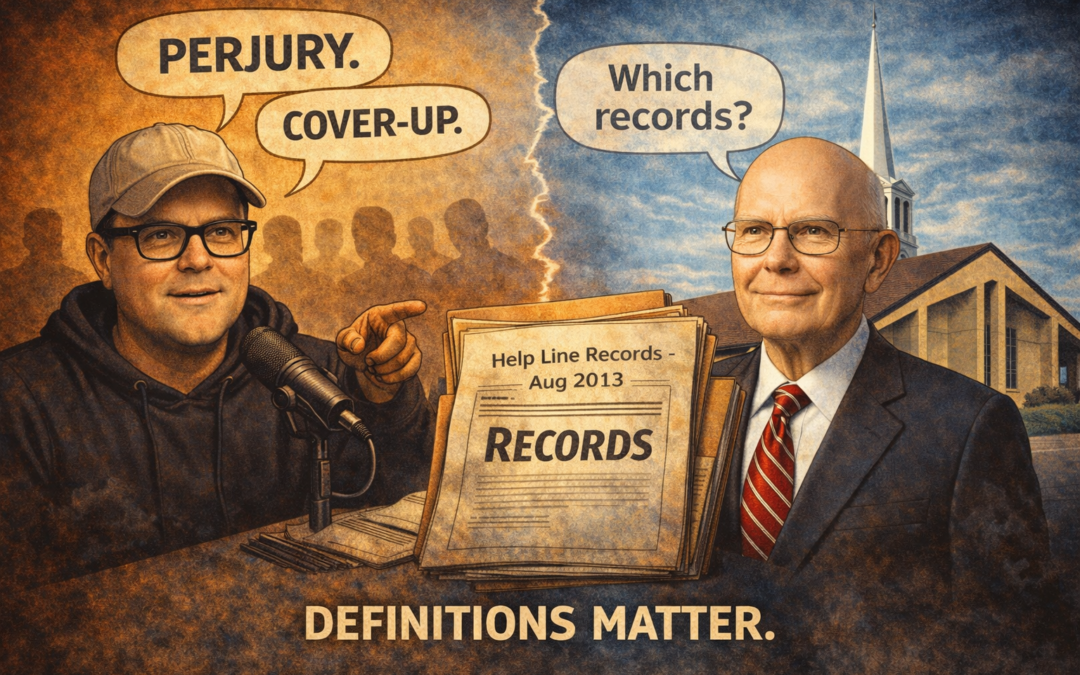
PODCAST CLAIMS REGARDING ABUSE HELP LINE “RECORDS”
EXECUTIVE SUMMARY
A podcast segment from Mormon Discussion Inc. (Radio Free Mormon and Bill Reel) alleges that The Church of Jesus Christ of Latter-day Saints was “caught lying” and committing perjury because a Church newsroom statement references “help line records from August 2013,” while Church representatives in other legal cases allegedly testified that help line records are destroyed daily.
This rebuttal evaluates each claim using transcript-only quotations, legal standards, and publicly available reporting. The central analytical issue is definitional: the word “records” can refer to multiple categories (e.g., metadata, call logs, contemporaneous summaries, retained notes, or recordings). Without establishing that the same category of record is being referenced in both contexts, claims of perjury or fraud are not substantiated.
SEGMENT 1: CLAIM THAT THE CHURCH WAS “CAUGHT LYING AGAIN”
Timestamp: 00:02:07 – 00:03:26
Speaker: Podcast Host
Word-for-Word Quote
“Helpline records from August 2013 directly contradict this narrative. Hold it. Stop the presses. What the [__] did you just do, Mormon church? You just proved that you are lying again… we don’t have them because all the records are destroyed at the end of the day. Sign Paul Ridding under penalty of perjury.”
Core Claim
The Church committed perjury because it now references “helpline records from August 2013” after allegedly swearing that all records are destroyed daily.
Claim Type
Legal accusation / institutional dishonesty.
The argument depends on treating the word “records” as a single, fixed category. In legal and operational contexts, records may include:
-
Call metadata (dates, number of calls)
-
Routing or intake logs
-
Contemporaneous summaries
-
Retained notes or recordings (which may be subject to destruction policies)
Without producing the actual sworn testimony text and demonstrating that it covered all categories of records (including metadata or summaries), the allegation of perjury does not meet the legal standard of material falsity plus intent.
Sources
-
Church Newsroom, “Getting It Right: Clarifying Claims About the Church Abuse Help Line”
https://newsroom.churchofjesuschrist.org/article/getting-it-right-clarifying-claims-church-abuse-help-line -
AP / NY1, “Judge limits privilege defense in AZ Mormon sex abuse case”
https://ny1.com/nyc/queens/ap-online/2022/08/18/judge-limits-privilege-defense-in-az-mormon-sex-abuse-case
SEGMENT 2: CLAIM THAT THE HELP LINE IS A “COVER-UP”
Timestamp: 00:04:37 – 00:05:43
Speaker: RFM
Word-for-Word Quote
“The earlier AP investigation found that the helpline plays a central role in the cover up of child sex abuse in the Mormon church… directs the most serious cases to attorneys… all information… is confidential under the clergy penitent privilege… and attorney client privilege.”
Core Claim
The help line exists primarily to cover up child sexual abuse.
Claim Type
Motive attribution / institutional misconduct allegation.
Evaluation
Routing sensitive matters to legal counsel and asserting clergy-penitent or attorney-client privilege is lawful and common among institutions. The Associated Press describes how these mechanisms operate but does not make a judicial finding that the help line’s purpose is criminal concealment.
To substantiate a “cover-up” claim as fact, evidence of intent to obstruct reporting or prosecution—confirmed by court findings—would be required.
Sources
-
Associated Press, “Takeaways from The AP’s investigation into the Mormon Church’s handling of sex abuse claims” (Dec. 2023)
https://apnews.com/article/mormon-church-investigation-child-sex-abuse-4db829616a5c5cfa351a2e95d778ae9e -
“Clergy as Mandatory Reporters of Child Abuse and Neglect” (PDF overview of state laws)
https://www.dea.gov/sites/default/files/2018-07/Clergy%20as%20Mandated%20Reporters%20of%20Child%20Abuse%20and%20Neglect.pdf
SEGMENT 3: SPECULATION ABOUT RECORDED CALLS
Timestamp: 00:08:25 – 00:09:42
Speaker: RFM
Word-for-Word Quote
“This almost leads me to believe that it’s not somebody writing out notes… This is a recorded phone call… They’re recording the phone call and they have the transcript or they have the audio.”
Core Claim
The Church must be recording and retaining hotline calls.
Claim Type
Speculation presented as inference.
Evaluation
Detailed summaries can be produced without audio recordings through structured intake processes or contemporaneous documentation. The speaker explicitly signals inference (“almost leads me to believe”), which cannot support accusations of fraud or perjury.
SEGMENT 4: CALL FOR CONTEMPT AND “FRAUD UPON THE COURT”
Timestamp: 00:10:39 – 00:10:59
Speaker: RFM
Word-for-Word Quote
“I think those need to have new actions taken and the church held in contempt of court for perpetrating a fraud upon the court.”
Core Claim
The Church committed fraud upon the court.
Claim Type
Unsupported legal conclusion.
Evaluation
“Fraud upon the court” is a narrow doctrine determined by judges, requiring proof of intentional deception that corrupted the judicial process. No ruling, filing, or evidentiary showing is cited.
Reference: Cornell Law School, Legal Information Institute — Perjury
https://www.law.cornell.edu/wex/perjury
FINAL CONCLUSION
The podcast’s narrative relies on:
-
Conflation of legal terms (“records”)
-
Speculation elevated to accusation
-
Motive attribution without adjudicated findings
-
Repeated assertions of criminal conduct without evidence
As presented, claims of perjury, fraud, and institutional cover-up are not substantiated by the evidence cited.
OBJECTIVITY STATEMENT
This rebuttal does not intend to minimize abuse or dismiss victims. Mormontruth.org acknowledges the reality of abuse by members of the Church and condemns all abuse in any form. It evaluates claims strictly on evidence, legal standards, and verifiability. Allegations of criminal conduct require adjudicated findings, not inference or rhetorical escalation.