
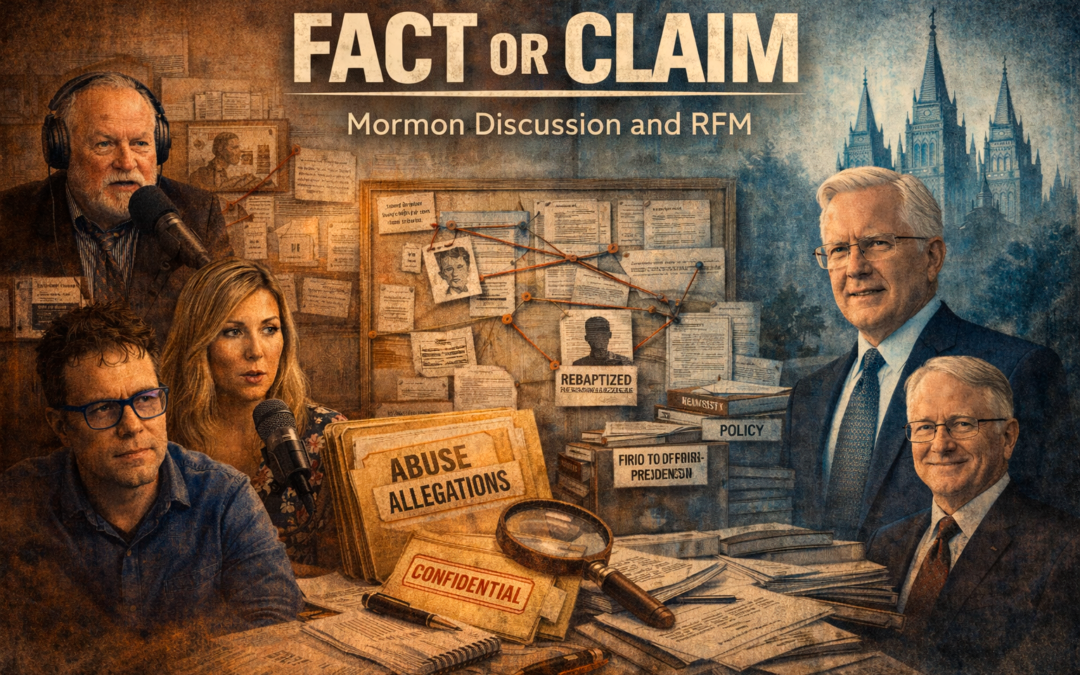
Wade Christofferson: Facts, Speculation, and the Limits of the Public Record
The Wade Christofferson case became a major topic of debate after a March 2026 episode of the Mormon Discussion podcast discussed allegations, church discipline history, and questions about institutional responsibility.
The segment raises serious concerns. Federal prosecutors have filed criminal charges. Earlier allegations of abuse in Crystal Lake have been reported. And public reporting confirms that Wade Christofferson was once excommunicated and later readmitted to the Church. Those facts matter.
But the podcast often goes beyond what the current public record actually shows. In several places it moves from documented evidence to speculation, inferred motives, or sweeping institutional claims.
Understanding the difference between those categories is essential for any serious analysis.
This article separates what is documented, what remains disputed, and what the evidence does not currently support.
The central article discussed in the segment was the
Chicago Sun-Times report published March 5, 2026.
Federal allegations were also reflected in the
U.S. Attorney’s Office for the Southern District of Ohio charging announcement.
Evaluation Table
The table below distills the main claims made in this section of the transcript and classifies them against the current public record.
| Claim Summary | Category | Evaluation |
|---|---|---|
| Wade faces serious criminal allegations and earlier Crystal Lake abuse accusations | Mostly True | Supported if kept in allegation form |
| Local or national leaders knew, hid abuse, and provided cover | Partial Truth / Not Fully Provable | Local secrecy concerns are supported; national knowledge is not proved |
| Wade was excommunicated, readmitted, resumed leadership, and later allegations emerged | Mostly True / Context Omitted | Core history is supported, but the segment omits limiting context from the Church statement |
| First Presidency approval on annotations proves high-level knowledge in this case | Partial Truth / Inferential | Policy point is real; case-specific conclusion is still unproved |
| D. Todd knew earlier and the later reporting narrative was curated for optics | Not Provable | These are theories, not established facts |
| The system protects abusers, the helpline suppresses reporting, and no meaningful two-adult rule exists | Misleading / Overstated | Past controversies are real; one present-tense policy claim is wrong |
| President Oaks likely knew, and he was chief justice of the Utah Supreme Court | False in Part / Speculative | The title claim is wrong; the knowledge claim is unproved |
The factual core is serious and should not be minimized
“Questions are now being raised about whether local — or even national — Mormon leaders knew of that abuse but kept it secret, failing to tell police and providing cover that allowed child abuse to perpetuate.”
— Radio Free Mormon, reading the Chicago Sun-Times, 00:02:30
On the basic criminal-allegation summary, the segment stands on solid ground. The
Chicago Sun-Times reported on March 5, 2026, that Wade Christofferson had previously served as a member and leader in Crystal Lake and had faced accusations of abusing minors there. Meanwhile, the U.S. Attorney’s Office for the Southern District of Ohio separately announced in November 2025 that Wade S. Christofferson was arrested and charged federally with attempted sexual exploitation of a minor and coercion and enticement.
Therefore, the podcast’s core framing holds: the allegations are serious and documented in public reporting and federal charging materials.
That distinction matters. A strong rebuttal does not deny documented facts. Instead, it acknowledges them and then separates them from claims that the evidence does not yet prove.
Abuse allegations this serious demand moral seriousness. At the same time, they require evidentiary discipline.
Where the segment is strongest: local secrecy concerns
“No authorities were brought in. Nothing was ever mentioned to the membership.”
— Edward Nachel as quoted in the segment, 00:08:11–00:09:13
This is the part critics can press hardest. The Sun-Times report described Edward Nachel’s account that, after Wade Christofferson was excommunicated in the mid-1990s over alleged misconduct, leaders “apparently never went to police or told their flock.” According to the report, “no authorities were brought in,” and a rumor circulated that the issue involved an extramarital affair.
If accurate, this would represent a serious failure in transparency and child protection.
However, the segment then moves beyond the available evidence. The same Sun-Times article frames higher-level knowledge as a question under investigation—not as a conclusion.
In other words:
-
serious reason exists to investigate local handling
-
proof of national leadership knowledge does not yet exist
The segment repeatedly blurs that distinction.
What is documented about excommunication and readmission — and what the segment leaves out
“Initially he was excommunicated by the church for that behavior … but he was later allowed to return as a full member and leader and subsequent abuse happened.”
— Radio Free Mormon, 00:04:00
Here again, the basic outline is substantially supported. The
Sun-Times
reported that Wade Christofferson was initially excommunicated, later returned as a full member, and resumed leadership roles. The Church’s statement to the paper likewise said he was readmitted in 1997 following established disciplinary and confession processes. That part of the story is not speculative.
What the segment does not tell the audience is that the same Church statement also said the Church is “aware of no abuse involving his Church service after that time.” That does not exonerate Wade Christofferson from all later alleged wrongdoing. It does, however, materially qualify the podcast’s insinuation that readmission itself proves later abuse occurred through Church service. A publication-ready brief should state both sides of that record. The segment only states one.
The First Presidency annotation argument is partly correct but still unproved
“It takes first presidency approval to remove an annotation.”
— Rebecca, 00:11:49–00:12:19
This is one of the segment’s more sophisticated points, and it is only half wrong. The policy premise is correct. The
General Handbook
says only the Office of the First Presidency may authorize removing an annotation from a membership record. That means any claim about annotation removal is not trivial or purely local.
But the argument still jumps a gap it has not closed. The public record reviewed for this brief does not include Wade Christofferson’s membership record, nor does it include a public Church confirmation that his annotation was in fact removed. The hosts infer removal because he later resumed leadership. That may be plausible. It is not yet proved. So the clean classification is this: the policy point is true; the case-specific conclusion remains inferential.
The D. Todd Christofferson Knowledge Theory
“I just feel in the positions that D. TODD was in, he would have been aware. He would have had access to excommunication records.”
— Rebecca, 00:36:54–00:38:29
This is the segment’s biggest reputational leap. The Church’s March 2026 statement said D. Todd Christofferson was told of the excommunication in the 1990s but not the specific reasons, and that it was not until around 2020 that he first learned through family disclosure of some of his brother’s abuse history. The same
Sun-Times report
also noted Floodlit’s claim that an accuser said D. Todd knew of at least one abuse allegation in or about 2018. Those are competing public narratives. The record is disputed.
The podcast does not leave the question in that disputed posture. Instead, it repeatedly moves from “I just feel,” “wouldn’t you look,” and “there’s no way” to a functional accusation of earlier knowledge. That is not proof. It is argument from incredulity. Suspicion may be understandable here. Certainty is not yet earned.
The “crafted narrative” claim remains conjecture
“Crafting a scenario, a war room perhaps … I think it was crafted. I think it was curated … Again, just my personal opinion.”
— Rebecca, 00:44:43–00:45:43
This portion is the easiest to classify because the speaker effectively classifies it herself. She says she is guessing. That matters. It is one thing to say the Church’s public statement should be cross-examined, or that the chronology raises questions. It is another thing entirely to float a “war room,” a curated scenario, and a deliberate optics strategy as though those were facts. They are not facts on the public record reviewed here. They are speculative motive assignments.
A publication-ready rebuttal should say this plainly: questioning a narrative is fair; inventing a backstage narrative without evidence is not analysis, it is screenplay.
The “system protects abusers” claim overreaches
“They are often telling the bishop … to not report it.”
— Bill, 00:28:07–00:29:19
“They do it for pretty much every child predator.”
— Radio Free Mormon, 00:49:37–00:50:20
“The church didn’t make the change to require two adults in the room with a child.”
— Bill, 00:52:42–00:53:22
The segment is not wrong to point to real abuse-handling controversies. The
Associated Press investigation in 2022
into the Church’s abuse help line put enormous public pressure on the institution and remains one of the strongest reasons critics distrust internal reporting systems. That history is real and relevant.
But the present-tense policy claims in the segment are overstated, and one is flatly wrong. Current Church materials say bishops and stake presidents should call the help line to help protect victims, protect potential victims, and comply with legal reporting requirements. Another official Church resource says no Church leader should ever dismiss a report of abuse or counsel a member not to report criminal activity. Current activity policy also says at least two adults must be present at all Church activities attended by children and youth, and Church safety guidance says when adults are teaching children or youth, at least two responsible adults should be present. That does not erase earlier failures. It does mean the podcast’s claim that the Church “didn’t make the change” is inaccurate as a statement about current policy.
Relevant Church sources include the
abuse help-line page,
the
General Handbook section on activities,
and the
Protecting Children and Youth guidance.
The better critical formulation would be this: past practices and specific cases raise serious concerns about whether policy was followed, whether reforms came too late, and whether current safeguards are enough. That is a hard criticism. It is also a defensible one. “Pretty much every child predator,” by contrast, is not a demonstrated fact. It is a hasty generalization dressed up as institutional analysis.
The Oaks claim collapses on a factual error
“He was the chief justice on the Utah Supreme Court.”
— Radio Free Mormon, 00:47:20–00:48:28
This point is not a close call. Official Church biography identifies Dallin H. Oaks as having served as a
justice of the Utah Supreme Court
when he was called as an apostle in 1984. Utah courts’ historical materials identify Gordon R. Hall as chief justice during the early 1980s, including the 1981–85 period. So the “chief justice” claim is wrong.
For court-history reference, see the
Utah courts historical timeline.
That factual mistake matters because it props up an even larger speculative claim: that Oaks therefore likely knew the “baggage” and either acted recklessly or incompetently in selecting D. Todd Christofferson for the First Presidency in October 2025. There is no public evidence in the record reviewed here establishing what Oaks knew at that point. The argument therefore fails twice — first on title, then on proof.
Logic and legal-risk assessment
The segment relies heavily on three weak forms of reasoning: argument from incredulity (“there’s no way”), hasty generalization (“pretty much every child predator”), and motive imputation (“crafted,” “curated,” “war room”). Those are not just rhetorical habits. They are the exact moves that make a serious critique less trustworthy, because they replace documented fact with implied certainty.
From a legal-risk standpoint, the highest-exposure claims are the ones that assign specific knowledge, concealment, or PR orchestration to named leaders without proof. U.S. defamation law requires a public-figure plaintiff to show falsity and actual malice — knowledge of falsity or reckless disregard for truth — and false-light claims generally focus on public falsehoods or misleading implications that would be highly offensive. That does not bar strong criticism. It does mean critics need to distinguish sharply between what is proved, what is alleged, and what is only inferred. For a concise legal overview, see the
Cornell Legal Information Institute explanation of defamation.
Risk flags
- High risk: “D. Todd knew earlier and was effectively part of the cover-up.”
- High risk: “President Oaks knew or should have known and acted anyway.”
- High risk: “The Church does this for pretty much every child predator.”
- Moderate risk: “The reporting sequence was crafted or curated in a PR ‘war room.’”
Bottom line
The clean, publication-ready conclusion is this: the Wade Christofferson segment is strongest when it sticks to the documented record — the serious federal allegations, the Crystal Lake accusations, the reported excommunication, the later readmission, and the deeply troubling claim that local leaders did not warn police or families. It is weakest when it tries to prove more than the record currently proves.
The public evidence does not yet establish that D. Todd Christofferson knowingly facilitated a cover-up, that President Oaks knew and ignored the issue, or that the Church handles “pretty much every child predator” this way. That is the line the segment crosses, and that is where the rebuttal lands.
Sources Consulted
- Chicago Sun-Times — “Mormon church child sex abuse cover-up?” (March 5, 2026)
- U.S. Attorney’s Office, Southern District of Ohio — Wade Christofferson charging announcement
- General Handbook — Membership councils, annotations, and related disciplinary procedures
- Church abuse help-line guidance
- General Handbook — Activities, including supervision standards
- Protecting Children and Youth — Church safety guidance
- Associated Press — 2022 investigation into Church abuse reporting
- Official biography of Dallin H. Oaks
- Utah courts historical timeline