
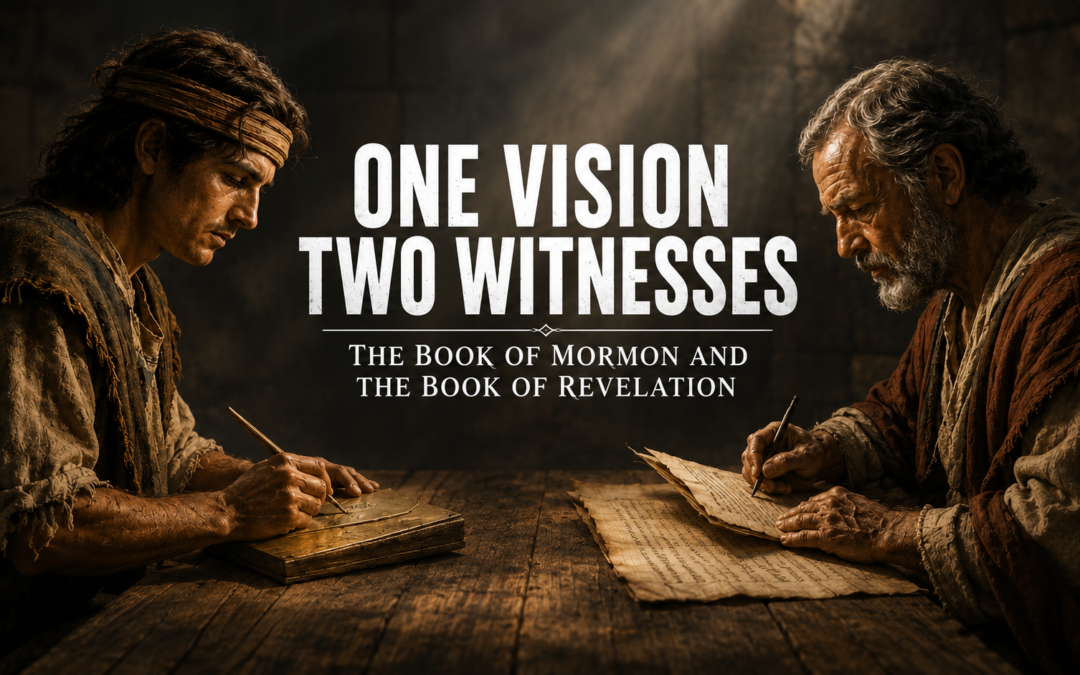
The Book of Mormon and the Book of Revelation: A Complete Textual and Thematic Analysis
The Book of Mormon and the Book of Revelation are closely connected through shared prophetic visions, recurring symbolism, Christ-centered theology, and parallel teachings about the last days. This guide examines every major textual, thematic, and doctrinal connection between these two sacred books using official Latter-day Saint scripture references.
The relationship between the Book of Mormon and the Book of Revelation reveals one of the most remarkable scriptural connections in Latter-day Saint theology. Although scholars frequently study these books independently, they share numerous prophetic, textual, and theological parallels that become increasingly clear when examined side by side.
Most importantly, 1 Nephi 14 records that Nephi saw the same apocalyptic vision later written by John in the Book of Revelation. However, the Lord instructed Nephi not to record everything because John had been appointed to preserve that vision. Consequently, the Book of Mormon functions as a companion witness that helps explain many of Revelation’s symbols through clearer language and additional prophetic context.
This comprehensive analysis explores every major connection identified between these two books, including verbal parallels, structural patterns, Christological themes, prophetic visions, and shared doctrines such as the Tree of Life, the New Jerusalem, the sealed book, the Great Apostasy, and the Restoration. Throughout the article, Doctrine and Covenants 77 serves as the authoritative Latter-day Saint framework for interpreting the Book of Revelation.
Part I: Nephi’s Forbidden Vision
This is the foundational connection between the two books. In 1 Nephi 14, Nephi records that an angel showed him everything John would later write — but commanded him not to write those things because John would write them. This was approximately 600 BC, roughly 700 years before John wrote Revelation.
1 Nephi 14:24–28
“And behold, thou shalt not write them after the manner which thou seest them… The things which thou shalt see hereafter thou shalt not write; for the Lord God hath ordained the apostle of the Lamb of God that he should write them… and the name of the apostle of the Lamb was John, according to the word of the angel, who should write the things which I saw.” 1 Nephi 14:24–28
1 Nephi 14:14 — What Nephi Saw Before Stopping
“I, Nephi, beheld the power of the Lamb of God, that it descended upon the saints of the church of the Lamb, and upon the covenant people of the Lord, who were scattered upon all the face of the earth; and they were armed with righteousness and with the power of God in great glory.” 1 Nephi 14:14
The word “remainder” in verse 28 is critical: Nephi has already written some of what John would write (1 Nephi 11–14), but John was to write the rest. This means 1 Nephi 11–14 is a partial, plainly-written record of part of the Book of Revelation — the same vision, expressed without symbolic coding. Wherever the two visions overlap, the Book of Mormon version provides a plain-language key to Revelation’s symbolic language.
The additional witness in 1 Nephi 14:26 indicates other prophets also saw this vision and wrote sealed records that will eventually be brought forth.
Part II: The Vision Chain
The Book of Mormon and Joseph Smith’s revelations indicate that the vision John recorded was not unique to John — multiple prophets were shown the same grand panorama of God’s dealings with the earth from beginning to end.
Ether 4:4–7 — Brother of Jared’s Vision
“Behold, I have written upon these plates the very things which the brother of Jared saw; and there never were greater things made manifest than those which were made manifest unto the brother of Jared… then will I manifest unto them the things which the brother of Jared saw, even to the unfolding unto them all my revelations.” Ether 4:4–7
1 Nephi 14:26 — Others Who Saw and Wrote
“And also others who have been, to them hath he shown all things, and they have written them; and they are sealed up to come forth in their purity, according to the truth which is in the Lamb, in the own due time of the Lord, unto the house of Israel.” 1 Nephi 14:26
The visionary pattern — often beginning with a white tree or burning bush — appears to signal the same foundational vision: Lehi’s white tree (1 Nephi 8:10), Moses’ burning bush (Exodus 3:2), the brother of Jared’s vision of Christ’s finger through the veil (Ether 3:6). Each prophet appears to receive portions of the same panoramic vision, with each assigned responsibility to write different sections.
Revelation 10:7 affirms this: “the mystery of God should be finished, as he hath declared to his servants the prophets.” The Book of Mormon is the restoration of the middle portion of that long prophetic chain.
Part III: The “Shortly Come” Verbal Pattern
The Book of Revelation opens: “The Revelation of Jesus Christ, which God gave unto him, to shew unto his servants things which must shortly come to pass“ (Revelation 1:1). This precise phrase — “shortly come” — appears multiple times in the Book of Mormon and Doctrine and Covenants, suggesting a shared eschatological vocabulary deliberately connecting these records:
Revelation
“things which must shortly come to pass”. Revelation 1:1
1 Nephi 22:15
“these things must shortly come; yea, even blood, fire, and vapor of smoke must come; and it must needs be upon the face of this earth”. 1 Nephi 22:15
Helaman 16:4
“that Christ must shortly come”. Helaman 16:4
Alma 16:19
“holding forth things which must shortly come, yea, even holding forth the coming of the Son of God”. Alma 16:19
Mormon 8:34
“great and marvelous things concerning that which must shortly come at the day when these things shall come forth among you”. Mormon 8:34
The phrase appears in both books in the context of the Second Coming and the events leading to it — suggesting these texts share a conscious eschatological vocabulary that connects them as companion witnesses of the last days.
Part IV: The Lamb of God Christology
The Book of Revelation uses “the Lamb” as Christ’s primary title 28 times. 1 Nephi chapters 11–14 uses “the Lamb of God” in remarkably similar ways — establishing Christ as the central figure of both books under this identical title. This title is rare outside John’s writings (Gospel of John, Revelation) and 1 Nephi.
Revelation 5:12
“Worthy is the Lamb that was slain to receive power, and riches, and wisdom, and strength, and honour, and glory, and blessing.” Revelation 5:12
1 Nephi 11:21
“Behold the Lamb of God, yea, even the Son of the Eternal Father! Knowest thou the meaning of the tree which thy father saw? … the love of God, which sheddeth itself abroad in the hearts of the children of men.” 1 Nephi 11:21–22
Revelation 21:14
“And the wall of the city had twelve foundations, and in them the names of the twelve apostles of the Lamb.” Revelation 21:14
1 Nephi 12:8–10
“And the angel spake unto me, saying: These twelve apostles of the Lamb, who are chosen to minister unto thy seed… And the twelve ministers of thy seed shall be judged of them.” 1 Nephi 12:8–10
Additional Lamb parallels: the “blood of the Lamb” as the means of salvation (Rev 7:14 / 3 Nephi 27:19); the Lamb’s book of life (Rev 21:27 / Alma 5:57–58); the marriage of the Lamb (Rev 19:7) and temple covenant themes throughout the Book of Mormon.
Part V: The Great and Abominable Church / Whore of Babylon
The description of the great and abominable church in 1 Nephi 13–14 and the whore of Babylon in Revelation 17–18 are perhaps the most structurally close sections of the two books. The same entity is described using nearly identical imagery from two different prophets writing centuries apart.
Revelation 17:4–5
“And the woman was arrayed in purple and scarlet colour, and decked with gold and precious stones and pearls, having a golden cup in her hand full of abominations and filthiness of her fornication: And upon her forehead was a name written, MYSTERY, BABYLON THE GREAT, THE MOTHER OF HARLOTS AND ABOMINATIONS OF THE EARTH.” Revelation 17:4–5
1 Nephi 13:7–9
“And I also saw gold, and silver, and silks, and scarlets, and fine-twined linen, and all manner of precious clothing; and I saw many harlots. And the angel spake unto me, saying: Behold the gold, and the silver, and the silks, and the scarlets, and the fine-twined linen, and the precious clothing, and the harlots, are the desires of this great and abominable church. And also for the praise of the world do they destroy the saints of God.” 1 Nephi 13:7–9
Revelation 17:6
“And I saw the woman drunken with the blood of the saints, and with the blood of the martyrs of Jesus.” Revelation 17:6
1 Nephi 13:9
“for the praise of the world do they destroy the saints of God, and bring them down into captivity” 1 Nephi 13:9
Revelation 17:15
“The waters which thou sawest, where the whore sitteth, are peoples, and multitudes, and nations, and tongues.” Revelation 17:15
1 Nephi 14:11
“I looked and beheld the great city of the Gentiles; and I saw the great and abominable church; and I saw that it was exceedingly numerous, and its dominions were upon all the face of the earth, among all the nations, kindreds, tongues, and people.” 1 Nephi 14:11
Revelation 17:16 — The whore’s self-destruction
“And the ten horns which thou sawest upon the beast, these shall hate the whore, and shall make her desolate and naked, and shall eat her flesh, and burn her with fire.” Revelation 17:16
1 Nephi 22:13–14
“the great and abominable church, which is among all the nations of the Gentiles, shall tumble to the dust and great shall be the fall of it. For behold, saith the prophet, the time cometh speedily that Satan shall have no more power over the hearts of the children of men.” 1 Nephi 22:13–14
Additional “Babylon” warnings in the Book of Mormon that parallel Revelation 18’s “Babylon is fallen” language: 2 Nephi 28 (the apostate church of the last days), Mormon 8:26–41 (Moroni’s address to the latter-day Gentiles), and Ether 8:18–25 (the warning against secret combinations).
Part VI: The Tree of Life and River of Living Water
The Book of Revelation ends exactly where the Book of Mormon begins: at the tree of life, beside a river of living water. Lehi’s vision in 1 Nephi 8 and Nephi’s interpretation in 1 Nephi 11 describe the same scene that Revelation 22 describes as the eternal state of the redeemed. The beginning of the Book of Mormon and the end of Revelation are pointing to the same destination.
Revelation 22:1–2
“And he shewed me a pure river of water of life, clear as crystal, proceeding out of the throne of God and of the Lamb. In the midst of the street of it, and on either side of the river, there was the tree of life, which bare twelve manner of fruits… and the leaves of the tree were for the healing of the nations.” Revelation 22:1–2
1 Nephi 8:10–12
“I beheld a tree, whose fruit was desirable to make one happy… I did go forth and partake of the fruit thereof; and it was most sweet, above all that I ever before tasted. Yea, and I beheld that the fruit thereof was white, to exceed all the whiteness that I had ever seen. And as I partook of the fruit thereof it filled my soul with exceedingly great joy.” 1 Nephi 8:10–12
Revelation 7:17
“For the Lamb which is in the midst of the throne shall feed them, and shall lead them unto living fountains of waters: and God shall wipe away all tears from their eyes.” Revelation 7:17
1 Nephi 11:25
“the tree of life was a representation of the love of God… the waters which my father saw was filthiness; and so much was his mind swallowed up in other things that he beheld not the filthiness of the water. And the large and spacious building… was vain imaginations and the pride of the children of men.” 1 Nephi 11:25 / 1 Nephi 12:16–18
Related references: 2 Nephi 2:15 (tree of life in the garden); Alma 12:21–26 (Alma’s sermon on the tree of life and the fall); Alma 32:40–43 (the tree of life as faith).
Part VII: The Rod of Iron
Revelation 2:27; 12:5; 19:15
“And he shall rule them with a rod of iron… she brought forth a man child, who was to rule all nations with a rod of iron… and he shall rule them with a rod of iron.” Rev 2:27 · Rev 12:5 · Rev 19:15
1 Nephi 8:19; 11:25; 15:24
“I beheld a rod of iron, and it extended along the bank of the river, and led to the tree… the rod of iron… was the word of God… whoso would hearken unto the word of God, and would hold fast unto it, they would never perish.” 1 Ne 8:19 · 1 Ne 11:25 · 1 Ne 15:24
Revelation’s “rod of iron” governs nations and destroys wickedness. The Book of Mormon’s “rod of iron” is the word of God leading to the tree of life. Both uses point to the same divine instrument — scripture, truth, and the word of God as both a guiding path for the righteous and a rod of judgment against the wicked. The Revelation promise to Thyatira (Rev 2:26–27) connects overcoming through righteousness to ruling with the rod of iron — precisely the path that leads through the rod of iron in Lehi’s vision to the tree of life.
Part VIII: The Sealed Book
Revelation 5:1
“And I saw in the right hand of him that sat on the throne a book written within and on the backside, sealed with seven seals.” Revelation 5:1
Moroni 10:2; Ether 4:5
“I seal up these records, after the manner of my fathers” / “he commanded me that I should seal them up… the things which the brother of Jared saw” Moroni 10:2 · Ether 4:5
The sealed portion of the Book of Mormon — the brother of Jared’s record — contains similar comprehensive content. Ether 3:25–28: “And when the Lord had said these words, he showed Unto the brother of Jared all the inhabitants of the earth which had been, and also all that would be; and he withheld them not from his sight, even unto the ends of the earth.” The sealed portion of the Book of Mormon and the sealed book of Revelation appear to contain the same comprehensive panorama of history.
Also relevant: 2 Nephi 27:7–8: “the Lord God shall bring forth unto you the words of a book, and they shall be the words of them which have slumbered. And behold the book shall be sealed.”
Part IX: The Seven Churches
Revelation 1:4; 2–3
“John to the seven churches which are in Asia… unto Ephesus, and unto Smyrna, and unto Pergamos, and unto Thyatira, and unto Sardis, and unto Philadelphia, and unto Laodicea.” Revelation 1:4 · Revelation 2–3
Mosiah 25:22
“Notwithstanding there being many churches they were all one church, even the church of God; for there was nothing preached in all the churches except it were repentance and faith in God. And now there were seven churches in the land of Zarahemla.” Mosiah 25:22
The LDS interpretive tradition reads the seven churches as representing seven dispensations — from Adam through the restoration — with each church having both historical and dispensational significance. The seven churches in Mosiah, appearing in the Book of Mormon’s account of a period when the church spread through all the land, parallel both the structural and dispensational interpretations.
Part X: D&C 77 — The Authoritative Interpretive Key
Doctrine and Covenants Section 77 is unique in the canon: it is a revelation given specifically to answer questions about the Book of Revelation. It provides authoritative LDS interpretations for 15 specific elements of Revelation chapters 4–11:
D&C 77:1
Sea of glass (Rev 4:6) = the earth in its sanctified and immortal state. D&C 77:1
D&C 77:2–4
Four beasts (Rev 4:6–8) = four angels “holding the everlasting gospel, to commit unto their fellow servants” — actual beings with the appearance of those animals. D&C 77:2–4
D&C 77:5
24 elders (Rev 4:4) = elders who were dead and belonged to the seven churches. D&C 77:5
D&C 77:6–7
Sealed book (Rev 5:1) = God’s economy over 7,000 years of temporal earth history; 7 seals = 7 thousand-year periods. D&C 77:6–7
D&C 77:8–9
Angel with seal of the living God (Rev 7:2) = priesthood authority; four angels at four corners = hold back destruction until servants sealed. D&C 77:8–9
D&C 77:11
144,000 (Rev 7:4) = high priests ordained to administer the everlasting gospel to all nations. D&C 77:11
Part XI: The Seven Promises and Temple Ordinances
The seven promises given to those who “overcome” in each of the seven churches (Revelation 2–3) correspond to elements of the LDS temple endowment and the covenant path described throughout the Book of Mormon. Working from last to first (Laodicea to Ephesus) traces the journey from the restoration back to the Garden of Eden:
Laodicea — Rev 3:21
“To him that overcometh will I grant to sit with me in my throne, even as I also overcame, and am set down with my Father in his throne.” Rev 3:21
Philadelphia — Rev 3:12
“Him that overcometh will I make a pillar in the temple of my God… and I will write upon him the name of my God… and I will write upon him my new name.” Rev 3:12
Sardis — Rev 3:5
“He that overcometh, the same shall be clothed in white raiment; and I will not blot out his name out of the book of life.” Rev 3:5 · Alma 5:57
Thyatira — Rev 2:26–28
“To him will I give power over the nations… he shall rule them with a rod of iron… And I will give him the morning star.” Rev 2:26–28
Pergamos — Rev 2:17
“I will give him the hidden manna, and will give him a white stone, and in the stone a new name written, which no man knoweth saving he that receiveth it.” Rev 2:17
Ephesus — Rev 2:7
“To him that overcometh will I give to eat of the tree of life, which is in the midst of the paradise of God.” Rev 2:7
The sequence traces a journey: beginning in the garden (Ephesus — tree of life) through the receiving of the white stone / new name (Pergamos — Urim and Thummim), being clothed in white (Sardis — garments), becoming a pillar in the temple (Philadelphia — temple covenants), and finally sitting with Christ in his throne (Laodicea — exaltation). The Book of Mormon’s covenant path — baptism, endowment, exaltation — mirrors this same sequence.
Part XII: The 24 Elders
Revelation 4:4
“And round about the throne were four and twenty seats: and upon the seats I saw four and twenty elders sitting, clothed in white raiment; and they had on their heads crowns of gold.” Revelation 4:4
D&C 77:5 — Their Identity
“These elders of whom John saw were elders who had been faithful in the work of the ministry and were dead; who belonged to the seven churches, and were then in the paradise of God.” D&C 77:5
The number 24 appears significantly in the Book of Mormon context. While D&C 77:5 gives the authoritative identification of the 24 elders as faithful deceased ministers from the seven churches, several 24-related patterns in the Book of Mormon are worth noting for their possible typological significance:
- Mosiah 8:8–9: King Limhi sent 43 people to recover 24 gold plates filled with engravings — Mosiah 8:8–9
- Mormon 6:11: After the final battle at Cumorah, 24 survivors remained — Mormon 6:11
- Mormon 1:2: Mormon was told to go to Cumorah at age 24 to receive the plates — Mormon 1:2
- Mosiah 25:22: Seven churches in Zarahemla parallel the seven churches of the 24 elders
Part XIII: The White Stone and New Name
Revelation 2:17
“To him that overcometh will I give to eat of the hidden manna, and will give him a white stone, and in the stone a new name written, which no man knoweth saving he that receiveth it.” Revelation 2:17
Alma 37:23
“And the Lord said: I will prepare unto my servant Gazelem, a stone, which shall shine forth in darkness unto light, that I may discover unto my people who serve me, that I may discover unto them the works of their brethren, yea, their secret works, their works of darkness.” Alma 37:23
The Urim and Thummim (seer stones) run throughout the Book of Mormon narrative as instruments of revelation and translation: Mosiah 8:13–18 (seers with interpreters); Mosiah 28:13–16 (interpreters passed through the plates); Ether 3:23–28 (two stones given to the brother of Jared). D&C 130:10–11 explicitly identifies the white stone of Revelation 2:17 with an individual Urim and Thummim.
Part XIV: The 144,000
Revelation 7:1–4
“And I heard the number of them which were sealed: and there were sealed an hundred and forty and four thousand of all the tribes of the children of Israel.” Revelation 7:4
D&C 77:11
“those who are sealed are high priests, ordained unto the holy order of God, to administer the everlasting gospel; for they are they who are ordained out of every nation, kindred, tongue, and people, by the angels to whom is given power over the nations of the earth, to bring as many as will come to the church of the Firstborn.” D&C 77:11
The LDS interpretive framework connects the 144,000 to the priesthood ordinance work of the restoration — both the missionary work and the temple/genealogy work begun in Joseph Smith’s day. D&C 128 places the great work for the dead — which includes gathering records and performing ordinances — in the context of the preparation for Christ’s coming.
Part XV: The Angel with the Everlasting Gospel
Revelation 14:6–7
“And I saw another angel fly in the midst of heaven, having the everlasting gospel to preach unto them that dwell on the earth, and to every nation, and kindred, and tongue, and people, Saying with a loud voice, Fear God, and give glory to him; for the hour of his judgment is come.” Revelation 14:6–7
Moroni 10:4
“And when ye shall receive these things, I would exhort you that ye would ask God, the Eternal Father, in the name of Christ, if these things are not true; and if ye shall ask with a sincere heart, with real intent, having faith in Christ, he will manifest the truth of it unto you, by the power of the Holy Ghost.” Moroni 10:4
The LDS Church places an image of Moroni as the angel of Revelation 14:6 atop its temples. D&C 133:36–37 confirms that multiple angels have been sent with their respective gospel keys — making the restoration of the gospel through Moroni (and the Book of Mormon as the “everlasting gospel” text) a direct fulfillment of this Revelation prophecy.
The Book of Mormon itself describes the coming forth of the record to “every nation, and kindred, and tongue, and people” (1 Nephi 13:40) — using the exact language of Revelation 14:6. See also Mosiah 3:13: “the Lord God hath sent his holy prophets among all the children of men, to declare these things to every kindred, nation, and tongue.”
Part XVI: The New Jerusalem
Revelation 21:1–2
“And I John saw the holy city, new Jerusalem, coming down from God out of heaven, prepared as a bride adorned for her husband.” Revelation 21:1–2
Ether 13:3–6
“This land was the place of the New Jerusalem, which should come down out of heaven… And blessed is he that dwelleth therein, for it is they whose garments are white through the blood of the Lamb.” Ether 13:3–6
Revelation 21:1
“a new heaven and a new earth: for the first heaven and the first earth were passed away”. Revelation 21:1
Ether 13:9
“Then cometh the New Jerusalem; and blessed are they who dwell therein, for it is they whose garments are white through the blood of the Lamb; and they are they who are numbered among the remnant of the seed of Joseph”. Ether 13:9
Both texts explicitly connect the New Jerusalem to white garments washed in the blood of the Lamb — creating a direct verbal link between Revelation 21 and Ether 13. Additionally, 3 Nephi 20:22 and 3 Nephi 21:23–25 contain Christ’s own prophecy of the New Jerusalem to be built on this land by the remnant of Joseph — directly citing and fulfilling the Revelation 21 vision.
Part XVII: Alpha and Omega
Revelation 1:8; 22:13
“I am Alpha and Omega, the beginning and the ending, saith the Lord, which is, and which was, and which is to come, the Almighty.” Revelation 1:8 / Rev 22:13
3 Nephi 9:18
“I am the light and the life of the world. I am Alpha and Omega, the beginning and the end.” 3 Nephi 9:18
The risen Christ declares this title both in Revelation and personally to the Nephites after his resurrection — the same divine self-declaration in both records, spoken at moments of divine theophany. See also D&C 19:1: “I am Alpha and Omega, Christ the Lord.”
Part XVIII: Garments Washed White in the Blood of the Lamb
Revelation 7:14; 19:8
“These are they which came out of great tribulation, and have washed their robes, and made them white in the blood of the Lamb.” / “fine linen, clean and white: for the fine linen is the righteousness of saints.” Rev 7:14 · Rev 19:8
Alma 5:21–27; 3 Nephi 27:19
“Have your garments been cleansed and made white through the blood of Christ?” / “no unclean thing can enter into his kingdom; therefore nothing entereth into his rest save it be those who have washed their garments in my blood”. Alma 5:21–27 · 3 Nephi 27:19
This is one of the most precise verbal parallels: both books use the phrase “garments… washed… white… blood of the Lamb/Christ” as the defining description of the redeemed. The imagery appears throughout the Book of Mormon: Jacob 1:19 (garments clean of blood); Mormon 9:6 (garments cleansed by the blood of Christ); Ether 13:9 (New Jerusalem inhabitants’ garments white through the blood of the Lamb).
Part XIX: The Woman Clothed with the Sun — Revelation 12
Revelation 12:1–6
“A woman clothed with the sun, and the moon under her feet, and upon her head a crown of twelve stars… And the woman fled into the wilderness, where she hath a place prepared of God, that they should feed her there a thousand two hundred and threescore days.” Revelation 12:1–6
1 Nephi 11:18–20
“And he said unto me: Behold, the virgin whom thou seest is the mother of the Son of God, after the manner of the flesh. And it came to pass that I beheld that she was carried away in the Spirit.” 1 Nephi 11:18–20
Revelation 12:17 — The Remnant
“And the dragon was wroth with the woman, and went to make war with the remnant of her seed, which keep the commandments of God, and have the testimony of Jesus Christ.”Revelation 12:17
1 Nephi 13:34–35
“I will be merciful unto the Gentiles in that day, insomuch that I will bring forth unto them, in mine own power, much of my gospel… Yea, and I will also bring a remnant of the seed of Joseph, that I may bring forth, even as many of the house of Israel as will come.” 1 Nephi 13:34–35
The LDS interpretation of Revelation 12 sees the woman as the church of God that fled into the wilderness (the apostasy) and the man child as the restored kingdom. The “remnant of her seed” in Revelation 12:17 parallels the “remnant” language throughout the Book of Mormon — the preserved seed of Lehi who would receive the restored gospel (2 Nephi 9:2; 3 Nephi 16:12).
Part XX: Christ’s Coming to Bountiful as Type of the Second Coming
Christ’s appearance to the Nephites at Bountiful after his resurrection (3 Nephi 11–27) follows a sequence that closely parallels the Second Coming described in Revelation 19–21. In LDS interpretation this is a typological anticipation — the first coming to America foreshadowing the Second Coming to the world:
Revelation 19:11–16 — Second Coming
“And I saw heaven opened… he that sat upon him was called Faithful and True… and his name is called The Word of God… and out of his mouth goeth a sharp sword.” Revelation 19:11–16
3 Nephi 11:7–17 — Coming to Bountiful
“This is my Beloved Son, in whom I am well pleased… And it came to pass that the multitude went forth, and thrust their hands into his side, and did feel the prints of the nails… and did know of a surety and did bear record.” 3 Nephi 11:7–17
Specific parallel elements: the voice from heaven announcing Christ (3 Nephi 11:3–7 / Rev 19:6); the multitude falling to the earth (3 Nephi 11:12 / Rev 1:17); the establishing of the church and ordinances (3 Nephi 27 / Rev 21); and the 200-year period of Zion following (4 Nephi 1:1–18 / Rev 20:1–6).
Part XXI: Fourth Nephi and the Millennium
Revelation 20:1–3, 6
“And I saw an angel come down from heaven… and he laid hold on the dragon, that old serpent, which is the Devil, and Satan, and bound him a thousand years… they lived and reigned with Christ a thousand years.” Revelation 20:1–3, 6
4 Nephi 1:2–18
“And it came to pass that there was no contention in the land, because of the love of God which did dwell in the hearts of the people. And there were no envyings, nor strifes… and surely there could not be a happier people among all the people who had been created by the hand of God.” 4 Nephi 1:2–18
The Book of Mormon records an actual historical fulfillment of millennial conditions following Christ’s appearance — peace, no contention, no rich and poor, all things common, the church of God established — lasting approximately 200 years before Satan was “loosed” again (4 Nephi 1:26–34). This parallels the Millennium in miniature: Christ comes, establishes Zion conditions, Satan is bound, then loosed again. The LDS tradition reads this as a type and shadow pointing forward to the full Millennium of Revelation 20.
Part XXII: Judgment at the Last Day
Revelation 20:12–13
“And I saw the dead, small and great, stand before God; and the books were opened: and another book was opened, which is the book of life: and the dead were judged out of those things which were written in the books, according to their works.” Revelation 20:12–13
Alma 11:43–44
“The soul shall be restored to the body… and all men shall stand before God, to be judged according to their works… then shall the righteous shine forth in the kingdom of God. But behold, an awful death cometh upon the wicked.” Alma 11:43–44
The Book of Mormon contains extensive doctrinal elaboration of the judgment scene in Revelation 20. 2 Nephi 9:15–16: “they who are righteous shall be righteous still, and they who are filthy shall be filthy still… they who are righteous shall receive a righteous judgment”. Mormon 3:20: “we shall stand before God to be judged of our works”. Alma 40 provides the most detailed BoM exposition of the resurrection and judgment.
Part XXIII: The Two Witnesses
Revelation 11:3–4
“And I will give power unto my two witnesses, and they shall prophesy a thousand two hundred and threescore days, clothed in sackcloth. These are the two olive trees, and the two candlesticks standing before the God of the earth.” Revelation 11:3–4
D&C 77:15
“They are two prophets that are to be raised up to the Jewish nation in the last days, at the time of the restoration, and to prophesy to the Jews after they are gathered and have built the city of Jerusalem in the land of their fathers.” D&C 77:15
The “two witnesses” typology connects to the LDS law of witnesses that runs through both books — that truth is established “in the mouth of two or three witnesses” (2 Corinthians 13:1). The Book of Mormon was deliberately produced with three special witnesses and eight additional witnesses — fulfilling this principle. Ether 5:2–4 records Moroni’s instruction to Joseph Smith that three witnesses would be shown the plates — a divinely designed fulfillment of the “two or three witnesses” principle that runs through Revelation as well.
Part XXIV: Ezekiel 37 — The Stick of Joseph Bridge
Ezekiel 37:15–17
“Take thee one stick, and write upon it, For Judah… then take another stick, and write upon it, For Joseph, the stick of Ephraim… And join them one to another into one stick; and they shall become one in thine hand.” Ezekiel 37:15–17
2 Nephi 3:12
“And the things which shall be written out of the book shall be of great worth unto the children of men… and in them which shall be written by the fruit of thy loins, and also that which shall be written by the fruit of the loins of Judah, shall grow together, unto the confounding of false doctrines and laying down of contentions.” 2 Nephi 3:12
The Book of Mormon (stick of Joseph/Ephraim) and the Bible (stick of Judah) becoming “one in thine hand” is the foundational LDS claim — and both books together then enable the understanding of the third great record: the Book of Revelation. The chain is: Bible → Book of Mormon → Revelation, with each illuminating the others. Elder Anderson affirmed this interpretation in recent general conference.
Part XXV: The Mystery of God Finished — The Seventh Angel
Revelation 10:7
“But in the days of the voice of the seventh angel, when he shall begin to sound, the mystery of God should be finished, as he hath declared to his servants the prophets.” Revelation 10:7
D&C 88:108–110
“And then shall the first angel again sound his trump in the ears of all living, and reveal the secret acts of men, and the mighty works of God in the first thousand years. And then shall the second angel sound his trump, and reveal the secret acts of men… in the second thousand years…” D&C 88:108–110
Amos 3:7: “Surely the Lord God will do nothing, but he revealeth his secret unto his servants the prophets.” Both Revelation 10:7 and the Book of Mormon’s whole purpose — to bring hidden things to light in the last days — fulfill this principle. The “mystery of God finished” correlates with the fullness of the restoration when all dispensations are gathered into one (D&C 27:13; D&C 128:18).
Parts XXVI–XXIX: Additional Significant Connections
26. The Fifth Seal — The Martyrs
Revelation 6:9–11: “I saw under the altar the souls of them that were slain for the word of God, and for the testimony which they held… How long, O Lord, holy and true, dost thou not judge and avenge our blood?”
D&C 135:7 applies this verse directly to Joseph and Hyrum Smith: the blood of the martyrs crying from the ground. The Book of Mormon’s pattern of righteous martyrs (Abinadi in Mosiah 17; the believers burned in Alma 14) typologically anticipates the fifth seal’s martyrs. Alma 14:10–11: “the Lord receiveth them up unto himself, in glory; and he doth suffer that they may do this thing… that the blood of the innocent shall stand as a witness against them.”
27. The Testimony of Jesus Is the Spirit of Prophecy
Revelation 19:10: “for the testimony of Jesus is the spirit of prophecy.” This verse defines the entire prophetic tradition. Every prophet in the Book of Mormon bears testimony of Christ as the defining act of their prophetic calling. Jacob 7:11: “none of the prophets have written, nor prophesied, save they have spoken concerning this Christ.” 2 Nephi 25:26: “We talk of Christ, we rejoice in Christ, we preach of Christ… that our children may know to what source they may look for a remission of their sins.”
28. The Great Earthquake and Third Days of Darkness
Revelation 6:12: “there was a great earthquake; and the sun became black as sackcloth of hair, and the moon became as blood.”
3 Nephi 8:5–23 records the great destruction at Christ’s death in America — earthquakes, fires, whirlwinds, three days of darkness so complete that fire could not be lit. The sun darkening, the moon becoming as blood, earthquakes and devastation preceding the coming of Christ are all present in miniature at the American continent before the first coming — a type of the sixth seal’s events preceding the Second Coming.
29. Secret Combinations and the Beast
Revelation 13:7: “And it was given unto him to make war with the saints, and to overcome them: and power was given him over all kindreds, and tongues, and nations.”
Ether 8:18–25: Moroni’s explicit warning about secret combinations in the last days — “Wherefore, O ye Gentiles, it is wisdom in God that these things should be shown unto you, that thereby ye may repent of your sins, and suffer not that these murderous combinations shall get above you… For it cometh to pass that whoso buildeth it up seeketh to overthrow the freedom of all lands, nations, and countries.” This is Moroni’s last-days warning to readers who would encounter the book — directly applicable to the beast’s dominion described in Revelation 13.
See also Helaman 6:21–30 and Helaman 2:8 for the Gadianton Robbers — the Book of Mormon’s type of the latter-day secret combination that parallels Revelation 13’s beast structure.
Part XXX: Synthesis — What the Connections Show
The connections documented across these 29 categories can be organized into five levels of relationship between the two books:
Level 1 — Direct prophetic identification
Nephi was shown John’s vision and commanded not to write it (1 Nephi 14:24–28); Ether 4:16 identifies the sealed records with John’s Revelation. The books are consciously connected as companion witnesses of the same vision.
Level 2 — Verbal/phrasal parallels
“Shortly come,” “Alpha and Omega,” “Lamb of God,” “rod of iron,” garments “washed white in the blood of the Lamb,” “every nation, kindred, tongue, and people” — dozens of precise verbal echoes that cannot be accidental in a translation produced by Joseph Smith.
Level 3 — Structural parallels
Seven churches (both books), sealed book (both books), the New Jerusalem (both books), white garments (both books), the judgment scene (both books) — the same theological architecture organizing both texts.
Level 4 — Typological parallels
3 Nephi’s appearance of Christ as a miniature of the Second Coming; 4 Nephi’s 200-year Zion as a type of the Millennium; the destruction at Christ’s death as a type of the sixth seal events. The Book of Mormon provides historical instances of the patterns that Revelation projects onto the last days.
Level 5 — Interpretive completion
The Book of Mormon (with D&C 77) provides the plain-language key to Revelation’s symbolic language. Where Revelation uses symbols — the Lamb, the beast, the sealed book, the four horsemen — the Book of Mormon provides the plain version. 1 Nephi 14’s vision is the same vision as Revelation, written without symbolic coding, for the specific purpose of enabling the latter-day reader to understand what John was saying.