Select Page
Faith and Honesty: What do the Facts Demand?

Faith and Honesty: What do the Facts Demand?

April 2026

Dr Michael Coe on Book of Mormon Archaeology: The Complete Two-Part Analysis — Where He’s Decisive, Where LDS Scholarship Pushes Back, and What Honesty Demands of Both Sides

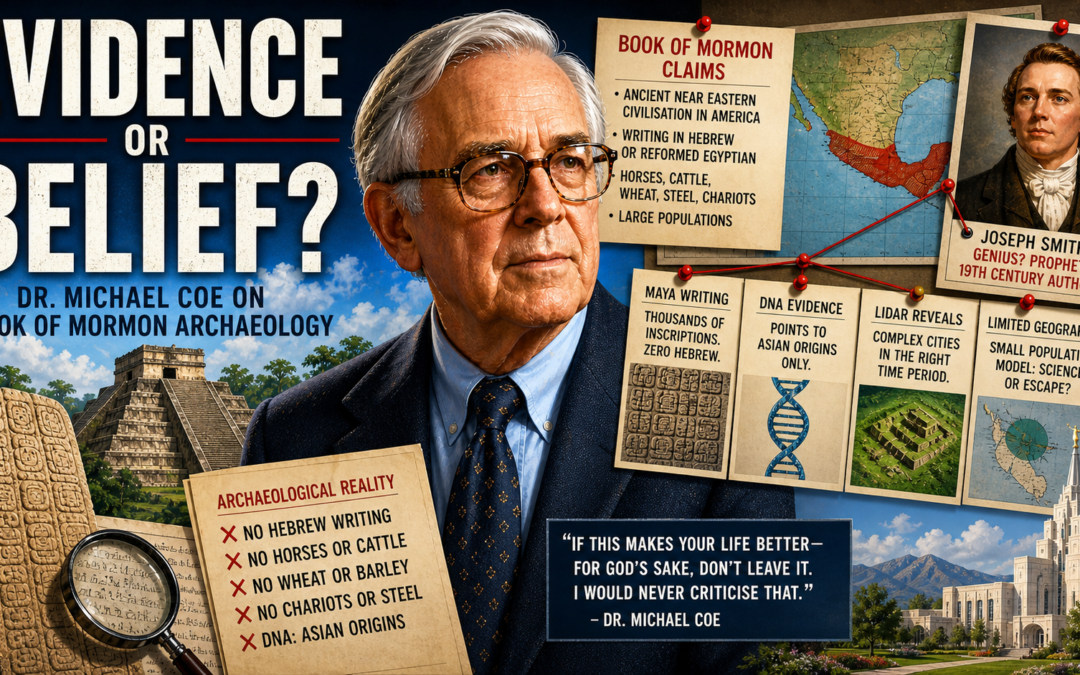
In April 2026, renewed interest in Book of Mormon archaeology has brought fresh attention to two landmark interviews with DDrMichael D. Coe, Yale’s leading Maya archaeologist.

Together, these interviews form one of the most sustained external scholarly critiques of Book of Mormon historicity. More importantly, they reveal where Coe is decisive, where LDS scholarship pushes back, and where the evidence remains genuinely contested.

Those two-part analyses examine every major claim with balance, clarity, and intellectual honesty.

In Memoriam — Dr Drchael D. Coe (1929–2019)

Dr Drhael Coe passed away in September 2019 at age 90. He was the Charles J. MacCurdy Professor Emeritus of Anthropology at Yale, curator emeritus of the Peabody Museum, and one of the preeminent Mayanists of the 20th century. His Breaking the Maya Code was nominated for a National Book Award. His book The Maya reached a ninth edition.

He reviewed Thomas Stewart Ferguson’s pro–Book of Mormon monograph and authored the 1973 Dialogue article on Book of Mormon archaeology. And he also maintained a professional relationship with John Sorenson, the pro-Book-of-Mormon author of the American Antiquity monograph.

Importantly, Coe was not anti-Mormon. He consistently expressed admiration for Joseph Smith’s achievement, maintained warm friendships with LDS scholars, and closed both interviews by advising believing members to stay in their faith if it made their lives better. This analysis honours him by engaging his arguments seriously.

About These Two Episodes

Part I (Ep. 2141 — originally 2011): The foundational three-part audio interview covering the full scope of Book of Mormon archaeological claims — animal anachronisms, metals, language, DNA, the Joseph Smith context, the Quetzalcoatl narrative, chiasmus, and personal advice to believing Mormons. Coe also discusses Mormon archaeologist Thomas Stewart Ferguson’s loss of faith and his own relationships with LDS scholars.

Part II (Ep. 2142 — originally 2018): A video follow-up at Coe’s Yale home. Focused on three areas: (1) what LiDAR technology has revealed about Mesoamerican civilisation and whether it corroborates Book of Mormon claims; (2) a direct response to the open letter FAIR Mormon and John Sorenson published after the 2011 interview; and (3) updated views on the limited geography model and DNA evidence.

How this analysis is structured: Every section is rated on a two-sided scale — where Coe is decisively right, where LDS scholarship has genuine responses, and where the question is genuinely contested. Labels from Part I and Part II are noted so readers can follow the source. Neither side gets a free pass. Tags indicate which interview each claim comes from: Part I, Part II, Both.

Where Coe Is Decisive, Both Interviews

Strongest Argument — From Both Interviews

Thousands of Maya inscriptions spanning 1,500 years contain zero Hebrew, Aramaic, or Egyptian — the writing is entirely Native American Maya.

Coe’s Most Decisive Point

“We can read almost everything — 95% of what follows the dates on these inscribed monuments. What language is this in? It’s in Maya. Not only Maya — there are 29 extant Maya languages… There are no Semitic words whatsoever in it. It has no relation whatsoever with any languages we know of in the Old World.”
—Dr. Michael Coe, Part I (2011), ~01:01:30

About that, this is Coe’s strongest argument—and it is difficult to dismiss.

Linguistic Evidence

The Maya writing system has been largely deciphered and is now well understood. It records the Ch’orti’ Maya language, which is still spoken today. Linguists worldwide have analyzed thousands of inscriptions—on monuments, ceramics, and codices—have been analyzed by linguists worldwide by linguistics.

Crucially, none contain Hebrew, Aramaic, Egyptian, or any Near Eastern linguistic influence.

The Olmec Case

In addition, the Olmec — sometimes proposed by some LDS scholars as the Jaredites — left behind the Cascajal Block, the only known Olmec inscription. Coe co-published this discovery. It is entirely Native American in character. In contrast, the Book of Mormon describes a literate Near Eastern civilisation maintaining records in a Near Eastern language for 1,000 years in the Americas. Researchers have never found any trace of that language tradition has ever been found anywhere across Mesoamerica.

Geographic Implications

In Part I, Coe noted this point with BYU linguist Robertson in mind: Robertson himself worked on Maya decipherment and could not produce Old World linguistic parallels. In Part II, Coe returned to this when responding to Sorenson’s open letter, noting that Sorenson’s reference to Brian Stubs finding Semitic influence in Uto-Aztecan languages is disputed and entirely outside Robertson’s Maya speciality.

Geographically, the Maya lowlands, where LDS scholars most often place the Book of Mormon — the Maya lowlands —have the most thoroughly documented language record, and it is wholly non-Semitic.

Assessment: Coe Has the Stronger Argument — By a Significant Margin

Fifteen centuries of deciphered, peer-reviewed Maya writing contains no Hebrew or Egyptian influence. No LDS scholar has produced peer-reviewed evidence of Near Eastern language in Mesoamerican inscriptions. This is the hardest single fact for Book of Mormon Mesoamerican historicity to account for.

Second Strongest — From Both Interviews

No pre-Columbian horses, cattle, chariots, steel weapons, wheat, barley, or silk have ever been found — and pollen studies conclusively rule out Old World grain.ns

Archaeological Consensus

“I can tell you that huge amounts of excavations all through the New World have been made over the last hundred years. Nobody has ever found a cowbone in a pre-Columbian site. Period. Not one pig bone has ever shown up. Horses disappeared by 7,000 BC. Chariots — zero.”
— Dr Michael Coe, Part I (2011), ~00:43:43–01:30:19

Archaeological Absence

The Book of Mormon mentions many animals, like horses, cattle, oxen, donkeys, goats, sheep, swine, and elephants. Also mentions instruments and supplies like chariots, steel swords, shields, wheat, barley, and silk as features of Nephite and Jaredite civilisation. Meanwhile, the archaeological record of Mesoamerica contains none of these in the relevant time periods.

Pollen Evidence

Even more decisively, pollen evidence is exceptionally strong. Wheat and barley, if grown, would have produced windblown pollen preserved in lake sediments. Palynologists (pollen scientists) have drilled lake beds across Mesoamerica for decades. Researchers have never found wheat or barley pollen in pre-Spanish sediments.

Rather than an absence of excavation, it is a direct scientific test that fails. Steel and iron, even if rusted, would leave chemical traces that modern methods can detect by modern methods. Archaeologists have found none in the relevant contexts. Gold and copper do not appear in Mesoamerica until roughly 700–800 AD, after the Book of Mormon narrative ends.

LDS Response: Loan-Shift Theory

Where LDS scholarship has a partial response: The “loan-shift” argument — that the English translation may use familiar words for unfamiliar animals (e.g. “horse” for tapir, “chariot” for litter) — has genuine linguistic precedent. The Aztecs called Spanish horses “deer that people ride.” FAIR LDS documents multiple historical examples of this phenomenon. And some LDS scholars note that BYU archaeologist John Clark has documented possible pre-Columbian horse remains in Yucatán caves, though the dates remain disputed.

However, Coe’s response was direct: you can’t twist language indefinitely. If “sword” means obsidian club, and “horse” means tapir, and “chariot” means carrying platform and “steel” means something else entirely, the text loses its predictive power. The cumulative weight of multiple simultaneous loan-shift explanations strains credibility even if each explanation is linguistically possible.

Assessment: Coe Stronger on the Core Facts — LDS Loan-Shift Argument Has Limited Linguistic Merit
Individual loan-shift explanations are linguistically defensible in principle. Requiring them simultaneously for horses, chariots, steel, wheat, barley, and silk is a different matter. Even more importantly, pollen evidence alone is a direct scientific test that fails, not merely an absence of excavation.

Third Strongest — Both Interviews

DNA evidence points exclusively to Central and East Asian origins — no pre-Columbian Native Americans show Near Eastern ancestry

Genomic Consensus

“The DNA all points to Central and East Asia, where these people came from, not to the Near East. Absolutely not.”
— Dr Michael Coe, Part II (2018), ~01:44:09

DNA Evidence

The scientific consensus on Native American origins is robust and has been strengthened since 2018 by ancient DNA studies. Pre-Columbian Native Americans — including skeletal remains from underwater Yucatán caves dated to well before the Book of Mormon period — descend from populations that crossed the Bering land bridge from Northeast Asia. No pre-Columbian DNA sample from anywhere in the Americas has shown Near Eastern, Middle Eastern, or Mediterranean ancestry.

Church Response

The Church’s own Gospel Topics Essay on DNA and the Book of Mormon acknowledges this directly and responds that Lehi’s group may have been too small to leave a detectable genetic signature. This uses legitimate population genetics — small immigrant groups can be absorbed into larger populations without leaving detectable traces. However, it requires the same “small population” reasoning used for linguistics, and creates the same tension with Book of Mormon population descriptions of armies numbering in the hundreds of thousands.

Assessment: Coe Correct — Church’s Own Essay Acknowledges the Problem
The genomic evidence for Asian (not Near Eastern) Native American origins is one of the most robust findings in modern science. The Church’s acknowledged response requires significant reinterpretation of how Joseph Smith and subsequent prophets identified Lamanites.

Where the Evidence Is Genuinely Contested, Both Interviews

Contested Claim 1

Chiasmus in the Book of Mormon — a 19th-century author familiar with the KJV Bible could easily have produced it.

Genuinely Contested

“The Book of Mormon is to me a recreation of the language of the Old Testament as in the King James Bible… you find the same kind of thing there. Poetry is found all around the world. It doesn’t prove the Book of Mormon.”
— Dr Michael Coe, Part I (2011), ~02:13:18

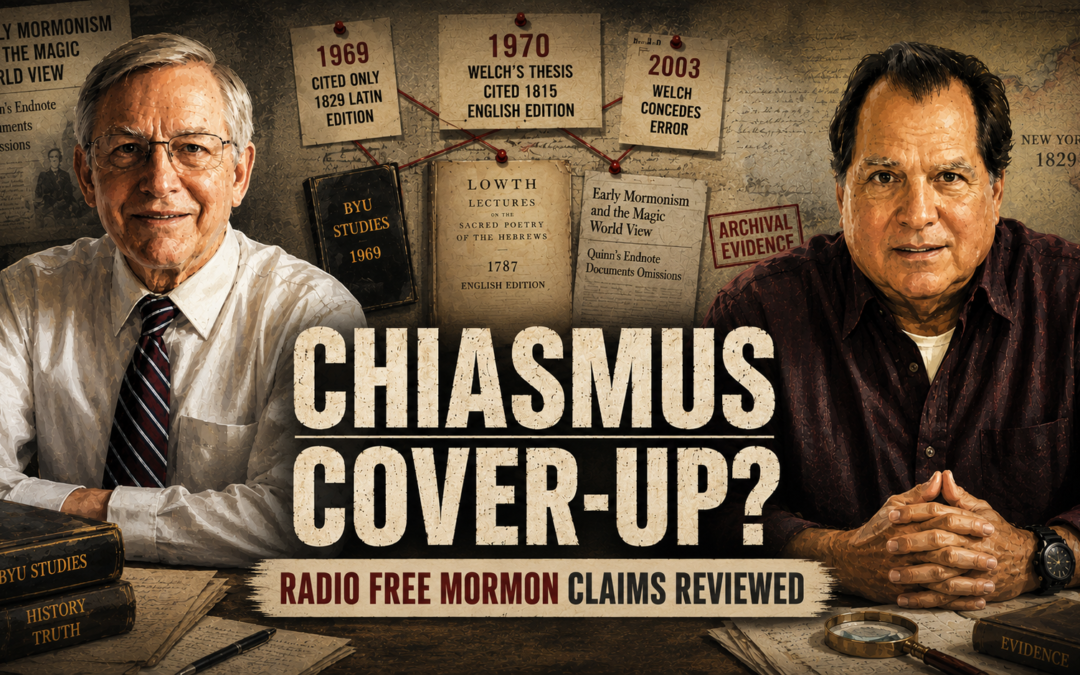
Chiasmus — a Hebrew literary structure in which a passage’s elements are repeated in reverse order — appears extensively throughout the Book of Mormon. LDS scholars, particularly John Welch, have documented complex chiastic structures that they argue are too sophisticated and numerous to have occurred by chance. Scholars first identified chiasmus in the Book of Mormon by Welch in 1967 — well after Joseph Smith’s death — suggesting he could not have deliberately inserted it as a forgery signal.

Coe acknowledged chiasmus exists in Mesoamerican literature (including the Popol Vuh) and throughout world poetry generally, and noted the King James Bible contains extensive parallel and chiastic structures that Joseph Smith knew intimately. He is right that chiasmus is not unique to the Book of Mormon. But the LDS argument is more specific: the Book of Mormon contains large-scale, multi-element chiastic structures that are characteristic of Hebrew composition but unlikely to arise spontaneously in 19th-century American writing.

Both sides have a point. The debate continues in peer-reviewed venues and has not been resolved.

Assessment: Genuinely Contested — Both Sides Have Legitimate Points

Chiasmus is neither a decisive proof of ancient authorship nor easily dismissed. It is one of the most interesting textual features of the Book of Mormon, and merits continued scholarly attention from both directions.

Contested Claim 2

LiDAR findings in Mesoamerica corroborate Book of Mormon descriptions of roads, fortifications, and large populations.

LDS Apologists Overreached — But Coe Understated What LiDAR Reveals

“I’m not thinking about the Book of Mormon [when reviewing LiDAR]. I’m thinking about my archaeology… LiDAR has not shown dense urbanisation like an Old World city. To call them cities is an exaggeration.”
—Dr. Michael Coe, Part II (2018), ~00:19:44

LDS blogger Kirk Magleby’s February 2018 article — which Dehlin read to Coe in detail — did overreach significantly. Claiming that LiDAR’s discovery of roads, fortifications, and settlement patterns constitutes specific proof of Book of Mormon historicity conflates generic civilisational features with specific textual predictions. Coe’s pushback on this was warranted.

Where Coe somewhat understated his case, LiDAR has genuinely revealed that Mesoamerican civilisation during the Book of Mormon time period was more complex and populous than previously understood. The El Mirador basin in Guatemala shows evidence of one of the largest pre-Columbian cities in the Americas, with a pyramid larger by volume than any Egyptian pyramid, dated to approximately 300 BC–150 AD — directly within Nephite narrative time periods. Coe himself had confirmed that morning (before the interview) that LiDAR had found previously unknown fortifications in northern Guatemala.

The honest framing: LiDAR found things consistent with large-scale civilisation during the right time period in the right geographic area. It did not find specifically Nephite culture — no inscriptions, no identifiable religious structures, no Old World cultural markers. Consistency is not confirmation.

Assessment: Both Sides Overstated — The Honest Answer Is “Consistent But Not Confirmatory”
LiDAR reveals a Mesoamerican world during Book of Mormon time periods that is more complex than previously understood — not proof, but not nothing. LDS apologists claimed proof they don’t have. Coe downplayed findings he acknowledged in private that same morning.

Contested Claim 3

The “limited geography / small population” model is not a scientific argument — it makes the Book of Mormon unfalsifiable.

Falsifiability Concern Valid — But Model Uses Real Science

“They must have been totally transparent because they do not affect anything else. Nobody’s ever seen them… you’re making up a new piece of mythology… If it’s so small, you need quantum physics to find these people.”
— Dr Michael Coe, Part II (2018), ~01:52:28

Coe’s falsifiability concern is real and important. Karl Popper’s principle — that scientific hypotheses must be capable of being disproved — is foundational to scientific reasoning. If a theory can explain any evidence (or absence of evidence) by making its target population infinitely small, it becomes scientifically untestable. Coe was right to identify this pattern in how some apologists respond to every challenge.

Where LDS scholarship has a genuine point: The small-population argument is not invented mythology — it is standard population genetics. Small immigrant groups do get genetically and linguistically absorbed into larger existing populations. The Viking settlement at L’Anse aux Meadows in Newfoundland — which Coe himself visited — lasted only a couple of years yet left detectable archaeological evidence precisely because it was eventually excavated after decades of targeted searching. Scholars developed the limited geography model from internal textual analysis, not invented to escape criticism.

The honest tension: the model does use legitimate science, but it requires abandoning Joseph Smith’s own and all subsequent prophets’ identification of Native Americans broadly as Lamanite descendants — a high theological cost that LDS scholars acknowledge.

Assessment: The Falsifiability Concern Is Legitimate — But “Mythology” Is Too Strong
Small-population population genetics is real science, not invented mythology. The falsifiability concern is genuine: a theory that explains all absent evidence by making the group invisible cannot be tested — and that is a real problem for scientific dialogue.

Where LDS Scholarship Has the Stronger Response Part I Primarily

LDS Stronger Response 1

Quetzalcoatl was the “great white god” — a record of Christ’s New World visit described in the Book of Mormon.

Coe Correct — But LDS Scholarship Has Moved Beyond This

“This whole idea of white people coming to the new world is basically made out of whole cloth — propaganda first set up by the Spaniards, then picked up by European racists.”
— Dr Michael Coe, Part I (2011), ~01:17:28

Coe is largely correct about the Quetzalcoatl narrative. The “great white god” identification was substantially constructed by Spanish conquistadors seeking to portray Cortez as a returning deity to ease the conquest, not by pre-Columbian peoples as a religious tradition. Researchers have fully deciphered the Temple of the Cross: it depicts King K’an B’alam’s dynastic succession, with no reference to Christ, Hebrew figures, or any Old World religious tradition.

Where this actually points LDS scholarship forward:

Modern LDS apologetics has substantially moved away from the Quetzalcoatl argument. The New World Archaeological Foundation — founded by Thomas Stewart Ferguson and supported by the Church — conducted serious scientific archaeology in Chiapas for decades and found no such evidence.

Contemporary LDS scholars at FAIR and the Interpreter Foundation rarely lead with Quetzalcoatl precisely because Coe’s type of critique has been internalised. The Church’s Gospel Topics Essays do not mention Quetzalcoatl. This is an argument where Coe won, and LDS scholarship has largely conceded the ground.

Assessment: Coe Correct — But the Best LDS Scholarship Has Moved Past This

The Quetzalcoatl-as-Christ argument has been largely abandoned by serious LDS scholars. Coe is right to dismiss it. This is a case where archaeological honesty has improved the quality of both secular and faithful scholarship.

LDS Stronger Response 2

There is nothing the Book of Mormon could have predicted that wouldn’t have been known to a well-read 19th-century American.

Incomplete — Book Contains Features Coe Did Not Engage

“If you really knew the Old Testament, all those things Book of Mormon apologists come up with — they’re all in the Old Testament, every single one of them… He had an incredible brain.”
—Dr. Michael Coe, Part I (2011), ~02:17:17

Coe’s 19th-century composition theory — that Joseph Smith synthesised the King James Bible, mound builder mythology, Ethan Smith’s View of the Hebrews, the racial theories of his day, and his own imagination — is historically well-grounded and serious. Much of the Book of Mormon’s structure does map onto identifiable 19th-century sources and concerns.

Where this argument is incomplete:

The Book of Mormon contains features that are genuinely difficult to explain by 19th-century composition alone. The Nahom/NHM discovery — three altars dated to the 7th–6th centuries BCE found by non-LDS German archaeologists in Yemen, corresponding to the location where Nephi says Ishmael was buried — was not known in 1830 and was not discoverable from any available map or text of the period.

The complex chiasmic structures discussed above were unknown to Western scholars until 1967. The Book of Mormon’s conspicuous absence of distinctively Mesoamerican features (chocolate, turkeys, jaguars, Maya writing) — which Coe himself raised — is also awkward for a 19th-century composition theory: why would someone imagining an elaborate ancient American civilisation leave out these things?

Coe did not engage Nahom in either interview. It is not a decisive proof, but it is a feature of the text that the 19th-century composition hypothesis handles poorly.

Assessment: LDS Scholarship Has Genuine Responses, Coe Did Not Engage

The Nahom discovery and complex chiasmus represent features of the Book of Mormon that the 19th-century composition hypothesis cannot easily explain. Coe’s argument is strong but not complete. Both sides have unexplained features.

What Coe Said That Most People Never Quote Both Interviews

Most Overlooked Statement — Part I

Coe on Joseph Smith: “I think he was one of the greatest men who ever lived… an incredible genius… I think at the end he truly believed it”

✓ Profound Nuance — Rarely Quoted

“I think Joseph Smith was not only one of the greatest Americans who ever lived, but I think he was one of the greatest men who ever lived… If it’s a work of fiction, nobody has ever done anything like this before. And I think it is fiction — but he really carried it through, and my respect for him is unbounded.”
—Dr. Michael Coe, Part I (2011), ~02:15:37 and PBS documentary

Those who deploy Coe’s arguments against the Book of Mormon rarely quote his extraordinary assessment of Joseph Smith himself. Coe consistently — in both interviews, in the PBS documentary, and in his 1973 Dialogue article — expressed deep admiration for Smith.

He compared him to shamans and prophets across history who begin with what may be performance, accumulate followers, and ultimately come to genuinely believe their own revelations. Coe said he believed Joseph Smith was “willing to sacrifice his life for it, which is the ultimate test.” He did not call Smith a con man or a liar; he called him a genius.

This nuance matters for how truth seekers receive Coe’s critique. He is not saying Joseph Smith was corrupt or malicious. He is saying the Book of Mormon is the product of one of the most remarkable minds in American history, working in a specific cultural moment, producing something extraordinary — whether or not it is what it claims to be. That is a more honest and more interesting argument than “it’s a fraud.”

A Point the Episode Does Not Dwell On

The world’s leading Maya archaeologist called Joseph Smith one of the greatest men who ever lived. That assessment deserves to be heard alongside his archaeological critique.

Most Overlooked Closing Statement — Both Interviews

Coe’s closing advice: “If this makes your life better — for God’s sake, don’t leave it. I would never criticise that.”

✓ Buried by Both Interviews — Essential Context

“If you believe that the Mormon religion gives you a set of values that you and your children and grandchildren can profit by — for God’s sake, don’t leave it… Don’t hang everything on the truthfulness or untruthfulness of that document, because in the long run you’ll be sorry.”
— Dr Michael Coe, Part II (2018), ~02:34:17

Both interviews — presented by Dehlin as potentially the most faith-challenging in Mormon Stories history — end with Coe giving essentially the same compassionate advice: the archaeological and historical questions about the Book of Mormon are separable from the question of whether LDS faith produces good human lives. He drew this distinction explicitly in Part I (“render unto Caesar what is Caesar’s”) and again in Part II.

His concern was never with the faith itself — it was with the anti-science epistemology of Mormon apologetics, and with the racist implications of the Lamanite narrative as historically transmitted. On the faith as a way of life, he was genuinely respectful. In Part I, he explicitly recommended that members could become “cultural Mormons” — embracing LDS values and community without requiring literal historical accuracy. He cited Darwin as someone who lost religious faith but lived a deeply moral life, suggesting the same is possible for Mormons.

Presenting Coe’s interviews as simple demolitions of LDS faith misrepresents his actual position.

Essential Context: Both Episodes Underemphasise

Dr. Coe explicitly and repeatedly advised believing Mormons not to leave their faith on account of his arguments. His critique was directed at specific epistemological errors in apologetics — not at LDS life, community, or moral values.

Frequently Asked Questions

Who was Dr Michael Coe, and why does his critique matter?

Dr Michael Douglas Coe (1929–2019) was the Charles J. MacCurdy Professor Emeritus of Anthropology at Yale University and one of the foremost Mayanists of the 20th century. His work on Maya writing decipherment, excavation of major Olmec sites, and popular books, including The Maya and Breaking the Maya Code,e shaped the field for generations. He was not anti-Mormon — he had LDS colleagues, expressed admiration for Joseph Smith, and ultimately advised believing Mormons to stay in their faith if it made their lives better.

His critique matters because he spent 65 years as a professional archaeologist in the exact geographic and cultural region where Book of Mormon events are most often proposed to have occurred. His objections are not ideological — they are the product of professional expertise.

Is there any Hebrew or Reformed Egyptian in Maya inscriptions?

No—there is no evidence of Hebrew or Reformed Egyptian in Maya inscriptions.

Scholars have largely deciphered the Maya writing system and recorded the Ch’orti Maya language. Thousands of inscriptions spanning over a millennium have been studied, and none show any connection to Near Eastern languages. And records the Ch’orti’ Maya language — wholly unrelated to Hebrew, Egyptian, or any Near Eastern tongue. Thousands of inscriptions spanning from approximately 100 BC to the Spanish conquest have been studied. None contains Near Eastern linguistic influence. BYU’s linguist confirmed the decipherment in part by BYU’s own linguist,t John Robertson, whom Coe specifically acknowledged. This is the strongest single archaeological argument against Book of Mormon historicity in a Mesoamerican setting.

Why are there no horses, cattle, or chariots in Book of Mormon archaeology?

American horses went extinct approximately 10,000 years ago — thousands of years before the Book of Mormon narrative begins. No pre-Columbian cattle, oxen, donkeys, goats, sheep, or Old World-style chariots have been found in Mesoamerican sites from the relevant time period. Pollen studies of lake sediments across Mesoamerica have found no wheat or barley pollen before the Spanish arrival — a direct scientific test of Old World grain cultivation that fails.

LDS scholars offer “loan-shift” explanations (e.g. “horse” may mean tapir) with some linguistic precedent. Coe found these unconvincing when applied simultaneously to multiple animals and technologies. The cumulative weight of the absent evidence remains the archaeological challenge.

Does chiasmus in the Book of Mormon prove it’s an ancient document?

Chiasmus — a Hebrew literary structure — appears extensively in the Book of Mormon and was first formally identified by scholars in 1967, well after Joseph Smith’s death. LDS scholars argue that the complex, multi-element chiastic structures are characteristic of Hebrew composition and unlikely to occur by chance. Coe acknowledged chiasmus exists in Mesoamerican literature and throughout world poetry, and noted the KJV Bible (which saturates the Book of Mormon’s language) contains extensive parallel structures.

Both sides have points. Chiasmus is neither a decisive proof of ancient authorship nor easily dismissed. It is one of the Book of Mormon’s most interesting textual features and deserves continued scholarly attention.

Was Quetzalcoatl the Jesus Christ of the Americas?

No. The “great white god” narrative around Quetzalcoatl was largely constructed by Spanish conquistadors seeking to portray Cortez as a returning deity to ease conquest, not by pre-Columbian peoples as an authentic religious tradition. The Temple of the Cross at Palenque has been fully deciphered by researchers. It depicts a Maya king’s dynastic succession with no reference to Christ or any Old World figure. Modern LDS apologetics has largely moved away from this argument, and the Church’s Gospel Topics Essays do not mention Quetzalcoatl. Coe is correct on this point, and serious LDS scholarship has substantially conceded it.

What is the Nahom evidence, and why didn’t Coe address it?

Nahom/NHM refers to three altar inscriptions containing the tribal name NHM discovered by non-LDS German archaeologists at the Bar’an Temple in Yemen, dated to the 7th–6th centuries BCE. The First Book of Nephi describes Ishmael being buried at “Nahom” at a location where the group then turned eastward, and the NHM altars correspond to a location matching this description. People did not know the name or location from any map or text available to Joseph Smith in 1830.

Coe did not address Nahom in either interview. Critics argue the name could have come from 18th-century maps; LDS scholars note the convergence of name, location, date, and directional turn is not easily explained by coincidence. It is one of the few Old World geographical evidences for the Book of Mormon that serious scholars on both sides continue to debate.

What did Dr Coe think Latter-day Saints should do about these problems?

Coe’s consistent advice across both interviews was compassionate: if LDS values and community make your life and your family’s life better, stay. He explicitly said he would “never criticise that.” His concern was specifically with anti-science epistemology — using anomalies to create unfalsifiable doubt rather than seeking truth, not with LDS faith or community.

He recommended members could embrace a “cultural Mormon” identity — finding real value in LDS moral teachings, community, and heritage without requiring literal historical accuracy. Also, He cited Darwin as someone who lost religious faith but lived a deeply moral life, suggesting the same path is open to Mormons. He called Joseph Smith one of the greatest men who ever lived.

The Honest Summary

Dr Michael D. Coe was the leading authority on the very civilisations where Book of Mormon events are often proposed to have occurred.

Because of that, his critique carries unusual weight.

on the civilisation where Book of Mormon events are most often proposed to have occurred. He was not hostile to Mormonism — he loved many LDS colleagues, admired Joseph Smith, and closed both landmark interviews by telling believers to stay in their faith if it served them. His arguments deserve exactly the engagement this analysis attempts: serious, sourced, and honest about where each side is stronger.

Where Coe is decisive:

The linguistic evidence is the hardest fact for Book of Mormon Mesoamerican historicity to answer. Fifteen centuries of deciphered Maya writing — confirmed in part by BYU’s own John Robertson — contains no Hebrew or Egyptian. The DNA evidence is genomic consensus, acknowledged by the Church’s own Gospel Topics Essay. The animal anachronisms, especially the pollen evidence ruling out Old World grains, represent direct scientific tests that fail.

Where the picture is more complex:

LiDAR reveals a Mesoamerican world during Book of Mormon time periods, more complex and populous than Coe’s casual dismissal in places implied. The loan-shift linguistic argument has genuine precedent. The limited geography model uses real population genetics.

Chiasmus and the Nahom discovery are features that the 19th-century composition hypothesis handles poorly. And the Book of Mormon’s conspicuous silence on distinctively Mesoamerican features — chocolate, turkeys, jaguars, Maya writing — is awkward for both a “Joseph made it up from what he knew” argument and a “it’s an ancient record” argument simultaneously.

Ultimately, intellectual honesty requires restraint from both sides.

LDS apologists should avoid overstating evidence such as LiDAR as proof. Critics, on the other hand, should acknowledge where LDS scholarship offers real responses.

Coe himself drew a clear boundary: archaeology and faith are separate questions. He answered the first with confidence. The second, he deliberately left open.

That distinction remains essential.

Content is for educational purposes. Sources are cited. Corrections are welcome.

The Truth about Book of Mormon Anachronisms Discussed with John Dehlin

The Truth about Book of Mormon Anachronisms Discussed with John Dehlin

April 2026

“The Biggest Book of Mormon Anachronism” — What’s Accurate, What’s Overstated, and What’s Missing

About This Episode

Dr. John Lundwall presents a sophisticated argument that the Book of Mormon’s highly literate, text-centered religious world is anachronistic for 600 BCE. At first glance, some of his observations carry real scholarly weight. However, several key claims are overstated. The argument selectively presents evidence and ignores crucial counterpoints. As a result, readers are not given the full picture.

This is the most academically sophisticated anti-Mormon argument in our rebuttal series to date. Dr. Lundwall is a credentialed scholar making arguments rooted in real scholarship on orality and literacy. Dismissing his argument is not the right approach. Engaging it honestly and completely means acknowledging what he gets right, correcting what he overstates, and supplying the evidence he omits.

The Core Argument

Lundwall’s central argument is straightforward: ancient societies primarily practiced religion through ritual, oral tradition, agriculture, and cosmology—not through written texts. In contrast, the Book of Mormon repeatedly emphasizes writing, record-keeping, and textual preservation.

According to Lundwall, this “literate worldview”—with over 140 references to records, sermons, and written commandments—reflects Protestant print culture in early 19th-century America, not 600 BCE Jerusalem or ancient Mesoamerica.

What Lundwall Gets Right

Conceded Point

Ancient religion was dominated by ritual, not text — and the Book of Mormon does have a heavily literate worldview

✓ Substantially True — and LDS Scholars Have Said So

Lundwall is correct that ancient Near Eastern religion — including Israelite religion — was primarily oral and ritual-based, not centered on individual scripture-reading. This is not a new critique; LDS scholars have discussed it for decades. The real question is what it means for the Book of Mormon — and the episode never honestly engages the LDS scholarly response.

Notably, the Interpreter Foundation — a peer-reviewed LDS scholarship journal — published a substantial analysis titled “Literacy and Orality in the Book of Mormon” that directly addresses this.

The study directly addresses this issue. It concludes that the text reflects a primarily oral culture with an elite literate class.

This matches what we expect in an ancient Near Eastern setting. Most people in the narrative do not read. Instead, a small priestly and royal class keeps records.

In addition, oral performance patterns appear throughout the text. These include chiasmus, repetition, and phrases like “and it came to pass.”

As a result, record-keeping remains concentrated in a small elite. This pattern aligns with known ancient scribal cultures.

This is exactly what we find in ancient Mesopotamia, Egypt, and Israel: writing was the preserve of an elite scribal class serving the temple and state. The Book of Mormon shows Nephi explicitly trained as a scribe before leaving Jerusalem — consistent with this model, not anachronistic to it.

Bottom Line
The orality of ancient religion is real. LDS scholars have acknowledged and studied this for decades. The existence of an elite literate class in the Book of Mormon is consistent with ancient patterns — not evidence of 19th-century projection. This conceded point should be heard carefully, but it does not settle the question.

The Claims — and the Full Picture

Claim 1 of 4

“There’s no way there’s a set of brass plates. Priests in Jerusalem in 600 BCE were doing rain dances — they were not compiling scriptures into books and bound plates”

⚠️ Misleading — Overstates the Archaeological Picture

“There’s no way there’s a set of brass plates. Those temple priests at that time, 600 BCE, are doing rain dances… They’re not compiling their scriptures into books.”
— Dr. John Lundwall, ~00:24:38

Why This Claim Matters

Lundwall argues that writing on metal plates and maintaining scriptural records would have been impossible in 600 BCE Jerusalem. If true, this would directly challenge the Book of Mormon’s historical plausibility.

What the Evidence Actually Shows

Literacy in 600 BCE Jerusalem

However, the archaeological record contradicts this claim.
Ancient Israelites were writing in meaningful ways at the time of Lehi’s departure. A Tel Aviv University study published in PNAS

shows widespread literacy in Judah around 600 BCE.
Researchers analyzed ink inscriptions from the Arad fortress and identified at least six authors.
This suggests a functioning educational system capable of producing complex texts.

In addition, the Lachish Letters—military correspondence from around 590 BCE—show routine written communication.
Likewise, the Ketef Hinnom silver scrolls contain the oldest known biblical text.

Writing on Metal Plates

FAIR LDS documents many examples of ancient writing on metal plates across the Mediterranean and Near East. These include the Pyrgi gold tablets, the Darius gold plates, and the Etruscan gold book.
Archaeologists have also found many copper and bronze inscriptions.

In addition, William Hamblin’s peer-reviewed study explores this evidence in detail. Therefore, the claim that brass plates could not exist is not just debatable—it conflicts with known findings.

To be fair, Lundwall raises a valid point. Many examples are ritual, not historical. However, “they don’t exist” and “this exact type doesn’t exist” are different claims. The episode blurs that distinction.

Claim 2 of 4

Monotheism is impossible in the Book of Mormon’s time — ancient peoples were all polytheistic, and you need literacy to develop monotheism

⚖️ Partially True — But the Israelite Case Is More Complex

“The Book of Mormon, everyone’s monotheistic… In the Book of Mormon we should be finding monotheistic iconography in the architecture and archaeology of Meso America or North America. And everywhere we go, we find polytheism.”
— Dr. John Lundwall, ~01:10:56

Lundwall’s Argument About Monotheism

However, Lundwall argues that monotheism requires literacy.
He claims that reducing many gods into one demands abstract thinking shaped by literacy. This is an interesting theoretical framework, but it has a serious problem when applied to the Israelites specifically: it doesn’t fit what we know about Israelite religion.

Historical Context: Israelite Religion in Transition

Lundwall himself acknowledges that early Israelites were “not monotheistic” — they worshipped multiple gods including Asherah. This is true; the Hebrew Bible itself records this. However, prophets like Lehi, Jeremiah, and Isaiah challenged that culture.
They taught explicit monotheism against dominant polytheism.
This tension defines the Deuteronomistic reform period (~630–600 BCE). The narrative framework of the Book of Mormon places Lehi in exactly this prophetic reform context. He is a dissenter from mainstream Israelite polytheism, aligning himself with the prophetic tradition that called Israel back to exclusive Yahweh worship. His departure from Jerusalem just before the Babylonian exile places him squarely within the historical moment when this tension was at its peak.

At the same time, the archaeological evidence Lundwall cites for polytheism in Meso-America is a separate question — the absence of monotheistic archaeology in the Americas is a genuine challenge for Book of Mormon geography models. But his claim that monotheism was simply impossible in 600 BCE Israel is not accurate; prophetic monotheism existed as a minority position alongside widespread popular polytheism, and the Book of Mormon’s narrative is built around exactly that tension.

Bottom Line
Prophetic monotheism existed in Israel in 600 BCE — it was a minority reform movement against popular polytheism, and that is precisely the context from which Lehi comes. The absence of monotheistic archaeology in the Americas is a real challenge for LDS geography models. But Lundwall’s broader claim — that monotheism was impossible in Lehi’s time — misreads the specific historical moment the Book of Mormon is set in.

Claim 3 of 4

“The only archaeological evidence we can find for the Book of Mormon is in the Old World” — and Nahom is not credible evidence

⚠️ Misleading — Dismisses Nahom Without Engaging the Actual Evidence

“The only archaeological evidence we can find for the Book of Mormon is in the Old World amongst the people who are trying to hide. And yet in the new world where there’s millions of people, we can’t find a single thing.”
— John Dehlin, ~02:07:54

What the Nahom Evidence Is

Dehlin makes this comment, not Lundwall — and the episode leaves it unchallenged and uncorrected, so it stands as an implicit claim of the episode. This claim matters because it mischaracterizes the Nahom evidence.

The Nahom discovery does not support the idea that ‘Old World people were trying to hide.”

Archaeologists discovered three altar inscriptions with the name NHM.
A German team—not LDS researchers—found them at the Bar’an Temple in Yemen.
They date to the 7th–6th centuries BCE.

This location matches where the Book of Mormon places Ishmael’s burial.
It also aligns with the point where Lehi’s group turns east.

 These altars were found by independent, non-LDS archaeologists and predate Joseph Smith by 2,400 years. Multiple peer-reviewed LDS studies document the convergence of name, location, date, and direction.

Why the Dismissal Falls Short

However, critics argue that Joseph Smith could have found “Nehhm” on 18th-century maps.
They also suggest the name match may be coincidental. These are legitimate points that researchers continue to debate. But dismissing Nahom as if it has no evidentiary value, or treating it as an embarrassing last resort, misrepresents the actual state of the scholarship. Terryl Givens described the NHM altars as “the first actual archaeological evidence for the historicity of the Book of Mormon” — not because it proves everything, but because the convergence of independent factors is not easily explained by coincidence.

Bottom Line
Nahom/NHM represents genuine, non-trivial archaeological evidence discovered by non-LDS researchers that corresponds to a specific Book of Mormon claim about a specific place, time, and directional turn. Whether it proves the Book of Mormon is a different question — but dismissing it as if it doesn’t exist or has no weight is not intellectually honest.

Claim 4 of 4

The dominoes argument: “If there are no gold plates, there’s no John the Baptist, no Aaronic priesthood, no temple endowment — it all falls”

🔷 Theological Claim — Asserted, Not Demonstrated

“If there’s no Moroni, there’s no John the Baptist. And therefore, there’s no restoration of the Aaronic priesthood. There’s no Peter, James, and John… All the dominoes fall. It all goes back to a literal historical tight translation.”
— John Dehlin, ~00:45:37

Dehlin presents this “dominoes” argument as obvious.
However, it assumes something deeper.
It assumes LDS faith depends entirely on a strict, literal translation model.
It also assumes no other framework exists.

Alternative Faith Models Within LDS Thought

The LDS Church’s Gospel Topics Essay on Book of Mormon Translation explicitly acknowledges that Joseph Smith used a seer stone placed in a hat and that he did not always look at the plates during translation — a disclosure that itself undermines a simple tight-translation model. Many faithful LDS scholars, including those published in the Interpreter Foundation, BYU Studies, and Dialogue, hold nuanced views of the translation process that allow for Joseph’s language, culture, and cognition to have participated in the text.

The “domino” logic also presupposes that the historicity of the Book of Mormon is the only basis for LDS truth claims. But the Church’s theology is grounded in multiple independent lines: the First Vision, the Restoration of priesthood authority, continuing revelation, living prophets, and the personal spiritual witness available to any sincere seeker. Lundwall and Dehlin are entitled to argue that the book’s historicity is foundational. But presenting this as so obvious that it doesn’t require argument — while millions of faithful members hold a more textured view — is not honest intellectual engagement.

Bottom Line
Whether Book of Mormon historicity is the single load-bearing pillar of LDS faith is a theological claim, not an established fact. The Church itself has acknowledged complexity in the translation process. Many faithful scholars and members hold views that don’t reduce to “tight translation or nothing.” The domino argument is rhetorically powerful but intellectually lazy — it presents one particular framing of LDS faith as the only possible framing.

The Honest Summary

Dr. John Lundwall presents a serious and intellectually sophisticated challenge to the Book of Mormon. His emphasis on the oral nature of ancient religion is well-supported, and his observations about literacy deserve careful consideration.

However, when we examine the full body of evidence, a more complex picture emerges.

Here’s what the episode leaves out.
Jerusalem in 600 BCE had documented literacy. It was not limited to temple elites.
Writing on metal plates appears across the ancient world.

In addition, the Nahom/NHM discovery provides real archaeological data.
Non-LDS researchers discovered it.

At the same time, prophetic monotheism already existed in Israel.
It functioned as a minority reform movement.

Finally, the idea that Book of Mormon historicity supports all LDS truth claims is a framework—not a proven fact.

Serious questions about the Book of Mormon deserve serious engagement on both sides. This episode provides one side with sophistication and the other side with nothing. Truth seekers deserve better than that.

The Book of Mormon promotes genocide and religious violence – Alyssa Grenfell Misleads

The Book of Mormon promotes genocide and religious violence – Alyssa Grenfell Misleads

Bottom Line

The Book of Mormon records violence. But it doesn’t justify it. It mourns it. Its final prophet, Moroni, is a lone survivor — not a victor. Genocide isn’t glorified — it’s grieved. The message is clear: spiritual pride destroys civilizations. That warning still applies.

Podcast YouTube Alyssa Grenfall
Episode “Evidence the Book of Mormon Is False”
Title “The Book of Mormon promotes genocide and religious violence”
Category Ethical Objections & Narrative Themes
Quote “This is a book that glorifies genocide, warfare, and religiously justified killing. What kind of God commands you to slaughter entire civilizations?” — 01:39:12
Core Claim The Book of Mormon is violent and morally repugnant — portraying God as sanctioning the slaughter of nonbelievers and glorifying military conquest.
Claim Type Partial Truth / Stripped of Context
Logical Questions
  • Does the Book of Mormon glorify violence or use it to teach moral principles?
  • Are the wars described justified, lamented, or condemned?
  • How does the narrative treat the humanity of the “enemies”?

🔍 Core Finding

Yes, the Book of Mormon contains warfare and destruction — but it never glorifies genocide. It portrays war as a tragic consequence of pride, rebellion, and moral decay. The final chapters are filled with mourning, not celebration.

“O ye fair ones, how could ye have departed from the ways of the Lord!”
Mormon 6:17

🛡️ Wars Are Defensive, Not Aggressive

Captain Moroni is the model general — not a conqueror. He fights to preserve liberty and refuses to pursue bloodthirsty campaigns. The Anti-Nephi-Lehies lay down their weapons and refuse to fight. Mormon himself condemns the Nephites when they seek vengeance.

“I was forbidden to preach unto them… the Lord had withdrawn His Spirit.”
Mormon 3:14–16

📖 Lamanites: Not Villains — Covenant People

  • Samuel the Lamanite is a prophet.
  • Multiple chapters promise the redemption of the Lamanites (2 Nephi 30:6, 3 Nephi 21).
  • They are repeatedly described as beloved children of God — not enemies to be exterminated.

📚 Ancient Scripture Includes Violent History

The Bible contains divine judgments, battles, and destruction. The Book of Mormon mirrors that literary and theological tradition — using war to teach moral decay and prophetic justice, not to celebrate violence.

📚 Sources

“The Book of Mormon plagiarizes the King James Bible” Wrong Framing by Alyssa Grenfell

“The Book of Mormon plagiarizes the King James Bible” Wrong Framing by Alyssa Grenfell

Bottom Line

The Book of Mormon’s use of the King James Bible is open, intentional, and theologically consistent. It claims to be another witness of Christ — not a standalone scripture. If God spoke to Nephi and Isaiah, it makes sense their revelations would sound the same. That’s not plagiarism. That’s the pattern of scripture.

Podcast YouTube Alyssa Grenfell
Episode “Evidence the Book of Mormon Is False”
Title “The Book of Mormon plagiarizes the King James Bible”
Category Translation & Textual Origin
Quote “Mosiah 14 is just a word-for-word copy of Isaiah 53. Third Nephi 13 copies Matthew 6 almost word for word. This is clearly plagiarism.” — 01:51:06
Core Claim The Book of Mormon is a fraud because it contains long passages copied directly from the King James Version of the Bible.
Conclusion True (KJV Used) / Misrepresented Intent
Logical Questions
  • Does quoting the KJV Bible mean the Book of Mormon is fraudulent?
  • What does the Book of Mormon claim about receiving the same revelations in different nations?
  • How do Latter-day Saint scholars explain the use of KJV language?

🔍 Core Findings

Yes, the Book of Mormon includes extended quotations from the KJV Bible. Isaiah, Malachi, and Matthew are prominent examples. But the text explicitly says that God gives the same revelations to different nations — and these teachings are included intentionally, not deceptively.

“God speaketh the same words unto all nations.”
2 Nephi 29:8

The Book of Mormon even tells readers why Isaiah is quoted so extensively:

“I did liken all scriptures unto us, that it might be for our profit and learning.”
1 Nephi 19:23

🧠 Why the KJV Language?

Joseph Smith and his audience knew and revered the King James Bible. Using that language made the text spiritually familiar. Scholars like Royal Skousen argue that the translation came through revelation but used Joseph’s biblical register to express sacred ideas.

“Translation is not about word-for-word equivalence, but about expressing sacred meaning in the hearer’s language.”
— Royal Skousen, The Earliest Text

📝 What About Italicized Words and KJV Errors?

Yes, even KJV artifacts like italicized words show up. But that may reflect the Lord using the language Joseph knew best to transmit ideas. This matches how revelation often comes in the language and capacity of the receiver (see D&C 1:24).

🔄 Are Repeated Scriptures Always Plagiarism?

The Bible quotes itself repeatedly. Christ quotes Isaiah. Paul quotes Psalms. The New Testament repeats Old Testament prophecies word-for-word. Using earlier scripture doesn’t imply deception — it shows continuity of God’s voice.

📚 Sources

  • Book of Mormon: Mosiah 14 (Isaiah 53), 3 Nephi 13 (Matthew 6), 2 Nephi 29:8, 1 Nephi 19:23
  • Royal Skousen, The Book of Mormon: The Earliest Text, Yale University Press (2009)
  • Grant Hardy, Understanding the Book of Mormon, Oxford University Press (2010)
  • John W. Welch, “Why Does the Book of Mormon Quote the KJV?”, Ensign, Sept. 1977
  • Mormoner.org – Bible Quotations in the Book of Mormon
“Reformed Egyptian is a made-up language!?” False Claim by Alyssa Grenfell

“Reformed Egyptian is a made-up language!?” False Claim by Alyssa Grenfell

Bottom Line

No, “Reformed Egyptian” isn’t listed in modern language textbooks. But it was never supposed to be. It was described as a sacred, evolving script unique to a small religious elite. Its absence in today’s linguistic record doesn’t disprove it — it aligns with exactly what the Book of Mormon claimed.

Podcast YouTube Alyssa Grenfell
Episode “Evidence the Book of Mormon Is False”
Title “Reformed Egyptian is a made-up language”
Category Linguistics & Translation
Quote “He said the Book of Mormon was written in Reformed Egyptian, and that’s a made-up language.” — 00:03:23
Core Claim The Book of Mormon claims to be written in “Reformed Egyptian,” which critics argue is not a real language and was invented by Joseph Smith.
Conclusion Claim is Partial Truth / Misleading Framing
Logical Questions
  • Is “Reformed Egyptian” a known historical language?
  • Does its absence from modern linguistics mean it was invented?
  • What did the Book of Mormon actually claim about it?

🔍 Core Finding

The Book of Mormon never claims “Reformed Egyptian” was a widespread, institutionalized language. Instead, it explicitly states that this script was modified over time by the Nephite record keepers and may not have been readable by other cultures. That’s not the same as “made up.”

“We have written this record in the characters which are called among us the reformed Egyptian… but the Lord knoweth the things which we have written.”
Mormon 9:32

📚 Ancient Parallels

Many small ancient cultures used hybrid or localized scripts for record keeping and ritual purposes:

  • Demotic evolved from Egyptian hieratic, which itself evolved from hieroglyphics.
  • Ugaritic cuneiform was unknown until the 20th century.
  • Minoan Linear A remains undeciphered despite decades of research.

“The concept of a modified Egyptian script adapted by a specific population is entirely consistent with ancient scribal practices.”
— John Gee, Egyptologist, Interpreter, 2014

🧠 A Misleading Standard

Critics demand that “Reformed Egyptian” show up in modern archaeology. But the Book of Mormon itself says no other people knew the language:

“…none other people know our language.” — Mormon 9:34

Expecting modern corroboration of a script the book claims was lost is circular reasoning. Ancient languages are often rediscovered centuries later — or never at all.

🪪 What Did Joseph Smith Mean?

There is no record of Joseph Smith claiming that “Reformed Egyptian” was recognized by scholars. He never promoted it outside the Book of Mormon text. He admitted he could not read the characters and translated by the gift of God.

📚 Sources

  • Book of Mormon, Mormon 9:32–34; 1 Nephi 1:2
  • John Gee, “The ‘Breathing Permit of Hôr’ among the Joseph Smith Papyri,” Interpreter, Vol. 1, 2012
  • Royal Skousen, The Book of Mormon: The Earliest Text (Yale, 2009)
  • Paul Hoskisson, “Reformed Egyptian,” Book of Mormon Reference Companion, 2003
  • Mormoner.org – Reformed Egyptian Overview
Zero Archaeological Book of Mormon Evidence? – Fact Checking Alyssa Grenfell

Zero Archaeological Book of Mormon Evidence? – Fact Checking Alyssa Grenfell

Bottom Line

There is no smoking-gun “Zarahemla tablet,” but the claim that there is “literally nothing” is false. Nahom alone defies that claim. Mesoamerican evidence aligns with dozens of textual features. The real question is not “is there nothing?” but “are we willing to evaluate the data fairly?”

Episode “Evidence the Book of Mormon Is False”
Title “There is zero archaeological evidence for the Book of Mormon”
Category Archaeology & Historicity
Quote “There’s never, ever been a single piece of archaeological evidence to support the Book of Mormon. Literally nothing.” — 00:19:41
Timestamp 00:19:41
Core Claim The Book of Mormon has zero supporting archaeological evidence; no cities, places, names, or artifacts have ever been discovered.
Conclusion False / Overstated
Logical Questions
  • Is it true that no archaeological evidence supports the Book of Mormon?
  • Are there locations or findings that match descriptions in the Book of Mormon?
  • Does lack of mainstream consensus mean there is “literally nothing”?

🔍 Core Findings

The claim that there is “literally nothing” to support the Book of Mormon archaeologically is inaccurate and misleading. It ignores significant findings in both the Old and New Worlds that align with Book of Mormon descriptions.

🧭 Key Evidence from the Old World: Nahom

1 Nephi 16:34 references “Nahom,” where Ishmael was buried. In 1994, archaeologists discovered ancient altars in Yemen inscribed with the tribal name “NHM” — matching both name and location. These date to the correct time period for Lehi’s journey and confirm a key waypoint on the route.

“This is the first direct archaeological correlation with a specific location mentioned in the Book of Mormon.”
— S. Kent Brown, BYU Studies, 2002

🗺️ Mesoamerican Correlations

Dozens of cultural and geographic details in the Book of Mormon — including cities, roads, markets, warfare, and natural disasters — align with Mesoamerican civilizations. No definitive site has been found, but the limited geography model shows high consistency with the text.

“The Book of Mormon’s setting—based on city sizes, travel distances, topography, and climate—best fits a limited geography in Mesoamerica.”
— John L. Sorenson, An Ancient American Setting

🔎 Why No Confirming Names?

The absence of direct inscriptions (e.g., “Zarahemla was here”) is expected:

  • Ancient cities were renamed or destroyed.
  • Records were hidden, destroyed (Mormon 6–8), or looted.
  • Archaeology rarely preserves tribal or scriptural names unless carved in stone.

📚 Sources

  • S. Kent Brown, “Nahom and the ‘Eastward’ Turn,” BYU Studies 42.2 (2003)
  • Warren P. Aston, Lehi and Sariah in Arabia (2015)
  • John L. Sorenson, An Ancient American Setting for the Book of Mormon (1985)
  • Mark A. Wright, “Heartland as Hinterland,” Interpreter Vol. 13 (2015)
  • Mormoner.org – Nahom Archaeology