
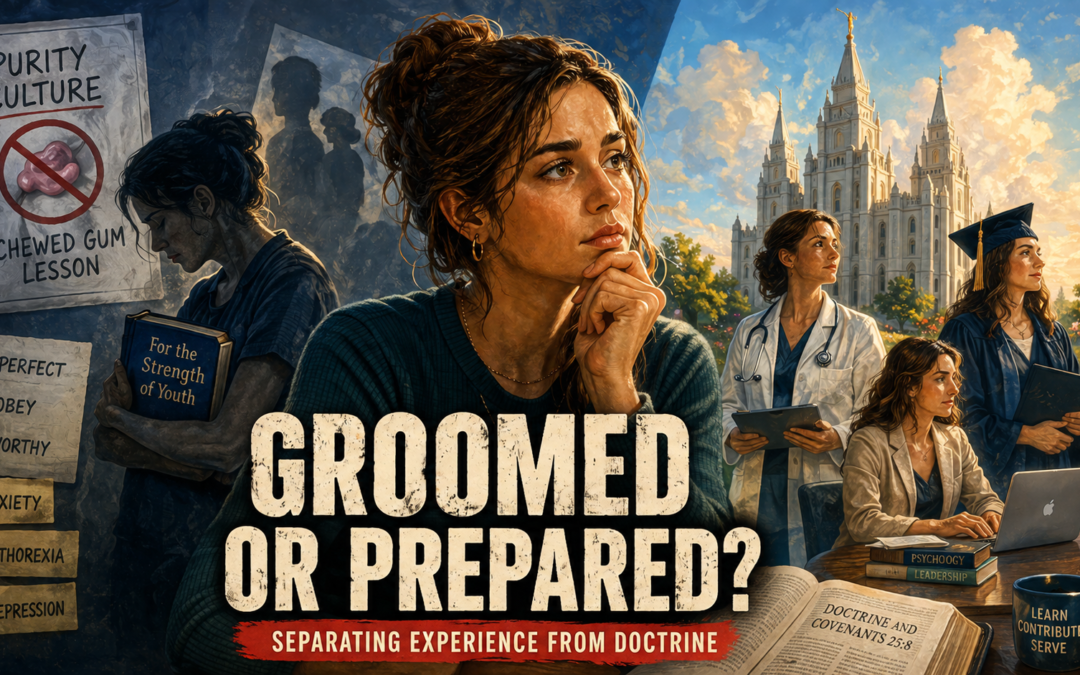
Was Chelsey “Groomed” for Motherhood — or Prepared for It?
About This Episode
John Dehlin, host of Mormon Stories, interviews Chelsey Rencher Liaga in a compelling and emotional episode centered on LDS motherhood pressure and women’s identity in the Church. Chelsey argues that the Church’s emphasis on motherhood robbed her of identity, freedom, and choice. Her experience is clearly real and deserves compassion.
Chelsey, a licensed therapist in Arizona, shares her story of growing up devoutly LDS in Gilbert before leaving the Church. She discusses perfectionism, orthorexia, purity culture, a post-mission depressive episode, and her gradual faith deconstruction. Because much of her story is sincere and relatable, it becomes even more important to separate personal experience from broader institutional claims.
The Central Argument
This episode builds the case that LDS motherhood pressure systematically “grooms” women for motherhood. It argues that this pressure strips women of autonomy, damages identity, and creates measurable psychological harm. Furthermore, it frames these outcomes as direct products of Church doctrine.
The episode points to the Family Proclamation, purity culture, and the expectation to become a stay-at-home mother as evidence of a harmful system. As a result, viewers may leave believing these are universal realities within the Church rather than experiences shaped by culture, geography, and local leadership.
A Familiar Pattern
This follows a familiar pattern often seen in Mormon Stories episodes. A real and painful personal story is shared, validated throughout the interview, and then expanded into a larger claim about the Church as a whole. Chelsey’s struggles are real, but the broader framing deserves scrutiny.
Chelsey’s professional clients are people who often feel harmed by religion. Her close circle includes many former members of the Church. Therefore, her perspective may naturally focus on negative outcomes. The episode never interviews women who experienced the same teachings positively, making the piece feel more like advocacy than balanced journalism.
The Claims — and the Full Picture
Claim 1: The Church Teaches Women Their Only Value Is Motherhood
“No one ever asked me, ‘Do you want to be a mom?’ It was never a question… Everything was always framed around, well, it has to be flexible cuz you’re going to be a mom.”
— Chelsey Rencher Liaga (~00:15:12)
Chelsey’s experience of feeling pressure toward motherhood is genuine. For many viewers, this reflects what they describe as LDS motherhood pressure in certain communities. Many women in heavily LDS communities report similar cultural expectations, especially in areas like Gilbert, Arizona. However, the episode repeatedly presents this as official Church doctrine rather than local culture.
What the Church Actually Teaches
The Church has consistently encouraged women to pursue education and personal development. Leaders often cite Doctrine and Covenants 25:8 as support for lifelong learning and contribution. The BYU Religious Studies Center documents LDS women serving as physicians, lawyers, professors, homemakers, teachers, artists, and business leaders.
The Church does not teach that women cannot work outside the home. In fact, many faithful LDS women build successful careers while remaining active and respected in their communities. Therefore, the claim that women only have value as mothers does not reflect official doctrine.
Where the Tension Is Real
At the same time, earlier Church leaders sometimes strongly encouraged mothers to stay home. Ezra Taft Benson frequently emphasized this role, and that legacy still shapes some ward cultures today. The Family Proclamation teaches that mothers are “primarily responsible” for nurturing children, which carries real social and emotional weight.
That tension deserves honest acknowledgment. However, the episode presents the most restrictive cultural version of this teaching as if it were universal doctrine. Chelsey’s experience is real, but it is not the whole picture.
Bottom Line
The pressure Chelsey felt is real and documented in many LDS communities. However, the episode conflates culture with doctrine. The Church teaches that motherhood is sacred and important, but it does not teach that women have no value outside of it.
Claim 2 of 4
Claim 2: Purity Culture Damages Women
“The chewed up gum virtue lesson. You can’t un-chew gum…”
— Chelsey Rencher Liaga (~00:26:57)
This is one of the strongest and most honest criticisms in the episode. Lessons like the “chewed gum” analogy have caused real psychological harm to many young women. Faithful LDS members have criticized these teachings for decades because they often create shame rather than teach healthy doctrine.
What the Church Actually Teaches
The Church’s doctrine of chastity centers on covenants, dignity, and the sacred nature of intimacy. It does not teach that a woman’s worth depends on her sexual history. Lessons like the “gum” analogy were never part of official Church curriculum.
Instead, local youth leaders often improvised these object lessons. Therefore, these examples reflect poor teaching methods rather than official doctrine.
A Legitimate Concern
Even so, chastity teaching has often created more social shame for women than for men. Researchers and members have both documented this imbalance. As a result, many women experienced these lessons as deeply harmful.
The Church has taken steps to correct this. Newer versions of For the Strength of Youth and updated curriculum materials emphasize agency, personal revelation, and covenant-based teaching instead of shame.
Bottom Line
Shame-based chastity lessons caused real harm and deserve criticism. However, they were never official doctrine, and the Church has actively moved away from them.
Claim 3 of 4
Claim 3: Mormonism Caused Her Perfectionism, Orthorexia, and Depression
“A mission is the perfect storm…”
— Chelsey Rencher Liaga (~01:00:04)
Chelsey’s struggles with perfectionism, orthorexia, and depression are real. She discusses them with honesty and insight. However, the episode repeatedly frames these issues as direct products of Mormonism.
Other Contributing Factors
Chelsey herself names several non-religious factors. She describes growing up around family diet culture and constant conversations about weight loss. She also identifies herself as a natural perfectionist and a “glass child” in a family with more demanding siblings.
American culture also places intense pressure on women’s bodies and appearance. Therefore, many of these pressures existed outside religion and likely shaped her regardless of faith.
What the Episode Leaves Out
The Church actively teaches mental health awareness and offers resources. Chelsey’s own story illustrates this. Her mission president’s wife first recognized signs of orthorexia and connected her to LDS Family Services.
That support came from within the Church structure. It did not come despite it. Furthermore, many studies show religious participation often improves mental health outcomes through support networks and meaning-making.
Bottom Line
Chelsey’s struggles were real, and mission life may have intensified them. However, the episode presents correlation as causation. The truth is more complex.
Claim 4 of 4
Claim 4: The Church’s Treatment of LGBTQ Members Is Indefensible
“If God is designing people to be born gay…”
— Chelsey Rencher Liaga (~01:09:53)
This is the most serious and emotionally weighty question in the episode. It deserves honest engagement rather than dismissal. Many faithful members have wrestled deeply with this same issue.
What the Church Teaches
The Church teaches that same-sex attraction itself is not sinful. It also teaches that God loves all His children equally. The law of chastity applies to all members and reserves sexual relations for marriage between a man and a woman.
Church leaders also teach that faithful members will receive every promised blessing in God’s timing. Therefore, the Church frames this issue within eternal theology rather than present-day fairness alone.
Where the Tension Is Real
Chelsey references the 2015 November Policy, which restricted ordinances for children of same-sex couples. That policy caused pain and confusion for many members. In 2019, Church leaders reversed it.
That reversal matters because it shows policy can change. However, the episode does not acknowledge this development. It focuses only on the pain without discussing the reconsideration.
Bottom Line
This is the most legitimate tension in the episode. The Church’s doctrinal position is sincere, not simple cruelty. However, the emotional and theological difficulty remains unresolved for many members.
The Honest Summary
Chelsey Rencher Liaga appears thoughtful, caring, and sincere. Her experience growing up in Gilbert, Arizona is real, and many of the pressures she describes exist in certain LDS communities. These include LDS motherhood pressure, shame-based chastity teaching, and the emotional intensity of mission life.
However, this episode fails to distinguish between culture and doctrine. It treats one woman’s painful experience as representative of a global institution serving millions. It attributes every negative outcome to the Church while ignoring positive experiences and internal reforms.
Truth seekers deserve both sides. The Church teaches motherhood is sacred, but it also values education and agency. Harmful local teachings have existed, but the Church has worked to move away from them. Serious LGBTQ tensions remain, but policies have changed and difficult questions continue to be discussed.
Ultimately, the debate over LDS motherhood pressure depends on whether those expectations come from doctrine, culture, or both.Chelsey’s story matters and deserves to be heard. It is not the full picture.