by Anonymous | Jul 6, 2026 | Book of Mormon, Doctrine, Joseph Smith
The Weight of Evidence: A Persuasive Case That the Evidence for the Restoration Substantially Outweighs the Evidence Against It
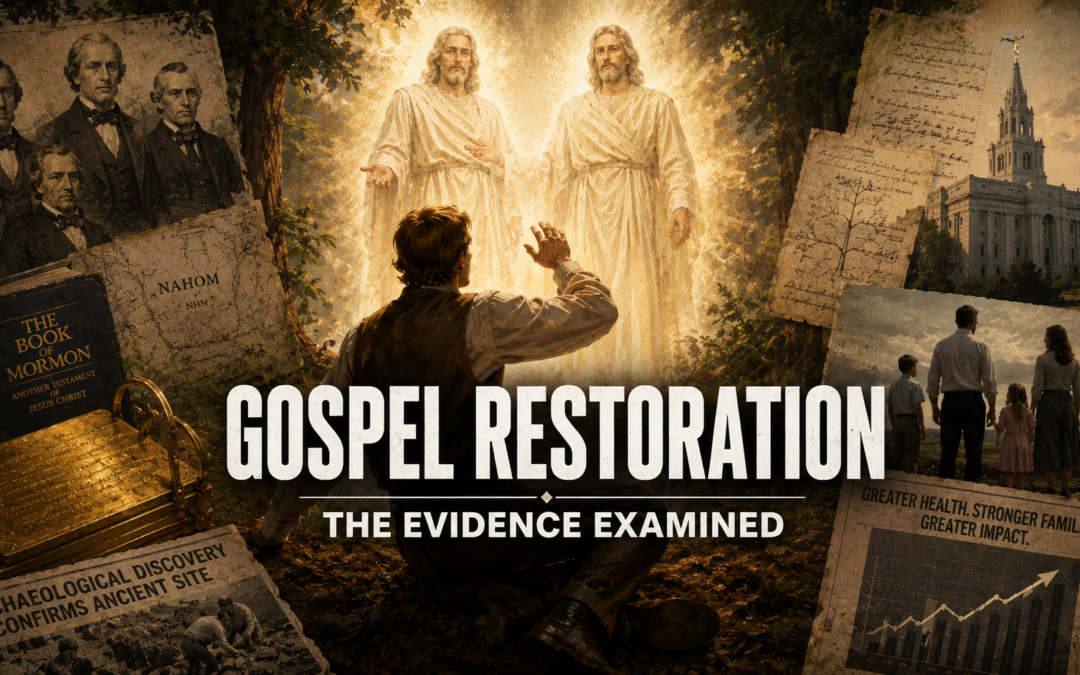
Gospel Restoration claims deserve the same careful evaluation applied to any major historical or religious claim. The question before us is not whether The Church of Jesus Christ of Latter-day Saints is socially comfortable or institutionally perfect. The question is narrower and more important: Is the weight of available evidence more consistent with the Restoration being genuine than with it being a fabrication? The answer, when the full record is examined honestly, is yes.
This article examines the historical, textual, archaeological, and prophetic evidence for the Restoration. It also explores a category of evidence that critics rarely address: the measurable fruits of living the gospel’s commandments. We make a critical distinction throughout: the gospel is perfect; the culture produced by imperfect human beings is not. Charges against Latter-day Saint culture, however valid in specific instances, are not charges against the revealed commandments. A judge evaluates a law by what happens when it is followed, not by what happens when it is violated.
Jesus himself gave us the standard: “By their fruits ye shall know them” (Matthew 7:20). We accept that standard completely and apply it rigorously.
I. The Production of the Book of Mormon Defies Natural Explanation
A. The Translation Speed and Complexity
Multiple historical sources indicate that Joseph Smith dictated the Book of Mormon’s 269,510 words in approximately 60 working days. He did so without notes, outlines, reference materials, or substantive revisions.1 For context, that is longer than the New Testament and nearly four times the length of the Quran, produced by a 23-year-old with minimal formal education.
The method of production was witnessed by multiple credible observers. Emma Smith served as one of Joseph Smith’s scribes. She testified that after meals or interruptions, Joseph “could at once begin where he had left off, without either seeing the manuscript or having any portion of it read to him.”2 This detail is forensically significant. No fraud maintaining a complex, internally consistent narrative across 60 working days could simply resume mid-thought after lunch without review.
The resulting text contains remarkable complexity. It includes more than 330 proper names, a consistent geography, three calendar systems, a system of weights and measures, complex narratives, poetic structures, and fulfilled prophecies. It looks nothing like what a young, poorly educated frontier farmer could be expected to dictate in about 60 working days.3
B. Chiasmus: The Literary Fingerprint of Authentic Hebrew Authorship
Perhaps the single most compelling textual evidence for the Book of Mormon’s ancient origins is the presence of chiasmus — a sophisticated Hebrew literary device of inverted parallelism. Chiasmus was “relegated to the intellectual subconsciousness of modern Western civilization until the mid-nineteenth century”4 and was essentially unknown in Joseph Smith’s rural New York environment in 1830.
BYU law professor John W. Welch identified chiasmus in the Book of Mormon in 1967. He made the discovery after attending an academic lecture in Regensburg, Germany. Upon recognizing the pattern, he searched the Book of Mormon and found chiasm throughout. Alma 36 alone is as extensive and precise as any chiastic passage known in ancient literature.5
Most chiastic passages were written by Nephi, Benjamin, and Alma, all descendants of Lehi who preserved Hebrew traditions. By contrast, chiasmus is largely absent from the writings of Mormon, Moroni, and Ether, who wrote from an assimilated tradition.6 This pattern matches what we would expect from an authentic ancient record rather than a nineteenth-century fabrication.
C. Nahom: The First Archaeological Corroboration
In 1 Nephi 16:34, Nephi records that Ishmael “was buried in the place which was called Nahom.” The text’s careful phrasing — that the place was already called Nahom before Lehi’s party arrived — opens the possibility of independent verification.
That verification arrived when a German archaeological team excavating the Bar’an temple in Marib, Yemen, unearthed three inscribed limestone altars. The altars were dated to the seventh or sixth centuries BC — squarely in the time frame of the Book of Mormon — and bear the inscription of the NHM tribal name.7 NHM is unique: no other ancient NHM toponym has been documented in all of Arabia.
Moreover, the Book of Mormon states that Lehi’s party traveled “nearly eastward” from Nahom. The Nihm region marks the first practical opportunity for eastward travel without crossing the shifting dunes of the Empty Quarter.8 The geographic detail, confirmed by modern satellite mapping, was physically unverifiable in Joseph Smith’s time. Few of the details needed to make this correlation were available and accessible in 1829.9
II. The Witnesses: A Case That Has Never Been Broken
The testimony of the eleven witnesses to the Book of Mormon constitutes one of the most durable evidentiary pillars of the Restoration. Eleven men signed their names to formal declarations testifying to physical contact with the golden plates. Three testified they were shown them by an angel. Eight testified that Joseph Smith personally showed them plates they handled, lifted, and examined. None of the eleven witnesses are known to have ever recanted their testimonies.10
Why the Witnesses’ Testimonies Matter
What makes this extraordinary is the context. Several witnesses — including Oliver Cowdery, David Whitmer, and Martin Harris — became bitterly estranged from Joseph Smith and were excommunicated from the Church. They had every motive that a fraud-theory requires: anger, disillusionment, financial loss, social ostracism. David Whitmer’s written proclamation is unambiguous:
“I have never at any time denied that testimony or any part thereof. I also testify to the world, that neither Oliver Cowdery or Martin Harris ever at any time denied their testimony. They both died reaffirming the truth of the divine authenticity of the Book of Mormon.” — David Whitmer, 1887
When mob violence literally threatened their lives, David Whitmer and Oliver Cowdery declared to William McLellin — himself then an ex-member and hostile witness — “God sent his holy angel to declare the truth of the translation of it to us, and therefore we know. And though the mob kill us, yet we must die declaring its truth.”11 McLellin, a fierce critic, replied: “Boys, I believe you. I can see no object for you to tell me falsehood now, when our lives are endangered.”
Richard Bushman, whose biography of Joseph Smith is acknowledged even by critics as the most balanced full scholarly treatment, noted that “secular historians have never come to grips with the fact that none of the eleven who saw the plates ever recanted.”12 No conspiracy of that scale, among men that dispersed and estranged, holds for decades without a single defection in the historical record.
III. Joseph Smith Taught Ancient Doctrines He Could Not Have Known
A. The Divine Council
Joseph Smith’s most theologically radical teachings — a corporeal, embodied God; a pre-mortal council of divine beings; the potential of humans to become as God — were condemned in his day as pagan innovation. Modern biblical scholarship has quietly demolished that dismissal. It can scarcely be doubted today that the earliest Hebrew conception of God was pluralistic. The basic concept that the ancient Hebrews of the patriarchal age believed in a plurality of Gods has become an essentially accepted idea in scholarship.13
Princeton scholar Mark S. Smith and other researchers argue that this divine council theology was embedded in pre-exilic Israelite religion. They also conclude that it was gradually suppressed through later religious reforms. Joseph Smith’s King Follett Discourse (1844) declared that “in the beginning, the head of the Gods called a council of the Gods. They came together and concocted a plan to create the world and people it.”14 This was treated as lunacy in 1844. Today, secular scholars describe pre-exilic Israelite religion in nearly identical terms.
B. Pre-Mortal Existence
Joseph Smith’s teaching that all human souls existed before birth was considered a pure invention. But the ancient record says otherwise. The Wisdom of Solomon — with deep roots in pre-Christian Jewish tradition — teaches the premortal existence of souls and the creation of the universe from unformed, uncreated matter.15 Joseph Smith taught both. He could not have derived this from the Wisdom of Solomon, which was not part of the Protestant canon available to him.
The Dead Sea Scrolls, discovered in 1947, provide additional support. Jewish and Christian sources from the first centuries teach that the mysteries of the gospel existed before mortal life. The Essenes also believed souls were “released from long bondage” before ascending to heaven.16 These texts were discovered more than a century after Joseph Smith taught premortal existence.
C. The Book of Abraham and the Anachronism Problem — Reversed
Critics argue Joseph Smith’s teachings reflect ideas culturally available in the 1830s. But the anachronism argument works powerfully in reverse. The Book of Abraham’s revelation about the premortal council in heaven finds support in ancient texts Joseph Smith did not have available. The ancient Jewish text Jubilees supports the Book of Abraham’s teaching about a premortal council. Although it dates to the second century BC, it wasn’t published in Latin until 1861, decades after Joseph Smith’s death. 17 Convergence with texts physically unavailable until after his death cannot be explained by plagiarism.
IV. The Josiah Reforms and the Case for Apostasy
The strongest structural argument for the Restoration is not a specific proof-text but a historical pattern: the systematic suppression of original Israelite religion and the corresponding need for its recovery.
The period just before 586 BC is critical: the Pentateuch was still being revised, Jeremiah was prophesying, and the Book of the Law — now generally thought to be Deuteronomy — was discovered in the temple. This is precisely when Lehi began his ministry in Jerusalem.18 King Josiah’s reforms systematically removed from the temple elements the Deuteronomist faction deemed heretical: theophanic traditions, the Asherah, and what Margaret Barker and others identify as authentic pre-exilic temple theology.
Barker — a non-LDS Methodist theologian and former president of the Society for Old Testament Study — argues that Josiah’s reforms placed Deuteronomists in positions of power, allowing them to suppress authentic pre-exilic temple theology, mysteries, and ritual. She identifies this theology as reflected in the pseudepigrapha and Dead Sea Scrolls, and argues that earliest Christianity — including Jesus as cosmic king and high priest (Hebrews), and visionary ascent to the celestial temple (Revelation) — was rooted in this suppressed tradition.19
The implication: if authentic Israelite religion was suppressed through scribal reform and later through the Nicene Council’s adoption of Neoplatonist metaphysics, then Joseph Smith’s teachings — a corporeal God, a divine council, temple ordinances, sealing authority, pre-mortal existence — are not innovations. They are recoveries. The Restoration’s claim is that Joseph retrieved what was buried.
V. Biblical Prophetic Convergences
A. Isaiah 29: A Marvelous Work and a Wonder
Isaiah 29 describes a people whose religion has become rote (v. 13), after which God performs “a marvelous work and a wonder.” Isaiah 29:4 speaks of a voice that shall “speak out of the ground” and “out of the dust.” Isaiah foresaw that when the book appeared, people would be contending over God’s word, providing the context for a marvelous work, causing the wisdom of the wise to perish while the meek increased their joy in the Lord.20 A record literally taken out of the ground by an uneducated farmer, causing exactly the theological upheaval Isaiah describes, fits this passage with a precision that cannot be casually dismissed.
B. Ezekiel 37: The Two Sticks
Ezekiel 37:15-22 records God commanding Ezekiel to join two sticks — one for Judah and one for Joseph/Ephraim — into one. For Latter-day Saints, this represents the Bible (the record of Judah) and the Book of Mormon (the record of Joseph/Ephraim), which would be joined in the last days to gather Israel.21 Today, members of The Church of Jesus Christ hold both volumes bound in one hand. Whatever the precise meaning of “sticks” in their original context, the underlying concept — two witnesses from divided Israel reunited — finds a remarkable fulfillment.
C. Isaiah 2 and Micah 4: The Mountain of the Lord’s House
Isaiah and Micah both prophesy that the Lord’s house will be established “in the tops of the mountains” in the last days. Early LDS leaders declared the pioneers’ establishment of the Church in the Rocky Mountains as a beginning of the fulfillment of these prophecies, with the Salt Lake Temple — featuring its six spires and the figure of Moroni — as the ‘house of the Lord’ in the mountains of America.22 The geographic literalism here is among the most observable of any biblical prophecy: a major religious institution establishing its world headquarters in the Rocky Mountains, drawing millions of converts from all nations.
VI. The Fruits of the Gospel: Empirical Evidence That the Commandments Work
Jesus taught: “Beware of false prophets, which come to you in sheep’s clothing, but inwardly they are ravening wolves. Ye shall know them by their fruits” (Matthew 7:15-16). This test is not rhetorical — it is empirical. We accept it. And we apply a critical distinction that critics consistently blur:
The gospel of Jesus Christ is perfect because it is based on eternal truth. The culture that imperfect people produce around it is not. A fair evaluation measures the law by what happens when it is followed — not by what happens when it is broken.
With that distinction established, the empirical record of actually living the restored gospel’s commandments is extraordinary.
A. The Word of Wisdom: A Health Code 150 Years Ahead of Science
In 1833, tobacco was widely viewed as medicinal, alcohol was nearly universal, and germ theory did not yet exist. During that period, Joseph Smith received a revelation forbidding tobacco, alcohol, coffee, and tea while encouraging grains, fruits, and moderate meat consumption. The medical establishment of his day would have considered this guidance eccentric at best.
The scientific community of our day considers it prescient. UCLA’s Dr. James Enstrom conducted a landmark 14-year study of 10,000 Latter-day Saints and found that death rates for active Church members are among the lowest ever reported in epidemiological literature, with 72 percent fewer deaths than the national average for males ages 25 to 64.23
The results extend to life expectancy. The study revealed that Mormon males had a life expectancy of 84.1 years — 9.8 years longer than U.S. white males — and Mormon females had a life expectancy of 86.1 years.24 Utah Mormons live seven years longer than the state’s non-Mormons. A 2004 BYU study confirmed the longer lives are attributable both to the health advice and to the well-documented protective effects of genuine religious observance.
The Salt Lake Tribune noted that the Word of Wisdom is “well ahead of its time” by any scientific measure. Every specific warning it contained — tobacco, alcohol, addictive drugs — has since been validated by modern medicine as a leading cause of preventable death. Joseph Smith revealed this without research grants, clinical trials, or peer review. He simply called it a word of wisdom.
B. The Law of Chastity: Protection in an Age of Sexual Commodification
The LDS law of chastity — reserving sexual intimacy exclusively for marriage between a man and a woman — is widely mocked in contemporary culture as repressive. The behavioral outcomes tell a different story.
LDS members exhibit lower rates of teen sexual activity, lower rates of out-of-wedlock births, lower rates of sexually transmitted infections, and lower rates of cohabitation than the general population.25 These are not trivial statistics. Out-of-wedlock births now account for over 40% of all U.S. births, bringing well-documented challenges for child development, economic stability, and generational poverty. The law of chastity, followed, provides a structural hedge against exactly these outcomes.
The law is not about shame. It is about covenant — reserving the most intimate of human bonds for the most committed of human relationships. The fruits: stronger families, more stable children, healthier emotional development. The commandment predicts this. The data confirms it.
C. Temple Marriage: The Most Marriage-Stabilizing Institution Documented
One of the most consistent findings in LDS social research is the stability of temple marriages. A 1993 study found that the five-year probability of divorce for Latter-day Saints was only 13% — the lowest of any religious group studied — compared to 36% for non-religious people.26
The most rigorous recent analysis, using the 2023 CFLDS survey of 3,865 participants, confirmed that temple marriage is associated with significantly lower divorce probability even after controlling for education, age, and income.27 Members who married in the temple and remained active were significantly more likely to still be in their first marriage.
This finding has significant social implications. The absence of a two-parent household remains one of the strongest predictors of child poverty in the United States. Temple-married Latter-day Saints have built — by practicing the restored covenant of eternal marriage — one of the most structurally stable family formations documented in social science. That is a fruit. Measured, confirmed, and reproducible.
D. Tithing and Financial Discipline: Aligning Resources With Values
The law of tithing — giving one-tenth of income to the Lord — is one of the most demanding financial commandments in any religious tradition. Critics view it as institutional extraction. The practical outcome for those who live it faithfully is something different.
Paying 10% of gross income before personal expenses requires discipline and delayed gratification. Those same habits also support long-term wealth building, consistent saving, and generosity. Combined with the Latter-day Saint emphasis on self-reliance, tithing encourages responsible financial stewardship.
Malachi 3:10 promises that tithers will see “windows of heaven” opened. Members across generations testify to this. But even setting aside the spiritual dimension: a religious community that practices systematic percentage-giving, discourages debt, emphasizes education, and maintains a welfare system for members in need has built infrastructure that carries individuals through crisis. The commandment is designed for human flourishing. Lived, it produces it.
E. Humanitarian Service: One Billion Dollars a Year and Growing
One of the clearest measurable outcomes of gospel living is the Church’s humanitarian work. In 2024, The Church of Jesus Christ of Latter-day Saints spent $1.45 billion on humanitarian aid, and self-reliance programs. It also completed 3,836 humanitarian projects across 192 countries and territories. 28
These contributions were not restricted to Church members. They went to refugees, disaster survivors, mothers and children, and communities in crisis, without regard to race, nationality, or religious affiliation.29 Church members additionally contributed 6.6 million hours of volunteer service in 2024 — in addition to the service hours logged through the JustServe platform, which supported 30,246 additional community service projects.
The Church’s annual charitable giving has risen every year since 2015. It has increased approximately fivefold since its finances became more publicly visible. This is not the profile of an institution hoarding wealth — it is the profile of a covenant community learning to consecrate its abundance for others’ benefit. The commandment to love and serve one another (John 13:34-35) is producing measurable global good on a scale that few institutions on earth can match.
F. Happiness and Wellbeing: What the Research Shows
Research comparing LDS members to the general population consistently finds elevated wellbeing among those who actually live the gospel. Duke and Johnson’s comparative study found that “Mormon respondents, on the whole, have a higher level of overall happiness than the American populace.” Within the LDS sample, they found that “the greater the religiosity the greater the happiness” — with the best predictors being virtues like patience and kindness, and knowledge of the scriptures.30
Broader social science research reports lower rates of suicide, depression, and substance abuse among active Latter-day Saints. It also reports higher self-esteem, stronger community support, greater self-control, and better addiction recovery outcomes.31
None of this is claimed to be the result of cultural pressure or social conformity. The research consistently shows that it is active gospel living — covenant keeping, service, scripture study, genuine faith — that correlates with these outcomes. The greater the religious engagement, the greater the benefit. That is the signature of a true law at work.
VII. The Gospel vs. The Culture: A Critical and Necessary Distinction
At this point, the honest critic will raise a legitimate challenge: if the gospel produces such good fruits, why do Latter-day Saint communities also produce judgment, perfectionism, exclusion, depression, and pain? The answer is not a dodge — it is the most important distinction in this entire article.
“The Gospel of Jesus Christ is perfect because it is based on eternal truth. Mormon culture is imperfect because it is the expression of imperfect people.”
The gospel commands love, humility, repentance, inclusion, and Christlike service. The culture — the human expression of imperfect people trying to live these commandments — sometimes produces: social pressure to conform, checking boxes rather than conversion, judgment of those who struggle, exclusion of those who are different, and performance of religiosity rather than practice of it.
Elder Jeffrey R. Holland expressed it plainly: “Except in the case of His only perfect Begotten Son, imperfect people are all God has ever had to work with.”32 The Church is not a museum for the spiritually polished — it is a hospital for sinners who are trying. Every ward has people who are cruel and people who are Christlike. Every ward has those living the gospel and those living the culture. The fruits of the gospel are visible in the latter; the failures of human nature are visible in the former.
Distinguishing Doctrine from Culture
Brigham Young rebuked the tendency of members to pressure each other into cultural conformity beyond what the Lord requires, warning against the impulse to make everyone “just so long to fit their iron bedstead.” The cultural excess — the judgment, the rigidity, the one-upmanship of piety — is not the gospel. It is the antidote’s corruption. A counterfeit is evidence that something valuable exists to be counterfeited.
When critics point to the pain caused by LDS cultural pressure — and that pain is real, and it matters — they are making a charge against fallen human nature. They are not making a charge against the commandments that, when actually followed, produce the health outcomes, marriage stability, happiness statistics, and humanitarian impact documented above.
The commandment to love God and love your neighbor (Matthew 22:37-40) does not produce judgment and exclusion. Culture does. The commandment to “do good unto all men” (Galatians 6:10) does not produce $1.45 billion in humanitarian aid annually by accident — it produces it because people are, however imperfectly, trying to live it.
VIII. Answering the Objections Honestly
A persuasive argument that ignores counter evidence is advocacy, not analysis. The principal objections deserve direct engagement.
A. Archaeological Silence in the Americas
This is the strongest objection and must be acknowledged as such. No archaeological consensus supports the existence of a Nephite civilization in pre-Columbian America. Horses, steel, wheat, and chariots mentioned in the Book of Mormon are not attested archaeologically in the relevant period.
Several responses are available, none perfect: the limited geography model proposes a confined Mesoamerican setting; the Book of Mormon itself anticipates the extinction of its civilization; and the absence of evidence in a largely unexplored pre-Columbian record is not equivalent to evidence of absence. But none of these fully resolve the tension. Intellectual honesty requires acknowledging this gap. What intellectual honesty also requires is noting that this single objection must be weighed against the convergent affirmative evidence reviewed throughout this article. The gap is real. It is not, by itself, dispositive.
B. Multiple First Vision Accounts
Joseph Smith left more than one account of his First Vision, and they differ in emphasis. The scholarly consensus on oral testimony consistently shows that multiple honest accounts of a single event naturally vary across different audiences and time periods. The core claim — a divine theophany in which the Father and Son appeared — is consistent across all accounts. Rigid, word-perfect uniformity across decades would itself be suspicious. The variation is what authentic memory looks like.
C. Theological Novelty
The charge that Joseph Smith’s theology is too novel to be ancient collapses under the scholarship reviewed above. Pre-mortal existence, divine embodiment, a council of divine beings, human deification, temple-centered worship, sealed priesthood authority — each of these is attested in pre-Christian Jewish sources, early Christian texts, the Nag Hammadi library, and the Dead Sea Scrolls. They are not 19th-century inventions. They are ancient recoveries.
D. Church Scandals and Institutional Failures
The Church, like every institution staffed by human beings, has had and will have failures: moments of institutional arrogance, policies later reversed, leaders who abused authority, and cultural norms that have caused real harm. These are real. They should not be minimized.
But the evidentiary standard for evaluating a revealed gospel cannot be the behavior of its imperfect practitioners — or no revealed religion in history could survive scrutiny. The standard must be: when the commandments are actually kept, what happens? The health outcomes answer that question. The marriage stability data answers that question. The humanitarian giving answers that question. The happiness research answers that question. The fruits of genuine gospel living are good. That is what the standard requires.
IX. Conclusion: The Balance of Evidence
The case for the Gospel Restoration rests not on any single proof but on a convergence of independent evidence streams, each individually suggestive and collectively compelling.
Historical and Textual Evidence
Consider what must all be explained away simultaneously:
- A 270,000-word text of startling internal complexity produced in 60–65 working days by an uneducated 23-year-old, without notes, manuscript, or revisions — and containing sophisticated Hebraic literary structures not recognized by Western scholarship until 137 years after publication.
- An exact ancient place-name (NHM/Nahom) in the correct geographical location and correct historical period, confirmed by German archaeologists in 1994 — physically unverifiable in Joseph Smith’s day.
- Eleven witnesses, including multiple men who became bitter enemies of Joseph Smith, who maintained their testimonies under persecution and unto death without a single recantation across decades.
- Theological teachings that converge with ancient texts (Jubilees, Dead Sea Scrolls, Wisdom of Solomon, Nag Hammadi) that were physically inaccessible until a century or more after Joseph Smith’s death.
- The broader scholarly corroboration of pre-Josiah Israelite religion as containing the very theological elements — embodied deity, divine council, temple mysteries, sealing authority — the Restoration claims to recover.
- Biblical prophecies in Isaiah 29, Ezekiel 37, Isaiah 2:2-3, and the Joseph Smith Translation of Genesis 50 that find plausible and sometimes striking fulfillments in Restoration events.
Empirical Evidence from Gospel Living
- A health code revealed in 1833 that has been confirmed by modern epidemiology to produce 9.8 additional years of life expectancy in male members who follow it — and which anticipated medicine’s conclusions by over a century.
- Temple marriages that produce among the lowest divorce rates of any religious community documented in social science literature.
- $1.45 billion in annual humanitarian giving across 192 countries, distributed without regard to faith or nationality, with 6.6 million volunteer hours annually — and growing every year.
- Consistent research findings that active gospel living correlates with higher happiness, lower depression, lower substance abuse, stronger families, and greater community resilience than the general population.
Weighing the Main Objections
Against this, critics offer: New World archaeological silence (genuine, but not dispositive against the totality of the affirmative record), variation in first-person accounts across decades (normal for authentic memory), theological novelty (refuted by the ancient documentary record), and the sins of an imperfect human culture (real, but not a charge against the commandments that produced the above fruits when followed).
The burden of proof in this debate has historically been placed entirely on believers. But the production of the Book of Mormon itself is a problem for naturalism that has never been satisfactorily solved. Fraud theories require Joseph Smith to have been simultaneously a master literary architect, a student of obscure ancient Near Eastern culture, a hypnotist capable of sustaining a conspiracy among eleven estranged men for decades, and a prophet of biblical prophecy by extraordinary coincidence. The cumulative improbability of that profile strains natural explanation to its breaking point.
And when we add the second category of evidence — the measurable, documented, reproducible fruits of actually living the restored gospel’s commandments — the case becomes stronger still. Jesus said we would know them by their fruits. We accept that test completely. The fruits of genuine LDS gospel living, documented by independent researchers across decades, are good.
“By their fruits ye shall know them.” — Matthew 7:20
The evidence for the Gospel Restoration does not prove it in the mathematical sense. Nothing in history is proven that way. But weighed by the same standards of probability and convergent evidence applied to any other historical claim — and supplemented by the empirical record of what the commandments produce when actually kept — the evidence substantially favors it over the alternatives.
That is not faith alone. That is the verdict of an honest reckoning with the full record.
Sources & Notes
Book of Mormon Translation and Literary Evidence
- Evidence Central, “Book of Mormon Evidence: Rapid Translation,” ScriptureCentral (2020); John W. Welch, “How Long Did It Take to Translate the Book of Mormon?” BYU Studies (1988).
- Emma Smith, quoted in FAIR Latter-day Saints, “Category: Book of Mormon/Translation/Speed.”
- ScriptureCentral, “Book of Mormon Evidence: The Book of Mormon’s Miraculous Translation Speed” (2020).
- John W. Welch, “Chiasmus in the Book of Mormon,” Religious Studies Center, BYU (1969).
- Welch, ibid. On Alma 36 specifically.
- FAIR Latter-day Saints, “Category: Book of Mormon/Anthropology/Language/Hebraisms/Chiasmus.”
- Warren P. Aston, “Newly Found Altars from Nahom,” Journal of Book of Mormon Studies 10, no. 2 (2001).
- Warren P. Aston, “A History of NaHoM,” BYU Studies Quarterly 51 (2012).
- ScriptureCentral, “Book of Mormon Evidence: Nahom” (2024).
The Witnesses of the Book of Mormon
- Wikipedia, “Book of Mormon Witnesses”; Religious Studies Center, BYU, “The Testimonies of the Book of Mormon Witnesses.”
- Witnesses of the Book of Mormon, “Did any witness ever recant?” (WitnessesOfTheBookOfMormon.org).
- Richard L. Bushman, Joseph Smith: Rough Stone Rolling (Knopf, 2007), cited in ScriptureCentral.
- Stephen O. Smoot, “Examining Six Key Concepts in Joseph Smith’s Understanding of Genesis 1:1,” BYU Studies.
- Joseph Smith, King Follett Discourse (April 7, 1844), in Teachings of the Prophet Joseph Smith, pp. 346-347; FAIR Latter-day Saints, “Joseph Smith and the Biblical Council of Gods” (2010).
- LDS Scripture Teachings, “Joseph Smith and the Apocrypha” (2017).
- FAIR Latter-day Saints, “Premortal Life”; Religious Studies Center, BYU, “Premortal Existence, Foreordinations, and Heavenly Councils” (1986).
- LDS Scripture Teachings, “Ancient Texts That Correlate with the Book of Abraham” (2017).
Josiah’s Reforms and Temple Theology
- Benjamin L. McGuire, “Josiah’s Reform: An Introduction,” Interpreter Foundation.
- Kevin Christensen, “Prophets and Kings in Lehi’s Jerusalem and Margaret Barker’s Temple Theology,” Interpreter Foundation; “Vindicating Josiah,” Interpreter Foundation (2019).
Biblical Prophecies
- Encyclopedia of Mormonism, “Book of Mormon, Biblical Prophecies About.”
- Ibid.; Encyclopedia of Mormonism, “Ezekiel, Prophecies of.”
- Religious Studies Center, BYU, “Nephi, Isaiah, and the Latter-day Restoration.”
Empirical Evidence for Gospel Living
- James E. Enstrom, “Health Practices and Mortality among Active California Mormons, 1980-93,” Religious Studies Center, BYU; BYU Daily Universe, “Religious lifestyle aspires to good health, says UCLA researcher” (2003).
- Deseret News, “UCLA study proves Mormons live longer” (2010), reporting on Enstrom’s 25-year study.
- LDS Latter-day Saints Q&A, “Stunning Stats on Saints — Evidences” (latterdaysaintsqa.com); Deseret News sociologist Tim Heaton summary, 2002.
- MormonR.org, “Latter-day Saint Marriage & Divorce Statistics”; citing 1993 study finding 13% five-year divorce probability.
- BYU Studies, “Temple Marriages Are Less Likely to End in Divorce,” analyzing the 2023 CFLDS Survey (N=3,865).
- Deseret News, “Church of Jesus Christ increased charitable giving” (March 25, 2025); Church of Jesus Christ Newsroom, “2024 Caring for Those in Need Summary.”
- Church of Jesus Christ Newsroom, ibid.
- Duke and Johnson (1981), cited in Religious Studies Center, BYU, “Religiosity, Mental Health, and Latter-day Saints: A Preliminary Review of Literature (1923-95).”
- LDS Latter-day Saints Q&A, “Stunning Stats on Saints — Evidences”; Deseret News, Tim Heaton statistical summary (2002).
Church Culture and Gospel Living
- Elder Jeffrey R. Holland, quoted in LDS Living, “Why We Need More Flawed, Imperfect People in the Church.”
Content is for educational purposes. Sources are cited. Corrections are welcome.
by Anonymous | Jun 17, 2026 | Doctrine, Joseph Smith
Older Than the Critics: The Ancient World’s Quiet Verdict on Joseph Smith
What ancient evidence from the world’s oldest religious texts reveals, and why the standard case against the Prophet collapses under the weight of its own evidence.
There is a version of the story you have heard your whole life. In it, Joseph Smith is a clever frontier improviser who stitched together a religion out of revival-tent enthusiasm, a borrowed Bible, and a few Masonic handshakes. The theology is treated as invented; original to him, sourced from nowhere older than his own imagination.
It is a tidy story. However, it has only one problem. In fact, ancient evidence from the world’s oldest religious texts disagrees with it.
Not Latter-day Saint material. Not apologetics. The clay tablets, the temple texts, the mortuary liturgies, the creation epics — the raw archaeological and textual record assembled over the last century by Egyptologists, Assyriologists, classicists, and comparative scholars who had no interest whatsoever in Joseph Smith, and in many cases no interest in religion at all. When you lay their findings side by side, a pattern emerges that the standard story simply cannot absorb. And once you have seen it, you cannot un-see it.
Here is the claim, stated without hedging: what Latter-day Saints believe is older than the traditions that mock it. Joseph Smith did not invent the architecture of the Restoration. He recovered it. And the scholars who unknowingly documented that architecture were not building a case for the Prophet. They were reading the ancient record honestly, and it kept landing in the same place.
Ancient Evidence and What “Myth” Actually Means
The whole argument hinges on a word that has been quietly weaponized. In casual speech, myth means false — a story invented by people too primitive to know better. However, that is not what the serious academic study of mythology concluded.
Mircea Eliade, who held the chair in the history of religions at the University of Chicago for some three decades, understood myth as preserved memory — an account of what happened at the foundation of the world, which ritual then reenacts. Walter Burkert, the Swiss classicist whose work on Greek and Near Eastern religion is foundational, treated myth as cultural memory transmitted across spans of time that written history cannot reach. Neither man was religious in any conventional sense. They were describing what the evidence showed.
Consequently, that distinction changes everything. If myth is memory rather than fabrication, then the resemblances between ancient traditions are not literary accidents to be waved away. They are data. And the question becomes unavoidable: what are all these civilizations remembering?
Five Examples of Ancient Evidence Across Civilizations
Preserved memory alone does not prove a shared source — two peoples could remember different events that happen to rhyme. What turns memory into evidence is specificity: not vague thematic overlap, but identical structural mechanisms performing identical theological functions, appearing again and again across traditions that had no business being in contact.
Indeed, five of them keep surfacing.
1. The divine council
A presiding deity, delegated governance, a hierarchy of divine authority over creation. This is the oldest recoverable theological framework in the ancient Near East. Moreover, it does not stay there. It appears in Zoroastrian theology, in the oldest Vedic texts, in the earliest layers of Egyptian cosmology, and, decisively, in the Popol Vuh of the Maya — a civilization with no transmission route to Mesopotamia whatsoever. Parallel evolution requires a shared stimulus. There was no shared stimulus between ancient Sumer and pre-Columbian Mexico.
2. The flood and the chosen survivor
In the Atra-Hasis epic and the Epic of Gilgamesh — both predating the biblical account in written form, both documented in detail by Andrew George of the University of London — a divine council decrees the flood, a sympathetic deity warns a righteous man, an ark is built to specific dimensions, birds are released in sequence to find land, and the survivor offers sacrifice upon emergence. Floods are common; however, that is not the point. That precise procedural sequence is not what you would generate from merely having survived high water. It is a remembered event.
3. The garden
A bounded sacred space of direct, unmediated divine communion, lost through a specific act of transgression, with the latent possibility of restoration. It appears in the Sumerian Eridu Genesis, in Egyptian descriptions of an original sacred precinct, in the Zoroastrian vara, and in the Indo-European memory of a golden age. Suffering can teach a culture that things are bad now. It cannot, on its own, teach that things were once sacred, that access was lost through moral failure, and that it might one day be recovered.
4. The dying and rising mediator
Here the careful work of Jonathan Z. Smith rightly dismantled the crude old idea that Christianity simply lifted a universal archetype from mystery cults. But what survives the critique is a quieter, more precise observation: across multiple traditions there exists a figure whose descent into death and return functions as the mechanism of cosmic restoration. And notice how this locks into the garden. The garden poses the problem — communion lost through transgression. The mediator is the proposed solution. Problem and solution, surfacing together, across cultures that had no reason to converge on the same answer.
5. The sacred ascent
A structured movement through layered sacred space, with specific knowledge required at each threshold, culminating in a transformative divine encounter. Egyptian mortuary theology, the Mesopotamian descent of Inanna, the Eleusinian mysteries, Jewish Merkabah mysticism — the same complex, over and over. Margaret Barker, a Methodist scholar and former president of the Society for Old Testament Study, has argued that this was the original theology of the first temple in Jerusalem, suppressed in the reforms of the seventh century BC, which is precisely why it survived only in fragments scattered across other traditions.
Why Ancient Evidence Challenges the Borrowing Theory
The Limits of the Borrowing Theory
The reflexive answer is borrowing. Israel borrowed from Mesopotamia; contact is well documented; case closed.
But borrowing only explains the contact routes. It explains why neighbors resemble neighbors. It does nothing to explain why the same theological architecture shows up in the Popol Vuh, in Pacific island flood traditions, in pre-Columbian garden narratives — in places where no caravan, no scribe, and no trade route ever reached. If borrowing were the whole story, the pattern would be confined to the map of human contact. Instead, it is not. It leaks out everywhere, into cultures sealed off from one another by oceans.
The Problem with Parallel Evolution
Parallel evolution — the idea that the human mind simply generates these stories on its own — fails for a more elegant reason. If universal psychology produced the architecture, then isolated cultures should converge on all the big theological questions at roughly equal rates. In practice, they don’t. The convergence is selective. It clusters tightly around these five elements and not across the whole field of religious thought. By contrast, Joseph Campbell handled the broad strokes — the hero’s journey is a genuine universal — but the sacred-ascent complex, with its specific threshold knowledge, is far too elaborate and far too particular to be a Jungian archetype. Selective convergence on highly specific elements is not the fingerprint of common cognition. It is the fingerprint of common transmission: a single original, fragmented and carried in pieces across a scattering humanity, each shard preserving the structure even as the surface details drifted.
Cultural Memory and Ancient Transmission
The Egyptologist Jan Assmann gave this mechanism a name: cultural memory. He was simply describing how foundational experiences get encoded in ritual and narrative and survive across enormous time scales. He was not making a theological argument. Nevertheless, what he described is exactly what you would expect to find if one original tradition had broken apart and dispersed across the ancient world. The connective tissue is real, too: the Vedic concept of ṛta, the Egyptian ma’at, and the Zoroastrian asha are three different words, in three different civilizations, for one and the same idea — a divinely established order governing both the cosmos and human conduct. Mary Boyce, who held the chair in Iranian studies at the University of London, documented how Zoroastrianism sits at the crossroads of these worlds, its Amesha Spentas standing structurally cognate with the divine-council figures of the Near East.
The part that should stop you cold
Now bring it home. Latter-day Saints make a specific, testable, falsifiable claim: there was one original revelation, given beginning with Adam, fractured globally as humanity scattered, preserved in varying clarity in every ancient tradition, and restored in fullness in the nineteenth century.
The Restoration’s Testable Prediction
That claim makes a prediction. The five elements should appear not only along documented contact routes, but also in traditions completely isolated from the Old World. If they were confined to the contact routes, diffusion would explain everything and the thesis would be in trouble. Instead, the divine council sits in the Popol Vuh, the sacred garden in pre-Columbian cosmology, the chosen-survivor flood in Pacific cultures with no Mesopotamian contact. The thesis holds precisely where it could have been falsified.
The Book of Mormon and Pre-Exilic Israel
Furthermore, there is the Book of Mormon itself — which is where the argument stops being atmospheric and becomes surgical.
The book claims to preserve a scriptural tradition carried out of Jerusalem around 600 BC — roughly two decades after King Josiah’s reform had begun systematically scrubbing exactly this theology from the official Israelite record. Frank Moore Cross dated that reform to 621 BC and documented the suppression of the divine council, the heavenly intermediary, and the anointing traditions — precisely the material Lehi’s family would have carried with them. And the opening chapter of First Nephi has Lehi seeing the heavens open and God enthroned amid a vast assembly: explicit divine-council language, the very theology being purged from Jerusalem in the years he left it. Either that is a remarkable coincidence, or it is exactly what a record predating the reform would look like.
Ancient Textual Evidence in Isaiah
It goes further. The textual criticism of Emanuel Tov established that the Masoretic Text — the Hebrew basis for the King James Bible Joseph Smith had in front of him — is a later, standardized tradition that flattened readings preserved in earlier manuscripts. In several places the Book of Mormon’s Isaiah passages align with those older readings rather than the Masoretic. In 2 Nephi 12:16, the phrase “and upon all the ships of the sea” appears — absent from the King James Version, but present in the Septuagint, the Greek translation produced centuries before the Masoretic standardization. As Scripture Central documents, Joseph Smith did not have the Septuagint in 1829. He had the King James Bible. The reading he produced reaches back behind the Bible he was working from.
And the Masonry objection? It cuts the other way
Yes — Joseph became a Freemason in 1842 and introduced the temple endowment the same year. The parallels are real, and pretending otherwise would be dishonest.
But follow the objection where it actually leads. Freemasonry itself claims ancient origins, tracing its ritual to Solomon’s temple. And the specific elements that parallel the Latter-day Saint endowment are precisely the ones Masonry attributes to the ancient temple — not the parts Masonry invented for itself. Therefore, even if Joseph drew on Masonic forms the question only moves back a step: where did Masonry get those?
Temple Theology and Ancient Origins
Margaret Barker answers it without ever touching Latter-day Saint theology. Working entirely in pre-exilic Hebrew sources, she documented a first-temple theology of sacred garments — markers of divine status and covenant access, part of the priestly investiture, stripped away in Josiah’s reforms. That same element appears in Masonic ritual, attributed to Solomonic origin. And it appears in the Latter-day Saint endowment. Three traditions, converging on one specific ritual element. Barker found the ancient original through independent research, in material that predates any Renaissance esoteric source by more than two thousand years. There is no intermediary needed between Joseph Smith and the original — because the original is documented, and it is genuinely ancient. The honest reading is that all three are drawing from the same source at different distances and degrees of clarity.
The Verdict of the Ancient Evidence
Independent Scholars, Unexpected Corroboration
Here is what makes this case so difficult for the critic, and it deserves to be said boldly.
None of these scholars set out to corroborate Joseph Smith. Eliade, Burkert, Jacobsen, Assmann, Boyce, George, Barker, Cross, Tov — they were trying to understand ancient civilization. The corroboration is a byproduct of their work, which is exactly what makes it so hard to dismiss. You cannot accuse them of cooking the books for the Restoration. They did not know the Restoration was on the table.
Consequently, the familiar critique faces a wall. The position that Joseph Smith invented his theology requires you to believe that an unlettered young man in 1820s New York independently fabricated the precise theological content that comparative scholars would spend the entire twentieth century discovering in the oldest texts on earth — content drawn from a suppressed pre-exilic theology he had no access to, aligned with manuscript traditions he had never seen, distributed across isolated civilizations he had never heard of.
You are free to reject the Latter-day Saint conclusion. That door stays open. But you are not free to pretend the convergence isn’t there. An explanation that only works by ignoring the evidence is not an explanation. It is an avoidance.
What the Ancient Evidence Ultimately Suggests
The five structural elements were not Joseph Smith’s innovations. They sit in the oldest religious material humanity has ever recovered, documented by people with no stake in the answer. When critics say the Church merely borrows from ancient traditions, the accurate reply is: yes — in the sense that it recovers them. That is the entire claim of the Restoration. That has always been the whole point.
What you believe, Latter-day Saint, is older than the traditions that criticize it. The ancient world remembered it in fragments. A prophet, in the fullness of time, was given it whole.
Follow the evidence honestly, and it leads somewhere unexpected. It led a generation of secular scholars to document the very architecture of the gospel without ever meaning to. And it will lead anyone willing to look — as it led the Prophet himself — to a door that the mind alone cannot open, and that the heart, with the power of prayer, finally can.
Frequently Asked Questions
Did Joseph Smith invent Restoration theology?
According to Latter-day Saint claims, Joseph Smith restored doctrines that existed in ancient religious traditions rather than inventing new theology. Comparative studies of ancient texts reveal recurring themes such as divine councils, sacred ascent, temple worship, and covenantal relationships with God.
What ancient evidence is discussed in this article?
Supporters point to parallels between Restoration theology and ancient Near Eastern, Egyptian, Jewish, Zoroastrian, and Mesoamerican traditions, including concepts such as divine councils, sacred temples, prophetic visions, and pre-mortal existence.
What is the divine council in ancient religion?
The divine council is an ancient theological concept describing a heavenly assembly governed by a supreme deity. Similar structures appear in Mesopotamian, Egyptian, biblical, and Mesoamerican traditions and are often compared to teachings found in Restoration scripture.
How does the Book of Mormon relate to ancient Israelite beliefs?
Some researchers have noted similarities between themes in the Book of Mormon and elements of pre-exilic Israelite religion. These include divine council imagery, temple-centered worship, heavenly ascent motifs, and covenant theology. Scholars such as Margaret Barker and Frank Moore Cross have argued that some of these traditions were more prominent in ancient Israel before the religious reforms associated with King Josiah.
Sources & Further Reading
Verify every claim for yourself. None of the academic scholars below were writing to defend the Restoration.
On myth as memory
The five structural elements
On transmission and convergence
The Book of Mormon’s checkable claims
Content is for educational purposes. Sources are cited. Corrections are welcome.