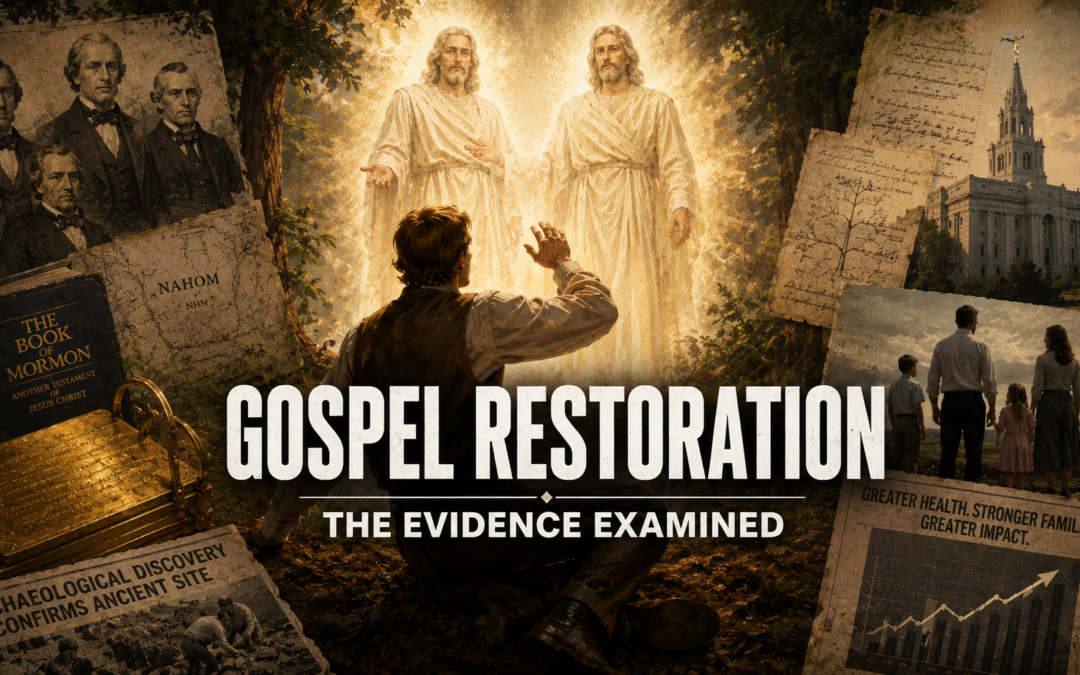
Older Than the Critics: The Ancient World’s Quiet Verdict on Joseph Smith
What ancient evidence from the world’s oldest religious texts reveals, and why the standard case against the Prophet collapses under the weight of its own evidence.
There is a version of the story you have heard your whole life. In it, Joseph Smith is a clever frontier improviser who stitched together a religion out of revival-tent enthusiasm, a borrowed Bible, and a few Masonic handshakes. The theology is treated as invented; original to him, sourced from nowhere older than his own imagination.
It is a tidy story. However, it has only one problem. In fact, ancient evidence from the world’s oldest religious texts disagrees with it.
Not Latter-day Saint material. Not apologetics. The clay tablets, the temple texts, the mortuary liturgies, the creation epics — the raw archaeological and textual record assembled over the last century by Egyptologists, Assyriologists, classicists, and comparative scholars who had no interest whatsoever in Joseph Smith, and in many cases no interest in religion at all. When you lay their findings side by side, a pattern emerges that the standard story simply cannot absorb. And once you have seen it, you cannot un-see it.
Here is the claim, stated without hedging: what Latter-day Saints believe is older than the traditions that mock it. Joseph Smith did not invent the architecture of the Restoration. He recovered it. And the scholars who unknowingly documented that architecture were not building a case for the Prophet. They were reading the ancient record honestly, and it kept landing in the same place.
Ancient Evidence and What “Myth” Actually Means
The whole argument hinges on a word that has been quietly weaponized. In casual speech, myth means false — a story invented by people too primitive to know better. However, that is not what the serious academic study of mythology concluded.
Mircea Eliade, who held the chair in the history of religions at the University of Chicago for some three decades, understood myth as preserved memory — an account of what happened at the foundation of the world, which ritual then reenacts. Walter Burkert, the Swiss classicist whose work on Greek and Near Eastern religion is foundational, treated myth as cultural memory transmitted across spans of time that written history cannot reach. Neither man was religious in any conventional sense. They were describing what the evidence showed.
Consequently, that distinction changes everything. If myth is memory rather than fabrication, then the resemblances between ancient traditions are not literary accidents to be waved away. They are data. And the question becomes unavoidable: what are all these civilizations remembering?
Five Examples of Ancient Evidence Across Civilizations
Preserved memory alone does not prove a shared source — two peoples could remember different events that happen to rhyme. What turns memory into evidence is specificity: not vague thematic overlap, but identical structural mechanisms performing identical theological functions, appearing again and again across traditions that had no business being in contact.
Indeed, five of them keep surfacing.
1. The divine council
A presiding deity, delegated governance, a hierarchy of divine authority over creation. This is the oldest recoverable theological framework in the ancient Near East. Moreover, it does not stay there. It appears in Zoroastrian theology, in the oldest Vedic texts, in the earliest layers of Egyptian cosmology, and, decisively, in the Popol Vuh of the Maya — a civilization with no transmission route to Mesopotamia whatsoever. Parallel evolution requires a shared stimulus. There was no shared stimulus between ancient Sumer and pre-Columbian Mexico.
2. The flood and the chosen survivor
In the Atra-Hasis epic and the Epic of Gilgamesh — both predating the biblical account in written form, both documented in detail by Andrew George of the University of London — a divine council decrees the flood, a sympathetic deity warns a righteous man, an ark is built to specific dimensions, birds are released in sequence to find land, and the survivor offers sacrifice upon emergence. Floods are common; however, that is not the point. That precise procedural sequence is not what you would generate from merely having survived high water. It is a remembered event.
3. The garden
A bounded sacred space of direct, unmediated divine communion, lost through a specific act of transgression, with the latent possibility of restoration. It appears in the Sumerian Eridu Genesis, in Egyptian descriptions of an original sacred precinct, in the Zoroastrian vara, and in the Indo-European memory of a golden age. Suffering can teach a culture that things are bad now. It cannot, on its own, teach that things were once sacred, that access was lost through moral failure, and that it might one day be recovered.
4. The dying and rising mediator
Here the careful work of Jonathan Z. Smith rightly dismantled the crude old idea that Christianity simply lifted a universal archetype from mystery cults. But what survives the critique is a quieter, more precise observation: across multiple traditions there exists a figure whose descent into death and return functions as the mechanism of cosmic restoration. And notice how this locks into the garden. The garden poses the problem — communion lost through transgression. The mediator is the proposed solution. Problem and solution, surfacing together, across cultures that had no reason to converge on the same answer.
5. The sacred ascent
A structured movement through layered sacred space, with specific knowledge required at each threshold, culminating in a transformative divine encounter. Egyptian mortuary theology, the Mesopotamian descent of Inanna, the Eleusinian mysteries, Jewish Merkabah mysticism — the same complex, over and over. Margaret Barker, a Methodist scholar and former president of the Society for Old Testament Study, has argued that this was the original theology of the first temple in Jerusalem, suppressed in the reforms of the seventh century BC, which is precisely why it survived only in fragments scattered across other traditions.
Why Ancient Evidence Challenges the Borrowing Theory
The Limits of the Borrowing Theory
The reflexive answer is borrowing. Israel borrowed from Mesopotamia; contact is well documented; case closed.
But borrowing only explains the contact routes. It explains why neighbors resemble neighbors. It does nothing to explain why the same theological architecture shows up in the Popol Vuh, in Pacific island flood traditions, in pre-Columbian garden narratives — in places where no caravan, no scribe, and no trade route ever reached. If borrowing were the whole story, the pattern would be confined to the map of human contact. Instead, it is not. It leaks out everywhere, into cultures sealed off from one another by oceans.
The Problem with Parallel Evolution
Parallel evolution — the idea that the human mind simply generates these stories on its own — fails for a more elegant reason. If universal psychology produced the architecture, then isolated cultures should converge on all the big theological questions at roughly equal rates. In practice, they don’t. The convergence is selective. It clusters tightly around these five elements and not across the whole field of religious thought. By contrast, Joseph Campbell handled the broad strokes — the hero’s journey is a genuine universal — but the sacred-ascent complex, with its specific threshold knowledge, is far too elaborate and far too particular to be a Jungian archetype. Selective convergence on highly specific elements is not the fingerprint of common cognition. It is the fingerprint of common transmission: a single original, fragmented and carried in pieces across a scattering humanity, each shard preserving the structure even as the surface details drifted.
Cultural Memory and Ancient Transmission
The Egyptologist Jan Assmann gave this mechanism a name: cultural memory. He was simply describing how foundational experiences get encoded in ritual and narrative and survive across enormous time scales. He was not making a theological argument. Nevertheless, what he described is exactly what you would expect to find if one original tradition had broken apart and dispersed across the ancient world. The connective tissue is real, too: the Vedic concept of ṛta, the Egyptian ma’at, and the Zoroastrian asha are three different words, in three different civilizations, for one and the same idea — a divinely established order governing both the cosmos and human conduct. Mary Boyce, who held the chair in Iranian studies at the University of London, documented how Zoroastrianism sits at the crossroads of these worlds, its Amesha Spentas standing structurally cognate with the divine-council figures of the Near East.
The part that should stop you cold
Now bring it home. Latter-day Saints make a specific, testable, falsifiable claim: there was one original revelation, given beginning with Adam, fractured globally as humanity scattered, preserved in varying clarity in every ancient tradition, and restored in fullness in the nineteenth century.
The Restoration’s Testable Prediction
That claim makes a prediction. The five elements should appear not only along documented contact routes, but also in traditions completely isolated from the Old World. If they were confined to the contact routes, diffusion would explain everything and the thesis would be in trouble. Instead, the divine council sits in the Popol Vuh, the sacred garden in pre-Columbian cosmology, the chosen-survivor flood in Pacific cultures with no Mesopotamian contact. The thesis holds precisely where it could have been falsified.
The Book of Mormon and Pre-Exilic Israel
Furthermore, there is the Book of Mormon itself — which is where the argument stops being atmospheric and becomes surgical.
The book claims to preserve a scriptural tradition carried out of Jerusalem around 600 BC — roughly two decades after King Josiah’s reform had begun systematically scrubbing exactly this theology from the official Israelite record. Frank Moore Cross dated that reform to 621 BC and documented the suppression of the divine council, the heavenly intermediary, and the anointing traditions — precisely the material Lehi’s family would have carried with them. And the opening chapter of First Nephi has Lehi seeing the heavens open and God enthroned amid a vast assembly: explicit divine-council language, the very theology being purged from Jerusalem in the years he left it. Either that is a remarkable coincidence, or it is exactly what a record predating the reform would look like.
Ancient Textual Evidence in Isaiah
It goes further. The textual criticism of Emanuel Tov established that the Masoretic Text — the Hebrew basis for the King James Bible Joseph Smith had in front of him — is a later, standardized tradition that flattened readings preserved in earlier manuscripts. In several places the Book of Mormon’s Isaiah passages align with those older readings rather than the Masoretic. In 2 Nephi 12:16, the phrase “and upon all the ships of the sea” appears — absent from the King James Version, but present in the Septuagint, the Greek translation produced centuries before the Masoretic standardization. As Scripture Central documents, Joseph Smith did not have the Septuagint in 1829. He had the King James Bible. The reading he produced reaches back behind the Bible he was working from.
And the Masonry objection? It cuts the other way
Yes — Joseph became a Freemason in 1842 and introduced the temple endowment the same year. The parallels are real, and pretending otherwise would be dishonest.
But follow the objection where it actually leads. Freemasonry itself claims ancient origins, tracing its ritual to Solomon’s temple. And the specific elements that parallel the Latter-day Saint endowment are precisely the ones Masonry attributes to the ancient temple — not the parts Masonry invented for itself. Therefore, even if Joseph drew on Masonic forms the question only moves back a step: where did Masonry get those?
Temple Theology and Ancient Origins
Margaret Barker answers it without ever touching Latter-day Saint theology. Working entirely in pre-exilic Hebrew sources, she documented a first-temple theology of sacred garments — markers of divine status and covenant access, part of the priestly investiture, stripped away in Josiah’s reforms. That same element appears in Masonic ritual, attributed to Solomonic origin. And it appears in the Latter-day Saint endowment. Three traditions, converging on one specific ritual element. Barker found the ancient original through independent research, in material that predates any Renaissance esoteric source by more than two thousand years. There is no intermediary needed between Joseph Smith and the original — because the original is documented, and it is genuinely ancient. The honest reading is that all three are drawing from the same source at different distances and degrees of clarity.
The Verdict of the Ancient Evidence
Independent Scholars, Unexpected Corroboration
Here is what makes this case so difficult for the critic, and it deserves to be said boldly.
None of these scholars set out to corroborate Joseph Smith. Eliade, Burkert, Jacobsen, Assmann, Boyce, George, Barker, Cross, Tov — they were trying to understand ancient civilization. The corroboration is a byproduct of their work, which is exactly what makes it so hard to dismiss. You cannot accuse them of cooking the books for the Restoration. They did not know the Restoration was on the table.
Consequently, the familiar critique faces a wall. The position that Joseph Smith invented his theology requires you to believe that an unlettered young man in 1820s New York independently fabricated the precise theological content that comparative scholars would spend the entire twentieth century discovering in the oldest texts on earth — content drawn from a suppressed pre-exilic theology he had no access to, aligned with manuscript traditions he had never seen, distributed across isolated civilizations he had never heard of.
You are free to reject the Latter-day Saint conclusion. That door stays open. But you are not free to pretend the convergence isn’t there. An explanation that only works by ignoring the evidence is not an explanation. It is an avoidance.
What the Ancient Evidence Ultimately Suggests
The five structural elements were not Joseph Smith’s innovations. They sit in the oldest religious material humanity has ever recovered, documented by people with no stake in the answer. When critics say the Church merely borrows from ancient traditions, the accurate reply is: yes — in the sense that it recovers them. That is the entire claim of the Restoration. That has always been the whole point.
What you believe, Latter-day Saint, is older than the traditions that criticize it. The ancient world remembered it in fragments. A prophet, in the fullness of time, was given it whole.
Follow the evidence honestly, and it leads somewhere unexpected. It led a generation of secular scholars to document the very architecture of the gospel without ever meaning to. And it will lead anyone willing to look — as it led the Prophet himself — to a door that the mind alone cannot open, and that the heart, with the power of prayer, finally can.
Frequently Asked Questions
Did Joseph Smith invent Restoration theology?
According to Latter-day Saint claims, Joseph Smith restored doctrines that existed in ancient religious traditions rather than inventing new theology. Comparative studies of ancient texts reveal recurring themes such as divine councils, sacred ascent, temple worship, and covenantal relationships with God.
What ancient evidence is discussed in this article?
Supporters point to parallels between Restoration theology and ancient Near Eastern, Egyptian, Jewish, Zoroastrian, and Mesoamerican traditions, including concepts such as divine councils, sacred temples, prophetic visions, and pre-mortal existence.
What is the divine council in ancient religion?
The divine council is an ancient theological concept describing a heavenly assembly governed by a supreme deity. Similar structures appear in Mesopotamian, Egyptian, biblical, and Mesoamerican traditions and are often compared to teachings found in Restoration scripture.
How does the Book of Mormon relate to ancient Israelite beliefs?
Some researchers have noted similarities between themes in the Book of Mormon and elements of pre-exilic Israelite religion. These include divine council imagery, temple-centered worship, heavenly ascent motifs, and covenant theology. Scholars such as Margaret Barker and Frank Moore Cross have argued that some of these traditions were more prominent in ancient Israel before the religious reforms associated with King Josiah.
Sources & Further Reading
Verify every claim for yourself. None of the academic scholars below were writing to defend the Restoration.
On myth as memory
Mircea Eliade — biography and method (Britannica); see The Sacred and the Profane and Myth of the Eternal Return
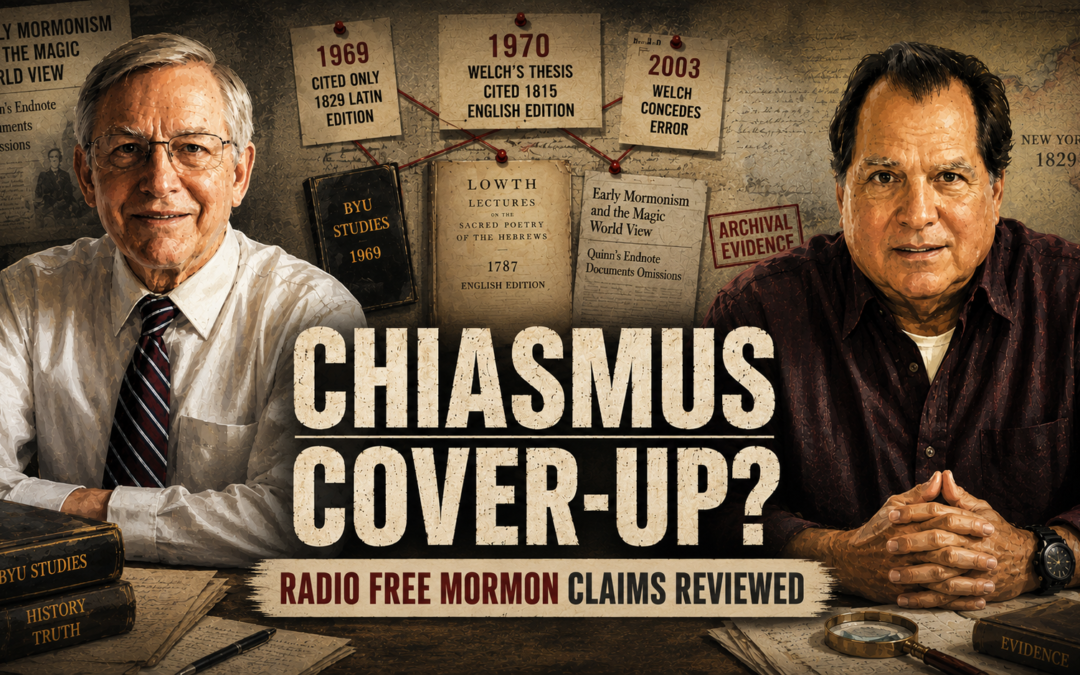
Chiasmus Cover-Up? Quinn’s Allegations Against John Welch — What the Evidence Actually Shows
D. Michael Quinn documented significant citation omissions in John Welch’s early chiasmus scholarship. However, Welch later acknowledged several errors, revised key claims, and narrowed his position. As a result, the evidence weakens the original apologetic argument but does not fully settle the debate over Book of Mormon chiasmus.
D. Michael Quinn’s five-page endnote presents detailed archival research that documents a concerning pattern in John Welch’s citations. However, RFM’s framing leaves several important questions unresolved. For example, what did Welch later concede? How did LDS scholars respond to the pre-1830 availability problem? And does chiasmus still retain evidential value after Quinn’s corrections?
This article examines those questions directly while preserving Quinn’s findings and adding missing historical context.
About This Episode
Radio Free Mormon Episode 458 examines D. Michael Quinn’s five-page endnote (footnote 108, chapter 6) from the revised edition of Early Mormonism and the Magic World View (1998). Quinn argues that John Welch understated the availability of English-language publications on biblical parallelism before 1829. He further described this pattern as “escalating intentional concealment.”
RFM brings personal weight to this: he describes grabbing hold of chiasmus as a “last lifeline” during the Mark Hofmann forgery crisis in the mid-1980s, relying specifically on Welch’s assurances that no pre-1830 American had access to the concept. The episode is emotionally authentic and the scholarship it draws on is real. This rebuttal focuses on four specific questions the episode does not fully answer.
Why This Episode Is Different
This is not a doctrinal debate or a straightforward claims episode. It is a close reading of archival scholarship — Quinn’s endnote — which itself is a close reading of John Welch’s citation patterns across 30 years of publications. The primary question is not what the Book of Mormon says but what was available in print in upstate New York in 1829. This requires engaging the actual bibliographic evidence Quinn documents, not just accepting or rejecting his conclusion.
RFM presents the episode as strongly weighted toward Quinn’s conclusions. According to that framing, Quinn’s scholarship is accurate, Welch’s omissions are damaging, and the evidence appears overwhelming. However, the episode gives less attention to several important issues: Welch’s 2003 response and concessions, the strongest remaining LDS arguments for chiasmus, and the distinction between “the concept existed before 1830” and “chiasmus still retains evidential value.”
Key sources for this rebuttal: Quinn’s endnote text is independently transcribed at A Careful Examination. Welch’s original 1969 BYU Studies article is available at BYU Studies. Welch’s 2003 FARMS Review response is referenced in BYU library archives. All specific claims about publication dates, catalog availability, and Welch’s citations are verifiable from Quinn’s endnote as transcribed.
Where Quinn’s Documentation Is Accurate
Quinn’s Documentation — Confirmed
Welch’s 1969 BYU Studies article cited only Lowth’s 1829 Latin edition while his own 1970 thesis cited Lowth’s 1815 American English edition — the timeline is damning
✓ Documented and Confirmed by Welch’s Own 2003 Concession
“The rediscovery of chiasmus in the Bible can be credited to three theologians of the nineteenth century: Robert Lowth, John Jebb, and John Forbes. Lowth, the Bishop of London… There exists no chance that Joseph could have learned of this style through academic channels. No one in America, let alone in Western New York, fully understood chiasmus in 1829.”
— John Welch, BYU Studies, Autumn 1969 (available at byustudies.byu.edu)
.
Lowth’s Earlier English Editions
Quinn’s endnote documents a specific and consequential bibliographic anomaly. In his 1969 BYU Studies article, Welch cited Robert Lowth as one of three scholars who “rediscovered” chiasmus — but cited only Lowth’s 1829 Latin edition, which was published the same year as the Book of Mormon and was therefore too late and in the wrong language to be accessible to Joseph Smith. This framing created the impression that Lowth’s only publication on the subject was in Latin in 1829.
However, Lowth (1710–1787) had published his Lectures on the Sacred Poetry of the Hebrews in English in London in 1787 — 42 years before the Book of Mormon. American editions followed in 1815 and 1829. Quinn’s research in the British Museum General Catalog and National Union Catalog documented these editions explicitly. The 1787 English edition alone preceded the Book of Mormon by four decades.
Why the Timeline Matters
The strongest evidence against Welch comes from his own master’s thesis. Welch submitted and approved the thesis in April 1970, only months after the BYU Studies article appeared. This means Welch knew about the earlier English-language source at the same time he was writing the article that cited only the 1829 Latin edition. Quinn characterises this as deceptive, and Welch’s 2003 FARMS Review paper did not convincingly explain the discrepancy. He acknowledged the error. He also stated “I regret the previous point of misinformation” but attributed it to following other scholars’ characterisations rather than independently verifying the primary sources.
Assessment: Quinn’s Documentation Is Accurate and Welch Partially Conceded It
The timeline contradiction between the BYU Studies article and the master’s thesis is real, documented, and conceded by Welch in 2003. Whether it represents intentional concealment or motivated non-investigation — as Quinn alleges — or an inadvertent inconsistency is the point of ongoing debate. What is not debated is that the omission was consequential and directionally favourable to the apologetic argument.
Horne’s 1825 American edition discussing inverted parallelism was advertised in the Palmyra newspaper and available 9 miles from Joseph Smith’s home — Welch dropped all references to Horne in his 1982 reprint
✓ Documented by Quinn; Conceded by Welch in 2003
“In 1860, a section on chiasmus was finally added to [Horne’s] famous encyclopedia… There exists no chance that Joseph could have learned of this style through academic channels.”
— John Welch, BYU Studies, 1969 (as quoted by Quinn)
Horne’s 1825 Edition and Local Availability
Quinn’s second major finding is about Thomas Hartwell Horne (1780–1862), whose Introduction to the Critical Study and Knowledge of the Holy Scriptures discussed inverted parallelism, diagrammed examples from Isaiah and Psalms, and cited Bishops Lowth and Jebb as principal sources. According to Quinn’s research in the National Union Catalog, Horne’s first American edition was published in Philadelphia in 1825 — and was advertised for sale in the Wayne Sentinel (a Palmyra-area newspaper) in April 1825, August 1826, and January 1827. The 1818 London edition was available at the Canandaigua bookstore, nine miles from Joseph Smith’s home, from 1820.
Welch’s 1969 article stated that a section on chiasmus was “finally added” to Horne’s work only in the 11th edition of 1860. This claim requires having examined prior editions to know what they did and did not contain. Yet Welch’s own 1970 master’s thesis cited Horne’s 1836 American edition — meaning Welch knew by 1970 that Horne’s work had American editions well before 1860. In the 1981 bibliography he edited, Chiasmus in Antiquity, Welch acknowledged Horne’s work had “numerous editions printed in US and England for over 50 years following the first edition.”
Removal of Horne References
When Welch reprinted his 1969 BYU Studies article in Noel Reynolds’ 1982 Book of Mormon Authorship, he dropped all references to Horne entirely — not updating them, not correcting them, but removing them. Quinn argues this is because Welch had by then discovered or been informed that Horne’s 1825 American edition discussed chiasmus, making his “finally added in 1860” claim untenable.
In his 2003 response, Welch conceded: “contrary to what I had previously thought and as Michael Quinn has shown, Thomas Hartwell Horne adopted Jebb’s basic terminology and presented a few of Jebb’s examples of introverted parallelism in Horne’s 1825 edition.” He stated “I regret the previous point of misinformation” and acknowledged the 1825 Philadelphia edition was available in Joseph Smith’s neighbourhood.
Assessment: Quinn’s Core Finding Is Accurate — Confirmed by Welch’s Own 2003 Concession
The Horne documentation is Quinn’s strongest finding. The 1825 American edition was locally available to Joseph Smith, and Welch’s claim that chiasmus was not in Horne until his 1860 11th edition was false — as his own citations in other contexts demonstrate he had reason to investigate. The 2003 concession, though qualified, confirmed the essential point.
Welch’s 2003 partial concession substantially narrows the original claim — and his adjusted position is more defensible than the original
RFM Acknowledges This But Underweights It
“Today I acknowledge that people in Joseph Smith’s environs in 1829 could have known of chiasmus, but I still doubt that Joseph Smith actually did.” — John Welch, FARMS Review, 2003
RFM covers Welch’s 2003 FARMS Review paper — “How Much Was Known about Chiasmus in 1829 When the Book of Mormon Was Translated?” — and does acknowledge some concessions within it. However, the episode largely frames the paper as an exercise in damage control that “doesn’t cover the ground.” A closer reading suggests something more nuanced. In reality, Welch made several substantive concessions that significantly changed the evidential landscape.
Welch conceded: (1) Horne’s 1825 Philadelphia edition was available in Joseph Smith’s neighbourhood; (2) “information was available in the 1820s on various forms of parallelism in the Hebrew Bible”; (3) “I regret the previous point of misinformation”; and (4) his adjusted claim moved from “no chance” to “a very low probability” — a significant qualification. He attributed the error to following other scholars’ characterisations without independently verifying earlier editions.
Whether this explanation is adequate is a fair question. Quinn’s documentation suggests Welch had reason to verify (he cited Horne’s 1836 edition in his thesis; if the 5th edition exists, earlier editions should have been checked). But the 2003 paper does represent a genuine, if belated, correction of the record — published in a venue readable by LDS scholars and members, not buried or hidden. RFM’s framing that the paper “more looks like excuses” underweights how significantly the concessions narrow Welch’s original claims.
Assessment: Welch’s 2003 Concessions Are More Substantive Than RFM Acknowledges
The shift from “no chance / statistically insignificant” to “low probability, and the sources were available” is a meaningful correction. It doesn’t erase the problematic citation pattern Quinn documents, but it demonstrates Welch’s willingness to update his position when confronted with evidence — even if the update came 34 years after the original claim.
Chiasmus retains meaningful evidential value even after Quinn’s corrections — the pre-1830 availability of simple parallelism descriptions does not explain Alma 36
🔷 A Critical Distinction the Episode Does Not Draw
“There exists no chance that Joseph could have learned of this style through academic channels. No one in America, let alone in Western New York, fully understood chiasmus in 1829.” — John Welch, 1969 (the claim Quinn and RFM are rebutting)
RFM’s analysis focuses primarily on pre-1830 availability. However, this approach combines two separate questions that should remain distinct.
Question 1: Was chiasmus available before 1829?
Yes. Following Quinn’s research and Welch’s later concessions, the answer is clear: descriptions of biblical parallelism existed in English and were locally accessible.
Question 2: Does Book of Mormon chiasmus still retain evidential value?
This question remains debated. LDS scholars argue that the strongest evidence never depended solely on Joseph Smith being unaware of chiasmus.
Why Alma 36 Remains Central
This distinction matters for an important reason. The strongest LDS argument never relied only on Joseph Smith being unaware of chiasmus. Instead, supporters point to the complexity of specific structures, particularly Alma 36. That 30-verse chapter is structured as a complete, precisely inverted chiasm with its theological centrepoint (Christ’s atoning power) at the exact structural centre of the chapter. LDS scholars argue this level of composition — not a casual awareness of general parallelism — would require either divine origin or deliberate, sophisticated construction of a kind that goes far beyond knowing that Hebrew poetry used mirrored structures.
Complexity Versus Awareness
Knowing that Hebrew poetry used parallel structures differs from intentionally creating a 30-verse theological chiasm. Supporters argue that Alma 36 reflects deliberate literary design rather than simple awareness. The evangelical Institute for Religious Research, writing critically of LDS claims, acknowledges: “The question of whether chiasmus proves the Book of Mormon is ancient is a legitimate scholarly debate, not a closed question.” The pre-1830 availability of Horne’s book does reduce but does not eliminate the evidential weight of complex chiasmus — and the episode does not make this distinction.
Assessment: The Evidential Question Survives Quinn’s Corrections — Reduced but Not Eliminated
Quinn’s documentation corrects Welch’s overstated certainty about pre-1830 ignorance. It does not demonstrate that Joseph Smith consciously used Horne’s diagrams to construct Alma 36. The pre-1830 availability of simple parallelism descriptions weakens but does not eliminate chiasmus as evidence for ancient composition. RFM does not draw this distinction.
Quinn documented multiple omissions involving Robert Lowth and Thomas Hartwell Horne. Welch later acknowledged several errors but denied intentional concealment.
Was chiasmus available before 1829?
Yes. Quinn documented English-language works discussing biblical parallelism that were available before publication of the Book of Mormon.
Does Alma 36 remain evidence for ancient composition?
The issue remains debated. Critics argue cultural exposure explains the structure, while LDS scholars maintain Alma 36 reflects sophisticated literary design.
Frequently Asked Questions
Citation Questions
Did John Welch intentionally hide pre-1830 publications about chiasmus?
Quinn’s scholarship documents a troubling pattern. Welch’s 1969 BYU Studies article cited only Lowth’s 1829 Latin edition. However, his 1970 master’s thesis cited Lowth’s 1815 American English edition. Welch also claimed that chiasmus appeared in Horne only in the 1860 edition. However, his 1981 bibliography acknowledged multiple earlier editions. Between 1969 and 1982, Welch dropped all references to Horne entirely from his republished article.
Quinn concluded this represented “escalating intentional concealment.” Welch’s 2003 response attributed the errors to following other scholars’ characterisations without independent verification. What is not debated: the omissions were real, they were consistent in one direction (making Joseph Smith’s access to chiasmus concepts seem less likely), and Welch knew about at least some of the omitted sources at the time of writing.
Evidential Questions
Does chiasmus still serve as evidence for the Book of Mormon being an ancient text?
The evidential value is reduced but not eliminated by Quinn’s corrections. The availability of Horne’s 1825 book means Joseph Smith could theoretically have absorbed the concept of Hebrew parallelism from his cultural environment. However, LDS scholars focus on the complexity of specific structures, especially Alma 36. That chapter contains a precise inverted chiasm. Supporters also note that Christ’s atonement appears at the structural center. The difference between knowing “Hebrew poetry uses parallel structures” and deliberately constructing that level of composition is significant.
Scholars continue to debate Alma 36. Some see ancient Hebrew composition. Others argue for literary construction or unconscious pattern formation. Quinn’s corrections change the framing of the pre-1830 availability argument but do not settle the compositional question.
What did Welch concede in his 2003 response to Quinn?
Welch’s 2003 FARMS Review paper made several important concessions. He acknowledged that Horne’s 1825 edition was available near Joseph Smith. He also stated, “I regret the previous point of misinformation.” In addition, he admitted that information about biblical parallelism existed in the 1820s. Finally, he shifted from “no chance” to “very low probability.” He maintained that people in Joseph Smith’s environment could have known about chiasmus but doubted Joseph Smith actually did. The 2003 paper acknowledged Quinn by name and cited his endnote.
Background Questions
Who was D. Michael Quinn and is his scholarship reliable?
D. Michael Quinn (1944–2021) was a historian and former BYU professor who was excommunicated from the LDS Church in 1993 after publishing scholarship critical of LDS institutional history. Despite his excommunication, Quinn maintained rigorous academic standards throughout his career. Early Mormonism and the Magic World View (first edition 1987, revised edition 1998) is extensively footnoted, draws on primary archival sources, and has been engaged — not dismissed — by serious LDS scholars including Welch himself. His footnote 108 represents original archival research in major bibliographic catalogues that was sufficiently well-documented that Welch conceded its core findings in 2003, eight years before Quinn’s death.
What is chiasmus and why does it matter for the Book of Mormon?
Chiasmus (or inverted parallelism) is a literary structure in which a series of ideas (A-B-C) is stated and then restated in reverse order (C-B-A), creating a mirrored structure. It appears extensively in the Hebrew Bible. John Welch discovered it in the Book of Mormon during his mission in 1967 and published his findings in BYU Studies in 1969. The evidential claim: (1) chiasmus is characteristically ancient Hebrew; (2) the Book of Mormon contains sophisticated, multi-element examples; and (3) the concept was unknown to 19th-century Americans, so Joseph Smith couldn’t have deliberately inserted it. Quinn’s scholarship challenged point (3) by demonstrating that English-language descriptions of biblical parallelism were available in Joseph Smith’s neighbourhood. Points (1) and (2) remain part of the ongoing scholarly debate.
The Honest Summary
Quinn’s Findings
D. Michael Quinn’s five-page endnote documents a real and troubling citation pattern. The evidence supports several core findings. Lowth’s earlier English editions were omitted. Horne’s 1825 American edition was also absent from later references.
These omissions are consistent in direction and consequential in effect. Quinn’s characterisation of the pattern as “escalating intentional concealment” is one reasonable interpretation of the evidence. Whether it was deliberate concealment or motivated non-investigation may never be definitively settled.
Remaining Debate
RFM’s episode gives limited attention to Welch’s 2003 FARMS Review paper. However, the paper included genuine concessions. Welch acknowledged pre-1830 American access to chiasmus descriptions. He also retracted stronger claims about Joseph Smith having “no chance” of exposure. In addition, the availability of Horne’s diagrams does not automatically explain Alma 36. The broader question remains open. Did Joseph Smith absorb the idea culturally, or does the text reflect deliberate chiastic composition? Quinn’s corrections address access to the concept. However, they do not fully settle the compositional debate.
Truth seekers engaging with chiasmus as Book of Mormon evidence deserve both the full weight of Quinn’s scholarship — which is significant — and the honest acknowledgement that “the concept was available in print” and “the composition cannot be explained without divine origin” are not the same claim, and the latter is not refuted by the former.
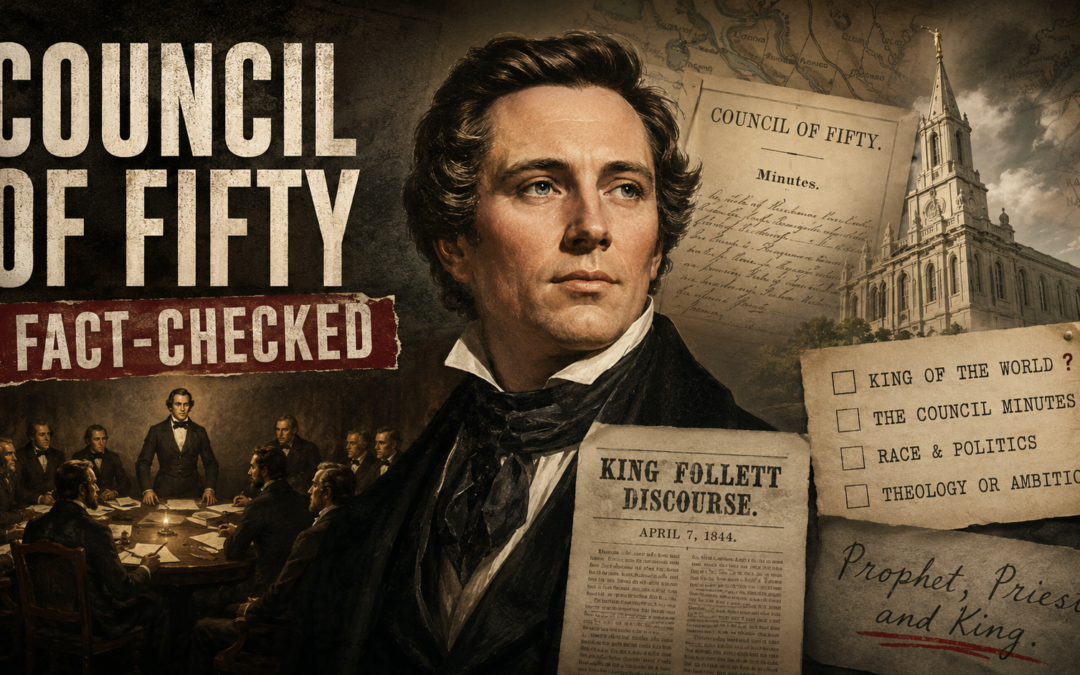
“Joseph Smith Ordained King of the World”: Five Claims About the Council of 50, the King Follett Discourse, and 1844 Politics — Fact-Checked
Mormon Stories covers Chapter 30 of John Turner’s landmark biography with care and scholarly depth. Much of the episode is historically accurate and valuable. However, five specific claims — from Joseph’s supposed “coronation” to his views on race and the meaning of the Council of 50 minutes — need additional context or factual clarification.
About This Episode
Mormon Stories Episode 2140 features host John Dehlin and Dr. John Turner, professor of religious studies at George Mason University and author of Joseph Smith: The Rise and Fall of an American Prophet (Yale University Press).
In this episode, they discuss Chapter 30 of Turner’s book, titled The Kingdom, 1844. Topics include:
Joseph Smith’s presidential campaign
The Council of Fifty
The King Follett discourse
The Nauvoo polygamy controversy
Emma Smith’s public role in denouncing polygamy
Turner is a careful and highly credentialed historian. His biography is widely regarded as one of the most rigorously sourced single-volume studies of Joseph Smith.
Overall, the episode is substantially accurate. Still, several claims are overstated or missing critical context. In one case, a claim is simply incorrect. The historical record provides a more precise picture.
📖
Note on the Source
This episode stands out in our rebuttal series because the guest — Dr. John Turner — directly corrects several of John Dehlin’s overstatements during the interview itself.
Where Turner corrects Dehlin, we note it. Where Dehlin’s framing remains unchallenged despite Turner’s nuance, we address it.
Turner’s book is recommended for readers seeking the full scholarly context.
What the Episode Gets Right
Conceded — Historically Accurate
The Council of Fifty was a real, secret theocratic body with ambitions to replace American governance
The council was organized on March 11, 1844, as the political arm of the Kingdom of God. It aimed to establish a “theodemocracy” in western territories outside the United States. Members took strict oaths of secrecy, and Joseph Smith served as the presiding head.
The council also coordinated Joseph’s presidential campaign and discussed cooperation with Native Americans.
Turner’s description of the council’s ambitions is well supported by the minutes. These include:
Aspirational theocracy
Growing Mormon frustration with the U.S. Constitution
Joseph Smith symbolically breaking a ruler while criticizing existing governments
The Church History Department has also published an official overview confirming these facts.
Bottom Line
The Council of Fifty was real, secret, and politically ambitious. It aimed to establish governance outside existing American structures. The Joseph Smith Papers support the episode’s core description of the council.
However, the actual council minutes present something more limited. Joseph was recognized as the presiding head of a preparatory earthly kingdom that remained subordinate to Jesus Christ, who was still considered “King of Kings.”
The event was politically provocative and theologically bold. Still, it was not a literal claim to global political rule.
Direct Answer
Joseph Smith was acclaimed “Prophet, Priest, and King” within the Council of Fifty. He was not literally crowned king of the world.
Turner explicitly corrects this framing in the episode itself.
The Council of Fifty minutes “fundamentally changed Mormon history”
⚖️ Overstated — Turner Corrects This Too
John Dehlin describes the release of the Council of Fifty minutes as potentially explosive.
Turner disagrees.
He states clearly:
“I would say there’s nothing in the Council of Fifty minutes that fundamentally changes our understanding of the last several months of Joseph Smith’s life.”
No. John Turner directly rejects that characterization in the episode.
Joseph Smith was acclaimed “Prophet, Priest, and King” within the Council of Fifty, not literally crowned ruler of the world.
The Joseph Smith Papers editors also confirmed that later rumors exaggerated what actually occurred.
What did the Council of Fifty minutes reveal?
The minutes confirmed that the council functioned as the political arm of the Kingdom of God and supported Joseph Smith’s presidential campaign.
They also documented secrecy oaths, theodemocratic ambitions, and discussions involving Native Americans.
However, the release of the minutes did not fundamentally rewrite Mormon history.
What does the King Follett discourse teach?
The discourse teaches that:
God was once a man
Humans may become gods through exaltation
Matter is eternal
Faithful believers can inherit divine glory
These teachings became foundational to LDS theology.
Was Joseph Smith an abolitionist?
Joseph Smith’s 1844 platform opposed slavery and proposed emancipation by 1850.
At the same time, his racial attitudes reflected many of the assumptions common among white Americans in the nineteenth century.
Why did Joseph Smith run for president?
After failing to receive political support from major presidential candidates regarding Mormon losses in Missouri, Joseph launched his own campaign.
His platform included anti-slavery proposals, territorial expansion, and government reforms.
What role did Emma Smith play in the polygamy controversy?
Emma publicly denounced polygamy during Relief Society meetings in 1844, even while privately aware that plural marriage was being practiced by church leaders.
Turner notes that this created significant emotional and political tension within Nauvoo.
The Honest Summary
Mormon Stories Episode 2140 is one of the stronger entries in the Joseph Smith series.
John Turner is a careful historian, and his corrections of John Dehlin’s overstatements improve the discussion rather than weaken it.
The episode accurately presents the Council of Fifty as real, secretive, and politically ambitious. It also correctly portrays the seriousness of the Nauvoo polygamy crisis.
Still, five important areas require additional precision:
Joseph Smith was not literally crowned king of the world
His statements about divinity existed within LDS theology about exaltation
The Council of Fifty minutes were significant but not explosive revelations
His racial views were more complex than simple abolitionism
The King Follett discourse deserves recognition as serious theology, not merely political theatre
Readers exploring early Mormon history deserve both honesty and precision. Joseph Smith’s final months were dramatic, controversial, and historically significant. But careful distinctions still matter.
Content is for educational purposes. Sources are cited. Corrections are welcome.
In this section of Mormon Stories, John Dehlin and historian John G. Turner move through four important issues: John C. Bennett’s credibility, Joseph Smith’s Springfield extradition fight and late anti-slavery language, Brigham Young’s “David” loyalty language, and whether those Nauvoo-era conflicts map directly onto the modern Church’s treatment of critics. The conversation is strongest when it stays close to primary documents and weakest when it turns mixed evidence into settled fact or stretches a nineteenth-century crisis into a single modern institutional “playbook.” The purpose of this article is simple: separate what the record clearly shows from what the podcast merely infers.
1. John C. Bennett was compromised, but he was not irrelevant
Segment reviewed: 00:34:31–00:40:30
John Turner: “In in the end, Bennett was a critic without credibility. It was easy for church leaders to expose him as an adulterer, womanizer, and fraud because he was all of those things.” (Timestamp 00:34:31–00:35:12; transcript lines 146–149.)
John Dehlin: “the way Joseph dealt with these dissenters is to smear them into oblivion using an army of his followers by making up lies and smearing and discrediting them” (Timestamp 00:39:09–00:39:49; transcript lines 167–170.)
John Dehlin: “If you add the fact that John C. Bennett was co-president of the church” (Timestamp 00:10:56; transcript line 50.)
Verdict: Bennett was deeply unreliable, but the podcast still overstates the case when it treats him as either wholly worthless or wholly decisive. The “co-president” label is incorrect.
Turner is right that Bennett was morally compromised. Church history sources identify him as assistant president in the First Presidency, not “co-president,” and they also document his fall from grace and excommunication. That means the podcast inflates Bennett’s office when it calls him a co-president. That may sound small, but it matters: inflated titles make later conflict sound bigger and more dramatic than the record requires.
At the same time, Bennett cannot simply be thrown out as useless. Joseph Smith Papers preserves evidence showing that Bennett published materials historians still have to reckon with, including the text traditionally known as the Happiness Letter and the affidavit of Martha Brotherton. So the sound historical approach is not “trust Bennett” and it is not “ignore Bennett.” It is “read Bennett carefully and corroborate him.”
That is also where Dehlin’s framing goes too far. There is evidence that Joseph and his allies mounted a strong public counterattack against dissenters. But this segment does not prove that every damaging statement was knowingly fabricated. Saying Joseph used followers to “make up lies” states more than the sources establish claim by claim.
What readers should know clearly:
Bennett was assistant president in the First Presidency, not a co-president.
Bennett was compromised and often unreliable.
Bennett still transmitted documents and allegations that historians cannot ignore.
The safest conclusion is not total trust or total dismissal, but careful corroboration.
Why this matters: Once a source is called “anti-Mormon” or “without credibility,” readers can be tempted to stop reading entirely. But good history tests hostile sources instead of discarding them automatically.
2. The Springfield legal story is mostly right, but the slavery and Morehouse claims need clearer facts
Segment reviewed: 00:41:18–00:58:37
John Turner: “Joseph’s on the run because he is wanted as an accessory” (Timestamp 00:41:18–00:42:08; transcript lines 176–179.)
John Turner: “And the reasoning is uh Joseph is not a fugitive from justice in Missouri.” (Timestamp 00:43:10; transcript line 182.)
John Dehlin: “I assume that the Mormon church donated money to Mhouse College.” (Timestamp 00:51:45; transcript line 215.)
John Turner: “Joseph’s 1844 platform when it came to slavery actually was pretty bold at the time.” (Timestamp 00:54:47; transcript line 227.)
Verdict: The Springfield extradition points are strong. The “Lincoln before Lincoln” framing is too sweeping, and the Morehouse funding assumption is wrong on the current record.
The legal history here is one of the stronger parts of the segment. Joseph really was being pursued in connection with the attempted assassination of former Missouri governor Lilburn W. Boggs, and the Illinois proceedings really did turn on whether Joseph was a fugitive from justice in Missouri. On that point, Turner’s explanation tracks the historical documents well.
The race discussion is more complicated. Turner is also right that Joseph’s 1844 presidential platform took a notably anti-slavery position for its time. The platform proposed compensated emancipation by 1850 using federal revenue from public lands. That is historically significant. But it does not justify a simple heroic comparison such as “Lincoln before Lincoln.” Joseph Smith Papers also preserves Joseph’s segregationist language, including the statement that Black people should be confined “by strict law to their own species.” So the fuller record is mixed: late anti-slavery movement in one direction, but not modern racial egalitarianism.
The Morehouse point is easier. A portrait of Joseph Smith was unveiled at Morehouse College on February 1, 2026. But later reporting quoted a Church spokesperson saying the Church did not donate money to Morehouse College and did not pay for the portrait. So Dehlin’s assumption about Church funding is unsupported.
What readers should know clearly:
Joseph was pursued in the Boggs case, and the fugitive-from-justice issue really was central in Springfield.
Joseph’s 1844 platform did call for ending slavery by 1850.
That same historical record also includes segregationist language from Joseph Smith.
The current reporting says the Church did not donate money to Morehouse and did not pay for the portrait.
Why this matters: Readers deserve the whole picture. A real anti-slavery plank should be acknowledged, but it should not be used to erase contradictory evidence or to invent facts about a modern event like the Morehouse portrait.
3. Brigham Young’s “David” language shows loyalty pressure, but the podcast turns it into something bigger than the source says
Segment reviewed: 00:59:21–01:05:07
John Turner: “the implication was that the first loyalty of people should be to to Joseph in this circumstance.” (Timestamp 01:00:08; transcript line 248.)
John Turner: “all he had against Orson was when he came home from his mission he loved his wife better than David.” (Timestamp 01:00:56; transcript line 251.)
John Dehlin: “Joseph above all else. Joseph before all, including your own spouse and children, if necessary.” (Timestamp 01:02:58; transcript line 260.)
Verdict: The source does show strong prophet-centered loyalty language. It does not, by itself, prove a universal doctrine of “Joseph before spouse and children.”
This section begins with a real historical point. Joseph Smith Papers explains that Joseph used David-and-Jonathan language in the fall of 1842, and Turner is right that the implication involved strong loyalty to Joseph in a moment of crisis. The phrase about Orson Pratt loving his wife “better than David” is not made up. It is part of the source tradition.
But Dehlin’s next move is the problem. He takes a difficult, situational loyalty test and turns it into an all-purpose slogan: “Joseph above all else.” That is not the same thing. In fact, Turner himself pushes back in the moment and says that reading may overstate what Brigham Young meant, because Brigham also appears to have had sympathy for Orson Pratt’s impossible position.
So the careful conclusion is narrower and stronger: the documents do show real pressure to prioritize Joseph during this crisis. What they do not plainly show is a universal rule that spouse and children always come second.
What readers should know clearly:
The David-and-Jonathan comparison is real and does point to strong loyalty expectations.
The phrase about Orson Pratt loving his wife “better than David” is grounded in the historical record.
Dehlin’s broader slogan goes beyond what the source itself directly states.
Why this matters: Historical sources often reveal pressure, symbolism, and expectations. That does not always mean they establish a complete doctrine in the absolute form later commentators prefer.
4. The modern parallel is an argument, not a proven historical chain
Segment reviewed: 01:05:07–01:10:06
John Dehlin: “the modern LDS church’s approach of smearing its honest critics” (Timestamp 01:05:07; transcript line 269.)
John Dehlin: “shows this repeated pattern of the church going after and smearing and uh character assassinating its critics.” (Timestamp 01:05:48; transcript lines 272–276.)
John Turner: “it is it is all too common.” (Timestamp 01:10:06; transcript line 290.)
Verdict: Some later disciplinary examples named in the segment are real. But this section still does not prove a single uninterrupted Church “playbook” from 1842 to the present.
This is where the podcast shifts from historical analysis into a larger institutional argument. Some of the later cases Dehlin names are real enough. The September Six were disciplined in 1993, and Dehlin himself was excommunicated in 2015. So it would be unfair to say the entire modern application is invented.
But the stronger claim is much bigger: that the Nauvoo crisis of 1842–43 establishes the roots of a modern Church strategy of smearing honest critics. That conclusion is not demonstrated just by lining up several painful episodes from different decades. To prove a claim like that, a writer would need to show continuity of method, continuity of institutional intent, and a direct connection across time. This section does not do that work.
Turner’s reply is more disciplined. He says this kind of behavior is “all too common,” meaning institutions under pressure often justify questionable actions in the name of self-preservation. That is a narrower and more defensible historical point.
What readers should know clearly:
Some modern examples named in the podcast are real.
Those examples alone do not prove one continuous institutional strategy from Nauvoo to today.
The more careful claim is that institutions under threat often react badly, and Mormon history is not unique in that respect.
Why this matters: Readers should distinguish between a strong analogy and a proven historical chain. A pattern can be argued, but it still has to be demonstrated.
Five Places the Podcast Turns “Spiritual Wifery” Evidence into Assumption
Podcast: Mormon Stories — Joseph Smith Podcast Episode: 2112 Series Part 31 Primary topic: John C. Bennett, “spiritual wifery,” Nauvoo scandal framing Tone intent: Critical of overreach, open to evidence either way
The episode raises real historical questions. Nauvoo in 1841–1843 includes documented secrecy, allegations of sexual misconduct, reputational warfare, and deep human cost. Those are not things we should sanitize.
But the podcast also makes several highly subjective leaps—moves where the audience is nudged to treat a plausible interpretation as settled fact, or where modern criminal/abuse categories are pasted onto messy 1840s disputes without careful definitions.
Below are five of the most substantive “subjective overreach” moments—each paired with a tighter, more evidence-disciplined way to read the record.
1) “It seems impossible Bennett wasn’t told by Joseph…”
Why this matters: suspicion is not proof
Timestamp: 00:11:13–00:11:52 Speaker: John Dehlin
“my opinion is it seems impossible that John C. Bennett wasn’t at least told by Joseph Smith about eternal polygamy and began practicing it, you know, after Joseph told him about it.”
“it just it’s it’s too coincidental… he’s going to get accused of spiritual wiferey, but somehow that emerged completely independent and unaware of Joseph’s own polygamy. It just seems impossible.”
Core claim
Because Joseph was privately teaching plural marriage, Bennett’s “spiritual wifery” accusations almost certainly trace back to Joseph’s disclosure/approval.
Claim type
Probability argument / inference presented as near-certainty
Objective analysis
This is a reasonable question—but it’s still a probability claim, not a demonstrated fact.
A more disciplined way to frame it:
Yes, Bennett plausibly had awareness of rumors and/or insider knowledge about plural marriage. The episode itself has Turner concede Bennett had “detailed information,” and the historical documentary record shows “spiritual wifery” accusations swirling in that period.
No, awareness does not equal authorization—especially not authorization for Bennett-style promiscuity framed as “permission if kept secret.” The Joseph Smith Papers editorial framing explicitly distinguishes Bennett’s “spiritual wife” accusations from what Joseph and insiders considered their (separate) plural-marriage practice—and notes that participants did not even use “spiritual wife/wifery” as their own term.
The record also preserves an episode where Bennett publicly denied—strongly—that Joseph ever authorized “illicit intercourse.” That denial doesn’t prove Bennett was truthful forever (he later attacked Joseph), but it does prove the episode is more complicated than “impossible.”
Spiritual framework
You can interpret Nauvoo two very different ways:
Counterfeit-permission framework: “Spiritual wifery” functions as a predatory spiritual pretext—men claiming religious permission for sex while demanding secrecy.
Covenant-layering framework: plural marriage (however controversial) was presented among insiders as a covenant practice under claimed authority—distinct (in their minds) from seduction tactics.
The key point: the podcast often collapses these frameworks into one story, then treats the collapse as proven.
Bottom line
“It seems impossible” is not evidence. A fair conclusion is: Bennett likely knew something—by rumor or disclosure—but the leap to ‘therefore Joseph approved Bennett’s system’ is not proven by the best documentary framing.
Evaluation Table — Segment 1
Claim summary
Category
Evaluation
Sources
“Impossible” Bennett wasn’t told/approved by Joseph
Not Provable (Speculative)
Plausible question, but not demonstrated; documentary framing distinguishes terms and practices; Bennett denial exists
Transcript ; JSP intro on terminology and corroboration limits ; Bennett denial in Times & Seasons publication
Rhetorical tactic tag: certainty inflation (“impossible”) from incomplete data.
2) “This is where the Church’s long history of coverups of sexual abuse begins”
Why this matters: anacty into indictment
Word-for-word quote
Timestamp: 01:13:58–01:15:36 Speaker: John Dehlin Transcript lines: 317, 320
“this is where the Mormon church’s super long history of coverups”
“of sexual uh, abuse scandals begins… the playbook… begins in in 1842 Nauvoo”
Core claim
A Nauvoo-era caution about publicity is the origin point of modern institutional sexual-abuse coverups.
Claim type
Institutional motive attribution + modern scandal backcasting
Objective analysis
This is one of the episode’s biggest interpretive leaps:
The transcript segment is triggered by language about public scandal management (“don’t make everything public…”). That is not automatically a “sexual k.” It can be (and often is) general crisis containment—sometimes wise, sometimes cowardly, soming on what is being concealed and why.
The Relief Society minutes and Church Historian’s Press material show the same era also includes women and leaders emphasizing moral reform and “putting down iniquity.” That complicates any simple “coverup origin story.”
Even the Church’s own modern historical synthesis acknowledges a dilemma in the 1842 public denials: leaders wanted to refute Bennett’s accusations without publicly explaining confidential plural marriage. That’s not flattering—but it’s not identical to “covering sexual abuse.”
Bottom line
The podcast is right that Nauvoo leaders engaged in reputation management. It is not shown that this equals the “beginning” of modern sexual-abuse coverup systems. That claim is too categorical for the evidence being discussed.
Evaluation Table — Segment 2
Claim summary
Category
Evaluation
Sources
“1842 Nauvoo = origin of LDS abuse-coverup playbook”
Misleading (Anachronism)
Evidence supports scandal-avoidance language and confidentiality dilemmas, not a proven causal origin of modern abuse coverups
Transcript ; Relief Society minutes context (Church Historians Press) ; Church Historian’s Press on denial dilemma ; Gospel Topics essay framing “spiritual wifery” + denials
“the smearing, the use of lies to smear uh truthful whistleblowers. Is that fair to say?”
“I think that’s certainly fair to say in this context… yes.”
Core claim
Joseph/Church used deliberate lies to smear women who were truth-tellers and “whistleblowers.”
Claim type
Defamassertion (“lies,” “truthful”) presented as settled
Objective analysis
There are two separate questions the podcast merges into one:
Were there public conflicts and reputational attacks? Yes—Nauvoo’s Bennett crisis produced dueling claims, affidavits, public statements, and deep polarization.
Were the targeted women “truthful whistleblowers,” and were the counterclaims “lies”? That is not something you get to assert as a premise. It requires case-by-case evidence and careful weighting of sources, timing, incentives, and corroboration.
Even Church Historian’s Press framing makes clear that public denials were shaped by a dilemma: refuting Bennett while not publicly disclosing confidential plural marriage. That context can generate misleading public messaging—but “misleading under a confidentiality dilemma” is not automatically identical to “knowing lies to smear truthful whistleblowers.”
The episode’s moral outrage may be understandable, but the language “lies” and “truthful whistleblowers” fun delivered before the evidentiary trial.
Evaluation Table — Segment 3
| 01:25:01 | 01:25:47 | “Lies used to smear truthful whistleblowers” | Not Provable (Overstated) | Conflict and reputation warfare are documented; calling one side “truthful” and the other “lying” requires claim-by-claim proof not provided here | Transcript ; Times & Seasons contextual framing (JSP) ; Church Historian’s Press: public denials dilemma |
Rhetorical tactic tag: verdict language (“truthful,” “lies”) without evidentiary scaffolding.
4) The Whitney letter: “I need sex… bring your daughter” + “trafficking”
Why this matters: you can be morally critical without making claims the text doesn’t make
Word-for-word quotes
A) Letter read aloud, then reinterpreted Timestamp: 01:57:43–01:59:00 Speaker: John Dehlin (reading and then paraphrasing)
“I take this opportunity to communicate some of my feelings privately…”
“…it would afford me great relief… now is the time to afford me sucker in the days of exile.”
“I wanna I need some sex. Can you bring your daughter?”
B) Criminal-label escalation Timestamp: 02:00:56 Speaker: John Dehlin
“they’re complicit in not only trafficking their daughter to Joseph Smith”
C) Turner’s own corrective—spiritual motivation claim Timestamp: 02:10:02 Speaker: John Turner
“trafficking. Well, first of all, they believe what Joseph is telling them theologically…”
Core claims
The letter’s “succor” language is basically a request for sex with a teenager.
The parents “trafficked” their daughter.
retive paraphrase → asserted as meaning; then criminal-label rhetoric
Objective analysis
This is where precision matters most.
What the transcript does establish
The letter (as read in the episode) is emotionally intense, requests a visit, and includes secrecy cues (the episode discusses burning the letter and hiding from Emma). That is legitimate evidence of a clandestine relationship and concealment—at minimum.
“Succor” in early English usage means help/aid/relief, not inherently sex. The podcast’s phrase “sexual sucker” is not an evidentiary translation; it’s an interpretation layered onto the word.
The letter is a known historical document (the Joseph Smith Papers hosts it).
What the transcript does not establish
The paraphrase “I need some sex” is not the text. It may reflect Dehlin’s impression of the implications, but it is still an inference—and should
“Trafficking” is a modern criminal term with defined elements (force, fraud, coercion, exploitation frameworks,h-century clandestine sealing arrangement “trafficking” is rhetorically explodoes not match the legal definition** as used by major authorities.
A more honest critical phrasing
If someone wants to be ethically critical without overclaiming, a tighe:
“The letter strongly suggests secrecy and a clandestine relationship involving a 17-year-old. That is ethically disturbing to many modern readers, and the concealment from Emma raises serious moral questions.”
That’s strong criticism—without imbel the evidence in this segment doesn’t establish.
The Whitney letter is serious evidence of secrecy and relationship complexity. But “I need sex” and “trafficking” are interpretive escalations, not direct textual conclusions.
Evaluation Table — Segment 4
Claim summary
Category
Evaluation
Sources
“Succor” letter = “I need sex”
Misleading (Interpretation stated as text)
The episode reads the letter, then inserts sexual paraphrase; secrecy is evidenced, but sex is not explicitly stated in the quoted wording
Transcript ; Webster 1828 on “succor” meaning aid/relief ; JSP hosts the letter
Parents “trafficked” their daughter
False / Defamatory Label (as used here)
The term “trafficking” has defined elements; this segment does not establish those elements; better to use accurate moral language without criminal claims
Transcript ; U.S. State Dept definition overview ; UN Palermo Protocol definition framework
Rhetorical tactic tag: prosecutorial labeling (high emotional impact, low evidentiary fit). Risk flag: 🔴 High false-light risk for “trafficking.”
5) “The difference between Joseph and Epstein/Jeffs is indistinguishable”
Why this matters: disgust-transfer is not historiography
Word-for-word quote
Timestamp: 01:32:22–01:33:04 Speaker: John Dehlin
“the difference between him and Jeffrey Epstein and Warren Jeffs is indistinguishable”
Core claim
Joseph Smith is morally indistinguishable from modern, infamous sexual predators.
Claim type
Analogy as verdict
Objective analysis
Analogies can be useful when they clarify a mechanism. This one mostly does something else: it imports moral certainty from modern criminal cases into a historically contested, differently documented context.
Even if one concludes Joseph behaved grievously, “indistinguishable” is still an overreach because:
Modern predator cases often involve documented criminal patterns, victims, corroboration structures, and legal adjudication that are not parallel to how 1840s records function.
The analogy short-circuits evidence: it pressures the listener to feel that the conclusion is already morally decided, so source analysis becomes almost irrelevant.
A more evidence-open approach would be:
“Some patterns of secrecy, authority, and sexual access claims raise ethical concerns. But we should still evaluate each Nauvoo allegation on its own documents rather than collapsing everything into type.”
This analogy is emotionally potent but evidentially weak. It functions as rhetorical “verdict language,” not careful historical reasoning.
Evaluation Table — Segment 5
Claim summary
Category
Evaluation
Sources
Joseph “indistinguishable” from Epstein/Jeffs
Misleading (False Equivalence)
Emotional comparison substitutes for documentary argument; doesn’t adjudicate specific Nauvoo claims
Transcript
Rhetorical tactic tag: guilt-by-association / disgust transfer. **Risk flag:*false-light risk (implied equivalence to child sex abuse).
What we can responsibly say after these five corrections
If we’re trying to be critical and evidence-based:
The episode is right to treat Nauvoo as morally and historically complex.
But it repeatedly blurs three categories:
documented secrecy and scandal-control,
documented public controversy/affidavits/dueling claims, and
proven criminal abuse systems (a modern category with defined terms).
Keeping those separate doesn’t “exonerate” anyone. It just keeps us honest.
Sources consulted for this blog
(Only transcript quotes above are quoted; sources below are used for documentary framing and definitions.)
Joseph Smith Papers — Introduction to Journals: Volume 3 (terminology + corroboration cautions reery”)
Joseph Smith Papers — Times and Seasons, 1 Oct. 1842 (“On Marriage”) (distinguishes Bennett’s “secret wife system” from insider plural marriage framing)
Joseph Smith Papers — Letter to the Church and Others… as published (Bennett denial episode in the record)
Joseph Smith Papers — Letter to the Whitneys, 18 Aug. 1842 (document hosting)
Webster’s 1828 — “succor” (meaning as aid/relief)
Church Historian’s Press — Relief Society minutes entry containing “little tale will set the world on fire” context
Church Historian’s Press — Statement context on public denials dilemma (Doc 1.6)
Gospel Topics Essay — Plural Marriage in Kirtland and Nauvoo (mentions rumors, “spiritual wifery,” and carefully worded denials)
U.S. Dept. of State — “What is trafficking in persons?” overview definition framework
There is no documentary evidence that Joseph practiced or revealed polygamy in 1831–32. Later recollections cannot overturn contemporary scripture and records.
Podcast
Mormon Stories Podcast – John Dehlin & John Turner
Episode
Did Joseph Smith Speak in Tongues? (Pt. 12) – Ep. 2053
Title
“Joseph secretly began polygamy in 1831–32.”
Category
Polygamy / Early Doctrine
Quote
“Joseph Smith privately removed ambiguity from the matter about the time Jesse Gaus was converted… Joseph told individuals that he had inquired of the Lord concerning the principle of plurality of wives and received for answer that it was a true principle.” — John Dehlin citing Quinn, 00:23:55–00:29:30
Core Claim
Joseph introduced polygamy as early as 1831–32, decades before Nauvoo.
Conclusion
Unverified → Retroactive Memory Inflation
Logical Questions
Are there contemporary 1830s records confirming this?
What does the 1835 Doctrine & Covenants say?
Do later reminiscences outweigh primary evidence?
🔍 Core Finding
📖 Doctrinal Context
The Book of Mormon (Jacob 2:27–30) condemns polygamy except if God commands it. No revelation on polygamy was canonized until D&C 132 (1843). In 1835, the official D&C explicitly denied polygamy (D&C 101:4, 1835 edition).
The claim rests on speculation, not evidence. Even D. Michael Quinn admitted ambiguity. The historical record shows Joseph did not introduce formal polygamy until the 1840s.
📊 Factual Verification
No 1831–32 document in the Joseph Smith Papers records a polygamy revelation.
The only “evidence” is William Phelps’ 1861 recollection—30 years later.
Joseph’s first known plural marriage was to Fanny Alger (~1835–36), not 1831.
🤔 Likely Misunderstanding
Critics assume later recollections prove early polygamy. But memory inflation decades after Joseph’s death (esp. amid RLDS vs. Utah debates) is unreliable compared to contemporaneous records.
⚖️ Legal / Media Literacy Note
Presenting speculation as fact risks misleading audiences and mischaracterizing Joseph’s history.
There is no documentary evidence that Joseph practiced or revealed polygamy in 1831–32. Later recollections cannot overturn contemporary scripture and records.