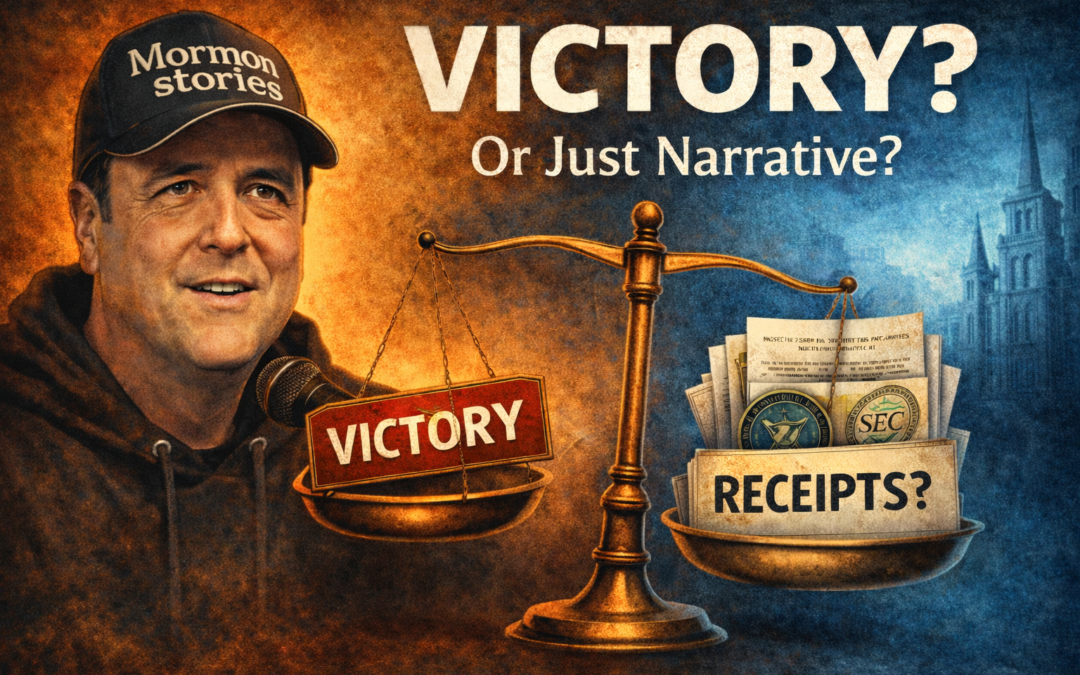
Can Mormon Podcasters Declare “Victory”? Five Claims in John Dehlin’s Essay That Need Stronger Receipts
A critical-but-evidence-open analysis of five of the most subjective or least-supported claims in John Dehlin’s Feb. 11, 2026 Substack post—distinguishing
documented facts from asserted motives, causal credit-claims, and numbers presented with more certainty than the sources warrant.
How we grade claims: “True” means the claim is strongly supported by publicly verifiable sources.
“Partial” means directionally supported but overstated. “Misleading” means a rhetorical move that reads as fact but isn’t proven.
“Not Provable” means evidence is not provided or not accessible publicly at the claimed level of certainty.
#
Claim
Why it matters
1
Church “intentionally hid” history and “punished truth-tellers”
Asserts institutional intent as fact without producing the internal evidence required to prove intent.
2
Podcasts “forced” transparency projects and policy shifts
Converts possible influence into claimed causal control without receipts from decision-makers.
3
“Over $300B” + “fraud/cover-up” framing
Uses a mix of estimates and enforcement actions, then upgrades them into a single settled “fraud” narrative.
4
“Internal pollsters” + SEO drove the “Mormon” rebrand
Highly specific internal-knowledge claim offered without any underlying poll, memo, or dataset.
5
Women “serve at equal rates” as men
It’s verifiable—and reporting indicates women are ~30%, not 50%.
1) “Intentional hiding” + “punishing truth-tellers” is asserted as fact, not demonstrated
Where it appears in Dehlin’s essay: around lines 43–44.
Dehlin’s wording:
Church intentionally hiding its problematic history
Objective issue
This is a motive claim at institutional scale. Motive can be argued, but it can’t be declared as settled fact without
internal documentation (policies, directives, admissions) showing an intent to hide information—versus uneven teaching, cultural
assumptions, or “correlated” curriculum choices.
What the evidence can support
There are documented cases where prominent thinkers faced Church discipline (e.g., the “September Six”), supporting a narrower claim: some public dissent collided with institutional boundaries.
But “directly due to intentional hiding” is a stronger conclusion than the publicly available evidence in the essay itself establishes.
What would count as proof?
Internal communications instructing leaders/teachers to withhold specific historical facts to preserve belief.
Decision-maker testimony that concealment (not pedagogy, not prioritization, not correlation) was the goal.
2) “Podcasts forced transparency” is influence presented as proven causation
Where it appears in Dehlin’s essay: around lines 49–60.
Dehlin’s wording: forced the LDS Church (Substack line ~49)
Objective issue
It’s plausible that podcasts and online criticism added pressure. The problem is the upgrade from “we influenced” to “we forced”—a causation claim that requires evidence from inside the decision chain.
What the record supports
The transparency projects exist (Joseph Smith Papers, Gospel Topics pages/essays, Saints volumes).
The Joseph Smith Papers Project was officially established in April 2001—well before the “podcast era” framing centered on pre-2005.
That does not disprove later influence, but it does undermine “podcasts caused it” as a simple story.
Evidence-open framing
A defensible middle-ground claim is: podcasts likely contributed to external awareness and pressure, while these projects also reflect
long-running internal archival work, scholarly standards, and institutional priorities.
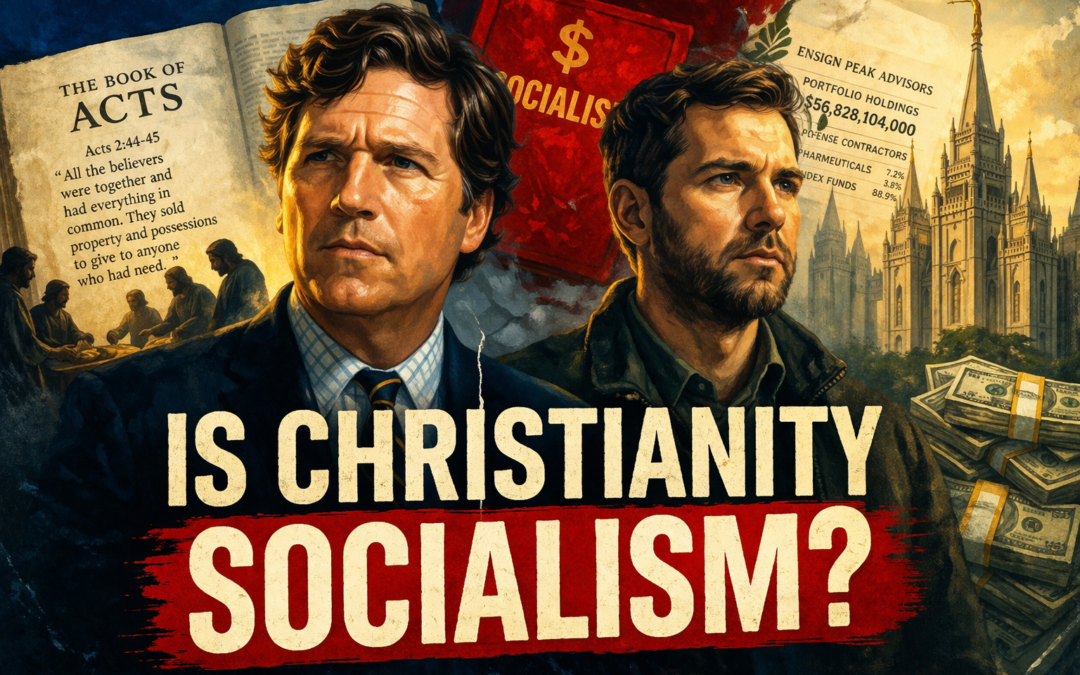
“Hundreds of billions” is often discussed as an estimate (combining models for investments and other assets).
But presenting a single round number as a settled audited fact—then labeling the entire story “fraud”—blurs: (a) what is proven by enforcement actions, (b) what is estimated, and (c) what is moral judgment.
What the record supports
The SEC described disclosure violations related to Ensign Peak and the use of shell entities to obscure the Church’s equity portfolio
and control structure, with fines totaling $5 million.
The SEC action is real; what it proves is specific (a disclosure/reporting structure and related failures), not a blanket finding that
“the Church committed $300B fraud.”
Evidence-open correction
A maximally accurate phrasing is: “The SEC found serious disclosure violations tied to Ensign Peak’s reporting approach; separately,
analysts estimate total Church assets in the hundreds of billions. Treat the $300B+ figure as an estimate unless an audited total is publicly released.”
Where it appears in Dehlin’s essay: around line 69.
Dehlin’s wording (short excerpt): internal LDS Church pollsters (Substack line ~69)
Objective issue
This claim is both specific and consequential (it asserts internal polling results and strategic branding causation).
But the essay does not provide the poll, the methodology, or any internal documentation—so readers can’t verify it.
What we can verify publicly
President Nelson publicly framed the naming emphasis as a doctrinal issue (removing the Savior’s name from the Church’s name, etc.).
Whether one accepts that rationale or not, it is the stated public reason and must be weighed.
Media dynamics (including SEO) are plausibly part of modern institutional communications—but “this caused the rebrand” needs evidence.
Evidence-open approach
If Dehlin (or others) can produce the polls or internal docs, this claim becomes testable. Until then, it’s best classified as Not Provable and should be treated as an interpretation—not a documented fact.
5) “Women now serve at equal rates” is checkable—and doesn’t check out
Where it appears in Dehlin’s essay: around line 91.
Dehlin’s wording (short excerpt): women now serve at equal rates (Substack line ~91)
Objective issue
This is the kind of claim that strengthens an argument only if it’s accurate. “Equal rates” implies parity (roughly 50/50).
Public reporting does not support that.
What the public sources support
The Church announced (Nov 21, 2025) that women can serve at age 18 (same minimum age as men), effective immediately.
Reporting around that announcement described women as roughly ~29% of missionaries—not “equal rates.”
Evidence-open correction
A more accurate claim is: “Women can now serve at the same minimum age as men (18), and women’s participation has risen—but it is still not equal in share.”
MormonTruth is critical of overreach and open to evidence. For the disputed causal and internal-knowledge claims above,
the fastest path to clarity would be:
Internal documentation (polls, memos, emails, meeting notes) showing what leadership believed and why decisions were made.
Decision-maker testimony linking specific transparency actions directly to podcast/media pressure (not just general “internet age”).
Clear definitions (e.g., what “fraud” means legally vs. morally; what counts as “forced”).
A Comparative Legal, Theological, Empirical, and International Analysis for an Interfaith Audience
Prepared for publication on mormontruth.org. This white paper is informational and does not constitute legal advice.
Abstract
This white paper offers an exhaustive, well-sourced examination of whether and how mandatory child‑abuse reporting should apply to local leaders in The Church of Jesus Christ of Latter‑day Saints (LDS). We evaluate arguments on both sides using evidence from United States case law and statutes, public‑health and social‑work research, theological frameworks across traditions (Latter‑day Saint, Catholic, Orthodox, Protestant, Jewish, Muslim), comparisons to health‑care and elder‑care industries, and current developments in common‑law jurisdictions abroad (notably Australia and the UK). We use the Arizona “Adams” case—in which an LDS bishop did not report an abuser—as a central case study for why mandated reporting can be valuable, while also integrating research (including Public Square Magazine’s critique) that cautions about system overload, false positives, and chilling effects on help‑seeking.1Table of Contents
Executive Summary
Mandated reporting can save children by triggering faster investigations and stopping ongoing abuse. The Arizona case illustrates risks when clergy do not report.2
But expanded mandates can also harm when overbroad: research shows universal mandates increase unsubstantiated reports and burden systems without improving substantiated safety outcomes; they can deter victims and families from seeking help.178
U.S. statutes vary widely. Some states require clergy to report with no privilege exceptions (e.g., New Hampshire, West Virginia). Others mandate reporting but preserve a clergy‑penitent privilege for confessions. Litigation is active (e.g., Washington State 2025 injunction protecting the Catholic seal of confession).91011
LDS theology has no sacramental confession analogous to Catholic practice, but communications in pastoral counseling are often covered by clergy‑penitent privilege under state evidence law. Church materials emphasize a victim‑first, safety‑first approach and compliance with law.1213
Internationally, several Australian jurisdictions require clergy to report even confessional disclosures; the UK is rolling out a mandatory duty to report child sexual abuse; France has debated confession‑seal limits after abuse inquiries.141516
Recommendation in brief: Adopt a global, church‑level policy that (1) treats immediate victim safety as paramount; (2) requires reporting where civil law mandates it; (3) empowers leaders to encourage and assist reporting even when not mandated; (4) separates pastoral care from investigations; (5) standardizes training; and (6) respects lawful confidentiality regimes (e.g., the Catholic seal for interfaith contexts) while maximizing safety planning and support.
Definitions & Scope
Mandated reporting: Statutory duty to report suspected child abuse/neglect to civil authorities. Scope varies by jurisdiction (who must report, when, what counts as “reasonable suspicion”). See U.S. summaries by the Child Welfare Information Gateway.17
Clergy‑penitent privilege: Evidence‑law protection for confidential spiritual communications; scope and exceptions vary by state and country.10
LDS leadership in scope: Bishops, branch presidents, stake presidents, Relief Society/Elders Quorum presidencies, youth leaders, and other calling‑holders who may receive abuse disclosures during ecclesiastical duties.
Case Study: The Arizona Bishop Non‑Reporting Case
In Arizona, a Latter‑day Saint bishop consulted the Church’s helpline after a member confessed to sexually abusing his children. Relying on Arizona’s clergy‑penitent provisions, the bishop did not report. Subsequent investigations revealed years of continued abuse, sparking litigation and national scrutiny.2 In 2023, the Arizona Supreme Court affirmed that clergy could invoke privilege under state law in civil discovery,3 while later appellate proceedings questioned the scope of any duty to report and allowed claims to proceed.4
Why this case is often cited for mandated reporting: It exemplifies how privilege combined with permissive reporting (or institutional caution) can leave children at risk if disclosure isn’t promptly relayed to civil authorities. Survivors and advocates point to this outcome to argue for clearer reporting duties on clergy.
Theological Frames: LDS & Interfaith Contexts
LDS Perspective
The LDS Church condemns abuse categorically and emphasizes immediate victim protection, compliance with civil law, and assistance for survivors. Official materials and handbook guidance underscore that abuse “cannot be tolerated in any form” and that the Church’s first responsibility is to help victims and protect the vulnerable.121819 Local leaders are counseled to follow the law and may consult the Church helpline to navigate complex statutory duties.20
Catholic & Orthodox Perspectives
In Catholic theology, the seal of confession is “inviolable” (Canon 983–984), and priests are excommunicated for directly violating it.2122 This creates intense legal‑theological conflict where statutes compel disclosure of confessional admissions. Recent U.S. litigation in Washington protected the confessional seal (preliminary injunction), even as priests remain mandated reporters outside confession.11
Protestant, Jewish, Muslim, and other traditions
Most non‑sacramental traditions still rely on pastoral confidentiality. U.S. evidence rules in many states extend privilege to clergy across faiths for confidential spiritual counseling—though mandated reporting statutes may narrow that privilege in child‑protection contexts.10
U.S. Law & Policy Landscape for Clergy Reporting
States take markedly different approaches. The Child Welfare Information Gateway summarizes these patterns and notes frequent statutory amendments.1017
Approach
Illustrative Jurisdictions
Notes
Clergy are mandated reporters; confession not exempt
New Hampshire; West Virginia
Statutes deny clergy‑penitent privilege in child‑abuse contexts; duty applies even to pastoral/confessional settings.2324
Clergy mandated; confessional exception preserved
Many states (e.g., California retains a penitential‑communication exception)
Mandate exists but does not require breaching sacramental confession; other disclosures must be reported.2526
Recent constitutional litigation on confession
Washington (2025)
Federal court enjoined application of a new law to confessional disclosures; court highlighted inconsistent treatment vs. attorney privilege in parallel statute.11
Clergy not mandated reporters
Small number of jurisdictions
Some provide immunity if clergy choose to report; consult current state summaries.10
Other notable litigation includes a 2020 Montana Supreme Court case involving Jehovah’s Witnesses, which applied a statutory clergy exception to reverse a civil verdict for failure to report.27
What the Evidence Says
Do broader mandates improve child safety?
Peer‑reviewed studies find that universal mandated reporting (UMR) produces more reports—but not more substantiated cases; in some analyses, the proportion of unconfirmed reports increases and non‑professional reporters dominate, straining limited capacity.7828 Casey Family Programs’ evidence syntheses reach similar conclusions.29
System effects and family impacts
Investigative journalism and policy analyses (e.g., ProPublica/NBC’s Pennsylvania deep dive) show surges in hotline calls after legal expansions, with many allegations unsubstantiated, contributing to caseload saturation and delayed responses for the most endangered children.6 Meta‑synthesis research documents that caregivers and even child survivors may avoid services or fear disclosure because of mandatory reporting, undermining help‑seeking and therapeutic alliance.30
COVID‑period “natural experiment”
During early 2020, contact with mandated reporters (e.g., teachers) dropped markedly; some studies observed fewer reports but a higher proportion substantiated—consistent with a signal‑to‑noise problem in high‑volume regimes.31
Bottom line
Expanding mandate breadth alone is not a panacea. Targeted, trained reporting coupled with robust services and safety planning performs better than flooding hotlines with low‑quality reports. This aligns with the critique summarized by Mical Raz, MD, PhD: “increase supporting, not just reporting.”1
Comparators: Health Care, Hospitals & Nursing Homes
In U.S. health care, clinicians are widely mandated reporters for child abuse. HIPAA expressly permits required disclosures for child‑abuse reporting; thus privacy rules do not block compliance with state reporting statutes.3233 In elder care, the Elder Justice Act requires reporting of reasonable suspicion of crimes in federally funded long‑term‑care facilities within strict timelines, with penalties for failure to report.3435
Relevance for churches: These sectors show how confidentiality and duty‑to‑report can coexist where (a) roles are clear, (b) training is standardized, (c) timeframes are explicit, and (d) good‑faith reporters receive immunity. For ecclesiastical settings, analogous training and clear thresholds can improve reporting quality without obliterating legitimate confidentiality space (e.g., legally protected confession).
International Perspectives
Australia
Following the national Royal Commission, multiple jurisdictions imposed duties that encompass clergy; Queensland’s 2020 reforms criminalize failure to report or protect, removing reliance on the confessional seal for child‑sexual‑abuse matters.143637 Other states (e.g., Victoria, ACT) moved in similar directions;38 New South Wales created a criminal adult duty to report child‑abuse offenses (s.316A), while debates continue regarding confession‑specific carveouts.3940
United Kingdom
The UK (England) is introducing a mandatory reporting duty for child sexual abuse, following consultation and government response in 2024–2025; implementation details continue to evolve across services and faith settings.154142
France
After a landmark abuse inquiry, French debates have focused on whether civil law should override the confessional seal; government officials have pressed priests to report abuse notwithstanding sacramental claims, while bishops’ conferences have issued guidance to strengthen safeguarding.1643
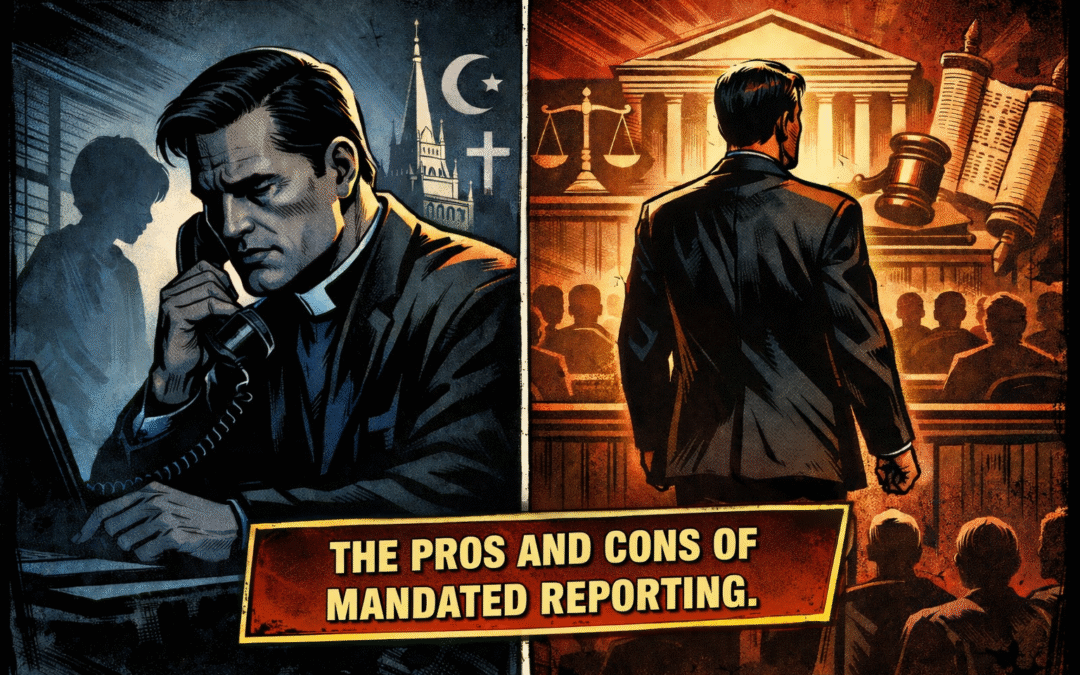
Pros and Cons of Mandated Reporting for LDS Leaders
Strong Arguments for Mandated Reporting
Immediate safety and timely intervention. Mandates can trigger faster law‑enforcement and child‑protection responses, stopping ongoing abuse—as the Arizona case tragically illustrates when reporting does not occur.2
Clarity and accountability. Clear legal duties reduce hesitation by lay clergy unfamiliar with complex statutes. Good‑faith immunity laws protect reporters, and standardized training improves threshold judgments.10
Consistency with other protective sectors. Health‑care and elder‑care frameworks show that privacy and reporting can coexist when systems are designed well (HIPAA allows these disclosures; elder‑care mandates exist).3234
Deterrence and culture change. Public knowledge that disclosures of active abuse will be reported may deter offenders and can shift organizational norms toward survivor‑first practices.
Strong Arguments against Broad or Absolute Mandates
Empirical concerns. Research shows universal mandates increase low‑quality reports without improving substantiation or safety, potentially reducing protection for the most at‑risk children by diverting resources.729
Chilling effects on help‑seeking. Survivors, non‑offending caregivers, and even potential offenders may avoid clergy, therapists, and clinicians if they fear automatic reporting, undermining early intervention and pastoral care.301
Interfaith and constitutional conflicts. In traditions with sacramental confession, compelled disclosure can violate religious exercise; federal courts have enjoined such laws (Washington 2025), especially where comparable privileges (e.g., attorney‑client) remain intact.11
Jurisdictional variability and legal exposure. LDS is global; bishops face a patchwork of rules. A one‑size policy risks conflicts with local statutes; careful harmonization is necessary.10
Objective Policy Recommendations for the LDS Church
Victim Safety as the Prime Directive. Make explicit: if anyone is in imminent danger, leaders must act immediately to secure safety (call 911/emergency services) regardless of privilege questions.
Always Obey Applicable Law. Where civil law mandates reporting (e.g., NH, WV; many international jurisdictions), the Church’s policy should require clergy to report in compliance with statute and within prescribed timeframes.232414
When not mandated, maximize assisted reporting. Encourage and assist victims or guardians in making the report; with their consent, accompany them. Document safety planning and referrals (medical, therapeutic, legal advocacy).
Maintain a robust, jurisdiction‑aware helpline. Staffed by attorneys and licensed clinicians able to (a) map local law, (b) help leaders gauge “reasonable suspicion,” and (c) craft safety plans that do not impede civil investigations.20
Clear separation of roles. Ecclesiastical interviews for spiritual care should not attempt to investigate. Avoid questions that could contaminate evidence; refer to professionals promptly.12
Training & certification. Require initial and periodic training for all leaders and youth‑facing callings on (a) recognizing abuse, (b) jurisdiction‑specific reporting, (c) trauma‑informed care, and (d) documentation.18
Communication & transparency. Post ward/stake‑level guidance on how members can report abuse externally and within the Church; include QR codes to state hotlines and to Church resources for victims.12
Interfaith sensitivity. In ecumenical ministries (e.g., community coalitions) or in countries with confession‑seal laws, coordinate policies to respect protected religious rites while still prioritizing safety planning and lawful reporting outside sacramental contexts.2111
Data, audits, and continuous improvement. Track de‑identified metrics (time to report when mandated, referral types, training completion) and audit annually to improve practice and reduce harm.
Model Policy Language
Mostly adapted in current Church policy:
1. Immediate Safety. When abuse is suspected or disclosed and any person is at imminent risk, leaders must contact emergency services immediately.
2. Compliance with Law. Leaders shall comply with all applicable civil child‑protection reporting laws. Where the law requires clergy reporting, leaders shall report within the statutory timeframe. Where the law prohibits disclosure of certain privileged communications, leaders shall respect such prohibitions while pursuing lawful safety planning.
3. Assisted Reporting. Absent legal barriers, leaders will encourage and assist victims, guardians, or witnesses to report to authorities and will facilitate access to medical and therapeutic services.
4. Pastoral Care vs. Investigation. Leaders provide spiritual care. They will not conduct civil or criminal investigations and will avoid questioning that could compromise evidence.
5. Consultation. Leaders shall contact the Church’s helpline to obtain jurisdiction‑specific legal and clinical guidance and to develop a trauma‑informed safety plan.
6. Documentation. Leaders will make a contemporaneous pastoral note of the date/time of disclosure, actions taken to ensure safety, whether a report was made (and by whom), and referrals provided—stored consistent with Church record policies and applicable law.
7. Training. All leaders and youth‑facing callings must complete initial and triennial training on abuse prevention, recognition, legal duties, and trauma‑informed response.
8. Communication. Units will publicly post and routinely circulate information on how to report abuse to civil authorities and within the Church, including links to local hotlines and Church victim‑assistance resources.
Implementation Checklist for Stakes & Wards
Designate a stake safeguarding specialist to track local law changes and coordinate training.
Maintain a one‑page local reporting “cheat sheet” with hotlines, timelines (e.g., “within 24 hours”), and immunity provisions.
Run simulated reporting scenarios annually for bishoprics and youth leaders.
Establish referral partnerships with licensed therapists and child‑advocacy centers.
Ensure two‑adult policies and visibility practices for youth activities are enforced.
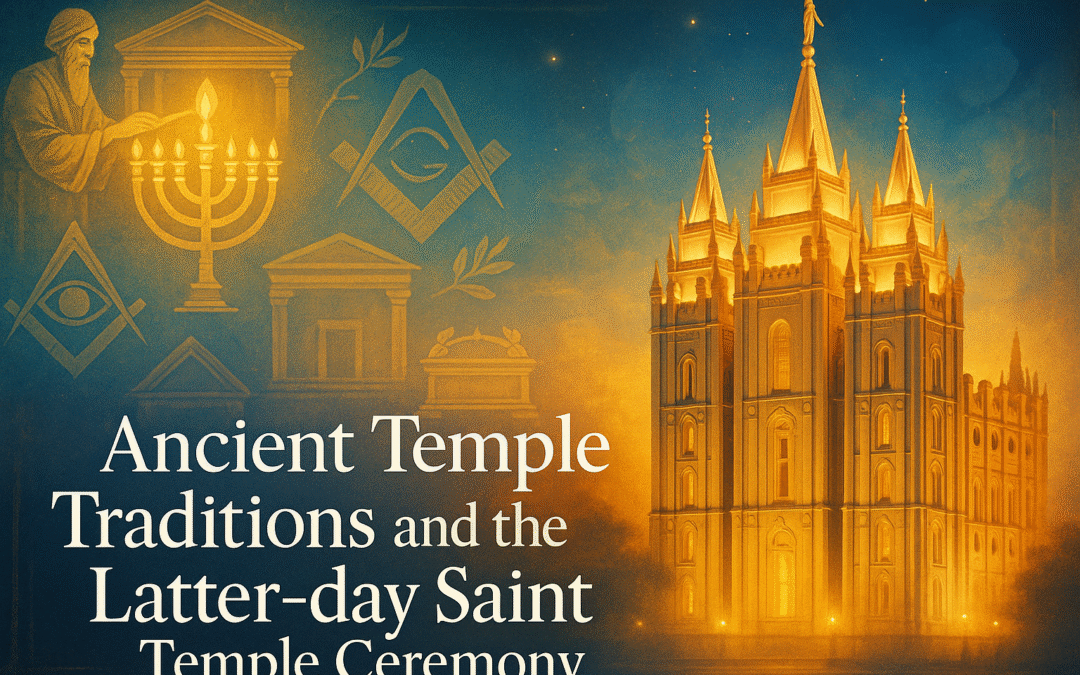
Ancient Temple Traditions and the Latter-day Saint Temple Ceremony
Abstract: This paper explores the origins, structure, and theological claims of the Latter-day Saint (LDS) temple ceremony, particularly the Endowment, in comparison with ancient Israelite and early Christian temple traditions. It incorporates scholarship from both LDS and non-LDS sources, including the work of Margaret Barker, and evaluates common critiques against the LDS temple experience from a doctrinal, historical, and psychological perspective. The paper ultimately argues for a pattern of restoration that connects modern LDS temple worship with ancient sacred traditions and practices.
Introduction
The temple holds a central place in Latter-day Saint theology and worship. Yet for many modern Christians—and especially former members of the Church of Jesus Christ of Latter-day Saints—the temple ceremony can seem unfamiliar, unnecessary, or even troubling. This study aims to evaluate whether the LDS temple ceremony is grounded in historical religious practices and if it is, as Latter-day Saints claim, a restoration of ancient ordinances and symbols.
1. Ancient Israelite Temple Worship
Temple rituals in ancient Israel involved washings, anointings, sacred clothing, covenants, and access restrictions to sacred spaces. The High Priest entered the Holy of Holies once a year, wearing white linen and performing sacrificial atonement (see Leviticus 16). These forms find reflection in the LDS temple, especially in the Initiatory and Endowment rituals.
Methodist scholar Margaret Barker has posited that King Josiah’s reforms around 623 BCE removed elements of Israel’s older temple theology—such as the divine feminine (Asherah), visionary ascent theology, and the role of the High Priest as a mediator figure. Barker’s work has been received positively by many LDS scholars due to its alignment with Latter-day Saint temple doctrines, including belief in a Heavenly Mother and sacred rituals as a means of ascending into the divine presence.
Barker’s key texts: The Older Testament, Temple Theology, Great High Priest.
3. Josiah’s Reforms: Loss or Purification?
2 Kings 22–23 describes Josiah’s purge of high places and the “discovery” of a lost book of the law, which many scholars identify as an early version of Deuteronomy. Barker argues that these reforms may have suppressed legitimate temple teachings such as wisdom traditions, anointing rites, and the divine feminine. LDS scriptures such as the Book of Mormon claim that “plain and precious” truths were taken from ancient records (1 Nephi 13).
4. Early Christianity and Temple Imagery
Early Christians saw Jesus as the new High Priest (Hebrews 9–10), and the temple veil’s tearing as symbolic of broader access to God—not the end of ritual or sacred space. Many early Christian communities maintained liturgical practices, including washings (baptism), anointings (chrism), sacred meals (Eucharist), and even marriage as a sacred rite (see Gospel of Philip).
Early Christian texts such as the Acts of John and other apocryphal writings describe prayer circles, ritual clothing, sacred names, and esoteric instruction—patterns echoed in the LDS Endowment.
5. Latter-day Saint Temple Worship: Restoration or Innovation?
Joseph Smith introduced the Endowment in 1842. Critics note similarities to Freemasonry, which Smith had recently joined. However, LDS leaders and scholars argue that Freemasonry preserved degraded fragments of ancient temple ritual, and that Joseph Smith received revelatory restoration of their original spiritual purpose. Core LDS temple covenants—obedience, sacrifice, chastity, and consecration—are not found in Masonic rites and align more closely with biblical covenants.
6. Modern Criticisms and Responses
a. The Veil Was Rent
Many Christians argue that Christ’s death made temples obsolete. LDS theology agrees that the veil’s tearing symbolizes open access to God—but contends that sacred ordinances and covenants still structure the process of entering His presence.
b. Masonic Influence
While Freemasonry and the LDS temple share superficial elements, the purpose, theology, and symbolic meaning differ significantly. Ritual washings, anointings, garments, and sacred handclasps appear in ancient texts independently of Masonry.
c. Changes Over Time
The temple ceremony has been adapted—most notably in 1990 and 2019—but the core doctrines and covenants remain unchanged. This aligns with the LDS belief in continuous revelation and is consistent with biblical precedent (e.g., Acts 15, changes to circumcision and dietary laws).
d. Secrecy and Psychological Objections
Critics sometimes describe the temple as secretive or emotionally challenging. Latter-day Saints understand temple teachings as sacred rather than secret, drawing on early Christian principles of the disciplina arcani. LDS leaders have also responded to valid concerns, making adjustments to improve clarity and inclusion (e.g., gendered language revisions in 2019).
7. Do the Parallels Prove Antiquity?
No one ancient source contains all elements of the LDS Endowment, but a constellation of practices—washings, anointings, priestly clothing, sacred names, ritual ascent, and symbolic marriages—do appear across ancient Judaism, Christianity, and early mystery traditions.
The cumulative case made by LDS scholars (e.g., Hugh Nibley, Jeffrey Bradshaw, David Calabro) is that these parallels support—not prove—the temple’s ancient roots. Margaret Barker’s independent findings further strengthen the plausibility of restoration claims.
Conclusion
The LDS temple ceremony stands at the crossroads of ancient and modern, ritual and revelation. Though modern audiences may find it foreign or challenging, its core elements—covenant, purification, symbolic ascent, and eternal union—mirror the most sacred traditions of the ancient world.
While gaps in historical continuity remain, the temple endowment exhibits unmistakable resonance with the sacred drama of temples past. Whether viewed as symbolic, psychological, or revelatory, the LDS temple invites all to ponder this ancient question anew: What does it mean to come into the presence of God?
References (Selected)
Barker, Margaret. The Gate of Heaven: The History and Symbolism of the Temple in Jerusalem. SPCK, 1991.
———. The Great High Priest: The Temple Roots of Christian Liturgy. T&T Clark, 2003.
Dever, William. Did God Have a Wife? Eerdmans, 2005.
Bradshaw, Jeffrey M. Temple Themes in the Book of Moses. Interpreter Foundation, 2014.
Hamblin, William J. “Vindicating Josiah.” Interpreter, Vol. 4, 2013.
Nibley, Hugh. Temple and Cosmos. Deseret Book, 1992.
Gospel of Philip (Nag Hammadi Codex II,3), trans. Wesley Isenberg.