
April 2026
“Graduated BYU and Resigned Immediately”: Five Doctrinal and Institutional Claims, Fact-Checked
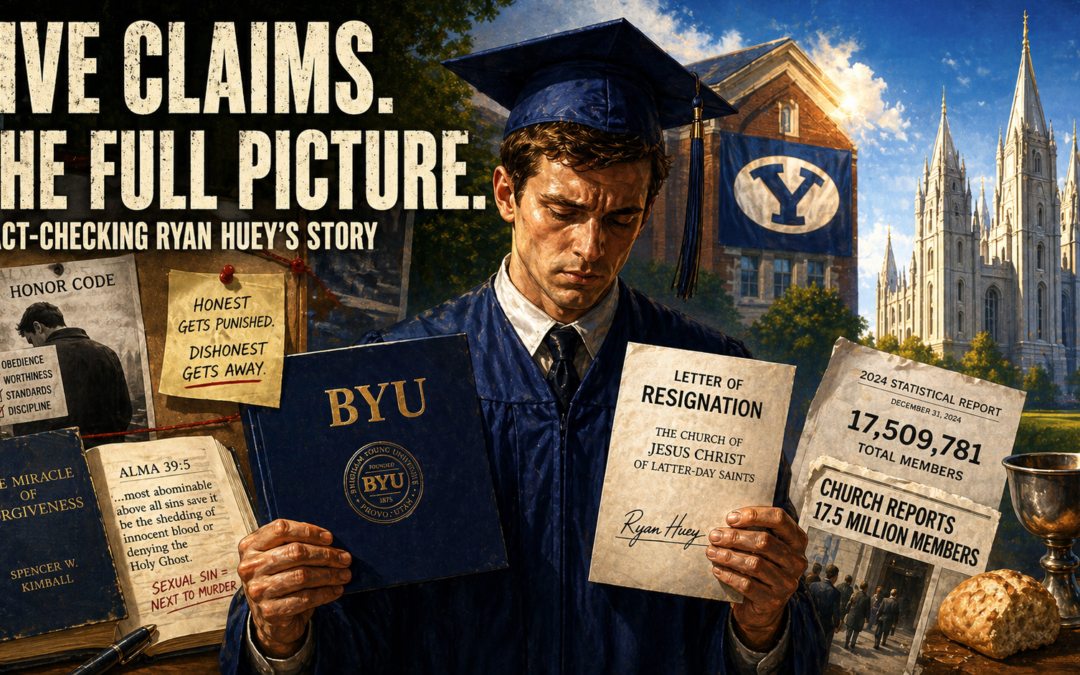
Ryan Huey’s story is compelling. He resigned from the LDS Church the same day he received his BYU diploma. As a result, his case highlights real tensions inside the LDS educational system.
However, five specific claims in the episode require careful fact-checking. These claims range from LDS teachings on sexuality to Church membership reporting.
About This Episode
In Mormon Stories Episode 2136 (March 5, 2026), Ryan Huey shares why he resigned from the LDS Church immediately after graduating from BYU.
He explains his devout upbringing, years of sexual shame, and a faith transition during his senior year. In addition, he describes the structural pressure created by BYU’s Honor Code for questioning students.
His personal story is emotionally compelling. However, some doctrinal and institutional claims in the episode need more context and factual clarification.
What We Are Addressing
This rebuttal does not dispute Ryan Huey’s lived experience or the psychological reality of LDS shame culture around sexuality. Researchers have well documented those issues.We address five specific verifiable claims: (1) that masturbation is “second only to murder” in LDS doctrine; (2) that taking the sacrament unworthily is “drinking damnation” in the extreme sense implied; (3) what BYU’s honour code can and cannot actually do to a student’s degree; (4) whether the Church stopped reporting membership numbers; and (5) what the 17 million member figure actually means.
What the Episode Gets Right
LDS shame culture around teenage male sexuality causes genuine psychological harm
✓ Documented and Accurate
Clinical and research literature well documents Ryan’s psychological experience on LDS young adults. The harm is real. Researchers have documented elevated rates of anxiety, scrupulosity (religious OCD), and shame-based disorders among young LDS men navigating the Church’s teaching on sexuality. The system Ryan describes — where honest teens get punished and dishonest ones escape consequences — is a genuine structural dysfunction that many members and leaders have acknowledged.
We do not dispute this. The rebuttal that follows is about precision in specific doctrinal claims, not a dismissal of the underlying harm.
Bottom Line
The Claims — and the Full Picture
Claim 1 of 5
Masturbation is “second only to murder” in LDS doctrine — it’s written in church publications
⚖️ Partially Accurate — Historically Transmitted, Scripturally Overstated, No Longer Current Policy
— Ryan Huey, ~00:12:27
What’s accurate:
Ryan is correct that this teaching appeared in LDS publications for decades. Spencer W. Kimball’s The Miracle of Forgiveness (1969) and his other writings grouped masturbation within the category of serious sexual sins. The scriptural basis cited is Alma 39:5, which states that sexual sin is “most abominable above all sins save it be the shedding of innocent blood or denying the Holy Ghost” — placing it third in a hierarchy below: (1) denying the Holy Ghost, (2) murder, (3) unchastity. LDS leaders often taught this as “sexual sin is next to murder” — which is real and was taught widely.
What’s overstated:
Two important distinctions. First, Alma 39:5 refers to serious sexual sin — specifically adultery in context, not masturbation. Church culture and leader commentary extended this teaching to masturbation, not direct canonical text. Second — and significantly — the current LDS General Handbook (2020) explicitly states that masturbation is not grounds for holding a church membership council. The Church no longer treats masturbation alone as a sin requiring formal church discipline. The 2020 handbook represents a formal evolution of position from the Kimball era.
yan experienced a teaching that caused real harm during his upbringing. But “it’s written in church publications” conflates a historically transmitted cultural teaching with current canonical doctrine. Truth seekers deserve to know both — the harm was real, and the current official position has moved.
Direct Answer
Claim 2 of 5
Taking the sacrament unworthily means “drinking damnation to your soul” — an extreme spiritual consequence
🔷 Scripturally Accurate — but many people misunderstand the word “damnation”
— Ryan Huey, ~00:16:37
Ryan is citing real scripture — though the primary source is 3 Nephi 18:29 in the Book of Mormon (not the Doctrine and Covenants as stated): “For whoso eateth and drinketh my flesh and blood unworthily eateth and drinketh damnation to his soul.” Paul’s words in 1 Corinthians 11:29 say essentially the same thing. The Church still teaches these verses today.
The critical doctrinal context:
In LDS theology, “damnation” does not mean what the word implies in everyday English (eternal hellfire). LDS doctrine defines damnation as being “stopped, blocked, or limited in one’s progression” toward God. According to Scripture Central’s entry on damnation: “In LDS doctrine, to be damned means to be stopped, blocked, or limited in one’s progress.” Elder John H. Groberg has taught that a person who sincerely desires to improve and is not under priesthood restriction is worthy to partake.
The psychological impact on Ryan — extreme fear of taking a weekly ordinance publicly — created real and understandable fear given how this was taught. But the “damnation” language, while in the text, carries a far more specific and limited doctrinal meaning than the everyday word implies. The gap between the word used and the doctrine intended is itself a source of the shame Ryan describes.
Direct Answer
Claim 3 of 5
BYU can withhold or revoke your diploma if you lose your faith — your degree is at risk for disbelieving
⚖️ Substantially True — with Important Precision on Mechanism and Limits
— Ryan Huey, ~01:13:42
Ryan’s warning is mostly accurate. However, the mechanism requires more precision.
What’s accurate:
BYU’s official Student Standing Policy states: “Students must be in good Honor Code standing to be admitted to, continue enrollment at, and graduate from BYU.” Good standing requires an active ecclesiastical endorsement, the student’s bishop renews it annually. A bishop can withdraw an endorsement at any time. BYU policy further states: “Students who are not in good Honor Code standing are not eligible for graduation, even if they have completed all necessary coursework.” Additionally, LDS students are required to “fulfill their duty in The Church of Jesus Christ of Latter-day Saints, attend Church meetings, and abide by the rules and standards of the Church.” If a bishop learns a student has stopped attending or openly departed from Church standards, the bishop can decline to renew or withdraw the endorsement — blocking graduation. And students who have formally resigned their Church membership cannot receive an endorsement at all.
Important precision:
Losing faith quietly and privately, without the bishop’s knowledge, will not trigger this mechanism. A bishop cannot read minds. The risk is real primarily for students who are openly departing — not attending, publicly challenging the Church, or violating honor code standards like coffee consumption or dress and grooming requirements. Ryan’s framing — that disbelieving itself threatens the diploma — is accurate only if the disbelief manifests in visible behavior or disclosure. The chilling effect on authentic self-expression is real; the mechanism requires observable behaviour, not interior thought alone.
What’s also true:
Once a degree has been awarded and posted, BYU does not revoke awarded degrees for faith changes. The risk window is pre-graduation.
Direct Answer
Claim 4 of 5
Did the LDS Church Stop Reporting Membership Numbers?
✗ Factually Incorrect — Membership Numbers Are Still Reported Every General Conference
— John Dehlin, ~02:21:08
This claim, made by Dehlin and not challenged by Ryan, is factually incorrect. The LDS Church continues to report total membership numbers at every General Conference through the annual statistical report. As recently as April 5, 2025, the Church reported that worldwide membership reached 17,509,781 as of December 31, 2024 — a net increase of 254,387 from the prior year. This report was published on the Church Newsroom website and in official conference materials.
What is true:
The Church does not separately report weekly attendance or activity rates. Independent researchers and analysts estimate that active weekly attendance represents approximately 30–35% of total membership — meaning perhaps 5–6 million people actively attend out of 17.5 million on record. This gap is real, significant, and not highlighted in official reporting. The total membership figure includes everyone baptised who has not formally resigned, including those who have been inactive for decades.
The claim that the Church “stopped reporting membership numbers” is simply false. The accurate criticism is that the Church reports total membership without contextualising the activity rate gap — which is a legitimate transparency concern, but a different claim entirely.
Direct Answer
Claim 5 of 5
The 17.5 million figure is fundamentally misleading because only ~5 million are active
⚖️ The Concern Is Legitimate — the Specific Numbers Require Nuance
— Ryan Huey, ~02:20:11
Ryan’s underlying concern — that the Church’s membership number significantly overstates active participation — is legitimate and widely acknowledged by independent researchers and even some Church-affiliated analysts. The gap between total membership and weekly attendance is real and substantial.
What the numbers actually show:
Independent analyses using ward and stake counts suggest that actual weekly attendance is probably closer to 30–35% of total membership — approximately 5–6 million globally. The Church itself, in statements to media, has acknowledged that “activity levels” differ from membership counts. The 17.5 million includes all people baptised who have not formally resigned or been removed, including those who joined decades ago and never attended again, deceased members whose deaths were not reported to local units, and members who have drifted away silently.
Where precision is needed:
The “5 million active” estimate is a reasonable independent analysis, not an official figure — and estimates vary from around 4 million to 7 million depending on methodology. Presenting it as established fact (“closer to five million”) without noting it is an estimate overstates certainty. Ryan’s decision to resign so his name isn’t counted among the 17.5 million is a completely coherent personal decision based on a legitimate transparency concern — the numbers do not accurately represent active participation. But the “5 million” figure itself is an estimate, not a confirmed internal count.
Direct Answer
Frequently Asked Questions
Does the LDS Church teach masturbation is second only to murder?
No, not officially.
This teaching appeared in LDS culture and leader commentary for decades and leader commentary, drawing on Alma 39:5, which places unchastity below murder and denial of the Holy Ghost in a hierarchy of serious sins. Spencer W. Kimball’s Miracle of Forgiveness (1969) grouped masturbation within serious sexual sins that carried grave consequences.
However, the 2020 LDS General Handbook explicitly removed masturbation from the list of offences warranting a formal membership council. The “second only to murder” framing for masturbation specifically overstates what the canonical text actually says — Alma 39:5 addresses sexual sin broadly (adultery in context), not masturbation specifically. The harm Ryan experienced was real; the current canonical position has evolved.
Can BYU really stop you from graduating if you lose your faith?
Yes — but the mechanism is indirect and requires observable behaviour. BYU requires all students to maintain an active ecclesiastical endorsement, renewed annually by their bishop, in order to graduate. A bishop can withdraw this endorsement if the student is no longer meeting Church standards — including attending sacrament meeting and abiding by the Church’s rules. If the endorsement lapses or is withdrawn before graduation day, the degree does not post even if all coursework is complete.
The risk is real for students who are openly departing — not attending, publicly disbelieving, or visibly violating honour code standards. Students who quietly disbelieve while continuing to attend and outwardly comply face lower practical risk, though they must live inauthentically. Students who have already graduated face no risk of having awarded degrees revoked.
Did the LDS Church stop reporting membership numbers?
No. The Church continues to report total membership at every General Conference through the annual statistical report. At the April 2025 General Conference, the Church reported 17,509,781 members as of December 31, 2024.
What the Church does not report separately is weekly attendance or activity rates. Independent researchers estimate that about 30–35% of total membership attends regularly — approximately 5–6 million people. This gap is real and is not highlighted in official reporting, which is a legitimate transparency concern. But the claim that reporting stopped is factually false.
What does “damnation” mean in LDS doctrine when taking the sacrament unworthily?
3 Nephi 18:29 (and 1 Corinthians 11:29) do teach that taking the sacrament unworthily brings “damnation to his soul.” In LDS theology, however, “damnation” means being blocked, stopped, or limited in spiritual progression — not eternal hellfire or the most severe punishment. According to LDS scripture commentary, “ultimate and total damnation comes only to the sons of perdition.” Taking the sacrament unworthily is serious, but the word “damnation” in everyday English carries far heavier connotations than the LDS doctrinal meaning intends.
How many Latter-day Saints are actually active?
The Church reports total membership of 17,509,781 (as of December 31, 2024). Independent researchers estimate actual weekly attendance at roughly 30–35% of total membership — approximately 5–6 million people globally. This estimate is derived from analyses of ward/stake counts relative to total membership, and is consistent with what the Church has acknowledged about “activity levels” differing from total membership.
The Church’s total membership figure includes everyone who has been baptised and not formally resigned, including decades-inactive members. The gap is real and is not highlighted in official reporting.
What are BYU’s honour code requirements for LDS students?
BYU requires LDS students to: maintain an active ecclesiastical endorsement from their bishop; attend church meetings; abide by the rules and standards of the LDS Church; and follow BYU’s dress and grooming standards, academic honesty policy, and other conduct requirements. The endorsement must be renewed annually. A bishop can decline to endorse or can withdraw an endorsement at any time. Loss of endorsement blocks class registration and graduation, even if all coursework is completed. Students who formally resign from the Church are not eligible for an endorsement and therefore cannot enrol or graduate.
The Honest Summary
Ryan Huey tells a story that many people will recognise — the psychological weight of LDS sexual shame culture, the confessional system’s perverse incentive structure (honest people get punished, dishonest ones escape), and the structural bind of attending a university where your degree depends on your bishop’s annual approval. These are real, documented problems. His decision to resign immediately after graduation is coherent and principled.
But several specific claims in the episode require correction. Masturbation as “second only to murder” in severity is a historically transmitted teaching rooted in leader commentary on Alma 39, not direct canonical text — and the 2020 General Handbook no longer treats masturbation as a membership-council offence, representing significant evolution. The sacrament “damnation” language is real scripture but carries a specific, limited LDS doctrinal meaning that differs from the everyday English word. BYU’s honour code does create real diploma risk — through the ecclesiastical endorsement mechanism — but primarily for students whose departure becomes visible, not for silent disbelief. The Church has not stopped reporting membership numbers; it continues to report them at every General Conference. And the “5 million active” figure is a reasonable estimate, not a confirmed fact.
Truth seekers deserve both the legitimate critique Ryan brings and the full accuracy of what LDS doctrine and institutional policy actually say. Both serve understanding. Neither alone is sufficient.