
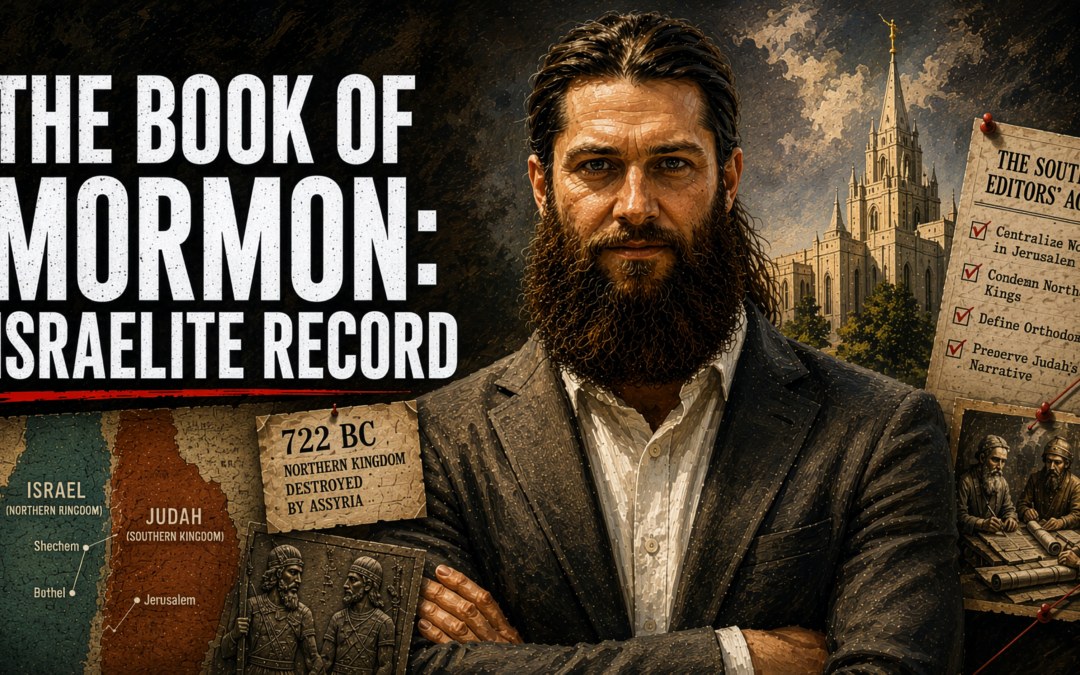
The Book of Mormon Is an Israelite Record — Not a Jewish One. Here’s Why That Difference Changes Everything.
Critics often argue that the Book of Mormon does not match ancient Judaism. In one sense, they are correct. However, that criticism may rely on the wrong historical comparison. The Book of Mormon presents itself as an Israelite record rooted in the northern kingdom tradition rather than in the later Judahite tradition that shaped Judaism after the Deuteronomistic reforms.
Over the last several decades, Protestant, Jewish, and secular scholars have independently reconstructed aspects of older northern Israelite theology. Interestingly, many of those reconstructed elements overlap with themes preserved in the Book of Mormon.
Therefore, the central question is not whether the Book of Mormon matches later Judaism. Instead, the question is whether it reflects an earlier Israelite tradition.
The Book of Mormon as an Israelite Record
Sometime around 600 BC, a prophet named Lehi sat down with a collection of ancient records and discovered something he apparently didn’t already know: his own tribal lineage. He was descended from Manasseh — son of Joseph, patriarch of the dominant northern tribe. Additionally, the Book of Mormon says he rejoiced at the discovery. Most readers pass right over it. They shouldn’t.
That single genealogical detail — so easily skipped — reframes the entire debate about the Book of Mormon’s historical plausibility. It places Lehi not among the Judahites who wrote the Bible, shaped the canon, and gave the world what we call Judaism, but among the northern Israelites whose kingdom Assyria conquered in 722 BC, whose tribes later scattered, whose theology diverged sharply from what Jerusalem would later codify,and whose traditions southern scribes largely removed from the surviving record.
Critics of the Book of Mormon have spent generations pointing out that it doesn’t match ancient Judaism. They’re right. It doesn’t. But the question they have not thought to ask is whether it was ever supposed to.
Northern Israel and Judah: Two Kingdoms, Two Theological Traditions
Around 930 BC, roughly 40 years after King Solomon’s death, the nation of Israel split. The northern kingdom kept the name Israel — sometimes calling itself Ephraim after its dominant tribe — and organized its religious life around sites like Shechem and Bethel. The southern kingdom took the name Judah, centered its theology exclusively on Jerusalem and its temple, and operated under a Davidic monarchy claiming God’s exclusive covenant blessing.
These kingdoms coexisted for nearly two centuries and frequently clashed politically and religiously.
The Assyrian Destruction of Northern Israel
Then, in 722 BC, the Assyrian Empire destroyed the northern kingdom.
As a result, Assyria scattered many northern tribes across the Near East and gradually disappeared from the historical record. Meanwhile, Judah survived. Its scribes survived as well, and they preserved the theological narrative that later shaped the biblical canon.
This is not a controversial claim — it is the working consensus of mainstream biblical scholarship. Frank Cross at Harvard spent decades mapping what scholars call the Deuteronomistic history: the edited theological narrative running from Deuteronomy through 2 Kings. Martin Noth established the foundational argument in 1943. The text consistently rewards centralised Jerusalem worship, condemns every northern king using the same formulaic language, and interprets every military defeat as punishment for straying from southern theology. The pattern is too consistent and too politically convenient to be coincidental.
The most concentrated expression of this editing project was Josiah’s reform of 621 BC — a sweeping program that destroyed local sacred sites, delegitimised northern priestly traditions, and suppressed prophetic traditions that emphasised direct personal encounter with God outside the institutional temple hierarchy. Temple authorities conveniently discovered a scroll in the Jerusalem temple right at the moment Josiah needed religious authority for a program he had clearly already decided to run.
When a critic picks up the Bible assembled by the southern kingdom, shaped by southern theology, and filtered through southern scribes after all of this, and then uses it to measure the Book of Mormon and concludes that it doesn’t match — they are correct. But the question they haven’t thought to ask is whether it was ever supposed to match that particular tradition.
Non-LDS Scholars Who Reconstructed Early Israelite Theology
Nevertheless, suppression is never total. Texts escape through multiple channels: apocryphal literature, sectarian texts like the Dead Sea Scrolls, and the internal patterns of the Hebrew Bible itself, where older material was incompletely edited out. Drawing from all three, a group of non-LDS scholars has spent decades reconstructing what pre-reform first temple theology actually looked like.
Their conclusions matter here because none of them was building a case for the LDS church. They were following the evidence wherever it led.
Frank Cross
Decades of work mapping the Deuteronomistic history — the southern kingdom’s editorial project shaping the Old Testament’s surviving form. Secular academic; no LDS affiliation.
Martin Noth
Established the foundational Deuteronomistic history argument in 1943, decades before LDS scholars began engaging with it. No LDS affiliation.
Margaret Barker
Reconstructed pre-reform first temple theology from apocryphal texts, archaeology, and internal biblical patterns. When she encountered LDS temple practice, she said she recognised it from her own research.
Michael Heiser
Documented the divine council framework from Hebrew grammar across multiple independent texts. Author of The Unseen Realm. No LDS affiliation.
Emanuel Tov
Edited the Dead Sea Scrolls publication project. His textual work confirms documented manuscript substitutions where divine council language was replaced with more monotheistic formulations.
Margaret Barker’s First Temple Theology — and What It Actually Looks Like
Margaret Barker is a British Methodist theologian who served as president of the Society for Old Testament Study — the UK’s main professional body for Old Testament scholars. Her reconstruction, based on apocryphal literature like 1 Enoch and the Ascension of Isaiah, the Dead Sea Scrolls, archaeological evidence from pre-reform sites, and internal patterns in the Hebrew Bible, describes a pre-reform tradition containing several distinctive features:
Key Features of Pre-Reform First Temple Theology (per Barker’s reconstruction)
- A heavenly divine council — a structured assembly of divine beings involved in governing the cosmos, documented independently by Michael Heiser from Hebrew grammar in Psalm 82, Deuteronomy 32:8, and Genesis 6.
- Direct prophetic access to God outside the institutional temple hierarchy — not mediated exclusively through an established priestly class.
- Sacred temple garments as markers of divine identity, attested archaeologically in pre-reform sites and in apocryphal texts.
- Deification — the idea that faithful human beings could be drawn into something divine through covenant relationship. Post-reform Judaism moved systematically away from this concept.
- Throne-room visions — prophets experiencing direct encounters with God presiding over his divine assembly, as seen in Isaiah 6, Ezekiel 1, and Daniel 7.
At the same time, Barker’s reconstruction goes beyond settled consensus — she acknowledges this herself. But the fact that the Deuteronomistic reform suppressed older traditions is the mainstream position. What Barker has done is argue specifically what those older traditions contained.
In 2003, she delivered a paper at a symposium and stated that when she first encountered LDS temple theology, she recognised it from her own research. Not something similar — something continuous with what she had independently reconstructed from ancient sources. She was not making a faith claim. She was making an academic observation. And she had arrived at it from her own work, not from any engagement with LDS apologetics.
When she first encountered LDS temple theology, she stated she recognised it — not as something similar to what she had been reconstructing, but as something continuous with it. That came from her own research.
— On Margaret Barker’s 2003 observation, as described in Moroni Standard
Why Lehi’s Lineage Matters
The Book of Mormon is explicit: 1 Nephi 5:14 states that Lehi was a descendant of Manasseh, one of the two sons of Joseph. This places him firmly in the northern Josephite tradition. His travelling companion Ishmael’s family, in LDS tradition (from a statement by Joseph Smith recorded by Erastus Snow), is identified as being from the tribe of Ephraim — the other dominant northern tribe.
But how does a Manassite family end up wealthy and established in Jerusalem? Importantly, the answer comes from an often-overlooked passage in 2 Chronicles 15. Around 895 BC — roughly three centuries before Lehi — King Asa of Judah received a prophetic message, and the response was a sizable voluntary migration: large numbers of people from Ephraim, Manasseh, and Simeon came south and settled in Judah. Not a military deportation — a voluntary relocation by people seeking more faithful covenant practice.
Three centuries is exactly long enough for a family to become thoroughly embedded in a city — building property, commercial relationships, and the social standing that would allow Lehi’s sons to approach a garrison commander for negotiation. It is also long enough for specific genealogical knowledge to blur across generations while the broader sense of covenant identity persists. This maps precisely onto what the text describes: Lehi knowing he belongs to Israel but not knowing precisely which branch until he reads it in the brass plates. He rejoiced when he found it — which, as the text notes, confirms he didn’t know it beforehand.
Why Laman and Lemuel’s Rebellion Was Theologically Predictable
The standard reading of Lehi’s rebellious older sons is that they were simply faithless and spiritually dull. But there is a historically grounded explanation for why their resistance runs so much deeper.
Laman and Lemuel grew up in Jerusalem. They came of age under Josiah’s reformed theology — the Deuteronomistic framework that had been actively reshaping Israelite religious culture for the two decades before Lehi left. And Josiah’s reform wasn’t purely ideological. It was physically enforced. He destroyed the high places. He defiled the altars at Bethel. He removed the Asherah poles from the Jerusalem temple. He physically eliminated the alternative worship sites where older theological practices had been carried out.
Under that framework, Lehi’s behaviour was not merely unconventional. It was theologically forbidden:
- Building altars outside Jerusalem violated Deuteronomy 12.
- Claiming to see God on his throne violated the reform’s prohibitions on that kind of vision.
- Prophesying about a coming Messiah who would die contradicted the institutional theology the scribes had been constructing.
- Asserting that the divine council still operated was exactly the cosmology that the reform was suppressing.
From Laman and Lemuel’s perspective, their father wasn’t receiving revelation. He was committing the specific theological violations that the religious establishment of their city had been condemning as apostasy. The family conflict in First Nephi isn’t just family drama. It’s a theological argument between the pre-reform northern tradition and the post-reform southern tradition, played out in one household in 600 BC — precisely when the tension between those two systems was at its highest.
The Brass Plates: A Northern Scribal Archive in Egyptian
If Lehi’s family came from a northern refugee community that had settled in Jerusalem three centuries earlier, the brass plates fit a specific historical profile. They would represent a distinct scribal tradition maintained separately from what the Judahite scribes were standardising — the kind of private archive that Josiah’s institutional reform wouldn’t have inventoried first.
LDS scholar Noel Reynolds has argued this tradition would have been maintained in Egyptian — which makes remarkable sense when you trace the genealogy carefully. Manasseh and Ephraim were raised in an Egyptian household. Their mother was the daughter of an Egyptian priest (Genesis 41:50–52). Egyptian would have been the natural sacred scribal language of a lineage with those roots.
Joseph Smith described the plates as written in “reformed Egyptian.” The historical explanation for why a Josephite scribal archive would use Egyptian is sitting in Genesis — requiring someone to read the genealogy carefully enough to trace the Egyptian educational context of Joseph’s sons and connect that to a claim about the plates’ script in a way that makes complete historical sense only if the lineage is actually real.
The Isaiah Variants and the Dead Sea Scrolls
LDS linguist Royal Skousen, who directed the Book of Mormon Critical Text Project, has documented that the Book of Mormon’s Isaiah passages diverge from the King James Version in patterns that are not random. Using standard textual criticism methodology — the same approach applied to any ancient document — he identified that:
Documented Isaiah Textual Variants in the Book of Mormon
- Several variants match the Great Isaiah Scroll from the Dead Sea Scrolls — discovered in 1947, over a century after the Book of Mormon was published. Notably, the scroll dates to approximately 100 BC and predates the Masoretic text by roughly 1,000 years.
- Some variants align with the Septuagint — the ancient Greek translation of the Hebrew scriptures.
- Other variants are entirely unique to the Book of Mormon — not matching any known manuscript tradition.
- The pattern of divergences is not consistent with random revision and is not explained by plagiarism from the KJV.
One important caveat deserves acknowledgement here: scholars debate whether Isaiah chapters 40–55 (known as Deutero-Isaiah) were written before or after the Babylonian exile. If they post-date 587 BC, Lehi couldn’t have had them on the brass plates in 600 BC. That is a genuine open question. But the textual variant argument does not depend on resolving it — the claim that the brass plates represent a distinct manuscript tradition independent of what became the Masoretic canon stands regardless of the authorship debate.
The Divine Council: Documented in the Manuscript Record
Michael Heiser and the Divine Council Framework
Michael Heiser, an evangelical Protestant scholar of biblical languages, has documented the divine council framework from the Hebrew grammar of multiple independent Old Testament texts. His argument is not based on a single verse but on a pattern:
Psalm 82 presents God standing in the assembly of El and judges among the Elohim. The grammar uses Elohim as both the presiding figure and the assembly he is judging — which cannot grammatically refer to human beings in that context. Likewise, Deuteronomy 32:8 preserves the Dead Sea Scrolls version — confirmed by Emanuel Tov‘s textual work — reading “according to the number of the sons of God,” where the later Masoretic text says “sons of Israel.” That is a documented substitution in the manuscript tradition, not a translation preference. And in Genesis 6, the phrase benê ha-Elohim refers to divine beings interacting with humans in a way the text never frames as metaphorical.
Divine Council Themes in the Book of Mormon
Multiple independent traditions preserved this divine council framework (a structured assembly of divine beings under a most high God). The Book of Mormon reflects the older cosmology from its very first chapter: Lehi’s opening vision in 1 Nephi 1 is a throne-room vision, God presiding over a heavenly council, following the specific literary genre Barker has documented as characteristic of pre-reform prophetic experience.
The Silence That Speaks: David, Solomon, and the Davidic Dynasty
One of the most telling features of the Book of Mormon is what it does not contain. Despite being an ancient Israelite text, it almost never references David, Solomon, the Davidic Covenant, Elijah, Elisha, or Samson. These figures are central to the southern kingdom narrative and are everywhere in the biblical text that a 19th-century author would have had open on his desk.
The King James Bible is saturated with the Davidic tradition. If you are inventing an ancient Israelite document with the KJV open in front of you, these figures are impossible to miss. The Book of Mormon’s consistent silence on them is exactly what you would expect from a Josephite family that preserved a pre-reform northern tradition and had no particular investment in celebrating the southern dynasty that oversaw the suppression of their theological heritage.
The Repentance Theology: 182 Times vs. 21
The word repent or repentance appears 21 times in the Old Testament and 22 times in the New Testament. Now, in the Book of Mormon it appears 182 times. Frequency alone is not decisive — any author could emphasise repentance heavily. But the issue is not just frequency. In fact, the Old Testament almost never explains what repentance actually is, how it works theologically, and what it accomplishes in the human soul’s relationship with God, or why an atoning Messiah is required for it to be possible.
The Book of Mormon contains elaborate doctrinal expositions of repentance. Alma 42 alone is a sustained theological argument about divine justice and mercy with no parallel in anything Joseph Smith had access to in 1830. A pre-reform source centred on direct covenant relationship and personal access to God would naturally preserve this kind of explicit theology — because it had not been stripped of the doctrinal framework that makes repentance intelligible as something more than ritual compliance. The ratio of 182 to 21 is a symptom; the doctrinal architecture underneath is the substantive point.
The Cumulative Pattern — and What It Would Require of Coincidence
What follows is not a single argument. It is a cumulative pattern across independent domains of scholarship, each pointing the same direction, each confirmed after Joseph Smith’s death, each by researchers with no motive to reach LDS-friendly conclusions.
Why the Coincidence Argument Becomes Difficult
For the coincidence argument to hold, Joseph Smith would have had to independently arrive at the North–South theological distinction before Noth mapped it in 1943; correctly preserve pre-Masoretic manuscript readings before the Dead Sea Scrolls were discovered in 1947; embed chiasmus in ways scholars didn’t detect for 137 years; construct a framework of suppressed northern prophets and murdered messianic witnesses that the scholarly model for canonical selection independently predicts; saturate his text with repentance theology at a ratio matching a pre-reform doctrinal tradition no one in 1830 had the framework to identify; and connect the Egyptian scribal language of the plates to the specific genealogical fact that Manasseh and Ephraim’s mother was an Egyptian priest’s daughter — a detail sitting in Genesis requiring both careful reading and knowing why it would matter.
Each of those could theoretically be coincidental. But the coincidence argument has to account for all of them simultaneously, across independent domains of scholarship, each pointing in the same direction.
The Restoration Claim — What Was Lost and When
According to LDS theology, the restoration claim was never about producing something new. It was a claim about recovering something that had been lost. From this perspective, the northern kingdom argument identifies specifically what was lost, when, and how.
Deuteronomistic reform dismantled specific theological features and replaced them with something narrower: scribal mediation replaced direct prophetic access; stricter monotheism compressed divine council cosmology; mainstream Israelite religion moved away from deification — the idea that human beings could participate in the divine through covenant and priesthood; temple authorities gradually restricted sacred knowledge accessible through temple anointing.
Consequently, LDS theology presents those concepts as restored rather than newly created: an embodied God who speaks to prophets, priesthood authority, exaltation, and temple worship as living ordinance. Moreover, these themes correspond to ideas that the reform reduced or removed. Finally, Protestant, Jewish, and secular scholars — rather than LDS researchers — developed much of the academic framework describing that earlier tradition.
Frequently Asked Questions
Is the Book of Mormon a Jewish Record?
No. According to the Book of Mormon itself, it is an Israelite record linked to Lehi’s descent from Manasseh (1 Nephi 5:14). This places the narrative within the northern Israelite tradition rather than later Judahite Judaism.
What Is Deuteronomistic History?
Deuteronomistic history refers to the theological editing tradition that shaped Deuteronomy through 2 Kings. Scholars such as Martin Noth and Frank Cross argued that this tradition reflects the perspective of Judah and Jerusalem after the northern kingdom disappeared.
What Did Margaret Barker Say About LDS Temple Theology?
Margaret Barker argued that pre-reform First Temple theology preserved older Israelite traditions. After encountering LDS temple concepts, she stated that she recognized similarities with ideas she had independently reconstructed.
Why is Lehi’s descent from Manasseh significant?
Lehi’s descent from Manasseh places him within the northern Josephite tradition rather than the southern Judahite one. This lineage also provides context for the Book of Mormon’s theological framework and its references to Egyptian scribal traditions.
Do Book of Mormon Isaiah passages align with the Dead Sea Scrolls?
Yes, in several documented cases. Royal Skousen‘s work on the Book of Mormon Critical Text Project has documented that the Book of Mormon’s Isaiah passages diverge from the King James Version in patterns that are not random. Some of those variants match the Great Isaiah Scroll from the Dead Sea Scrolls — discovered in 1947, more than a century after the Book of Mormon was published.
What is the divine council and does it appear in the Book of Mormon?
The divine council refers to a heavenly assembly of divine beings described in texts such as Psalm 82 and Deuteronomy 32:8. Supporters argue that Lehi’s vision in 1 Nephi 1 reflects this older Israelite tradition.
Sources & Further Reading
Scholarly Sources
- Wikipedia — Deuteronomistic History (Cross, Noth; overview of mainstream scholarly consensus)
- Wikipedia — Frank Moore Cross, Harvard; Deuteronomistic history scholarship
- Wikipedia — Martin Noth; foundational 1943 Deuteronomistic history thesis
- Wikipedia — Margaret Barker; first temple theology reconstruction; former president, Society for Old Testament Study
- Michael Heiser — The Divine Council; evangelical Protestant; documented from Hebrew grammar across independent texts
- Wikipedia — Emanuel Tov; Orthodox Jewish scholar; editor, Dead Sea Scrolls publication project
- Wikipedia — Dead Sea Scrolls; discovered 1947; Great Isaiah Scroll dated ~100 BC
- Wikipedia — Great Isaiah Scroll; predates Masoretic text by ~1,000 years; used for Book of Mormon textual variant analysis
LDS Sources
- Scripture Central — Nahom Evidence; NHM altar inscriptions in Yemen confirmed 1999
- FAIR LDS — Chiasmus in the Book of Mormon; first identified 1967 by John Welch
- Royal Skousen — Book of Mormon Critical Text Project; standard textual criticism methodology; Isaiah variant documentation
- Noel Reynolds — Lehi’s Library and the Brass Plates; BYU Religious Studies Center
Scriptural References
- 2 Chronicles 15; northern tribe migration to Judah under King Asa (~895 BC)
- Genesis 41:50–52; Manasseh and Ephraim’s Egyptian lineage through their mother, Asenath daughter of Potiphera
- 1 Nephi 5:14; Lehi identified as descended from Manasseh
- Alma 42; sustained theological exposition of repentance, justice, and mercy
Additional Historical Sources
- Wikipedia — 1 Enoch; apocryphal text preserving pre-reform theological content
- Wikipedia — Ascension of Isaiah; early Jewish and Christian composite text; portions dated as early as 2nd century BC
- Wikipedia — Elephantine Papyri; 5th-century BC Jewish military colony in Egypt maintaining theological practices diverging from post-reform Jerusalem
- Wikipedia — King Josiah; his 621 BC reform and the Deuteronomistic agenda
A Note on What This Argument Is and Isn’t
This is a coherence argument, not a proof argument. It shows that Lehi’s family fits a specific historical context that independent non-LDS scholarship has documented. Fitting that context doesn’t prove the Book of Mormon is true — that involves personal inquiry, faith, and more. But what it does mean is that the standard dismissal — “it doesn’t match ancient Judaism, therefore it’s a 19th-century invention” — is not the argument critics think it is.
The Book of Mormon doesn’t match the Judaism that survived the Deuteronomistic reform. It matches the profile of something older — Protestant, Jewish, and secular academics, who were not looking to help the LDS church, built the scholarly case for what that older tradition looked like. If you want to maintain the fabrication argument, you have to account for the northern theological profile, the Isaiah variants, the Arabian geography, the literary structures, and all the rest — each confirmed after Joseph Smith’s death, each by independent researchers who had no motive to reach LDS-friendly conclusions.
The version of Joseph Smith as a frontier autodidact who somehow engineered all of this gets progressively harder to square with what the scholarship actually shows. You don’t have to accept any LDS conclusion from this. But engaging it honestly is worth your time.
Based on the Moroni Standard video essay by Alex Arnold. All sources are linked above.