
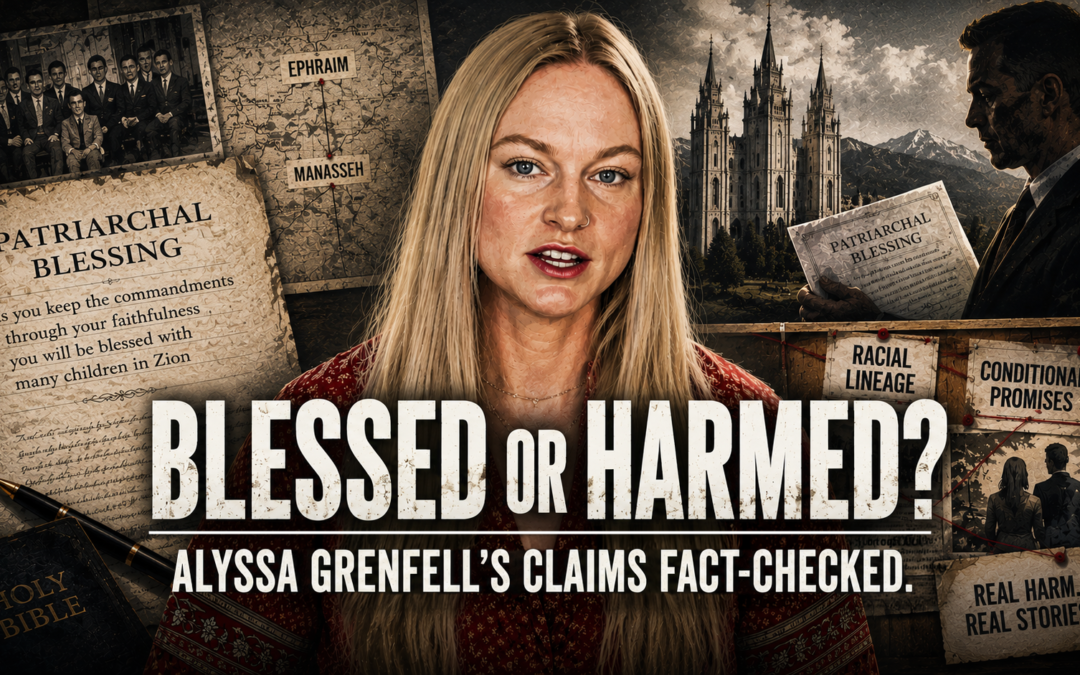
“The Weirdest Mormon Ritual I Haven’t Told You Yet”: Patriarchal Blessings — Five Claims Fact-Checked
Alyssa Grenfell’s video about patriarchal blessings raises several legitimate concerns about LDS culture, theology, and psychological harm. In particular, the video highlights issues involving LGBTQ members, infertility, racial lineage declarations, and the emotional weight many members attach to patriarchal blessings.
However, some historical and theological claims in the video require additional context, clarification, or factual correction.
This article fact-checks five major claims from Grenfell’s video using LDS sources, historical scholarship, and documented Church records. It also explains where the criticism is accurate, where the evidence is incomplete, and where important nuance changes the interpretation.
The goal is not to dismiss personal experiences. Many former members report real emotional harm connected to patriarchal blessings. Instead, this review focuses on historical accuracy, theological precision, and verifiable evidence.
About This Video
Alyssa Grenfell is an ex-Mormon YouTube creator who produces accessible, personal-experience-based content about leaving the LDS Church. This video covers patriarchal blessings — what they are, how they function, their racial history, their psychological impact on LGBTQ members and those experiencing infertility, and their historical origins. It is aimed at a general audience including people with no prior knowledge of Mormonism and blends personal anecdote, cultural criticism, and historical claims.
This article takes those personal experiences seriously. They reflect widely reported experiences of believing and former members. This rebuttal examines five factual claims that lack accuracy, overstate the evidence, or omit important historical context.
What This Rebuttal Concedes — These Points Are Accurate
Conditional Language Concerns
This is a valid concern. Blessings are heavily laden with “as you keep the commandments” and “through your faithfulness” qualifiers that shift responsibility for unfulfilled promises onto the recipient. The Church’s own guidance acknowledges that “if the blessing does not mention an important event… that does not mean we will not have that opportunity” — a built-in safety valve that makes falsification nearly impossible.
Racial History of Lineage Declarations
LDS historians have extensively documented the racial history of lineage declarations. The Church Historian’s Office confirmed in a 1961 report (presented to the Twelve in 1970) that “fifteen other lineages had been named in blessings, including that of Cain.” LDS historians acknowledge the pattern of Ephraim for white members and Manasseh for Pacific Islanders and Latin Americans. This troubling history deserves serious attention.
Psychological Harm Concerns
Many LGBTQ members and people experiencing fertility issues report real harm from patriarchal blessings. These are among the most consistent reports from ex-members and current members navigating these tensions. Blessings that promise “many children in Zion” can create serious psychological harm for women experiencing infertility, especially when the blessing conditions those promises on faithfulness. That is not adequately addressed by current Church pastoral practice.
Financial History
Historical records support the video’s financial claims. Patriarchs did receive compensation for blessings through much of the 19th and early 20th centuries, with the practice ending in the 20th century. Historical accounts support the video’s claim that donations continued until 1943.
Five Claims That Need Precision
Claim 1 of 5
Patriarchal blessings are essentially “Mormon fortune-telling” — equivalent to tarot cards or horoscopes
— Alyssa Grenfell, ~00:10:40
Why Critics Compare Blessings to Fortune-Telling
The fortune-telling comparison works as a psychological critique. Many patriarchal blessings sound vague, conditional, and difficult to falsify. The video also shows how patriarchal blessings use mechanisms similar to horoscopes. These include flexible interpretation, conditional framing, and broad personal statements.
The LDS Theological Perspective
However, believing members make an important theological distinction. Within LDS theology, members primarily view patriarchal blessings as declarations of covenant identity rather than simple predictions about the future. Official LDS teaching describes patriarchal blessings as personal revelation that includes lineage declarations and spiritual counsel. In most blessings, the lineage declaration appears first. LDS theology treats it as the central covenant element. It tells the recipient which tribe of Israel they belong to and what covenant responsibilities that entails. It treats future-oriented elements as conditional promises, not predictions.
This doesn’t make the fortune-telling parallel invalid — it’s a fair psychological critique. But it explains why the comparison generates pushback from believing members: they experience their blessing primarily as a statement of who they are in the covenant, not primarily as God telling them their future. Both experiences of the same document are genuine.
The fortune-telling comparison captures real mechanisms in how blessings function and can harm. It mischaracterises what blessings are intended to be theologically, which is why it frustrates believing members. Both things are true.
LDS Gospel Topics — Patriarchal Blessings (official Church description) ·
Wikipedia — Patriarchal Blessing (structure and content)
Claim 2 of 5
All patriarchal blessings are essentially the same “form letter” — everyone gets the same marriage, children, and mission content
— Alyssa Grenfell, ~00:23:53
Why Many Blessings Sound Similar
There is genuine evidence for the “form letter” concern. The Wikipedia article on patriarchal blessings notes that “the overwhelming majority of blessings declare the recipient to be a member of the tribe of Ephraim or Manasseh” and that common content (marriage, children, mission, faithfulness) appears across most blessings. LDS scholars and critics alike have observed that blessings tend to follow predictable templates.
Where Significant Differences Exist
Where this is overstated: “All blessings are the same” is not accurate. Some historical blessings included highly unusual details. Early blessings sometimes named descendants, missions, or specific future callings. Even in the modern era, some blessings contain highly specific content — career paths, health warnings, family dynamics — that differs substantially from the standard template. The video itself acknowledges variation when it notes that Taylor Frankie Paul’s blessing was “nicer and more complimentary” and that some people received unusual specifics like a future spouse’s name.
Grenfell’s stronger argument involves predictability rather than identical wording. Many blessings repeat similar themes and expectations. Critics also argue that the variation does not reflect divine insight. That is a fair argument. “Form letter” overstates it.
Most blessings do share common elements that reflect demographic expectations rather than unique divine knowledge. But significant variation exists, and “form letter” is imprecise. The better critique is about predictability, not identity.
Claim 3 of 5
Lineage is racially profiled: white people get Ephraim, brown people get Manasseh, Black people get Cain or Ham — the patriarch just looks at you when you walk in
Historians have documented the general pattern extensively. Dialogue Journal’s 2018 scholarship traces the full history: Ephraim dominates for white European-descent members; Manasseh is given to Pacific Islanders, Latin Americans, and Indigenous peoples; and some Black members did receive lineage declarations of “Cain” or “Cain and Ham” before the 1978 Revelation. The 1961 Church Historian’s Office report documented “fifteen other lineages had been named in blessings, including that of Cain.”
Important nuance the video omits
The treatment of Black members was not a uniform policy — it was inconsistent across patriarchs and time periods. Some patriarchs gave Black members no lineage at all. Some gave Cain or Ham. Some gave Ephraim or Manasseh. Some refused to give blessings. The 1971 Presiding Patriarch issued guidance that non-Israelite lineages (including Cain) should not be given. After the 1978 Revelation, Black members began receiving standard tribal lineage declarations like other members.
Modern LDS Teaching on Lineage
The video also discusses current lineage practices. Today, the Church teaches lineage as spiritual rather than genetic. Most members now receive Ephraim or Manasseh regardless of ethnicity. This change does not erase the racial history. However, modern LDS teaching now frames lineage as covenant identity rather than literal biological descent. Whether that reframing is satisfying or adequate is a fair question.
That racial pattern for Ephraim/Manasseh is historically documented. The all Black members got Cain or Ham claim is too uniform. The reality was inconsistent and arguably worse in some ways, since Black members could receive wildly different responses depending on the patriarch. Grenfell also leaves out the modern “spiritual rather than genetic” framing.
Dialogue Journal — Mormons and Lineage: The Complicated History of Blacks and Patriarchal Blessings (2018) ·
Wikipedia — Patriarchal Blessing (lineage declarations) ·
Interpreter Foundation — The Practice and Meaning of Declaring Lineage (2021)
Claim 4 of 5
The patriarchal line of authority — traced back through Joseph Smith to Peter, James, and John, and ultimately to Jesus Christ — is “basically like Lord of the Rings worldbuilding”
Grenfell’s fantasy-worldbuilding comparison is ultimately subjective. However, the historical claim behind it deserves serious engagement because LDS theology explicitly traces priesthood authority through Peter, James, and John to Jesus Christ.
The LDS Restoration Claim
LDS theology teaches that the Great Apostasy removed priesthood authority from the earth. Church leaders also teach that existing churches could not pass that authority down. Joseph Smith’s account is that Peter, James, and John appeared to him and Oliver Cowdery on the banks of the Susquehanna River in 1829 and conferred the Melchizedek Priesthood. LDS scholars take this historical claim seriously, while critics strongly dispute it. That claim differs significantly from something arbitrary like Santa’s red hat.— it is a foundational claim about the restoration of divine authority that distinguishes LDS ecclesiology from all other Christian traditions.
Grenfell accurately describes the LDS “line of authority” practice. Some LDS men order printed family trees that trace priesthood ordination chains. The Church History Library does maintain official priesthood line-of-authority records. Whether the underlying authority claim is credible is a separate question from whether the documentation system makes sense on its own terms — and it does, given LDS theological premises.
The LDS priesthood authority claim is not arbitrary mythology — it is a specific historical assertion about divine restoration that distinguishes LDS theology and is the source of LDS exclusivity claims. Engaging it as fantasy worldbuilding flattens an argument that LDS members and critics engage substantively.
D&C 27 — Priesthood restoration through Peter, James, and John ·
LDS Church History — Restoration of the Melchizedek Priesthood
Claim 5 of 5
Joseph Smith started patriarchal blessings in 1833 by blessing his father, who then blessed him back — essentially mutual self-congratulation
— Alyssa Grenfell, ~01:01:52
Historical records broadly support the timeline. Joseph Smith Sr. was ordained as the first Presiding Patriarch of the Church in December 1833, and he did give blessings to family members including Joseph Jr. Grenfell describes the historical sequence fairly accurately.
What the characterisation misses
The institution of patriarchal blessings was explicitly modelled on the Old Testament practice of patriarchal blessing. For example, Jacob blessing his twelve sons in Genesis 49, Isaac blessing Jacob and Esau, Abraham’s covenant blessings. Joseph Smith did not simply invent a mutual admiration scheme. The Joseph Smith Papers document the 1833 blessings in context, showing they were understood as a restoration of the ancient patriarchal order. Elijah Abel’s 1836 patriarchal blessing — the earliest known blessing to a Black member — shows the practice expanding rapidly beyond the Smith family.
People can reasonably question the theological motivation behind the practice. But calling it “basically mutual self-congratulation” strips historical context that makes the practice at least internally coherent within its theological framework, even for those who reject that framework.
Joseph Smith Sr. was the first patriarch and did bless family members. Joseph Smith modeled the institution on Old Testament patriarchal traditions. Grenfell’s characterisation is entertaining but lacks historical precision.
Joseph Smith Papers — Patriarchal Blessings 1833 ·
Wikipedia — Presiding Patriarch of the LDS Church
Frequently Asked Questions
What is a patriarchal blessing in the LDS Church?
A patriarchal blessing is a formal, once-in-a-lifetime blessing given to a member of the LDS Church by an ordained patriarch — a man called and sustained by the Quorum of the Twelve Apostles to serve a specific geographic area. The patriarch lays his hands on the recipient’s head and speaks what members believe is inspired counsel from God. The blessing declares the recipient’s tribal lineage in the House of Israel, offers personal spiritual counsel, and may include conditional promises about future experiences.
Members record and preserve the blessing for personal study. Church leaders describe patriarchal blessings as personal scripture that members should revisit throughout life. Most members receive a blessing during their teens or early twenties.
Are lineage declarations in patriarchal blessings based on race?
Yes. Historical LDS records show clear racial patterns in patriarchal lineage declarations. White members were most commonly assigned Ephraim, while Pacific Islanders, Indigenous peoples, and many Latin American members were frequently assigned Manasseh. Before 1978, some Black members received lineage declarations connected to Cain or Ham, although practices varied between patriarchs and time periods.
The 1961 Church Historian’s Office report documented that lineages including Cain had been given. In 1971, the Presiding Patriarch directed that non-Israelite lineages not be given. After 1978, Black members began receiving standard tribal declarations. Current Church teaching frames lineage spiritually rather than strictly genetically.
Can a patriarchal blessing cause psychological harm?
Yes — and this is one of the most well-documented concerns raised by former members and mental health professionals who work with ex-Mormons. Common harms include: anxiety produced by predictions of future hardship (as Grenfell describes from her own blessing); distress in LGBTQ members whose blessings promise heterosexual marriage and children; grief and self-blame in members who experience infertility after blessings promised “many children”; and chronic anxiety about unfulfilled promises that members attribute to their own insufficient faithfulness.
Conditional language often shifts responsibility onto the recipient. Members may interpret unfulfilled promises as personal failure rather than patriarchal error. That could create a feedback loop that reinforces faith while concentrating blame on the individual.
Did the LDS Church charge money for patriarchal blessings?
Yes — for the first approximately 100 years of the practice. Patriarchs received fees, then donations for blessings through much of the 19th and early 20th centuries. The video’s claim that the practice ended around 1943 is consistent with historical accounts. And the financial arrangement created a documented concern: early Church leaders noted that patriarchs had financial incentive to give particularly impressive blessings to encourage return visits (when multiple blessings were allowed). The modern Church does not charge payment for patriarchal blessings.
What tribe of Israel will I be declared in a patriarchal blessing?
Most LDS patriarchs declare members from the tribes of Ephraim or Manasseh — the two sons of Joseph who became tribes when Jacob adopted them (Genesis 48). Ephraim dominates for members of European descent; Manasseh is most common for Pacific Islanders, Latin Americans, and Indigenous peoples. Jewish converts are typically declared Judah. Patriarchs declare all other tribes far less frequently.
Today, the Church teaches lineage spiritually rather than genetically. The declaration connects members to the Abrahamic covenant and identifies covenant responsibilities instead of literal biological descent. LDS scholars acknowledge the historical practice of racially profiling lineage declarations. But is not the official basis for current declarations.
Why does the LDS Church teach that blessings should not be compared between members?
Church’s official guidance encourages members not to share or compare their blessings because Church leaders consider patriarchal blessings sacred and personal. Each blessing is unique to the individual and comparison may cause others to incorrectly judge their own blessing’s quality or completeness.
Critics, including Grenfell, argue the real reason is that comparison reveals how formulaic most blessings are. Both motivations may be real simultaneously: the Church genuinely teaches sacredness of the document, and the similarity of content across most blessings is a legitimate observation that comparing would surface.
The Honest Summary
Alyssa Grenfell’s patriarchal blessings video succeeds in highlighting several real and historically documented problems within LDS culture and history. The strongest parts of the critique involve psychological pressure, conditional promises, racial lineage patterns, and the emotional harm reported by LGBTQ members and people facing infertility.
At the same time, some claims in the video become less persuasive because they overstate or flatten important historical and theological details.
For example, patriarchal blessings are not viewed by believing members primarily as fortune-telling. Instead, LDS theology frames them as declarations of covenant identity and spiritual responsibility. Likewise, while many blessings follow predictable themes, historical evidence shows meaningful variation between blessings across time periods.
The racial history surrounding lineage declarations remains one of the most difficult aspects of patriarchal blessing history. Historical evidence confirms clear racial patterns, including the use of “Cain” and “Ham” lineage language before 1978. Although the modern Church now frames lineage spiritually rather than genetically, the historical record continues to raise serious questions.
Ultimately, people investigating patriarchal blessings deserve both honest critique and historical precision.