
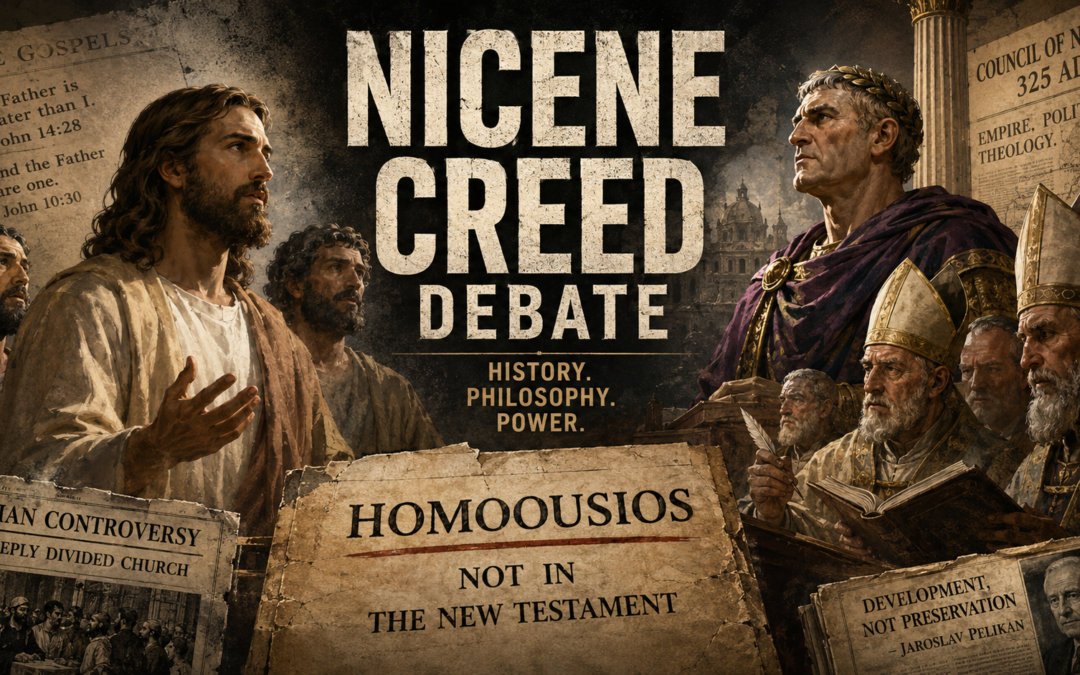
Are Mormons Christian? Why the Nicene Creed Debate Is Historically Contested
This article is inspired by the Moroni’s Standard podcast episode.
The Nicene Creed is the document most commonly used to argue that Latter-day Saints (mormons) are not Christian. However, before accepting that conclusion, an important question must be addressed: does the Nicene Creed accurately represent the original apostolic faith, or does it reflect a later theological development shaped by historical circumstances?
The key word in it — homoousios — doesn’t appear in the New Testament. An unbaptized Roman emperor called the council that produced it. The scholars who documented all of this are the ones creedal Christianity itself trained and cites. The argument that follows is theirs, not ours.
When someone tells a Latter-day Saint that they cannot be a Christian because they don’t conform to the Nicene Creed, someone is skipping a premise. The premise is whether that creed actually represents the original apostolic faith — or whether it represents something that developed considerably later, under circumstances that deserve a much closer look.
What This Article Examines
This article follows a single thread: the historical origins of creedal doctrine. Where the Nicene Creed came from, who produced it, what philosophical tradition it’s drawing on, and what the councils that formalized it actually looked like historically. The argument is not that the theology is definitely wrong.The argument is more precise. These historically conditioned and philosophically constructed documents cannot serve as a timeless apostolic standard. Simply put, that is not what they are.
Moreover, the scholars making this case are not LDS apologists. They are historians and patristic scholars trained and employed by creedal Christianity’s own institutions. Those same institutions frequently cite their work when studying church history. If your response to what follows is that the mainstream academic consensus on early church history is simply wrong — including the scholars the tradition considers its own authorities — that is a much larger problem that requires its own conversation.
The Scholars: Who They Are and Why It Matters
Every major claim in this article draws on one or more of the following scholars. None of them had any reason to reach conclusions favourable to LDS theology.
Jaroslav Pelikan
Greatest historian of Christian doctrine in the 20th century. His five-volume history (U. of Chicago Press) organized around development, not preservation. Lutheran, later Eastern Orthodox.
R. P. C. Hanson
Foremost modern scholar of the Arian controversy. His Search for the Christian Doctrine of God (T&T Clark, 1988) is the standard scholarly reference on Nicaea and its aftermath.
Lewis Ayres
Author of Nicaea and Its Legacy (Oxford University Press, 2004), the most comprehensive modern treatment of the turbulent post-Nicene period.
Rowan Williams
Author of Arius: Heresy and Tradition (Eerdmans). Concludes that Nicaea represented a decision between theological options, not a recovery of what had always been obvious in the text.
Adolf von Harnack
Coined the phrase “acute Hellenization of Christianity” to describe how Greek philosophical categories displaced the Hebrew tradition as the primary interpretive lens for Christian doctrine.
Henry Chadwick
Documents in The Early Church that Arianism had substantial support across the Eastern Empire and that the theological landscape at Nicaea was far more contested than the standard account suggests.
The Creeds: What They Are and What They’re Used For
The word creed comes from the Latin credo — I believe. In early Christianity, credal statements started as simple baptismal confessions: short, practical affirmations used when someone entered the community. Things like “Jesus is Lord,” or the threefold name of Father, Son, and Holy Spirit used in the baptismal rite. The Didache, a Christian instructional document from the late 1st or 2nd century, shows us that early world: the confessional language was centered on what Christ did. He died. He was buried. He rose. He appeared. It was not a Greek philosophical definition of what God is made of.
The major creeds that eventually emerged are three. The Nicene Creed in its current form dates to 381 AD. The Chalcedonian Definition from 451 AD. And the Athanasian Creed, composed sometime in the 5th to 7th centuries — despite the name, almost certainly not written by Athanasius. These three documents collectively define what scholars call creedal Christianity. The framework that Catholic, Eastern Orthodox, and most mainline Protestant traditions treat as the non-negotiable definition of who counts as a real Christian. When critics say Latter-day Saints aren’t Christian, this is almost always what they mean.
The Key Word That Isn’t in the Bible
The argument that Christians must conform to the Nicene Creed begins with a key theological term: homoousios, often translated as “consubstantial” or “of one substance.” Yet this word does not appear anywhere in the New Testament. As a result, critics question whether the creed reflects biblical language or later philosophical interpretation.
By contrast, the New Testament language about the Father and Son runs in a very different direction. Jesus says “the Father is greater than I” in John 14:28. He prays to the Father as a distinct person in John 17. At his baptism, the Father speaks from heaven while the Son stands in the water and the Spirit descends as a dove. Three distinct simultaneous presences in a relational hierarchy. Stephen, while filled with the Holy Ghost, looks up and sees the Son of Man standing at the right hand of God in Acts 7:55. Two beings. One standing, one seated. The distinction could not be more clear.
Getting from what those passages actually show — distinct persons in a relational hierarchy — to what Nicaea requires — a single indivisible metaphysical substance — requires importing a Greek philosophical framework that the text itself does not supply. The homoousios framework is in the reader, not the text.
— Hanson, The Search for the Christian Doctrine of God (T&T Clark, 1988)
Who Called the Council of Nicaea — and Why It Matters
Constantine’s Role in Convening Nicaea
In 325 AD, Emperor Constantine the Great convened the Council of Nicaea. Rather than being called by an apostle, prophet, or bishop, Constantine organized the council under imperial authority during a period of significant theological conflict within the Roman Empire. Constantine had adopted Christianity, or at minimum found it politically useful for his empire. A theological dispute between Arius of Alexandria and Alexander of Alexandria was creating instability across his realm, and he needed it resolved.
Constantine personally presided over council sessions in his imperial capacity, made his preference for the Athanasian position known, and used imperial authority to exile bishops who refused to sign. He had not yet been baptized at that point. The man who presided over the council that defined the nature of God for all of Christendom was an unbaptized layman.
Arianism, Eusebius, and the Political Context
Furthermore, Henry Chadwick documents that Arianism had substantial support across the Eastern Empire. Eusebius of Caesarea was the most prominent church historian of his era. He presided over Nicaea’s opening session and remains a primary source for the council. Theologically, he was much closer to Arius than to Athanasius. Eusebius wrote a letter to his congregation afterward acknowledging that homoousios was not a biblical word and saying he accepted it based on the emperor’s explanation. That letter survives. It is primary source evidence that bishops at Nicaea signed under pressure rather than pure theological conviction.
The Question of Authority
However, the standard response to this is: Constantine called the meeting, but the bishops did the theological work. His role was administrative, not doctrinal. But that misses the actual argument. The issue is not that Constantine wrote the theology. Instead, the real question concerns the mechanism of authority. From an LDS perspective, binding doctrinal decisions come through prophets and apostles who receive direct revelation. No emperor’s endorsement, no episcopal consensus, and no majority vote can supply what apostolic keys actually represent.
The 56 Years After Nicaea
Many Christians assume Nicaea settled the debate. However, controversy continued for decades, with competing theological positions remaining influential across the Roman Empire.
The standard account is that the Holy Spirit settled the question at Nicaea and the church moved forward unified. What actually happened in the 56 years between the Council of Nicaea (325 AD) and the Council of Constantinople (381 AD) is dramatically different.
A Timeline of Continued Conflict
Lewis Ayres of Durham University, whose Nicaea and Its Legacy (Oxford University Press, 2004) is the most comprehensive modern treatment of this period, documents all of this meticulously. Nevertheless, the natural response is that institutions go through turbulent periods and eventually arrive at consensus. But the problem is what finally produced the consensus. It wasn’t spiritual discernment. It was a law. Theodosius didn’t settle the theological debate. He ended it by making the losing position illegal. That is a significant difference. One community reaches a conclusion through discernment. The other enforces a position through imperial law.
Where the Philosophical Language Actually Came From
The Influence of Neoplatonism
The council fathers did not derive this framework from the Hebrew Bible. It came from the Neoplatonic philosophical tradition — the school that Plotinus developed in the 3rd century AD and that was adapted into a Christian context by theologians like the Cappadocian Fathers: Basil of Caesarea, Gregory of Nyssa, and Gregory of Nazianzus. These were men trained directly in Greek philosophy who self-consciously used it as a theological tool.
The specific concepts they introduced — God as absolutely simple without body, parts, or passions; the divine nature as timeless, spaceless, and utterly immaterial — all came from Neoplatonism, not from the Hebrew Bible. Adolf von Harnack called this process “the acute Hellenization of Christianity”: Greek philosophical categories becoming the primary interpretive lens for Christian doctrine, gradually displacing the more historically grounded categories of the Hebrew tradition.
The Biblical Portrait of God
The contrast with the biblical portrait of God is important. The God of the Old Testament walks in the garden in the cool of the day. He wrestles with Jacob through the night. He speaks to Moses face to face and then shows him his back. He sits on a throne. He has a right hand. Getting from that picture of God to the Nicene absolute — without a body, without passions, without location — is not something the text naturally does on its own. You need the Greek philosophical framework first. Then you read the text through it and call what comes out the plain teaching of scripture.
The Translation vs. Transformation Distinction
Paul Used Greek Language, Not Greek Theology
The immediate objection is that using Greek philosophical categories to articulate the faith isn’t corruption — it’s contextualization. Paul used Greek concepts too. The church had to translate its theology into the cultural register it inhabited.
But there is a crucial difference between translation and transformation. When Paul quotes Greek poets in Acts 17 to make contact with a Greek audience, he’s using their vocabulary to communicate an already pre-existing idea. That’s translation. Paul used Greek concepts as a point of contact and then moved to content that directly contradicted Greek philosophical assumptions — like the resurrection of the dead, which his audience typically walked out on. He didn’t restructure the doctrine of God using Greek categories. He used Greek concepts as an entrance and then moved to content the Greek framework couldn’t accommodate.
When Translation Becomes Transformation
What happened at Nicaea was the reverse operation entirely. Greek philosophical categories — immateriality, timelessness, absolute simplicity —determined how theologians interpreted the biblical portrait of God. The Greek framework wasn’t a bridge to biblical content. It became the filter through which biblical content had to pass.
A framework that genuinely clarifies the text should be able to accommodate what the text explicitly says. But if the framework requires that God cannot walk, cannot sit, cannot have a back, cannot be located anywhere — and the text explicitly describes all of those things — then the framework isn’t clarifying the text. It’s overwriting it. And when you call those descriptions “anthropomorphisms” to get around this, you still need a principle for determining which passages are figurative that doesn’t simply assume the Neoplatonic conclusion in advance. The text itself doesn’t mark them as figurative. The decision to read them as figures of speech gets made because the philosophical framework demands they can’t be literal.
What the Pre-Nicene Fathers Actually Taught
If the ancient believers already held creedal theology implicitly, the political circumstances of how Nicaea was run matter considerably less. If the bishops were formalizing what the whole church had always believed, the messiness of the process is secondary. The historical record doesn’t support that picture.
Justin Martyr, writing in the second century within a generation of the apostles, described the Son as a second god, numerically distinct from the Father and subordinate to him. Origen of Alexandria, arguably the most prolific and influential theologian of the 3rd century whose framework shaped the entire patristic era, subordinated the Son to the Father in ways that Nicene theology would later classify as at least semi-Arian — and was posthumously condemned as a heretic by the Fifth Ecumenical Council in 553 AD. Irenaeus of Lyon, a disciple of Polycarp who was a disciple of the apostle John, described the Son and the Holy Spirit as the “two hands of the Father.”
The trend line goes the wrong direction for any recovery narrative. The theology closest to the apostles — Justin Martyr within a generation, Irenaeus through a disciple of John’s disciple — is the most clearly subordinationist. The Nicene formula hardened as the tradition moved further from the apostolic era, not closer.
Rowan Williams, Archbishop of Canterbury, wrote in Arius: Heresy and Tradition (Eerdmans) that the Arian controversy was a thoroughly difficult theological question that the pre-Nicene tradition had not definitively answered, and that Nicaea represented a decision between different theological options rather than a recognition of what had always been obviously in the text.
The Chalcedonian Schism — 1,500 Years and Still Not Healed
The Chalcedonian Definition of 451 AD produced what most creedal Christians treat as the definitive statement on Christ’s nature: fully God and fully human in two natures, without confusion, without change, without division, and without separation. It also produced an immediate permanent schism that has never been resolved.
The Coptic Church of Egypt, the Ethiopian Orthodox Church, the Armenian Apostolic Church, and the Syriac Orthodox Church all rejected Chalcedon and were cut off from communion with Rome and Constantinople. These are not peripheral communities. The Coptic Church traces its origins to the apostolic era. The Ethiopian Orthodox Church has been continuously present since the 4th century. Together they represent tens of millions of Christians who have maintained unbroken apostolic traditions while describing Christ’s nature in terms that don’t conform to the Chalcedonian definition.
More telling: twentieth-century ecumenical dialogue between Catholic, Eastern Orthodox, and Oriental Orthodox theologians produced joint statements suggesting the 451 schism may have been rooted in a philosophical and linguistic misunderstanding rather than a genuine theological disagreement. If that’s right, the council that definitively settled Christ’s nature produced a 1,500-year fracture between some of Christianity’s oldest communities over a terminology dispute. That is not a neutral, ancient, apostolic baseline. That is a fourth and fifth-century settlement that a significant portion of ancient Christianity never accepted and still doesn’t.
Theosis: The Category That Western Christianity Suppressed
One of the most important convergences between LDS theology and the earliest Christian tradition concerns what LDS doctrine calls eternal progression and the broader patristic tradition calls theosis. Irenaeus of Lyon wrote that “Christ became what we are so that he might bring us to be what he is.” Athanasius himself wrote that “God became human so that humans might become God.” The entire Eastern Orthodox tradition of theosis — participation of the believer in divine life — is built on this principle. Norman Russell of Oxford documents its full scope across the church fathers in The Doctrine of Deification in the Greek Patristic Tradition (Oxford University Press, 2004).
C. S. Lewis — whom critics frequently cite as an authority on orthodox Christianity — wrote in Mere Christianity that God “will make even the feeblest of us into a dazzling, radiant, immortal creature, pulsating all through with such energy and joy and wisdom and love as we cannot now imagine.” Lewis was describing what LDS critics call heresy, in a book about what mere Christianity teaches.
The Eastern Orthodox and LDS concepts of divine participation are not identical, and conflating them would be dishonest. The patristic model involves participation in divine nature through grace; the LDS model involves literal progression toward exaltation. They are not the same doctrine. However, both traditions share a central idea. Humanity can participate in divine life rather than remain permanently separate from it. Patristic sources across East and West support that concept. It was progressively marginalized in Western Christianity specifically as that stream absorbed the Neoplatonic ontological gap between creator and creation — which is exactly the Hellenization process described above.
The Objections — and the Responses
You’re Cherry-Picking
This Is Just the Da Vinci Code Argument
The Holy Spirit was still guiding the church through an imperfect process. The councils got it right despite the messiness.
The Circular Argument at the Heart of the Creedal Standard
The deepest problem with using the creeds to exclude Latter-day Saints is that the argument is circular. It works like this: the councils define orthodoxy → anything outside the councils is unorthodox → therefore the councils’ conclusions are binding. But where did the councils get the authority to make that definition stick in the first place? You can’t demonstrate that they had apostolic authority by appealing to their decisions, because the authority of those decisions is exactly what’s in question.
The counter is the chain of transmission argument: Christ gave authority to the apostles, the apostles passed it to bishops through ordination, the bishops constitute the councils, so the councils inherit apostolic authority. But even granting that chain in principle, Nicaea was convened by an emperor with no place in any apostolic succession, presided over by that same unbaptized emperor, and produced signatures from bishops who later documented their own discomfort with what they were signing. If the chain of apostolic authority is supposed to flow through the bishops, then the mechanism that overrode those bishops — imperial pressure producing signatures under duress — is the chain being bypassed.
The Simplest Version of the Whole Argument
At the baptism of Jesus, a voice comes from heaven saying “This is my beloved son.” Jesus is standing in the water. Two distinct beings — one speaking, one being introduced. Stephen, filled with the Holy Ghost, looks up and sees the Son of Man standing at the right hand of God. Two beings. One standing, one seated. In John 17, Jesus prays that his disciples may be “one” as he and the Father are “one” — and he clearly isn’t asking his disciples to metaphysically merge into a single substance, because that would be incoherent. He is praying for unity of purpose and will and love, which is what “one” means in every other usage including the rest of the Bible.
Joseph Smith’s account of the First Vision — two distinct personages, the Father introducing the Son — reads like the New Testament baptism account rendered as a lived experience. It isn’t a contradiction of the text. Readers can approach the text without an imported framework telling them it cannot mean what it actually says.
The creedal doctrines that critics use as the definitive standard for Christian identity were produced at councils called by Roman emperors, using philosophical vocabulary that theologians borrowed from Greek Neoplatonism, to resolve theological disputes that had divided the church for decades, through processes that required imperial coercion to conclude. The historians who documented all of this are the scholars that creedal Christianity considers its own authorities. None of that historical record comes from LDS sources.
These historically conditioned, philosophically constructed documents cannot function as the timeless, neutral, apostolic baseline by which all other Christian claims are permanently evaluated. Because that is not what they are.
Frequently Asked Questions
Quick Answer
Many critics argue that Latter-day Saints are not Christian because they do not accept the Nicene Creed. However, historians of early Christianity note that the creed emerged centuries after the New Testament period and relied on philosophical language not found in scripture. Whether that development represents apostolic Christianity or later doctrinal evolution remains a matter of debate.
Does the word “homoousios” (consubstantial) appear in the New Testament?
No. The word homoousios — the defining theological term of the Nicene Creed — does not appear anywhere in the New Testament. It is a philosophical term borrowed from the Neoplatonic tradition. The New Testament presents the Father and Son as distinct persons. Jesus prays to the Father. The Father speaks at the baptism while the Son stands in the water. Stephen also sees the Son of Man standing at the right hand of God. Getting from these passages to a single indivisible metaphysical substance requires importing a Greek philosophical framework the text does not supply.
Who called the Council of Nicaea and what was his role?
The Roman Emperor Constantine the Great called the Council of Nicaea in 325 AD. He was not a bishop, apostle, or prophet. Constantine personally presided over sessions, made his preference for the Athanasian position known, and used imperial authority to exile bishops who refused to sign. He had not yet been baptized. Eusebius of Caesarea — the era’s most prominent church historian who presided at Nicaea’s opening — was theologically closer to Arius than Athanasius and wrote a letter to his congregation afterward confirming he signed based on the emperor’s explanation rather than his own theological conviction.
Was the Nicene Creed the settled consensus of the early church?
No. In the 56 years between Nicaea (325 AD) and Constantinople (381 AD), rival theological factions repeatedly displaced the Nicene formula. Athanasius was exiled five times by emperors favoring alternative positions. The Council of Sirmium (357 AD) produced a formula Jerome described as burying the faith of Nicaea in darkness. The Nicene formula only stabilized when Emperor Theodosius issued an imperial decree in 381 AD making Nicene Christianity the official religion of Rome and making Arianism illegal. Lewis Ayres of Durham University documents this entire period in Nicaea and Its Legacy (Oxford University Press, 2004).
Where did creation from nothing (ex nihilo) come from?
Creation from absolute nothing does not appear as developed Christian doctrine until the late 2nd century. German Protestant theologian Gerhard May published the definitive academic study establishing that ex nihilo was not in Genesis and not in the New Testament. It arrived as a philosophical response to Gnostic cosmologies in the second century and was then read backward into scripture as if it had always been there — the same pattern repeated throughout the development of creedal doctrine.
What did Jaroslav Pelikan conclude about the development of Christian doctrine?
Jaroslav Pelikan (1923–2006), Sterling Professor of History Emeritus at Yale University and widely regarded as the greatest historian of Christian doctrine in the 20th century, organized his five-volume History of the Development of Doctrine (University of Chicago Press, 1971–1989) around the concept of development — not preservation. That distinction is the entire argument: development is a historical description of what happened, not a guarantee that what happened carried apostolic authority.
What did the pre-Nicene church fathers teach about the nature of the Son?
The pre-Nicene fathers consistently described the Son in subordinationist terms. Justin Martyr (2nd century) described the Son as a “second god” distinct from and subordinate to the Father. Origen of Alexandria was the most influential theologian of the 3rd century. He subordinated the Son in ways later Nicene theology found problematic. The Fifth Ecumenical Council condemned him as a heretic in 553 AD. Irenaeus of Lyon described the Son and Holy Spirit as the “two hands of the Father.” The trend line goes the wrong direction for any recovery narrative: the theology closest to the apostles is the most clearly subordinationist.
Why did the Chalcedonian Definition (451 AD) fail as a universal standard?
The Chalcedonian Definition of 451 AD produced an immediate and permanent schism. The Coptic Church, Ethiopian Orthodox Church, Armenian Apostolic Church, and Syriac Orthodox Church all rejected it and have never accepted it. These communities trace their origins to the apostolic era and represent tens of millions of Christians. Twentieth-century theologians produced joint statements suggesting that philosophical and linguistic misunderstandings caused the 451 schism— meaning a council that definitively settled Christ’s nature produced a 1,500-year fracture over a terminology dispute.
Does LDS theology align with ancient Christian teaching on human divine participation?
The patristic tradition explicitly contains the category of human divine participation. Irenaeus wrote that “Christ became what we are so that he might bring us to be what he is.” Athanasius wrote that “God became human so that humans might become God.” The Eastern Orthodox tradition built its doctrine of theosis on this principle. C. S. Lewis described God making “even the feeblest of us into a dazzling, radiant, immortal creature” in Mere Christianity. The LDS doctrine of exaltation and the Orthodox doctrine of theosis are not identical, and conflating them would be dishonest. Patristic sources preserve this category — that humanity’s eternal destiny involves elevation into divine life rather than remaining permanently categorically lesser than God — across East and West. Over time, Western Christianity progressively marginalized it.
Primary Sources & Scholarly References
- Jaroslav Pelikan — The Christian Tradition: A History of the Development of Doctrine, 5 vols. (University of Chicago Press, 1971–1989)
- R. P. C. Hanson — The Search for the Christian Doctrine of God: The Arian Controversy 318–381 AD (T&T Clark, 1988; Baker Academic, 2005)
- Lewis Ayres — Nicaea and Its Legacy: An Approach to Fourth-Century Trinitarian Theology (Oxford University Press, 2004)
- Rowan Williams — Arius: Heresy and Tradition (Eerdmans, revised 2002)
- Henry Chadwick — The Early Church (Penguin History of the Church, Vol. 1, revised 1993)
- Adolf von Harnack — History of Dogma, 7 vols. (Williams & Norgate, 1894–1899) — source of “acute Hellenization” thesis
- Gerhard May — Creatio ex Nihilo: The Doctrine of ‘Creation out of Nothing’ in Early Christian Thought (T&T Clark, 1994) — establishes late 2nd-century origin of ex nihilo
- Norman Russell — The Doctrine of Deification in the Greek Patristic Tradition (Oxford University Press, 2004)
- C. S. Lewis — Mere Christianity (HarperCollins, 1952) — “dazzling, radiant, immortal creature” passage
- John 14:28 — “The Father is greater than I”
- Acts 7:55 — Stephen sees Son of Man at right hand of God
- Joseph Smith Papers — First Vision accounts (1832, 1835, 1838)
What This Argument Is — and Isn’t
This is not an argument that the Nicene theology is definitely wrong on the theological merits. Political processes can occasionally produce accurate conclusions, and the historical messiness of how the creeds were produced doesn’t by itself settle whether the theology is correct.
The argument is more specific: these historically conditioned, philosophically constructed documents cannot function as the timeless, neutral, apostolic baseline by which all other Christian claims are permanently evaluated. Because that’s not what they are. They are a historically situated, philosophically shaped, and politically conditioned fourth and fifth-century settlement — and using them as an objective standard to rule out other claims is circular reasoning. You’re defining orthodoxy by the councils and then rejecting anything outside the councils as unorthodox, without ever explaining where the councils got the authority to make that definition binding.
The next time someone tells a Latter-day Saint they cannot be a Christian because they don’t conform to the Nicene Creed, the question to ask is a simple one: Where did the Nicene Creed come from? And who gave its authors the authority to define Christianity for all time? Those are historically legitimate questions. And you don’t have to go on defense — because historians continue to contest the standard critics use against you, and the scholars contesting it are the tradition’s own authorities.
Based on Moroni Standard by Alex Arnold. All primary sources linked above.