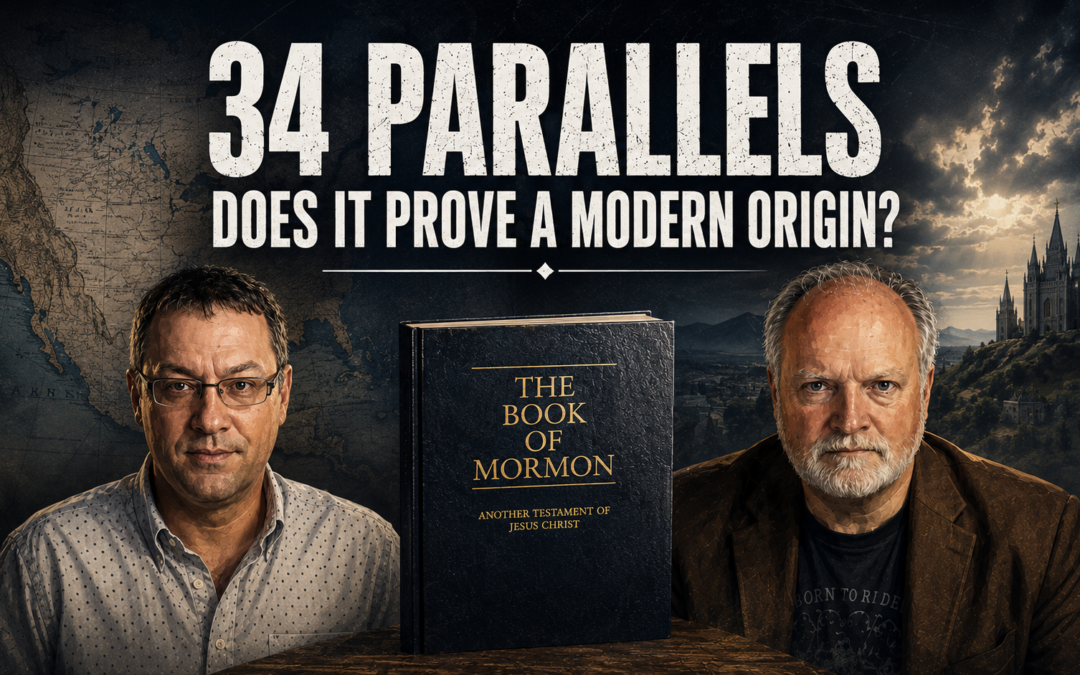
Of Course the Book of Mormon Answers Doctrinal Questions
“When Was the Book of Mormon Created?” — 34 Parallels Evaluated: The Argument That Proves Too Much
The Book of Mormon addresses many of the same doctrinal questions debated in Joseph Smith’s day. Critics often argue that this fact proves the book is a product of the 1820s and 1830s rather than an ancient record.
At first glance, that argument appears persuasive. After all, the Book of Mormon discusses infant baptism, the nature of God, revelation, miracles, church authority, free will, and other issues that were actively debated during the Second Great Awakening.
However, there is a crucial problem: most of these debates did not originate in 19th-century America. Instead, Christians have discussed many of the same questions since the earliest centuries of the church. As a result, the mere presence of those topics cannot establish a uniquely 19th-century origin.
This article evaluates the strongest version of the argument, including Alexander Campbell’s famous 1832 criticism, while distinguishing between genuinely contemporary parallels and theological debates that predate Joseph Smith by centuries.
About This Episode
This Mormonism Live episode, co-hosted by Radio Free Mormon and Bill Reel, runs approximately two and a half hours and presents 34 parallels between Book of Mormon content and religious controversies active in Joseph Smith’s 1820s-1830s upstate New York environment. Topics range from infant baptism and the proper mode of baptism to masonry, republican government, premillennialism, and slavery. The episode is anchored by Alexander Campbell’s 1832 pamphlet “Delusions,” which RFM quotes directly to show that a contemporary observer identified the same pattern.
This is the most substantive single-argument case against Book of Mormon authenticity in this rebuttal series. It deserves a proportionally substantive response — one that honestly credits what the argument gets right, identifies the core logical flaw, and explains what would constitute stronger vs. weaker versions of this evidence.
Why the Alexander Campbell Quote Matters
Before evaluating the argument’s weaknesses, its strongest piece of evidence deserves direct and honest acknowledgment. In his 1832 pamphlet “Delusions: An Analysis of the Book of Mormon,” Alexander Campbell — who lived in Joseph Smith’s geographic and intellectual neighborhood, knew the religious debates of the day personally, and had actually read the Book of Mormon — wrote:
This is real and significant. Campbell was a theologically sophisticated observer who identified the same pattern in 1832 that RFM identifies in this 2.5-hour episode. He named roughly 15-18 specific topics from the same list. Truth seekers deserve to engage this evidence honestly rather than dismissing it reflexively. The episode builds an extensive case on a foundation Campbell laid 194 years ago.
The following section explains what the Campbell quote does not establish and what the episode never addresses.
Why the “Doctrinal Questions” Argument Proves Too Much
The argument’s structure is: (1) The Book of Mormon addresses theological topic X. (2) Topic X was debated in Joseph Smith’s 19th-century environment. (3) Therefore, the Book of Mormon is a product of Joseph Smith’s environment. The problem is that premise 2 is true of virtually every theological topic, because the debates the Book of Mormon addresses are perennial Christian debates — not uniquely 19th-century ones. Applied consistently, the same argument would prove the New Testament is a product of 1st-century Jewish-Roman debates (which it addresses), Augustine’s City of God is a product of 5th-century pagan debates, and the Westminster Confession is a product of 17th-century English Reformed debates. The question the episode never answers: which of these 34 topics could not have appeared in an ancient text addressing Christian theological themes?
Sorting the 34 Parallels: Genuinely Contemporary vs. Perennial Debates
The episode presents all 34 parallels as equally indicative of 19th-century American origin. They are not. They fall into two fundamentally different categories with very different evidential weight.
Category A — Genuinely Specific to 19th-Century America
These are the episode’s strongest parallels.
Six of the 34 parallels are genuinely specific to the 19th-century American context rather than perennial Christian debates. These deserve honest acknowledgment as genuine evidence.
Political and Cultural Parallels
- Masonry condemned (#21) — The William Morgan affair occurred in Batavia, New York in 1826 — three years before the Book of Mormon was published, directly in Joseph Smith’s neighborhood. The anti-masonic movement was a specifically American political phenomenon that produced America’s first significant third party. The Book of Mormon’s extensive warnings about “secret combinations” with their oath-bound societies, murders for power, and governmental infiltration map directly onto the specific fears about Freemasonry circulating in that precise time and place.
- America as a promised land / Manifest Destiny (#23) — The framing of the Americas as a land “choice above all other lands” preserved by God for a righteous people reflects specifically 19th-century American exceptionalist ideology. This concept in its American form postdates the founding of the republic.
- Republican government endorsed (#24) — The Nephite transition from kings to judges in explicitly republican terms — with elections, rule of law, voice of the people, accountability mechanisms — mirrors the specific post-Revolutionary American political vocabulary. The Book of Mormon’s Mosiah 29 reads remarkably like a constitutional theory document of the early republic era.
Religious and Social Parallels
- Religious liberty at the state level (#25) — Massachusetts maintained its Congregationalist establishment until 1833. Connecticut disestablished in 1818. These are specifically contemporary debates, not perennial Christian questions.
- Slavery condemned (#29) — While slavery is ancient, the specific abolitionist framing of the 1820s-1830s American debate — with abolition societies, published treatises, and the argument that scripture-based slavery defenses were corrupted — is contemporary. The Book of Mormon’s language on this tracks the American abolitionist discourse of that era.
- The mound builder myth (#4) — The specific cultural narrative that a lost white race built sophisticated earthworks and was destroyed by “savage” Native Americans is a distinctly 19th-century American construct rooted in the refusal of white society to credit indigenous peoples with architectural achievement. The Nephite/Lamanite narrative maps onto this myth with notable precision.
Category B — Perennial Christian Debates Misidentified as 19th-Century
Their existence centuries before Joseph Smith does not support ancient authorship, but it does eliminate them as evidence for a 19th-century origin.
Twenty-eight of the 34 parallels are debates that Christianity has been having continuously since the 1st through 5th centuries — long before Joseph Smith and long before 19th-century America. The relevant question for each is: how old is this debate? If the answer is “since the early church,” it cannot serve as evidence of 19th-century origin.
Early Church Debates on Baptism
- Infant baptism (#5) — Tertullian argued against it c. 200 AD. Origen discussed it as “a thing causing frequent inquiries among the brethren” c. 220 AD. Cyprian of Carthage convened a council on it c. 250 AD. Augustine built his doctrine of original sin partly on it c. 400 AD. The Reformation-era Anabaptist controversy (1520s) brought it back explosively — 300 years before Joseph Smith. Oldest documented controversy: c. 200 AD.
- Mode of baptism — immersion vs. sprinkling (#8) — The Didache (c. 50–120 AD) already discusses preferring immersion but permitting pouring when water is scarce. This is a 1st-century document. Oldest documented controversy: c. 100 AD.
Debates About God, Salvation, and Free Will
- Nature of God — Trinity/modalism (#11) — The Arian controversy (Arius vs. Athanasius) led to the Council of Nicaea in 325 AD. Modalism (which Abinadi’s speech in Mosiah 15 reflects) was a 2nd-3rd century heresy opposed by Tertullian. Unitarianism reformulated ancient debates; it didn’t originate them. Oldest documented controversy: 2nd century AD.
- Predestination vs. free will (#13) — Augustine vs. Pelagius (5th century). Then Luther vs. Erasmus (1524). Then Calvin vs. Arminius (late 16th century). Then the Westminster Confession (1647). Joseph Smith entered a debate that had been raging for 1,400 years. Oldest documented controversy: c. 400 AD (Augustine vs. Pelagius).
- Faith vs. works (#14) — The epistle of James appears to be already in tension with Paul on this in the 1st century. Luther made it the central issue of the Reformation in 1517 — 300 years before Joseph Smith. Oldest documented controversy: 1st century AD.
- Has revelation ceased / Have miracles ceased / Have gifts of the Spirit ceased (#18, 19, 20) — The Montanist controversy (2nd century) was precisely about continuing prophecy vs. cessationism. Tertullian was a Montanist. This debate is nearly as old as Christianity itself. Oldest documented controversy: 2nd century AD.
- Universalism condemned (#12) — Origen himself was a universalist (2nd century). Gregory of Nyssa was a universalist (4th century). These are ancient debates recycled, not originated, in the 19th century. Oldest documented controversy: 2nd century AD.
- Paid clergy (#15) — The Waldensians (12th century) rejected paid clergy. John Wycliffe (14th century) attacked it. The Reformation addressed it extensively. Not a uniquely 19th-century controversy. Oldest documented controversy: 12th century.
Other Longstanding Christian Controversies
- Proper method of ordination (#31) — The apostolic succession controversy goes back to Cyprian of Carthage (3rd century) and was central to Anglican vs. Dissenter debates from the 16th century onward. Oldest documented controversy: 3rd century AD.
- Physical resurrection (#34) — Paul addressed Greek philosophical opposition to bodily resurrection in Acts 17 (his speech at Athens) and in 1 Corinthians 15. This is a 1st-century debate. Oldest documented controversy: 1st century AD.
- Retroactive atonement (#32), Did those before Christ know him (#33), Bible completeness (#1), Bible contains errors (#2), Which church is correct (#6), Name of the church (#7), Mode of the sacrament (#9), Open vs. closed communion (#10), Revival experiences (#16), Slain in the spirit (#17), Premillennialism (#22), Deism refuted (#26), Materialism and wealth (#27), Eternal torment (#28), Salvation for the dead (#30) — All of these have documented origins in the early church or at the Reformation, centuries before Joseph Smith.
Analyzing the Strongest Evidence — The Campbell Quote Revisited
Alexander Campbell’s 1832 observation is real and worth taking seriously — and it applies equally to any comprehensive theological text
Genuine Evidence — Insufficient to Establish the Conclusion.
The Campbell quote is the episode’s strongest piece of evidence and it deserves serious engagement rather than dismissal. Campbell had read the Book of Mormon. He knew the theological landscape personally. He identified the same pattern in 1832 that RFM identifies in 2026. This is not nothing. Three qualifications are necessary for a complete assessment:
Campbell was a hostile adversary, not a neutral observer
His pamphlet is titled “Delusions.” He was explicitly trying to debunk the Book of Mormon’s claims to divine origin. This doesn’t make his observation wrong — but it means he was actively looking for ways to dismiss it, which introduces confirmation bias toward the argument that best serves his conclusion. He found a pattern that supported what he already believed.
Campbell’s observation applies equally to the New Testament itself
The New Testament also “decides all the great controversies” of its own day: circumcision vs. uncircumcision (Acts 15; Galatians), food sacrificed to idols (1 Corinthians 8), spiritual gifts and their hierarchy (1 Corinthians 12-14), the role of Jewish law after Christ (Galatians 3-4), the proper mode of the Lord’s Supper (1 Corinthians 11), whether Jesus was truly human or merely appeared human (1 John 4:2). No one argues the New Testament is therefore inauthentic because it addresses 1st-century controversies. The relevant question for Campbell’s observation is not “does this book address contemporary debates?” — every theological text does — but “does this book address ONLY those debates, or does it address debates characteristic of multiple eras?”
Campbell’s list is significantly shorter than the episode’s 34
He names roughly 15-18 topics — most of which fall into the “perennial Christian debate” category. The specifically 19th-century American items (masonry, republican government, manifest destiny, slavery, state-level religious disestablishment) are either absent from Campbell’s list or mentioned only briefly. This is revealing: even Campbell, who lived in the environment and knew it best, didn’t anchor his argument to the specifically contemporary material.
Campbell’s observation is genuine and historically significant. Any comprehensive theological text addressing Christian themes would generate the same observation. The question of uniquely 19th-century provenance requires the specifically American parallels — the six genuinely contemporary items — not the perennial ones Campbell primarily lists.
The Most Important Point the Episode Never Addresses
A genuine ancient testament of Jesus Christ would address exactly these debates — making the parallels non-discriminating evidence
Why These Debates Are Not Uniquely 19th-Century
The Central Logical Flaw the Episode Never Acknowledges.
The episode’s entire argument rests on the premise that the Book of Mormon addressing 34 theological debates is suspicious — that it points to 19th-century origin. But there is a prior question the episode never asks: what would we expect a genuine ancient testament of Jesus Christ to address?
The answer is: exactly these topics. Baptism — its mode, its subjects, its administrators — is the central Christian initiatory rite. The nature of God — Father, Son, Holy Ghost — is the foundational Christian theological question. Free will versus predestination is inherent to any theology that simultaneously claims God is sovereign and humans are accountable. Faith versus works is logically embedded in any atonement theology. Whether revelation and miracles continue is a natural question for any community that has experienced them. Which community represents the true church is unavoidable for any group that believes they have been called out of existing churches.
These are not topics Joseph Smith might have included to resolve contemporary debates. These are the topics any record of Christ’s dealings with his people would naturally contain — whether written in 600 BC, 400 AD, or 1829. They are the DNA of Christian theology. The question is not “why does the Book of Mormon address these topics?” It is: “what serious Christian text would NOT address them?”
The Problem of Non-Discriminating Evidence
This makes the parallels non-discriminating evidence. In logic, evidence is probative when it is predicted by one hypothesis and not the other. Evidence that both hypotheses predict equally well cannot favor either one. Consider the two competing hypotheses:
Hypothesis A (Ancient): The Book of Mormon is an authentic ancient record of Christ’s dealings with people in the Americas. If true, we would expect it to address: baptism, the nature of God, free will, faith, miracles, revelation, proper church structure, salvation — because these are the unavoidable questions of any Christian community.
Hypothesis B (19th Century): Joseph Smith composed the Book of Mormon in the 1820s. If true, we would expect it to address the same topics — because these were actively debated in his environment.
Both hypotheses predict the same evidence: a theological text addressing Christian fundamentals. Evidence predicted equally by both hypotheses cannot be used to argue for either one over the other. The 28 perennial debates cannot favor Hypothesis B over Hypothesis A, because Hypothesis A predicts them just as strongly. This is the argument’s irreducible logical problem.
Why the Parallels Cannot Settle the Authorship Question
It is comparable to arguing: “The New Testament addresses debates about circumcision, food sacrificed to idols, and the proper administration of the Lord’s Supper — all of which were disputed in 1st-century Jewish Christianity. Therefore the New Testament was composed by 1st-century Christians to resolve their contemporary disputes rather than being an authentic record of Jesus.” The conclusion is technically consistent with the evidence but proves nothing — because an authentic record would produce identical evidence.
The episode’s closing argument — “I dare any apologist to respond to this publicly” — assumes the parallels constitute a challenge that cannot be answered. The non-discriminating evidence problem is that answer. The parallels tell us that whoever wrote the Book of Mormon was engaging with Christian theology. They do not tell us whether that engagement happened in 600 BC or 1829 AD, because authentic Christian scripture would produce exactly the same theological content either way.
The 28 perennial debates are exactly what a genuine ancient testament of Jesus Christ would contain. They are equally expected under ancient authorship. When two competing hypotheses predict the same evidence, that evidence cannot support one conclusion over the other. This is the argument’s central unanswered logical problem.
“The most correct book on earth” should restore original doctrine — which means it should CORRECT 19th-century creedal positions, not mirror them
The Episode’s Core Logic Inverts Under Examination.
There is a deeper problem with the episode’s argument that goes beyond the non-discriminating evidence point. The episode assumes that when the Book of Mormon agrees with 19th-century positions, this proves 19th-century origin. But this assumption collapses when you consider what the Book of Mormon claims to be.
The Book of Mormon’s Restoration Claim
Joseph Smith stated: “The Book of Mormon was the most correct of any book on earth, and the keystone of our religion, and a man would get nearer to God by abiding by its precepts than by any other book.” (History of the Church, 4:461.) This is a claim to represent original, uncorrupted Christian doctrine — not a derivative of any creedal tradition, not dependent on the New Testament as mediated through centuries of translation and council decisions, and not filtered through Nicene or post-Reformation theology.
Consider what the New Testament has been through before it reached 1829: Original Greek manuscripts exist in thousands of variants with no two identical. Jerome translated the text into Latin (the Vulgate, 4th century). Church councils — Hippo 393 AD, Carthage 397 AD — made institutional decisions about which books to include. Medieval monks copied manuscripts with variations both intentional and accidental. Erasmus assembled his Textus Receptus from a handful of late manuscripts (1516) — the foundation the King James Version (1611) was built on, not the oldest available texts. That same KJV was itself a product of 47 scholars making literary and doctrinal translation choices under King James’s political direction. By 1829, the “Bible” that Joseph Smith’s contemporaries were reading was a heavily mediated document separated from its originals by 1,800 years of copying, translating, conciliar gatekeeping, and editorial decision-making.
The Book of Mormon makes no such transmission claim. It presents itself as translated once from plates to English — bypassing the entire corrupted chain of transmission that produced 19th-century Christianity’s doctrinal landscape.
The Campbellite Comparison
This inverts the episode’s argument entirely. RFM argues: “The Book of Mormon agrees with Campbellite restorationist positions → therefore Joseph Smith copied the Campbellites.” But the Campbellites were not inventing new doctrine. They were explicitly and self-consciously trying to recover original New Testament Christianity — stripping away what they saw as Catholic and Protestant creedal accretions to get back to what Christ and the apostles actually taught. If both the Book of Mormon and the Campbellites independently arrived at the same positions on baptism by immersion, rejection of infant baptism, and rejection of paid clergy — the equally valid conclusion is that both were independently recovering the same original doctrine, not that one copied the other.
Infant Baptism as a Case Study
The specific example — infant baptism: The episode treats the Book of Mormon’s rejection of infant baptism as evidence that Joseph Smith was responding to the Baptist-Catholic debate of his era. But the actual historical question is: which position is correct? The scholarly consensus in early church history is that infant baptism was a later development — Tertullian argued against it as a novelty around 200 AD; it was not clearly established until Cyprian and Augustine in the 3rd-4th centuries. If the Book of Mormon represents the original teaching of Christ, it should teach believer’s baptism by immersion — because that was original practice before Catholic institutional innovation. The Campbellites and the Baptists were not creating something new. They were identifying something old. The Book of Mormon agreeing with them is consistent with all three independently accessing original doctrine.
The argument the episode can never answer
If the Book of Mormon teaches the original positions — the ones Jesus actually taught before centuries of creedal drift — then we would expect a genuine ancient witness of Christ to take those positions. And we would expect perceptive 19th-century restorationists who studied the New Testament carefully to independently arrive at the same positions. The convergence between the Book of Mormon and Campbellite theology is equally strong evidence that both were recovering original truth as it is evidence that one copied the other.
If the Book of Mormon is the most correct book on earth, it should correct the creedal drift of 1,800 years and return to original doctrine — which is exactly what restorationists like the Campbellites were independently trying to do. Convergence between them is as consistent with both independently recovering truth as with one copying the other. The episode never establishes why ancient authenticity would produce different theological positions than the ones the Book of Mormon takes.
The Methodological Standard — What Would Stronger Evidence Look Like?
The episode correctly criticizes the LDS apologetic method — but its own method has the same structural problem in reverse
Where the Episode’s Method Succeeds
RFM opens the episode with an excellent methodological critique: LDS apologists find parallels anywhere in the ancient world — Mesoamerica, Egypt, the Near East, any culture, any era — and present fuzzy connections as evidence. He says the right approach is to “pick a lane, pick a target, pick a place, and pick a time.” That is correct. Undisciplined parallel-hunting from any culture or era proves nothing.
Where the Method Falls Short
But the episode’s own method has the same structural problem in reverse. It presents 28 parallels that could come from any Christian era — from the 1st century to the 21st — as if they specifically point to 19th-century New York. Infant baptism has been debated since 200 AD. Predestination has been debated since Augustine. These parallels “pick a target” (19th-century New York) but the evidence doesn’t stay in that lane. It spreads across eighteen centuries of Christianity.
What Stronger Evidence Would Look Like
The most compelling evidence of 19th-century origin would be one of three things: (1) Book of Mormon text that mirrors specific 19th-century documents word-for-word in ways that cannot be explained by common literary tradition — the KJV Isaiah argument (covered in Rebuttal #24) does provide this kind of evidence; (2) Theological concepts that simply did not exist in any form before the 18th or 19th century and therefore cannot appear in an ancient text; or (3) The six genuinely contemporary parallels form a coherent cluster that points specifically to early American culture. The episode would be significantly stronger if it built its case around those six rather than diluting them with 28 perennial debates.
“Pick a lane” is the right standard. Applied consistently, it leaves the six genuinely American-specific parallels as the episode’s strongest evidence and reduces the 28 perennial debates to much weaker status.
The specific Campbellite connections are the episode’s most analytically potent material — and deserve honest engagement from LDS apologists
The Specific Campbellite Parallel Is the Episode’s Strongest Analytical Move.
Why Campbellite Parallels Matter
Beyond the Campbell quote itself, the episode makes a more specific and analytically potent point: the Book of Mormon doesn’t merely address topics that were debated generally — it consistently takes the Campbellite position on those debates. Infant baptism forbidden (Campbellite). Church named after Christ (Campbellite). Baptism by immersion (Campbellite). Condemnation of paid clergy (Campbellite). Rejection of creeds in favor of biblical authority (Campbellite). Several of Joseph Smith’s associates — Sidney Rigdon, Parley Pratt, Oliver Cowdery — came from Campbellite backgrounds. The fourth Article of Faith is strikingly similar to the Campbellite article of faith. This is a stronger argument than the general “these topics were debated” claim.
How LDS Scholars Respond
The honest LDS response to this is not easy. RFM offers two explanations — either Rigdon influenced the Book of Mormon directly, or Joseph Smith was deeply familiar with Campbellite writings independently. Both explanations are more parsimonious than the claim that the Nephite church coincidentally arrived at Campbellite positions. LDS apologists have largely acknowledged this influence while arguing it doesn’t determine the book’s ultimate origin. Blake Ostler’s expansion theory directly accommodates it: Joseph Smith’s theological reflections through a Campbellite-influenced lens would naturally produce Campbellite-flavored theological passages in any “expansion” of an ancient text.
The pattern isn’t just that these topics were debated — it’s that the Book of Mormon takes the specifically Campbellite position on most of them. This specific, directional connection to one theological tradition is more compelling than the general parallel argument.
The most intellectually honest LDS scholarly response to this evidence accepts the 19th-century influences while arguing for an ancient core
The Expansion Theory Is a Serious Engagement the Episode Acknowledges.
Bill Reel says near the episode’s close: “If you wonder what prompts people like Blake Ostler to come up with the expansion theory as a workaround, it is data like RFM presented tonight.” This is an important concession — sophisticated LDS apologists have already acknowledged the 19th-century parallels and developed frameworks to account for them.
What the Expansion Theory Proposes
Blake Ostler’s 1987 Dialogue article “The Book of Mormon as a Modern Expansion of an Ancient Source” proposes that the Book of Mormon is both a revelation to Joseph Smith and his expansion of an authentic ancient text — meaning Joseph Smith added 19th-century theological reflection to an ancient core. Ostler accepts both that the Book of Mormon has “obvious 19th century influences” and that it has “very strong evidence for having ancient origins,” and argues that treating it as both is the most intellectually honest approach to the evidence.
Criticism of the Expansion Theory
Critics of Ostler within LDS scholarship (Stephen Robinson at BYU) argue that the expansion theory “compromises the Book of Mormon as history” by separating historically true from theologically true in a way the text doesn’t support. This internal LDS scholarly debate is significant: it means informed believing scholars accept that the book contains 19th-century material while disagreeing about what that implies for its claims.
The episode presents the 19th-century parallels as an “open-and-shut case.” Ostler’s engagement with the same data shows it is not an open-and-shut case — it is a genuine scholarly debate among people who have examined the evidence carefully and reached different conclusions about what it proves.
Dismissing it as a “workaround” undervalues what is actually the most intellectually honest engagement with this evidence from within LDS scholarship. The debate about what the 19th-century parallels prove is not closed.
BYU RSC — Stephen Robinson’s critique of the expansion theory ·
Blake Ostler, “The Book of Mormon as a Modern Expansion of an Ancient Source,” Dialogue: A Journal of Mormon Thought 20:1 (Spring 1987): 66–123
Frequently Asked Questions
Why does the Book of Mormon answer so many doctrinal questions?
The Book of Mormon presents itself as another testament of Jesus Christ. Consequently, it addresses many of the same theological questions found throughout Christian history, including baptism, salvation, revelation, faith, repentance, and church authority.
Does the Book of Mormon address debates from Joseph Smith’s 19th-century environment?
Yes, but this is true of virtually every theological text ever written, because the debates the Book of Mormon addresses are perennial Christian debates, not uniquely 19th-century ones. Of the 34 parallels in the episode, approximately six are genuinely specific to 19th-century American context: the masonry controversy, America as a promised land, republican government, state-level religious liberty, slavery abolition debates, and the mound builder myth. The remaining 28 — infant baptism, the nature of God, predestination, faith vs. works, mode of baptism, and others — have been debated since the 1st through 5th centuries of Christianity.
What is the Alexander Campbell “Delusions” quote and why does it matter?
In 1832, Alexander Campbell wrote in his pamphlet “Delusions” that the Book of Mormon “decides all the great controversies — infant baptism, ordination, the trinity, regeneration, repentance, justification, the fall of man, the atonement… and even the question of Freemasonry, Republican government, and the rights of man.” This is genuine and significant evidence — Campbell had read the book and knew the theological landscape personally. However, the same observation would apply to any comprehensive theological text, including the New Testament, which also “decides” the great controversies of its 1st-century Jewish-Roman context. Campbell’s observation establishes that the Book of Mormon addresses contemporary debates; it does not establish that contemporary debates are the book’s unique or exclusive origin.
What is the strongest evidence discussed in the 34 parallels argument?
The strongest evidence involves the specifically American parallels, including anti-Masonic themes, republican government, American exceptionalism, slavery debates, religious disestablishment, and the mound-builder narrative. These parallels are more historically specific than the broader theological debates.
How old is the infant baptism debate? Wasn’t it uniquely 19th century?
The infant baptism debate is among the oldest in Christianity. Tertullian argued against it around 200 AD. Origen discussed it as a frequent point of controversy around 220 AD. Cyprian of Carthage convened a council arguing for baptizing infants before the eighth day after birth around 250 AD. Augustine built a major theology around it around 400 AD. The Reformation brought it back explosively with the Anabaptists in the 1520s — 300 years before Joseph Smith. The Baptist movement’s explicit rejection of infant baptism was well-established long before the 19th century. The Second Great Awakening intensified the debate, but the debate itself is 1,800 years old.
What are the six genuinely contemporary parallels worth taking seriously?
The six parallels genuinely specific to 19th-century American context are: (1) Masonry condemned — the William Morgan affair in Batavia, New York in 1826 directly in Joseph Smith’s neighborhood; (2) America as a promised land — 19th-century American exceptionalism and Manifest Destiny; (3) Republican government — the Book of Mormon’s explicit republican political vocabulary mirrors post-Revolutionary American political thought; (4) Religious liberty at the state level — Massachusetts and Connecticut’s disestablishment were contemporary events; (5) Slavery condemned — the specific abolitionist framing of the 1820s-1830s; (6) The mound builder myth — the specifically 19th-century American theory of a lost white race destroyed by savage Native Americans. These six deserve honest acknowledgment as the episode’s strongest parallels.
What is Blake Ostler’s expansion theory?
Blake Ostler’s 1987 Dialogue article “The Book of Mormon as a Modern Expansion of an Ancient Source” proposes that the Book of Mormon is both a revelation to Joseph Smith and his expansion of an authentic ancient text — meaning Joseph Smith added 19th-century theological reflection to an ancient core under inspiration. Ostler accepts that the book has both “obvious 19th century influences” and “very strong evidence for having ancient origins.” The expansion theory directly accommodates the 19th-century parallels without requiring them to prove the book is entirely a 19th-century fabrication. Critics within LDS scholarship argue the theory compromises the book’s historical claims. The episode’s Bill Reel acknowledges the theory exists specifically because of data like the 34 parallels — meaning sophisticated apologists already accept the core observation while contesting the conclusion.
If the Book of Mormon is “the most correct book on earth,” doesn’t it make sense that it would agree with restorationist positions?
Yes, and this is one of the episode’s least-addressed assumptions. Joseph Smith claimed the Book of Mormon represented original, uncorrupted Christian doctrine. The Campbellites and Baptists — with whom the Book of Mormon agrees on infant baptism, baptism by immersion, church organization, and paid clergy — were not trying to create new theology. Instead, they were attempting to recover what they believed was original New Testament Christianity.
As a result, agreement between the Book of Mormon and restorationist movements does not automatically demonstrate borrowing. There are at least two possible explanations: (1) Joseph Smith adopted restorationist ideas from his environment, or (2) both the Book of Mormon and restorationists independently arrived at the same conclusions because they were attempting to recover original Christian doctrine.
The episode largely assumes the first explanation. However, it never establishes why an authentic ancient testament of Christ would necessarily produce different theological conclusions from those reached by restorationists who were consciously trying to return to early Christianity.
The New Testament itself passed through centuries of translation, manuscript transmission, church councils, and editorial decisions before reaching Joseph Smith’s era. By contrast, the Book of Mormon claims to bypass that process through direct translation from ancient records. If the restorationists correctly identified aspects of original Christianity, agreement with the Book of Mormon could be interpreted as independent convergence rather than evidence of copying.
Why don’t doctrinal parallels prove a 19th-century origin for the Book of Mormon?
Because the parallels are largely non-discriminating evidence. In other words, they are expected under both major explanations for the Book of Mormon’s origin.
If the Book of Mormon is an authentic ancient testament of Jesus Christ, we would expect it to discuss baptism, the nature of God, faith, works, revelation, miracles, salvation, and church authority. These are foundational Christian questions that have existed for centuries.
Likewise, if the Book of Mormon was composed in Joseph Smith’s environment, we would expect it to address many of those same issues because they were actively debated during the Second Great Awakening.
Since both explanations predict the same evidence, the existence of doctrinal parallels alone cannot determine which explanation is correct. To establish a specifically 19th-century origin, critics must identify evidence that is unique to the modern period.
Examples of stronger evidence would include direct dependence on specific 19th-century texts, theological concepts that did not exist before the modern era, or a concentrated cluster of uniquely American themes such as anti-Masonry, republican government, Manifest Destiny, religious disestablishment, slavery debates, and the mound-builder narrative.
For that reason, the strongest parts of the 34 parallels argument are the genuinely American-specific parallels, not the broader theological debates that have existed throughout Christian history.
The Honest Summary
What the Episode Gets Right
The Alexander Campbell 1832 quote is genuine and impressive — a theologically sophisticated contemporary observer identified the same pattern in the Book of Mormon that the episode documents 194 years later. The six genuinely American-specific parallels (masonry, republican government, manifest destiny, state religious disestablishment, slavery, the mound builder myth) are real and worth honest acknowledgment. The specific Campbellite directional pattern — that the Book of Mormon doesn’t just address these topics but consistently takes the Campbellite position — is the episode’s most analytically potent observation.
What the Episode Overstates
The second major correction — and it inverts the episode’s logic entirely — is the “most correct book” argument the episode never addresses. Joseph Smith claimed the Book of Mormon represents original, uncorrupted Christian doctrine, independent of the New Testament’s compromised transmission history: Jerome’s Vulgate, the Hippo and Carthage councils, 1,000 years of manuscript copying, Erasmus’s late-manuscript Textus Receptus, and 47 King James translators making literary and doctrinal choices under royal direction.
The Campbellites and Baptists, with whom the Book of Mormon agrees, were not creating new theology. They were explicitly recovering what they identified as original New Testament positions obscured by creedal drift. If both the Book of Mormon and the restorationists independently arrived at believer’s baptism by immersion, rejection of infant baptism, and rejection of paid clergy, the equally valid conclusion is that both were independently recovering original doctrine — not that one copied the other. The episode assumes convergence proves copying. It equally proves independent recovery of the same original truth.
The third correction is that 28 of the 34 parallels are perennial Christian debates going back to the 1st through 5th centuries — not uniquely 19th-century ones. Infant baptism, predestination, faith vs. works, the nature of God, and whether miracles have ceased have all been debated continuously since the early church. Presenting them as specifically 19th-century products misidentifies what the evidence can actually show.
What the Evidence Actually Shows
The Book of Mormon emerged from a specific cultural and theological environment — 1820s upstate New York — and bears marks of that environment, most clearly in its six genuinely American-specific content areas and in its consistent alignment with Campbellite theological positions. This is legitimate evidence that deserves serious weight. What it does not show is that 28 of the 34 parallels could not have appeared in a pre-19th-century text, because they have all been appearing in pre-19th-century texts for over a millennium. The honest appraisal of this episode’s evidence is: six strong contemporary parallels, one specific Campbellite directional pattern, and an impressive historical witness in Alexander Campbell — in an argument that would be more compelling with 28 fewer parallels diluting the six that actually prove the point.