by Anonymous | Feb 27, 2026 | Church Conspiracy
Misleading Core Claim
Core Findings
- Stewardship Doctrine: Even where LDS belief includes personal revelation, LDS structure distinguishes personal guidance from “command authority” over others. A kidnapper’s claim “God told me” is not authorized priesthood stewardship.
- Authorized Priesthood Use: In LDS doctrine, binding directives for others come through authorized channels, not self-appointed prophets. This matters because the transcript’s framing invites the reader to see LDS belief as a causal license rather than a violated boundary.
- Reputational Precision: If “Mormon story” means (a) Utah context + (b) victim identity + (c) perpetrators’ prior affiliation, that can be stated precisely. But “roots in Joseph Smith” is a separate causal claim requiring primary documentation.
The transcript’s opening frame is rhetorically powerful but analytically imprecise: it blends descriptive “Mormon” context with unproven doctrinal causation.
Finding 2 “Roots in Joseph Smith / founding of Mormonism”
Speaker: John
00:05:02
"...I think this story very much fits alongside those in terms of it being not just Mormon crime and Mormon true crime, but Mormon true
crime that has its roots in Joseph Smith, in Mormon doctrine, Mormon history, and in the founding of Mormonism."
| Claim Summary |
Category |
Evaluation |
Sources |
| Smart case “roots” in Joseph Smith and LDS founding |
Misleading |
This is a broad causal claim. The transcript does not provide primary-source linkage (scripture, policy, institutional directive) connecting LDS founding
to kidnapping/rape. Similarity of themes (e.g., revelation language) is not proof of “roots” without defined mechanism. |
LDS Church statement on “erroneous connections”
Joseph Smith Papers (primary sources hub) |
Core Findings
- Covenant Layering: LDS history includes contested practices (e.g., plural marriage), but “roots” must be specified: What text? What instruction? What direct causal chain?
- Category Discipline: “Religious delusion” is cross-tradition. To claim “roots” in Joseph Smith, the analysis must show reliance on Joseph-era texts or rites as causal drivers—not merely rhetorical parallels.
“Roots in Joseph Smith” is asserted as a narrative conclusion rather than proven with a primary-source chain.
Finding 3 — “God allowed it / God told me” parallel to Joseph Smith
Speaker: Panel dialogue
00:11:47
"...the night he came to kidnap me, if he couldn't find a way in, then that was God's will not to do it."
00:12:16
"...Joseph Smith, everything that he did, he said, 'Oh, God God told me I had to marry this 14-year-old...'"
Core finding
- Authorized vs. Unauthorized Revelation: LDS systems claim revelation is constrained by stewardship. A kidnapper’s private “revelation” to harm others is doctrinally invalid and disciplinable.
- Precision Move: A valid critique is “revelation language can be weaponized.” An invalid leap is “therefore LDS doctrine caused kidnapping.”
Similar rhetorical form is real; converting that into institutional culpability requires stronger evidence than the transcript provides.
Finding 4 — “Polygamy is obviously Mormon” as blueprint for kidnapping
Speaker: John
00:36:06
"...polygamy is obviously Mormon. The idea of an already married man wanting to take not just a second wife but seven other wives..."
| Claim Summary |
Category |
Evaluation |
Sources |
| Mitchell’s multi-wife aim links to Joseph-era polygamy and thus “Mormon story” causation |
Misleading |
Polygamy is historically associated with early LDS practice and remains present in LDS scripture (D&C 132). However, kidnapping/rape are distinct crimes
not endorsed by LDS policy; equating “plural marriage doctrine exists” with “kidnapping blueprint” is a category collapse unless direct instruction is shown. |
D&C 132 (official LDS text)
Joseph Smith Papers — D&C 132
LDS Church newsroom statement (Mar 24, 2003) |
Core Finding
- Covenant Layering: The existence of a contested doctrine does not establish that a separate crime (kidnapping/rape) is doctrinally directed.
- Reputational Discipline: Critique the doctrine on its own terms (history, ethics, theology). Don’t “smuggle” kidnapping into the same bucket without proof.
“Polygamy is Mormon” can be historically true; “therefore kidnapping is Mormon-rooted” is an evidentiary leap.
Finding #5 — “Sex sin next to murder” scriptural framing used as interpretive engine
Speaker: John
00:51:53
"...The first is from the Book of Mormon itself in the Book of Alma chapter 39..."
"...'these things are an abomination in the sight of the Lord. Yay, most abominable above all sins, save it be the shedding of innocent blood or denying the Holy Ghost.'"
| Claim Summary |
Category |
Evaluation |
Sources |
| Alma 39 “abominable above all sins” positions sexual sin near murder and shapes harmful purity culture |
Not Provable (as direct causation) |
Alma 39:5 text exists and is often interpreted as placing sexual sin among the “most abominable” sins. That can contribute to purity culture dynamics,
but direct causal linkage to an individual victim’s internal shame requires clinical evidence and personal testimony beyond what’s established here. |
BYU Religious Studies Center discussing Alma 39:5
Scripture Central on Alma 39:5 |
Core Finding
- Truth discipline: Alma 39:5 is real text. The transcript’s use is interpretive.
Scripture exists; causation is not proven by citation alone.
Finding #6 — “Better dead than unclean” leadership quotes applied to rape/purity shame
Speaker: John
00:54:27
"...Marion G. Romney saying, 'We would rather come to this station and take your body off the train in a casket than to have you come home unclean...'"
"...Heber J. Grant... 'There is no true Latter-day Saint who would not rather bury a son or a daughter than to have him or her lose his or her chastity...'"
"...Bruce R. McConkie... 'better dead clean than alive unclean'..."
"...Spencer W. Kimble... 'It is better to die in defending one's virtue than to live having lost it without a struggle'..."
"...Gordon B. Hinckley said... 'She'd rather have me come home dead than unclean.'"
Core Finding
- Truth + precision: The rhetoric exists and is harmful in many real-world settings, especially when stated without context. But The Church of Jesus Christ of LDS also states abuse victims “are not responsible.” Both are true and must be held together honestly.
- Risk note: Doctrinal critique should target the rhetoric’s potential negative implications without falsely claiming the Church endorses rape.
Verified historical chastity rhetoric can plausibly amplify shame if used as a fear tool—but it is not the same as official endorsement of victim guilt.
Finding #7 — Richard G. Scott “degree of responsibility” statement
Speaker: John quoting Scott
01:08:27
"...Richard G. Scott ... said in general conference ... 'At some point in time, however, the Lord may prompt a victim to recognize a degree of responsibility for abuse.'"
| Claim Summary |
Category |
Evaluation |
Sources |
| GC messaging includes victim responsibility framing (victim-blame risk) |
True (re: existence of the talk) / Harmful (implication) |
The referenced General Conference talk exists and includes language that has been widely criticized as victim-blaming.
Notably, the same talk also affirms victims “are not responsible” when harmed against their will—creating internal tension in messaging. |
Official GC text: “Healing the Tragic Scars of Abuse” (Apr 1992) |
Legal & Logic Analysis
- Defamation/false light relevance: When evaluating blame assignment in abuse contexts, public statements can shape institutional reputation and survivor expectations. This is a reputationally sensitive category. The quote from Elder Scott is rational and does not in any way say that victims have a degree of responsibility generally.
The leadership messaging is verifiable and contains language that can be interpreted as victim-blaming; this is one of the transcript’s strongest “institutional messaging harm” evidentiary points. Elder Scott’s quote is clearly NOT intended to victim shame or tell victims they are responsible. John again takes any statement and uses it for his purposes without context.
Finding #8 — “Consent wasn’t taught” and sexual vocabulary suppression
Speaker: Panel dialogue describing Elizabeth’s reported experience
00:47:45
"...no one had discussed with me the difference between consensual sex and intimacy versus rape. I had a lot of shame..."
| Claim Summary |
Category |
Evaluation |
Sources |
| Consent education absent; purity framing dominates; shame increases |
Partial Truth |
The transcript asserts a common dynamic in conservative purity cultures. However, “uniquely Mormon” is not established.
LDS official materials do condemn abuse and affirm victim innocence (see Scott 1992), yet local culture/practice can differ widely. |
Scott (1992) — official condemnation of abuse + “not responsible” language |
Consent gaps are plausible and common in purity systems, but exclusivity (“Mormon only”) is not proven.
Finding #9 — Library encounter + religious deference
Speaker: Panel dialogue
01:53:51
"...their religion forbids her to show her face..."
"...And the police officer said fine."
| Claim Summary |
Category |
Evaluation |
Sources |
| Investigator backed off due to claimed religion; implies systemic over-deference to religion |
Not Provable (intent/motive) |
The event is described in transcript as a religious claim leading to non-escalation. The deeper claim—“excessive religious legal protections caused this outcome”—requires
case-specific documentation of the officer’s reasoning, departmental policy, and legal constraints. |
(Case-history sources vary; this packet focuses on verified doctrinal/policy sources and transcript fidelity.) |
The narrative is emotionally compelling, but a systemic legal conclusion requires more primary documentation than the transcript supplies.
Finding #10 — “Mitchell/Barzee LDS affiliation” and Church public response
Speaker: Panel exchange
02:06:54
"...David Mitchell and Wanda did not belong to the Church of Jesus Christ of Latter-day Saints... technically true, but is misleading..."
"...he definitely believed Joseph Smith was inspired..."
| Claim Summary |
Category |
Evaluation |
Sources |
| Debate over whether affiliation status negates “Mormon influence” framing |
True (re: public dispute exists) |
The LDS Church publicly addressed media “erroneous connections” soon after the arrest, emphasizing that Mitchell’s writings/doctrines were not LDS doctrine.
This is the proper “institutional rebuttal baseline.” |
Official LDS Church Newsroom: “Erroneous Reporting of Elizabeth Smart Case” (Mar 24, 2003) |
Whatever one concludes about cultural influence, the Church’s official position rejecting doctrinal linkage is verifiable and must be included for fair analysis.
Sources
Primary LDS sources cited above:
Supporting scripture commentary sources
Note on non-primary sources: Where the transcript references quotes attributed to books like The Miracle of Forgiveness or compilations like Gospel Standards, this packet prioritizes primary LDS-hosted sources and primary PDFs when available (e.g., conference report PDFs). Where only secondary index pages exist, they are not used as sole proof unless accompanied by a primary scan link.
by Anonymous | Feb 25, 2026 | Church Conspiracy
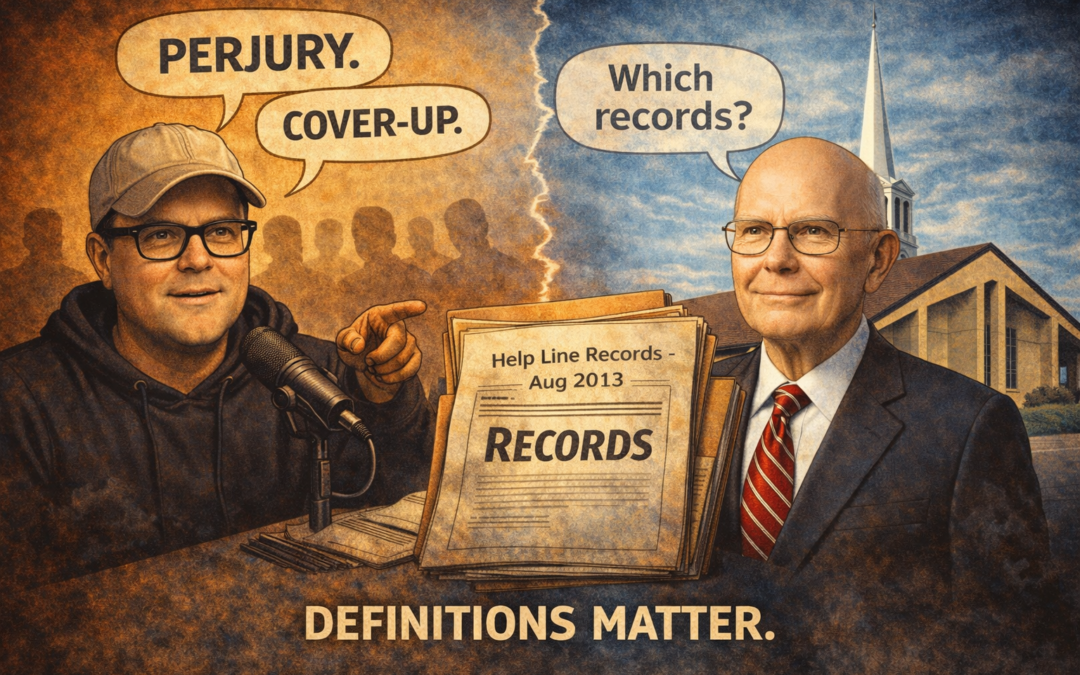
PODCAST CLAIMS REGARDING ABUSE HELP LINE “RECORDS”
SUMMARY
A podcast segment from Mormon Discussion Inc. (Radio Free Mormon and Bill Reel) alleges that The Church of Jesus Christ of Latter-day Saints was “caught lying” and committing perjury because a Church newsroom statement references “help line records from August 2013,” while Church representatives in other legal cases allegedly testified that help line records are destroyed daily.
This rebuttal evaluates each claim using transcript-only quotations, legal standards, and publicly available reporting. The central analytical issue is definitional: the word “records” can refer to multiple categories (e.g., metadata, call logs, contemporaneous summaries, retained notes, or recordings). Without establishing that the same category of record is being referenced in both contexts, claims of perjury or fraud are not substantiated.
SEGMENT 1: CLAIM THAT THE CHURCH WAS “CAUGHT LYING AGAIN”
Timestamp: 00:02:07 – 00:03:26
Speaker: Podcast Host
Word-for-Word Quote
“Helpline records from August 2013 directly contradict this narrative. Hold it. Stop the presses. What the [__] did you just do, Mormon church? You just proved that you are lying again… we don’t have them because all the records are destroyed at the end of the day. Sign Paul Ridding under penalty of perjury.”
Core Claim
The Church committed perjury because it now references “helpline records from August 2013” after allegedly swearing that all records are destroyed daily.
Claim Type
Legal accusation / institutional dishonesty.
The argument depends on treating the word “records” as a single, fixed category. In legal and operational contexts, records may include:
-
Call metadata (dates, number of calls)
-
Routing or intake logs
-
Contemporaneous summaries
-
Retained notes or recordings (which may be subject to destruction policies)
Without producing the actual sworn testimony text and demonstrating that it covered all categories of records (including metadata or summaries), the allegation of perjury does not meet the legal standard of material falsity plus intent.
Sources
SEGMENT 2: CLAIM THAT THE HELP LINE IS A “COVER-UP”
Timestamp: 00:04:37 – 00:05:43
Speaker: RFM
Word-for-Word Quote
“The earlier AP investigation found that the helpline plays a central role in the cover up of child sex abuse in the Mormon church… directs the most serious cases to attorneys… all information… is confidential under the clergy penitent privilege… and attorney client privilege.”
Core Claim
The help line exists primarily to cover up child sexual abuse.
Claim Type
Motive attribution / institutional misconduct allegation.
Evaluation
Routing sensitive matters to legal counsel and asserting clergy-penitent or attorney-client privilege is lawful and common among institutions. The Associated Press describes how these mechanisms operate but does not make a judicial finding that the help line’s purpose is criminal concealment.
To substantiate a “cover-up” claim as fact, evidence of intent to obstruct reporting or prosecution—confirmed by court findings—would be required.
Sources
SEGMENT 3: SPECULATION ABOUT RECORDED CALLS
Timestamp: 00:08:25 – 00:09:42
Speaker: RFM
Word-for-Word Quote
“This almost leads me to believe that it’s not somebody writing out notes… This is a recorded phone call… They’re recording the phone call and they have the transcript or they have the audio.”
Core Claim
The Church must be recording and retaining hotline calls.
Claim Type
Speculation presented as inference.
Evaluation
Detailed summaries can be produced without audio recordings through structured intake processes or contemporaneous documentation. The speaker explicitly signals inference (“almost leads me to believe”), which cannot support accusations of fraud or perjury.
SEGMENT 4: CALL FOR CONTEMPT AND “FRAUD UPON THE COURT”
Timestamp: 00:10:39 – 00:10:59
Speaker: RFM
Word-for-Word Quote
“I think those need to have new actions taken and the church held in contempt of court for perpetrating a fraud upon the court.”
Core Claim
The Church committed fraud upon the court.
Claim Type
Unsupported legal conclusion.
Evaluation
“Fraud upon the court” is a narrow doctrine determined by judges, requiring proof of intentional deception that corrupted the judicial process. No ruling, filing, or evidentiary showing is cited.
Reference: Cornell Law School, Legal Information Institute — Perjury
https://www.law.cornell.edu/wex/perjury
FINAL CONCLUSION
The podcast’s narrative relies on:
-
Conflation of legal terms (“records”)
-
Speculation elevated to accusation
-
Motive attribution without adjudicated findings
-
Repeated assertions of criminal conduct without evidence
As presented, claims of perjury, fraud, and institutional cover-up are not substantiated by the evidence cited.
OBJECTIVITY STATEMENT
This rebuttal does not intend to minimize abuse or dismiss victims. Mormontruth.org acknowledges the reality of abuse by members of the Church and condemns all abuse in any form. It evaluates claims strictly on evidence, legal standards, and verifiability. Allegations of criminal conduct require adjudicated findings, not inference or rhetorical escalation.
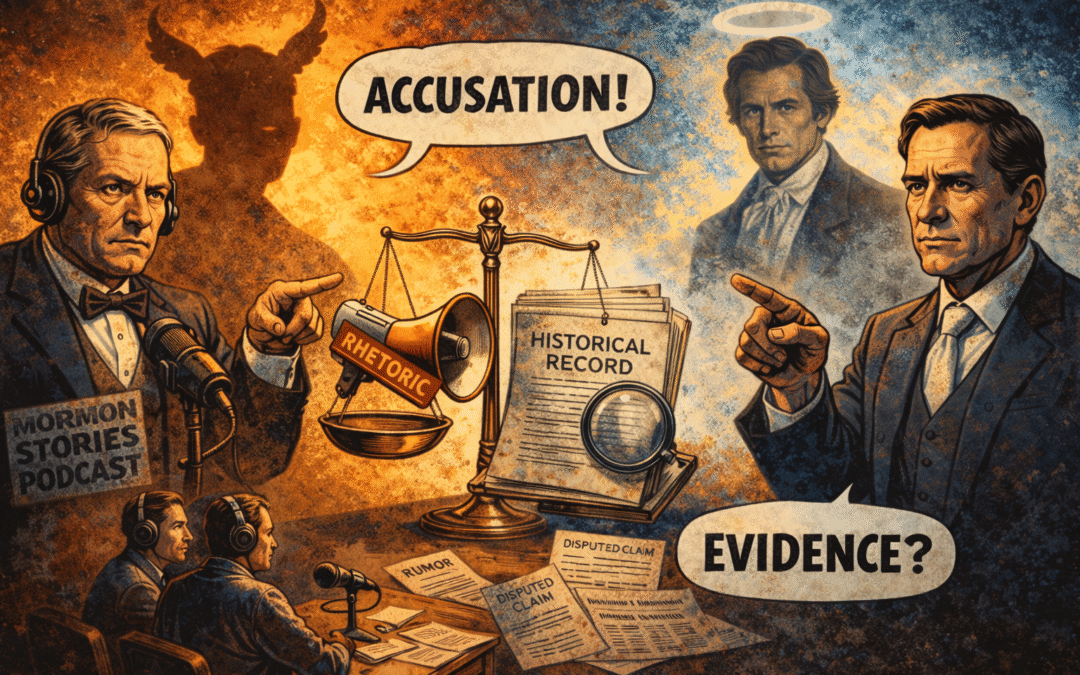
by Anonymous | Feb 25, 2026 | Joseph Smith
Five Places the Podcast Turns “Spiritual Wifery” Evidence into Assumption
Podcast: Mormon Stories — Joseph Smith Podcast
Episode: 2112 Series Part 31
Primary topic: John C. Bennett, “spiritual wifery,” Nauvoo scandal framing
Tone intent: Critical of overreach, open to evidence either way
The episode raises real historical questions. Nauvoo in 1841–1843 includes documented secrecy, allegations of sexual misconduct, reputational warfare, and deep human cost. Those are not things we should sanitize.
But the podcast also makes several highly subjective leaps—moves where the audience is nudged to treat a plausible interpretation as settled fact, or where modern criminal/abuse categories are pasted onto messy 1840s disputes without careful definitions.
Below are five of the most substantive “subjective overreach” moments—each paired with a tighter, more evidence-disciplined way to read the record.
1) “It seems impossible Bennett wasn’t told by Joseph…”
Why this matters: suspicion is not proof
Timestamp: 00:11:13–00:11:52
Speaker: John Dehlin
“my opinion is it seems impossible that John C. Bennett wasn’t at least told by Joseph Smith about eternal polygamy and began practicing it, you know, after Joseph told him about it.”
“it just it’s it’s too coincidental… he’s going to get accused of spiritual wiferey, but somehow that emerged completely independent and unaware of Joseph’s own polygamy. It just seems impossible.”
Core claim
Because Joseph was privately teaching plural marriage, Bennett’s “spiritual wifery” accusations almost certainly trace back to Joseph’s disclosure/approval.
Claim type
Probability argument / inference presented as near-certainty
Objective analysis
This is a reasonable question—but it’s still a probability claim, not a demonstrated fact.
A more disciplined way to frame it:
-
Yes, Bennett plausibly had awareness of rumors and/or insider knowledge about plural marriage. The episode itself has Turner concede Bennett had “detailed information,” and the historical documentary record shows “spiritual wifery” accusations swirling in that period.
-
No, awareness does not equal authorization—especially not authorization for Bennett-style promiscuity framed as “permission if kept secret.” The Joseph Smith Papers editorial framing explicitly distinguishes Bennett’s “spiritual wife” accusations from what Joseph and insiders considered their (separate) plural-marriage practice—and notes that participants did not even use “spiritual wife/wifery” as their own term.
-
The record also preserves an episode where Bennett publicly denied—strongly—that Joseph ever authorized “illicit intercourse.” That denial doesn’t prove Bennett was truthful forever (he later attacked Joseph), but it does prove the episode is more complicated than “impossible.”
Spiritual framework
You can interpret Nauvoo two very different ways:
-
Counterfeit-permission framework: “Spiritual wifery” functions as a predatory spiritual pretext—men claiming religious permission for sex while demanding secrecy.
-
Covenant-layering framework: plural marriage (however controversial) was presented among insiders as a covenant practice under claimed authority—distinct (in their minds) from seduction tactics.
The key point: the podcast often collapses these frameworks into one story, then treats the collapse as proven.
Bottom line
“It seems impossible” is not evidence. A fair conclusion is: Bennett likely knew something—by rumor or disclosure—but the leap to ‘therefore Joseph approved Bennett’s system’ is not proven by the best documentary framing.
Evaluation Table — Segment 1
| Claim summary |
Category |
Evaluation |
Sources |
| “Impossible” Bennett wasn’t told/approved by Joseph |
Not Provable (Speculative) |
Plausible question, but not demonstrated; documentary framing distinguishes terms and practices; Bennett denial exists |
Transcript ; JSP intro on terminology and corroboration limits ; Bennett denial in Times & Seasons publication |
Rhetorical tactic tag: certainty inflation (“impossible”) from incomplete data.
2) “This is where the Church’s long history of coverups of sexual abuse begins”
Why this matters: anacty into indictment
Word-for-word quote
Timestamp: 01:13:58–01:15:36
Speaker: John Dehlin
Transcript lines: 317, 320
“this is where the Mormon church’s super long history of coverups”
“of sexual uh, abuse scandals begins… the playbook… begins in in 1842 Nauvoo”
Core claim
A Nauvoo-era caution about publicity is the origin point of modern institutional sexual-abuse coverups.
Claim type
Institutional motive attribution + modern scandal backcasting
Objective analysis
This is one of the episode’s biggest interpretive leaps:
-
The transcript segment is triggered by language about public scandal management (“don’t make everything public…”). That is not automatically a “sexual k.” It can be (and often is) general crisis containment—sometimes wise, sometimes cowardly, soming on what is being concealed and why.
-
The Relief Society minutes and Church Historian’s Press material show the same era also includes women and leaders emphasizing moral reform and “putting down iniquity.” That complicates any simple “coverup origin story.”
-
Even the Church’s own modern historical synthesis acknowledges a dilemma in the 1842 public denials: leaders wanted to refute Bennett’s accusations without publicly explaining confidential plural marriage. That’s not flattering—but it’s not identical to “covering sexual abuse.”
Bottom line
The podcast is right that Nauvoo leaders engaged in reputation management. It is not shown that this equals the “beginning” of modern sexual-abuse coverup systems. That claim is too categorical for the evidence being discussed.
Evaluation Table — Segment 2
| Claim summary |
Category |
Evaluation |
Sources |
| “1842 Nauvoo = origin of LDS abuse-coverup playbook” |
Misleading (Anachronism) |
Evidence supports scandal-avoidance language and confidentiality dilemmas, not a proven causal origin of modern abuse coverups |
Transcript ; Relief Society minutes context (Church Historians Press) ; Church Historian’s Press on denial dilemma ; Gospel Topics essay framing “spiritual wifery” + denials |
Rhetorical tactic tag: category collapse (scandal management → abuse coverup).
3) “Lies to smear truthful whistleblowers”
Why this matters: labeling someone “truthful” is itself a factual claim
Word-for-word quote
Timestamp: 01:25:01–01:25:47
Speaker: John Dehlin (with Turner affirming)
Transcript line: 362
“the smearing, the use of lies to smear uh truthful whistleblowers. Is that fair to say?”
“I think that’s certainly fair to say in this context… yes.”
Core claim
Joseph/Church used deliberate lies to smear women who were truth-tellers and “whistleblowers.”
Claim type
Defamassertion (“lies,” “truthful”) presented as settled
Objective analysis
There are two separate questions the podcast merges into one:
-
Were there public conflicts and reputational attacks?
Yes—Nauvoo’s Bennett crisis produced dueling claims, affidavits, public statements, and deep polarization.
-
Were the targeted women “truthful whistleblowers,” and were the counterclaims “lies”?
That is not something you get to assert as a premise. It requires case-by-case evidence and careful weighting of sources, timing, incentives, and corroboration.
Even Church Historian’s Press framing makes clear that public denials were shaped by a dilemma: refuting Bennett while not publicly disclosing confidential plural marriage. That context can generate misleading public messaging—but “misleading under a confidentiality dilemma” is not automatically identical to “knowing lies to smear truthful whistleblowers.”
The episode’s moral outrage may be understandable, but the language “lies” and “truthful whistleblowers” fun delivered before the evidentiary trial.
Evaluation Table — Segment 3
| 01:25:01 | 01:25:47 | “Lies used to smear truthful whistleblowers” | Not Provable (Overstated) | Conflict and reputation warfare are documented; calling one side “truthful” and the other “lying” requires claim-by-claim proof not provided here | Transcript ; Times & Seasons contextual framing (JSP) ; Church Historian’s Press: public denials dilemma |
Rhetorical tactic tag: verdict language (“truthful,” “lies”) without evidentiary scaffolding.
4) The Whitney letter: “I need sex… bring your daughter” + “trafficking”
Why this matters: you can be morally critical without making claims the text doesn’t make
Word-for-word quotes
A) Letter read aloud, then reinterpreted
Timestamp: 01:57:43–01:59:00
Speaker: John Dehlin (reading and then paraphrasing)
“I take this opportunity to communicate some of my feelings privately…”
“…it would afford me great relief… now is the time to afford me sucker in the days of exile.”
“I wanna I need some sex. Can you bring your daughter?”
B) Criminal-label escalation
Timestamp: 02:00:56
Speaker: John Dehlin
“they’re complicit in not only trafficking their daughter to Joseph Smith”
C) Turner’s own corrective—spiritual motivation claim
Timestamp: 02:10:02
Speaker: John Turner
“trafficking. Well, first of all, they believe what Joseph is telling them theologically…”
Core claims
-
The letter’s “succor” language is basically a request for sex with a teenager.
-
The parents “trafficked” their daughter.
retive paraphrase → asserted as meaning; then criminal-label rhetoric
Objective analysis
This is where precision matters most.
What the transcript does establish
-
The letter (as read in the episode) is emotionally intense, requests a visit, and includes secrecy cues (the episode discusses burning the letter and hiding from Emma). That is legitimate evidence of a clandestine relationship and concealment—at minimum.
-
“Succor” in early English usage means help/aid/relief, not inherently sex. The podcast’s phrase “sexual sucker” is not an evidentiary translation; it’s an interpretation layered onto the word.
-
The letter is a known historical document (the Joseph Smith Papers hosts it).
What the transcript does not establish
-
The paraphrase “I need some sex” is not the text. It may reflect Dehlin’s impression of the implications, but it is still an inference—and should
-
“Trafficking” is a modern criminal term with defined elements (force, fraud, coercion, exploitation frameworks,h-century clandestine sealing arrangement “trafficking” is rhetorically explodoes not match the legal definition** as used by major authorities.
A more honest critical phrasing
If someone wants to be ethically critical without overclaiming, a tighe:
That’s strong criticism—without imbel the evidence in this segment doesn’t establish.
The Whitney letter is serious evidence of secrecy and relationship complexity. But “I need sex” and “trafficking” are interpretive escalations, not direct textual conclusions.
Evaluation Table — Segment 4
| Claim summary |
Category |
Evaluation |
Sources |
| “Succor” letter = “I need sex” |
Misleading (Interpretation stated as text) |
The episode reads the letter, then inserts sexual paraphrase; secrecy is evidenced, but sex is not explicitly stated in the quoted wording |
Transcript ; Webster 1828 on “succor” meaning aid/relief ; JSP hosts the letter |
| Parents “trafficked” their daughter |
False / Defamatory Label (as used here) |
The term “trafficking” has defined elements; this segment does not establish those elements; better to use accurate moral language without criminal claims |
Transcript ; U.S. State Dept definition overview ; UN Palermo Protocol definition framework |
Rhetorical tactic tag: prosecutorial labeling (high emotional impact, low evidentiary fit).
Risk flag: 🔴 High false-light risk for “trafficking.”
5) “The difference between Joseph and Epstein/Jeffs is indistinguishable”
Why this matters: disgust-transfer is not historiography
Word-for-word quote
Timestamp: 01:32:22–01:33:04
Speaker: John Dehlin
“the difference between him and Jeffrey Epstein and Warren Jeffs is indistinguishable”
Core claim
Joseph Smith is morally indistinguishable from modern, infamous sexual predators.
Claim type
Analogy as verdict
Objective analysis
Analogies can be useful when they clarify a mechanism. This one mostly does something else: it imports moral certainty from modern criminal cases into a historically contested, differently documented context.
Even if one concludes Joseph behaved grievously, “indistinguishable” is still an overreach because:
-
Modern predator cases often involve documented criminal patterns, victims, corroboration structures, and legal adjudication that are not parallel to how 1840s records function.
-
The analogy short-circuits evidence: it pressures the listener to feel that the conclusion is already morally decided, so source analysis becomes almost irrelevant.
A more evidence-open approach would be:
-
“Some patterns of secrecy, authority, and sexual access claims raise ethical concerns. But we should still evaluate each Nauvoo allegation on its own documents rather than collapsing everything into type.”
This analogy is emotionally potent but evidentially weak. It functions as rhetorical “verdict language,” not careful historical reasoning.
Evaluation Table — Segment 5
| Claim summary |
Category |
Evaluation |
Sources |
| Joseph “indistinguishable” from Epstein/Jeffs |
Misleading (False Equivalence) |
Emotional comparison substitutes for documentary argument; doesn’t adjudicate specific Nauvoo claims |
Transcript |
Rhetorical tactic tag: guilt-by-association / disgust transfer.
**Risk flag:*false-light risk (implied equivalence to child sex abuse).
What we can responsibly say after these five corrections
If we’re trying to be critical and evidence-based:
Keeping those separate doesn’t “exonerate” anyone. It just keeps us honest.
Sources consulted for this blog
(Only transcript quotes above are quoted; sources below are used for documentary framing and definitions.)
-
Joseph Smith Papers — Introduction to Journals: Volume 3 (terminology + corroboration cautions reery”)
-
Joseph Smith Papers — Times and Seasons, 1 Oct. 1842 (“On Marriage”) (distinguishes Bennett’s “secret wife system” from insider plural marriage framing)
-
Joseph Smith Papers — Letter to the Church and Others… as published (Bennett denial episode in the record)
-
Joseph Smith Papers — Letter to the Whitneys, 18 Aug. 1842 (document hosting)
-
Webster’s 1828 — “succor” (meaning as aid/relief)
-
Church Historian’s Press — Relief Society minutes entry containing “little tale will set the world on fire” context
-
Church Historian’s Press — Statement context on public denials dilemma (Doc 1.6)
-
Gospel Topics Essay — Plural Marriage in Kirtland and Nauvoo (mentions rumors, “spiritual wifery,” and carefully worded denials)
-
U.S. Dept. of State — “What is trafficking in persons?” overview definition framework
-
OHCHR (UN) — Palermo Protocol trafficking definition framework