
The Truth about Book of Mormon Anachronisms Discussed with John Dehlin
“The Biggest Book of Mormon Anachronism” — What’s Accurate, What’s Overstated, and What’s Missing
About This Episode
Dr. John Lundwall presents a sophisticated argument that the Book of Mormon’s highly literate, text-centered religious world is anachronistic for 600 BCE. At first glance, some of his observations carry real scholarly weight. However, several key claims are overstated. The argument selectively presents evidence and ignores crucial counterpoints. As a result, readers are not given the full picture.
This is the most academically sophisticated anti-Mormon argument in our rebuttal series to date. Dr. Lundwall is a credentialed scholar making arguments rooted in real scholarship on orality and literacy. Dismissing his argument is not the right approach. Engaging it honestly and completely means acknowledging what he gets right, correcting what he overstates, and supplying the evidence he omits.
The Core Argument
Lundwall’s central argument is straightforward: ancient societies primarily practiced religion through ritual, oral tradition, agriculture, and cosmology—not through written texts. In contrast, the Book of Mormon repeatedly emphasizes writing, record-keeping, and textual preservation.
According to Lundwall, this “literate worldview”—with over 140 references to records, sermons, and written commandments—reflects Protestant print culture in early 19th-century America, not 600 BCE Jerusalem or ancient Mesoamerica.
What Lundwall Gets Right
Conceded Point
Ancient religion was dominated by ritual, not text — and the Book of Mormon does have a heavily literate worldview
✓ Substantially True — and LDS Scholars Have Said So
Lundwall is correct that ancient Near Eastern religion — including Israelite religion — was primarily oral and ritual-based, not centered on individual scripture-reading. This is not a new critique; LDS scholars have discussed it for decades. The real question is what it means for the Book of Mormon — and the episode never honestly engages the LDS scholarly response.
Notably, the Interpreter Foundation — a peer-reviewed LDS scholarship journal — published a substantial analysis titled “Literacy and Orality in the Book of Mormon” that directly addresses this.
The study directly addresses this issue. It concludes that the text reflects a primarily oral culture with an elite literate class.
This matches what we expect in an ancient Near Eastern setting. Most people in the narrative do not read. Instead, a small priestly and royal class keeps records.
In addition, oral performance patterns appear throughout the text. These include chiasmus, repetition, and phrases like “and it came to pass.”
As a result, record-keeping remains concentrated in a small elite. This pattern aligns with known ancient scribal cultures.
This is exactly what we find in ancient Mesopotamia, Egypt, and Israel: writing was the preserve of an elite scribal class serving the temple and state. The Book of Mormon shows Nephi explicitly trained as a scribe before leaving Jerusalem — consistent with this model, not anachronistic to it.
The orality of ancient religion is real. LDS scholars have acknowledged and studied this for decades. The existence of an elite literate class in the Book of Mormon is consistent with ancient patterns — not evidence of 19th-century projection. This conceded point should be heard carefully, but it does not settle the question.
The Claims — and the Full Picture
Claim 1 of 4
“There’s no way there’s a set of brass plates. Priests in Jerusalem in 600 BCE were doing rain dances — they were not compiling scriptures into books and bound plates”
⚠️ Misleading — Overstates the Archaeological Picture
— Dr. John Lundwall, ~00:24:38
Why This Claim Matters
Lundwall argues that writing on metal plates and maintaining scriptural records would have been impossible in 600 BCE Jerusalem. If true, this would directly challenge the Book of Mormon’s historical plausibility.
What the Evidence Actually Shows
Literacy in 600 BCE Jerusalem
However, the archaeological record contradicts this claim.
Ancient Israelites were writing in meaningful ways at the time of Lehi’s departure. A Tel Aviv University study published in PNAS
shows widespread literacy in Judah around 600 BCE.
Researchers analyzed ink inscriptions from the Arad fortress and identified at least six authors.
This suggests a functioning educational system capable of producing complex texts.
In addition, the Lachish Letters—military correspondence from around 590 BCE—show routine written communication.
Likewise, the Ketef Hinnom silver scrolls contain the oldest known biblical text.
Writing on Metal Plates
FAIR LDS documents many examples of ancient writing on metal plates across the Mediterranean and Near East. These include the Pyrgi gold tablets, the Darius gold plates, and the Etruscan gold book.
Archaeologists have also found many copper and bronze inscriptions.
In addition, William Hamblin’s peer-reviewed study explores this evidence in detail. Therefore, the claim that brass plates could not exist is not just debatable—it conflicts with known findings.
To be fair, Lundwall raises a valid point. Many examples are ritual, not historical. However, “they don’t exist” and “this exact type doesn’t exist” are different claims. The episode blurs that distinction.
Claim 2 of 4
Monotheism is impossible in the Book of Mormon’s time — ancient peoples were all polytheistic, and you need literacy to develop monotheism
⚖️ Partially True — But the Israelite Case Is More Complex
— Dr. John Lundwall, ~01:10:56
Lundwall’s Argument About Monotheism
However, Lundwall argues that monotheism requires literacy.
He claims that reducing many gods into one demands abstract thinking shaped by literacy. This is an interesting theoretical framework, but it has a serious problem when applied to the Israelites specifically: it doesn’t fit what we know about Israelite religion.
Historical Context: Israelite Religion in Transition
Lundwall himself acknowledges that early Israelites were “not monotheistic” — they worshipped multiple gods including Asherah. This is true; the Hebrew Bible itself records this. However, prophets like Lehi, Jeremiah, and Isaiah challenged that culture.
They taught explicit monotheism against dominant polytheism.
This tension defines the Deuteronomistic reform period (~630–600 BCE). The narrative framework of the Book of Mormon places Lehi in exactly this prophetic reform context. He is a dissenter from mainstream Israelite polytheism, aligning himself with the prophetic tradition that called Israel back to exclusive Yahweh worship. His departure from Jerusalem just before the Babylonian exile places him squarely within the historical moment when this tension was at its peak.
At the same time, the archaeological evidence Lundwall cites for polytheism in Meso-America is a separate question — the absence of monotheistic archaeology in the Americas is a genuine challenge for Book of Mormon geography models. But his claim that monotheism was simply impossible in 600 BCE Israel is not accurate; prophetic monotheism existed as a minority position alongside widespread popular polytheism, and the Book of Mormon’s narrative is built around exactly that tension.
Prophetic monotheism existed in Israel in 600 BCE — it was a minority reform movement against popular polytheism, and that is precisely the context from which Lehi comes. The absence of monotheistic archaeology in the Americas is a real challenge for LDS geography models. But Lundwall’s broader claim — that monotheism was impossible in Lehi’s time — misreads the specific historical moment the Book of Mormon is set in.
Claim 3 of 4
“The only archaeological evidence we can find for the Book of Mormon is in the Old World” — and Nahom is not credible evidence
⚠️ Misleading — Dismisses Nahom Without Engaging the Actual Evidence
— John Dehlin, ~02:07:54
What the Nahom Evidence Is
Dehlin makes this comment, not Lundwall — and the episode leaves it unchallenged and uncorrected, so it stands as an implicit claim of the episode. This claim matters because it mischaracterizes the Nahom evidence.
The Nahom discovery does not support the idea that ‘Old World people were trying to hide.”
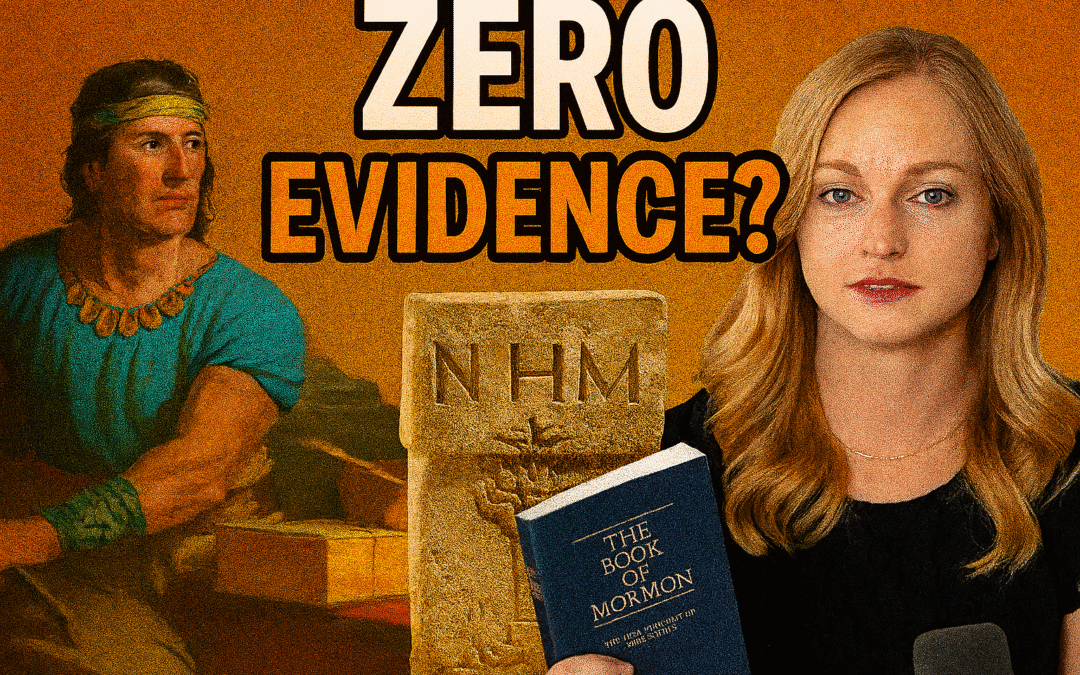
Archaeologists discovered three altar inscriptions with the name NHM.
A German team—not LDS researchers—found them at the Bar’an Temple in Yemen.
They date to the 7th–6th centuries BCE.
This location matches where the Book of Mormon places Ishmael’s burial.
It also aligns with the point where Lehi’s group turns east.
These altars were found by independent, non-LDS archaeologists and predate Joseph Smith by 2,400 years. Multiple peer-reviewed LDS studies document the convergence of name, location, date, and direction.
Why the Dismissal Falls Short
However, critics argue that Joseph Smith could have found “Nehhm” on 18th-century maps.
They also suggest the name match may be coincidental. These are legitimate points that researchers continue to debate. But dismissing Nahom as if it has no evidentiary value, or treating it as an embarrassing last resort, misrepresents the actual state of the scholarship. Terryl Givens described the NHM altars as “the first actual archaeological evidence for the historicity of the Book of Mormon” — not because it proves everything, but because the convergence of independent factors is not easily explained by coincidence.
Nahom/NHM represents genuine, non-trivial archaeological evidence discovered by non-LDS researchers that corresponds to a specific Book of Mormon claim about a specific place, time, and directional turn. Whether it proves the Book of Mormon is a different question — but dismissing it as if it doesn’t exist or has no weight is not intellectually honest.
Claim 4 of 4
The dominoes argument: “If there are no gold plates, there’s no John the Baptist, no Aaronic priesthood, no temple endowment — it all falls”
🔷 Theological Claim — Asserted, Not Demonstrated
— John Dehlin, ~00:45:37
Dehlin presents this “dominoes” argument as obvious.
However, it assumes something deeper.
It assumes LDS faith depends entirely on a strict, literal translation model.
It also assumes no other framework exists.
Alternative Faith Models Within LDS Thought
The LDS Church’s Gospel Topics Essay on Book of Mormon Translation explicitly acknowledges that Joseph Smith used a seer stone placed in a hat and that he did not always look at the plates during translation — a disclosure that itself undermines a simple tight-translation model. Many faithful LDS scholars, including those published in the Interpreter Foundation, BYU Studies, and Dialogue, hold nuanced views of the translation process that allow for Joseph’s language, culture, and cognition to have participated in the text.
The “domino” logic also presupposes that the historicity of the Book of Mormon is the only basis for LDS truth claims. But the Church’s theology is grounded in multiple independent lines: the First Vision, the Restoration of priesthood authority, continuing revelation, living prophets, and the personal spiritual witness available to any sincere seeker. Lundwall and Dehlin are entitled to argue that the book’s historicity is foundational. But presenting this as so obvious that it doesn’t require argument — while millions of faithful members hold a more textured view — is not honest intellectual engagement.
Whether Book of Mormon historicity is the single load-bearing pillar of LDS faith is a theological claim, not an established fact. The Church itself has acknowledged complexity in the translation process. Many faithful scholars and members hold views that don’t reduce to “tight translation or nothing.” The domino argument is rhetorically powerful but intellectually lazy — it presents one particular framing of LDS faith as the only possible framing.
The Honest Summary
Dr. John Lundwall presents a serious and intellectually sophisticated challenge to the Book of Mormon. His emphasis on the oral nature of ancient religion is well-supported, and his observations about literacy deserve careful consideration.
However, when we examine the full body of evidence, a more complex picture emerges.
Here’s what the episode leaves out.
Jerusalem in 600 BCE had documented literacy. It was not limited to temple elites.
Writing on metal plates appears across the ancient world.
In addition, the Nahom/NHM discovery provides real archaeological data.
Non-LDS researchers discovered it.
At the same time, prophetic monotheism already existed in Israel.
It functioned as a minority reform movement.
Finally, the idea that Book of Mormon historicity supports all LDS truth claims is a framework—not a proven fact.
Serious questions about the Book of Mormon deserve serious engagement on both sides. This episode provides one side with sophistication and the other side with nothing. Truth seekers deserve better than that.