Select Page
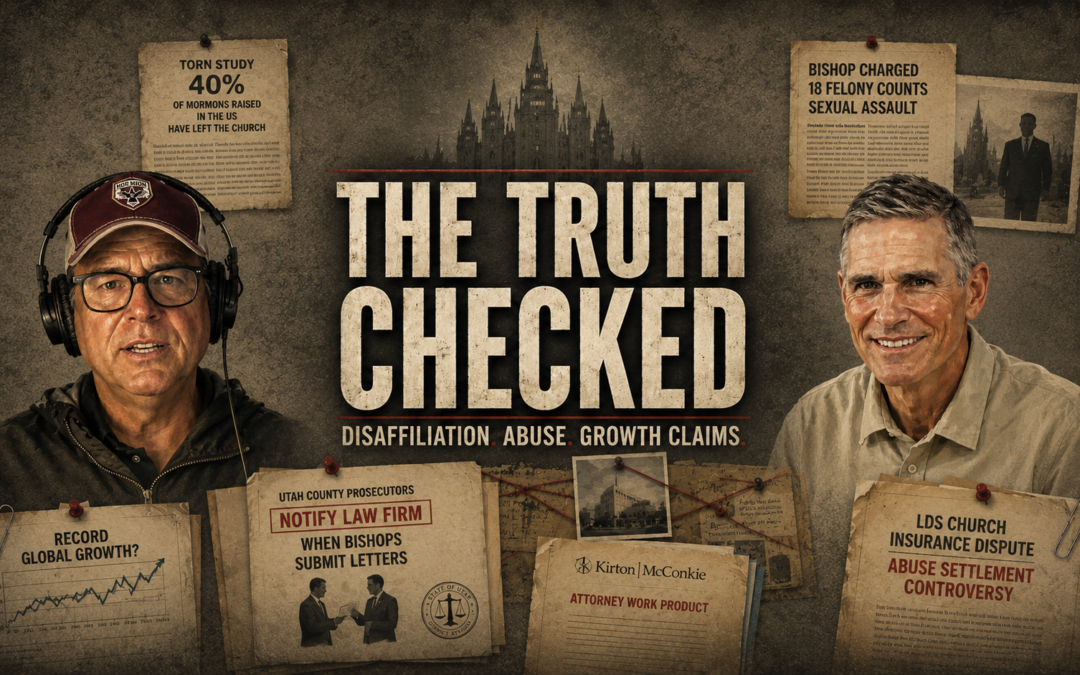
Mormon Stories Using Wade Christofferson to Smear Entire Church

Mormon Stories Using Wade Christofferson to Smear Entire Church

Top 5 Most Egregious Claims in This Section

Podcast: Mormon Stories Podcast, Episode 2117, “Breaking: Mormon Church Hides Wade Christofferson Abuse Enabling More Abuse – Ed Nachel”

Podcast Summary

The following section examines five of the most serious claims made in Mormon Stories Podcast, Episode 2117, particularly those presented as factual conclusions rather than unresolved questions. The goal is not to minimize the gravity of the abuse allegations involving Wade Christofferson, which are deeply troubling on their own. Instead, this analysis focuses on evaluating where the episode moves beyond documented evidence—transforming inference, recollection, or criticism into assertions of certainty about what church leaders supposedly knew, approved, or concealed. Because such claims carry significant reputational and factual implications, they deserve careful scrutiny against the available public record.

Who Ed Nachel Is in This Episode

Ed describes himself as a convert in the Chicago area who joined the Church in 1978, was called to the high council in 1996, had known Wade for close to 20 years, and had previously served in a branch presidency and other local callings. In other words, he is presented here as a former insider witness to a local ecclesiastical process, not as a custodian of Church headquarters records.

How These Five Were Ranked

These are ranked by evidentiary overreach and reputational severity—not by the seriousness of the abuse allegations against Wade Christofferson. This rebuttal does not minimize alleged abuse. It addresses only the podcast’s strongest leaps beyond what is publicly documented.

Method note: The core problem in this section is not concern for victims. It is the repeated move from allegation, recollection, or policy inference to public certainty about what unnamed “top leaders,” Church headquarters, or D. Todd Christofferson supposedly knew and approved.
# Claim Classification Why It Is Egregious
1 Top Church leadership knew and was complicit Not proved / false-light risk Attributes certainty and complicity to living leaders without a public documentary chain.
2 The Church covered up and enabled Wade’s later abuse Partial inference stated as fact Turns unresolved questions into a concluded institutional verdict.
3 Officials removed an abuse annotation from Wade’s membership record Not proved from public record Claims a specific record action without publicly produced membership documents.
4 The Church’s abuse hotline tells leaders not to contact police Misleading / overgeneralized Generalizes serious criticism from some cases into a universal official instruction.
5 Mormonism was founded in sexual predation and sexual coverups Polemical overreach Collapses disputed and complex 19th-century history into a totalizing slogan.

1) “Top church leadership must have known”

Speaker: John Dehlin

Word-for-Word Quote

“people involved would have known about and approved the removal of the annotation from his record that he was a known child abuser. So they would have been complicit in a cover up making it so Wade could get rebaptized and become a bishop Rick member again and not be viewed by his family and friends as a sexual predator of children.”

Core Claim

Senior Church leaders knew Wade was a child abuser, approved removing a record warning, and became complicit in a cover-up.

Classification

Not proved / false-light risk.

Why This Is Egregious

This is the most legally and reputationally loaded claim in the section because it moves from a theory about how record annotations work to a certainty that unnamed senior leaders knowingly approved concealment.

Core Finding

The public record does not presently prove that D. Todd Christofferson or “top church leadership” knew and approved the steps alleged here. The Chicago Sun-Times reported the Church’s statement that D. Todd Christofferson was not in a position to know about, and did not know about or influence, the ecclesiastical decisions regarding his brother’s membership; the same report says he later reported a recent allegation involving a minor to legal authorities.

Current Church policy does confirm that abuse annotations are real and that restrictions remain unless the First Presidency authorizes removal of the annotation. But that policy mechanism does not prove that Wade’s specific file was altered in the way the podcast claims. In other words: a theoretical pathway is not the same thing as a documented historical fact.

Bottom Line

Serious questions may remain, but “must have known” is stronger than the current public proof can sustain.

Sources

2) “The Mormon church covered up and enabled a child sexual predator”

Speaker: John Dehlin

Word-for-Word Quote

“They would have known all that and approved it. In other words, the Mormon church covered up and enabled a child sexual predator to not be found out and then also to be elevated to further positions of leadership,”

Core Claim

The Church knowingly hid Wade’s abuse and affirmatively empowered later abuse through rebaptism and leadership placement.

Classification

Partial inference stated as fact.

Why This Is Egregious

It announces a final institutional verdict—cover-up and enabling—when the publicly available record still contains major unresolved factual gaps.

Core Finding

There is a serious question here, but the podcast states the conclusion more strongly than the evidence currently in hand. Current Church policy says members who abuse others should not be given Church callings and that sexual abuse of a child leads to a membership annotation unless the First Presidency authorizes removal. That means the policy framework is significant. But the episode does not produce Wade’s actual record, a First Presidency directive, or a document showing who approved what and when.

The Church’s statement reported by the Sun-Times says Wade was readmitted in 1997 following established disciplinary and confession processes and says the Church is aware of no abuse involving his Church service after that time. That statement may be disputed by critics, but it means the public record is still contested, not closed.

Bottom Line

The podcast can fairly raise a grave institutional question. It cannot yet present institutional guilt as conclusively proved.

Sources

  • Uploaded transcript: 00:52:06–00:52:38, John Dehlin, lines 278–281.
  • General Handbook 38.6.2.5 – says abusers should not be given Church callings and explains abuse-related annotations.
  • Chicago Sun-Times (March 5, 2026) – reports the Church’s statement that Wade was readmitted in 1997 and that it is aware of no abuse involving his Church service after that time.

3) “Church officials removed an annotation on his records”

Speaker: Ed Nache

Word-for-Word Quote

“Said that when he was rebaptized into the church, church officials removed an annotation on his records. So, it was removed when he was rebaptized.”

Core Claim

A specific abuse annotation existed on Wade’s membership record and was later removed by Church officials at rebaptism.

Classification

Not proved from public record.

Why This Is Egregious

This is the factual hinge that supports several later accusations. If it is unproved, the rest of the certainty built on top of it weakens substantially.

Core Rebuttal

Current Church materials confirm the general policy: abuse annotations exist, bishops are expected to heed them, and restrictions remain unless the First Presidency authorizes removal. But the podcast does not produce Wade Christofferson’s membership record, an annotation notice, or a document showing that an annotation was actually removed in his case.

That matters. The difference between “this policy could allow an annotation to be removed” and “this specific annotation was removed here” is the difference between policy analysis and proof.

Bottom Line

The handbook supports the mechanism in theory. The episode does not publicly prove the mechanism was used in Wade’s case.

Sources

  • Uploaded transcript: 00:47:55–00:48:27, Ed Nachel, lines 257–260.
  • General Handbook 38.6.2.5 – says sexual abuse of a child leads to annotation and that restrictions remain unless the First Presidency authorizes removal.
  • Annotation of Membership Records – explains that annotations exist to help protect members and others.

4) “Don’t contact the police. Keep this quiet.”

Speaker: John Dehlin

Word-for-Word Quote

“And then of course the advice is don’t contact the police. Keep this quiet.”

Core Claim

The Church’s abuse hotline, as a matter of policy, advises leaders not to involve police and to suppress abuse reports.

Classification

Misleading / overgeneralized.

Why This Is Egregious

It converts documented criticism from some cases into a universal claim about official Church policy.

Core Finding

There is a real factual core to the criticism. AP reporting has documented cases in which critics say the help line and privilege claims were used to protect the institution rather than aid prosecution. That criticism is serious and should not be dismissed.

But John’s sentence overstates the published policy. Current Church materials say leaders should fulfill all legal obligations to report abuse to civil authorities, urge abusive members to report to law enforcement, and that the Church cooperates with civil authorities when it learns of abuse. So the more accurate formulation is this: some reported cases have raised serious concern about how the system has functioned, but the current published policy does not simply say “don’t contact the police.”

Bottom Line

Sharp criticism is fair. A universal policy claim is too broad.

Sources

  • Uploaded transcript: 00:39:40–00:40:19, John Dehlin, lines 214–218.
  • AP News (Dec. 12, 2023) – reports criticism that the Church used a legal playbook protecting itself from abuse claims.
  • General Handbook 38.6.2.5 and 38.6.2.7 – says leaders should urge reporting to law enforcement and fulfill legal reporting obligations.
  • How the Church Approaches Abuse – says the Church’s first priority is to help the victim and stop the abuse, and that it cooperates with civil authorities.

5) “The Mormon church was founded and marinated in sexual predation”

Speaker: John Dehlin

Word-for-Word Quote

“the Mormon church was founded and marinated in sexual predation and sexual coverups.”

Core Claim

Mormonism’s origins are best described not as difficult or controversial history, but as foundational sexual predation and cover-up.

Classification

Polemical overreach / historically misleading.

Why This Is Egregious

It takes a broad set of complicated, partly disputed historical questions and compresses them into a single accusatory slogan presented as settled fact.

Core Rebuttal

Official Church essays openly acknowledge that Joseph Smith left multiple First Vision accounts and that plural marriage in Nauvoo included facts many modern readers find morally difficult, including Helen Mar Kimball’s young age and sealings to some women already married to other men.

But those same official sources say the First Vision accounts tell a consistent core story, and they also note that Helen later described her sealing to Joseph as “for eternity alone,” suggesting no sexual relationship. They further state that the exact nature of some already-married women’s sealings is unknown. That does not settle every historical dispute, but it does show that the podcast’s totalizing slogan goes beyond what the sources themselves establish.

Bottom Line

“Difficult, contested, and morally challenging history” is supportable. “Founded in sexual predation and coverups” is an interpretive slogan, not a demonstrated historical conclusion.

Sources

  • Uploaded transcript: 01:07:22–01:09:12, John Dehlin, lines 356–365.
  • First Vision Accounts – says Joseph shared multiple accounts and that the accounts tell a consistent core story despite differences in emphasis.
  • Plural Marriage in Kirtland and Nauvoo – acknowledges difficult plural marriage facts while also noting that Helen Mar Kimball described her sealing as “for eternity alone” and that some sealings’ nature is unknown.

Closing Summary

The strongest pattern in this section is repeated conversion of inference into certainty. The episode can legitimately raise hard questions about secrecy, victim protection, and institutional handling. But its most aggressive lines leap past the publicly documented record and present disputed propositions as settled facts.

The five claims above are the most egregious because they either:

  • accuse living leaders of knowledge and complicity without public documentary proof,
  • state a specific record action as fact without producing the record,
  • turn serious criticism of some cases into a universal policy statement, or
  • flatten complex Church history into a sweeping moral slogan.


Are Women Leaving the LDS Church in Droves? Top 5 Claims From Mormon Newscast

Are Women Leaving the LDS Church in Droves? Top 5 Claims From Mormon Newscast

Women Leaving the Church

Podcast Mormon Newscast — “Monday Night February 23rd”

The BYU/Dyer material discussed in the episode defines “retention” primarily as continuing to identify as a Latter-day Saint (not automatically “weekly activity”). Conflating identify, retain, and active is a recurring distortion risk.

The gender retention gap among younger U.S. Latter-day Saints is real in the cited research. However, the episode repeatedly adds:

  1. Metric drift (“active” vs. “identify”)

  2. Exaggerated ratios (“twice”)

  3. Motive imputation (“by design”)

None of these additions are proven by the cited data.

Evaluation Table — Top 5 Women-Leaving Claims

Claim Summary Category Evaluation
Younger female members are leaving at a significantly higher rate than older female counterparts True (directionally) The cited retention-by-age data shows younger women retaining/identifying at lower rates than older women; the generational slope for women is steep.
“35% of females stay active” vs “57% of men” at age 18; huge discrepancy Partial Truth / Misleading The male figure is close; the female figure is in the high-30s in the cited figure. The larger problem is calling it “stay active” while also admitting it is likely “those who identify.”
The Church is not meeting women’s needs; women are leaving “in droves”; “can’t be argued” Partial Truth / Overreach Gap exists; “needs” is a causal claim not proven by the graph. “Droves” + “can’t be argued” is rhetorical certainty beyond what the data alone establishes.
Oaks said “work left to do” to boost women; women leaving “twice” men; otherwise “no women” for LDS children in 1–2 generations Mixed Oaks quote is externally corroborated. The “twice” ratio and “no women” forecast are exaggerated/speculative and not demonstrated by the cited retention figure.
Mission age 18 for women is “by design” to stop the 18–20 “freedom gap” where many young women leave; pipeline home → mission → marriage Not Provable (motive imputation) The policy change is real; claiming intent (“by design” to control/insulate) is not established by evidence in the episode and functions as a false-light framing risk.


Claim 1 — “Younger female members are leaving … at a significantly higher rate”

Word-for-word quote (00:20:30 | Speaker: Bill Reel | Transcript lines 118–119)

younger female members are leaving the church at a significantly higher rate than their older counterparts.

Core Claim: Younger women are exiting/deidentifying more than older women.

Claim Type: Statistical trend (gender × age retention).

Logical Questions (MTOPS):

  • What does “leaving” mean in the cited research: attendance, formal resignation, or self-identification?
  • Is the claim U.S.-specific data, cohort-specific, or global Church-wide?
  • Does the same dataset allow for later re-identification/return?

Core Rebuttal (data + covenant framing):

Data confirmation:
The BYU/Dyer report text and Figure 17 support the direction of the claim: younger women show notably lower retention/identification than older women.

Covenant layering (doctrinal lens):
Retention is not merely institutional “hold.” It reflects layered covenants, belonging, and discipleship practices. A real gender gap is therefore a stewardship alarm—leaders and members must respond without denial or scapegoating.

Stewardship doctrine (practical lens):
If younger women feel unseen, unheard, or perpetually “auxiliary” to male authority, the solution is not PR. It is repentance, listening, and meaningful inclusion in decision-making where appropriate.

Bottom Line: This trend claim is directionally supported by the cited retention-by-age data. The honest faithful response is not to deny it—it is to lead better.

Sources: [S1]

Deep Research Mode — strategic query log (Claim 1)
  • “Figure 17 Latter-day Saint retention rate in 2025 by gender and age (SSS 2025) PDF”
  • “How does BYU/Dyer define ‘retention’ (identify vs attend)?”
  • “Studies on gender differences in LDS retention / religiosity over time”
  • “Church policies or recent changes responding to women’s participation/retention”


Claim 2 — “35% of females … stay active” vs “57% … men” at age 18

Word-for-word quote (00:21:09 | Speaker: Bill Reel | Transcript lines 121–122)

35% of females are choosing to stay active in the LDS church. I’m going to say by the way I think this is those who identify um because I think we all understand the activity rates around 35% anyway. So that would be to me mindblowing. Men at the same age who identify as Latter-day Saints are are around 57% who stay, not leave. This is the retention rate. This is those who stay. That discrepancy is huge.

Core Claim: At age 18 the female “stay” rate is ~35% vs men ~57%—a massive retention gap.

Claim Type: Quantitative claim + metric label (“active” vs “identify”).

Logical Questions (MTOPS):

    • Is the 35% figure “active,” “identify,” or “retain + attend”?

    • What does the underlying figure actually show for women at age 18?

    • Is the discussion referring to Church activity rates generally, or a specific survey definition?

Core Rebuttal :

  • Metric discipline:
    The BYU/Dyer report’s Figure 17 describes retention as continuing to identify as Latter-day Saint. The plot places 18-year-old women in the high-30% range and men in the high-50% range—close to the episode’s approximation but not equivalent to “weekly activity.”

    Truthfulness test:
    The quote itself admits the drift (“I think this is those who identify”). That admission matters. When critics say “only 35% stay active,” listeners assume participation or attendance, yet the figure refers to identity retention.

    Authorized priesthood use (accountability lens):
    Leaders should not hide behind fuzzy metrics. If the data measures identity retention, it should be described that way. Precision builds credibility; imprecision fuels unnecessary fear.

    Bottom Line:
    The gender gap is real, but calling the graph “active” is misleading.

Sources: [S1]

Deep Research Mode — strategic query log (Claim 2)
  • “BYU Dyer report retention defined as identify as LDS in adulthood”
  • “Figure 17 values at age 18 male vs female”
  • “Difference between identity-retention and attendance-retention in Pew/SSS”
  • “How surveys operationalize ‘active retention’ across religions”


Claim 3 — “The church is not meeting the needs of women … leaving in droves … can’t be argued”

Word-for-word quote (00:22:34 | Speaker: Bill Reel | Transcript lines 127–128)

church is not meeting the needs of women and they are leaving by this graph alone. They are leaving in droves. Um I don’t think that can be argued with.

Core Claim: The gender retention graph proves the Church is failing women’s needs and women are leaving “in droves,” beyond dispute.

Claim Type: Causal inference + rhetorical certainty.

Logical Questions :

  • Does the graph demonstrate why younger women deidentify, or only that a gap exists?
  • Are there alternative explanatory variables (social secularization, family disruption, region, ideology, online ecosystems, life-stage transitions)?
  • Does the underlying report explicitly warn against over-reading causation?

Core Rebuttal:

  • What the data can prove: It supports a retention/identity disparity by age and gender.
  • What the data cannot prove by itself: “The church is not meeting the needs of women” is a causal diagnosis. A line graph does not establish causation—only correlation/trend.
  • Fallacy tag: This is a classic causal leap (“by this graph alone”) plus an overclaim of certainty (“can’t be argued”).
  • Stewardship Doctrine (faithful response): Even if causation is not proven, stewardship still demands action: (1) listen to women without punishment, (2) reduce culture-of-dismissal, (3) stop “token voice” patterns, (4) ensure doctrine is taught without unrighteous dominion.

Bottom Line: The gender gap is arguable (and real). The claim that the graph alone proves “needs not met” is not.

Sources: [S1]

Deep Research Mode — strategic query log (Claim 3)
  • “Does the BYU/Dyer report attribute causes of women’s lower retention?”
  • “Predictors of deidentification in FFYD 2020–2024 (gender differences?)”
  • “Scholarly work on LDS women, authority, and retention dynamics”
  • “Evidence thresholds for causal claims in survey research”


Claim 4 — Oaks quote + “twice the rate” + “no women for LDS children” forecast

Word-for-word quote (00:23:08–00:23:44 | Speaker: Bill Reel | Transcript lines 130–134)

I thought that was a great line. I’m going to read these four paragraphs. I do want to note though, several uh months ago, this was back in October of 25, if we remember when the first presidency was first called, Elder Oaks stated, “We have work left to do,” quote unquote, to boost women. And uh he acknowledged that we’ve got changes to make in order to keep the ongoing restoration working for the females in the church. And when you understand that they get

the data, they see it, they know that women are leaving at essentially twice the rate that men are in the church from the younger generation. It makes perfect sense when you understand that that they clearly they clearly get that in a generation or two there are no women here to have LDS children and the church clearly begins a significant decline if females are not brought back to at least somewhere around the rate of men male activity.

Core Claim: (1) Oaks acknowledged “work left to do” for women; (2) women are leaving at ~2× men; (3) without change, women vanish from LDS childbearing within 1–2 generations.

Claim Type: Verified quote + numerical exaggeration + speculative forecast.

Logical Questions :

  • Is the Oaks quote accurately sourced to a specific interview/public statement?
  • Does the cited retention figure actually justify “twice”?
  • Does the data justify a “no women” generational collapse prediction?

Core Rebuttal (separate truth from spin):

  • Confirmed portion: The Oaks “work left to do” framing is externally reported in major coverage. That is not “evidence of collapse”; it is evidence leaders recognize unfinished work.
  • Correct the math rhetoric: “Essentially twice” is not supported by the cited figure. The referenced graph is closer to high-30s vs high-50s at age 18—serious, yes; “double,” no.
  • Forecast discipline: “No women here to have LDS children” is a rhetorical doomsday extrapolation. Retention is not a one-way exit ramp; the underlying report itself notes the possibility of leaving and returning later in life.
  • Covenant Layering (doctrinal anchor): Change is not illegitimate because it responds to real needs. The Restoration is framed as “ongoing” precisely because humans learn, repent, and improve. But critics cannot claim omniscience about leaders’ internal motives or future outcomes.

Bottom Line: The leader quote may be real; the “twice” ratio and “no women in 1–2 generations” claim are inflated and speculative.

Sources: [S2], [S1]

Deep Research Mode — strategic query log (Claim 4)
  • “Oaks first interview ‘work left to do’ boost women October 2025”
  • “Compare ‘twice the rate’ claim to Figure 17 actual values”
  • “What does BYU/Dyer report say about leaving and returning later?”
  • “Demographic modeling: why linear extrapolation from a single cohort is unreliable”


Claim 5 — “Mission age 18 for women … by design” to close the “freedom gap” and stop leaving

Word-for-word quote (00:27:00–00:28:22 | Speaker: Rebecca | Transcript lines 151–161)

about the uh ability of women to add to the conversation. >> Yeah. And I’m sure he’s not aware at all when he told that story. I’m sure he thought he was magnanimously, you know, championing women. So, no, I think that the statistic of women um stepping away is terrifying to the church because I think they’ve taken women for granted for a very long time. They’re just going to be here. They’re going to stay. They’re going to raise the kids in righteousness. They’re going

to be the moms. We don’t need to worry about them. They’re content. They’re happy. They don’t need to sit on the stand. Um they just don’t consider women. And now all of a sudden here’s this data and that’s terrifying because we all know the women, you know, teach the children, the women have a huge influence. I believe that this is why women going on missions at age 18 is what they’re going to do now because it’s that gap. We have other statistics we’ve talked about here on on the

newscast bill, you know, if you remember that show it’s that gap there 18, 19, 20 where young women finally have the chance to maybe leave home for the first time or, you know, go get a job, kind of get more out of their parents, you know, under their thumb or their church leaders. And when they have that freedom, when they come up for air and they’re able to think for a minute, a lot of them leave. And a lot of them leave over social issues because you know they’re exposed to things as they

are able to move out of this insulated silo of a community that they’ve been in and the rhetoric that they hear all the time and that’s when they step away. So that’s not going to happen anymore. They are going to step from one insulated community in their parents’ home into a mission into a marriage where they need the church to support because of all the difficulties of young marriage and having a lot of children really early. So, I think it’s by design. I think they’re terrified of the statistic.

Core Claim: Lowering women’s mission age to 18 is intentionally designed to prevent young women from “coming up for air” and leaving in the 18–20 window.

Claim Type: Policy fact + motive attribution + coercion/insulation narrative.

Logical Questions:

  • Is the mission age change a documented fact? (Yes.)
  • Does any documentary evidence establish the asserted intent (“by design” to trap/insulate women)?
  • Is missionary service compulsory for women, or optional?
  • Are there plausible, non-malicious explanations consistent with official statements (equal opportunity; desire to serve; timing after graduation; responding to demand)?

Core Rebuttal (fact vs intent):

  • What’s true: The Church publicly announced young women may serve missions at age 18 (policy fact).
  • What’s not proven: “By design” alleges internal intent of control/insulation. The episode supplies no documentary proof (memos, minutes, admissions) establishing that motive as fact.
  • Authorized Priesthood Use (boundaries): If you accuse a religious institution of intentionally engineering a pipeline to limit women’s agency, you are no longer discussing “trend data”—you are alleging manipulative intent. That is a higher evidentiary bar.
  • Stewardship Doctrine (stronger, truthful critique option): It is legitimate to argue that leaders should prioritize women’s voice, safety, belonging, and meaningful authority. It is not legitimate to assert hidden motives as established fact without evidence.

Legal & reputational note (MTOPS):
Presenting “they did it to trap women” as factual intent can create a 🟠 moderate false-light risk when framed as certain rather than speculative commentary.

Bottom Line: The mission-age policy is real; the “control-by-design” motive is not proven and should be labeled as speculation—not asserted as fact.

Sources: [S3]

Deep Research Mode — strategic query log (Claim 5)
  • “Official Newsroom announcement lowering mission age for women to 18”
  • “Statements from Church leaders on why the age change was made”
  • “Is women’s missionary service optional vs required?”
  • “False light: public claim + reckless disregard standards (overview)”


Sources

Note: Transcript quotations are from the user-uploaded transcript. External sources below support evaluation of claims and provide primary documentation.

  1. [S1] W. Justin Dyer et al., “Latter-day Saint Religiousness, Well-Being, and Retention in the United States” (Working Paper, updated 12-16-2025), BYU Foundations. (See Figure 17 and retention definitions.)
    https://foundations.byu.edu/0000019b-1343-d613-a59b-17df82980000/latterdaysaintreligiosity-pdf
  2. [S2] The Salt Lake Tribune, “‘We have work left to do’ to boost women, says new LDS Church President Dallin Oaks” (Oct. 16, 2025).
    https://www.sltrib.com/religion/2025/10/16/lds-news-what-dallin-oaks-said-his/
  3. [S3] Church Newsroom, “Women Can Now Serve Missions for the Church of Jesus Christ of Latter-day Saints at Age 18” (Nov. 21, 2025).
    https://newsroom.churchofjesuschrist.org/article/women-missionary-service-age-18
  4. [S4] Cornell Law School Legal Information Institute (LII), “false light” (overview).
    https://www.law.cornell.edu/wex/false_light
  5. [S5] Cornell Law School Legal Information Institute (LII), “defamation” (overview).
    https://www.law.cornell.edu/wex/defamation
  6. [S6] U.S. Supreme Court, Milkovich v. Lorain Journal Co., 497 U.S. 1 (1990) (opinion vs fact implications; overview access).
    https://www.law.cornell.edu/supct/html/89-645.ZD.html

Sources Consulted — transparency summary

  • Primary trend documentation: BYU Foundations working paper (Dyer et al., 12-16-2025) for retention definition + gender/age chart.
  • Leadership quote verification: Salt Lake Tribune interview coverage (Oct. 16, 2025).
  • Policy fact verification: Official Church Newsroom mission age announcement (Nov. 21, 2025).
  • Legal framing references (for false-light/defamation screening): Cornell LII + Milkovich access page.


John Dehlin Using Elizabeth Smart to Blame the Church

John Dehlin Using Elizabeth Smart to Blame the Church

Mormon Stories Episode 2109 – Elizabeth Smart

On his Mormon Stories podcast, John Dehlin falsely claiming that Elizabeth Smart is a victim of the Mormon Church. He uses out of context quotes and statements from church leaders to evoke emotion and to blame the Church for extremism. Read on for an objective analysis of why this podcast is misleading and harmful.

Finding 1 — “Very much a Mormon story” 

Misleading Core Claim

The Elizabeth Smart kidnapping is “very much a Mormon story,” with causative roots in Mormonism and Joseph Smith.
Claim type: Religious responsibility framing; causal insinuation; reputational attribution.
Claim Summary Category Evaluation Sources (verified hyperlinks)
Kidnapping is “very much a Mormon story” linked to Mormonism/Joseph Smith Misleading “Mormon” can be a descriptive label (victim identity, regional context), but the quote shifts into implied causation (“influenced by Joseph Smith”)
without establishing a primary-source doctrinal or institutional causal chain. This is a classic identity→causation slide.
Church Newsroom statement rejecting “doctrinal connection” framing (Mar 24, 2003)
Doctrine & Covenants 132 (official LDS scripture page; includes plural marriage material)
Joseph Smith Papers — D&C 132 original revelation context

Core Findings

  • Stewardship Doctrine: Even where LDS belief includes personal revelation, LDS structure distinguishes personal guidance from “command authority” over others. A kidnapper’s claim “God told me” is not authorized priesthood stewardship.
  • Authorized Priesthood Use: In LDS doctrine, binding directives for others come through authorized channels, not self-appointed prophets. This matters because the transcript’s framing invites the reader to see LDS belief as a causal license rather than a violated boundary.
  • Reputational Precision: If “Mormon story” means (a) Utah context + (b) victim identity + (c) perpetrators’ prior affiliation, that can be stated precisely. But “roots in Joseph Smith” is a separate causal claim requiring primary documentation.

The transcript’s opening frame is rhetorically powerful but analytically imprecise: it blends descriptive “Mormon” context with unproven doctrinal causation.


Finding 2 “Roots in Joseph Smith / founding of Mormonism”

Speaker: John
00:05:02
"...I think this story very much fits alongside those in terms of it being not just Mormon crime and Mormon true crime, but Mormon true
crime that has its roots in Joseph Smith, in Mormon doctrine, Mormon history, and in the founding of Mormonism."
Claim Summary Category Evaluation Sources
Smart case “roots” in Joseph Smith and LDS founding Misleading This is a broad causal claim. The transcript does not provide primary-source linkage (scripture, policy, institutional directive) connecting LDS founding
to kidnapping/rape. Similarity of themes (e.g., revelation language) is not proof of “roots” without defined mechanism.
LDS Church statement on “erroneous connections”
Joseph Smith Papers (primary sources hub)

Core Findings

  • Covenant Layering: LDS history includes contested practices (e.g., plural marriage), but “roots” must be specified: What text? What instruction? What direct causal chain?
  • Category Discipline: “Religious delusion” is cross-tradition. To claim “roots” in Joseph Smith, the analysis must show reliance on Joseph-era texts or rites as causal drivers—not merely rhetorical parallels.

“Roots in Joseph Smith” is asserted as a narrative conclusion rather than proven with a primary-source chain.

Finding 3 — “God allowed it / God told me” parallel to Joseph Smith

Speaker: Panel dialogue
00:11:47
"...the night he came to kidnap me, if he couldn't find a way in, then that was God's will not to do it."
00:12:16
"...Joseph Smith, everything that he did, he said, 'Oh, God God told me I had to marry this 14-year-old...'"
Claim Summary Category Evaluation Sources
Mitchell’s “God’s will” framing parallels Joseph Smith’s “God told me” pattern Partial Truth It is fair to note rhetorical similarity (divine-authorization language). It is not automatically fair to convert similarity into doctrinal causation.
LDS doctrine and policy condemn coercion and abuse; a “God told me” claim can be framed as unauthorized, delusional, and contrary to stewardship.
LDS General Conference: “Healing the Tragic Scars of Abuse” (Elder Richard G. Scott, 1992)
D&C 132 (plural marriage scripture text)
Joseph Smith Papers (context for D&C 132)

Core finding

  • Authorized vs. Unauthorized Revelation: LDS systems claim revelation is constrained by stewardship. A kidnapper’s private “revelation” to harm others is doctrinally invalid and disciplinable.
  • Precision Move: A valid critique is “revelation language can be weaponized.” An invalid leap is “therefore LDS doctrine caused kidnapping.”

Similar rhetorical form is real; converting that into institutional culpability requires stronger evidence than the transcript provides.


Finding 4 — “Polygamy is obviously Mormon” as blueprint for kidnapping

Speaker: John
00:36:06
"...polygamy is obviously Mormon. The idea of an already married man wanting to take not just a second wife but seven other wives..."
Claim Summary Category Evaluation Sources
Mitchell’s multi-wife aim links to Joseph-era polygamy and thus “Mormon story” causation Misleading Polygamy is historically associated with early LDS practice and remains present in LDS scripture (D&C 132). However, kidnapping/rape are distinct crimes
not endorsed by LDS policy; equating “plural marriage doctrine exists” with “kidnapping blueprint” is a category collapse unless direct instruction is shown.
D&C 132 (official LDS text)
Joseph Smith Papers — D&C 132
LDS Church newsroom statement (Mar 24, 2003)

Core Finding

  • Covenant Layering: The existence of a contested doctrine does not establish that a separate crime (kidnapping/rape) is doctrinally directed.
  • Reputational Discipline: Critique the doctrine on its own terms (history, ethics, theology). Don’t “smuggle” kidnapping into the same bucket without proof.

“Polygamy is Mormon” can be historically true; “therefore kidnapping is Mormon-rooted” is an evidentiary leap.


Finding #5 — “Sex sin next to murder” scriptural framing used as interpretive engine

Speaker: John
00:51:53
"...The first is from the Book of Mormon itself in the Book of Alma chapter 39..."
"...'these things are an abomination in the sight of the Lord. Yay, most abominable above all sins, save it be the shedding of innocent blood or denying the Holy Ghost.'"
Claim Summary Category Evaluation Sources
Alma 39 “abominable above all sins” positions sexual sin near murder and shapes harmful purity culture Not Provable (as direct causation) Alma 39:5 text exists and is often interpreted as placing sexual sin among the “most abominable” sins. That can contribute to purity culture dynamics,
but direct causal linkage to an individual victim’s internal shame requires clinical evidence and personal testimony beyond what’s established here.
BYU Religious Studies Center discussing Alma 39:5
Scripture Central on Alma 39:5

Core Finding

  • Truth discipline: Alma 39:5 is real text. The transcript’s use is interpretive.

Scripture exists; causation is not proven by citation alone.


Finding #6 — “Better dead than unclean” leadership quotes applied to rape/purity shame

Speaker: John
00:54:27
"...Marion G. Romney saying, 'We would rather come to this station and take your body off the train in a casket than to have you come home unclean...'"
"...Heber J. Grant... 'There is no true Latter-day Saint who would not rather bury a son or a daughter than to have him or her lose his or her chastity...'"
"...Bruce R. McConkie... 'better dead clean than alive unclean'..."
"...Spencer W. Kimble... 'It is better to die in defending one's virtue than to live having lost it without a struggle'..."
"...Gordon B. Hinckley said... 'She'd rather have me come home dead than unclean.'"
Claim Summary Category Evaluation Sources
Historical LDS leadership rhetoric elevates “virtue” over life and can intensify rape-related shame Partial Truth The quotes cited in the transcript are verifiable in multiple sources. It is reasonable that such rhetoric can intensify sexual shame culture.
However, LDS doctrine also contains explicit statements that victims are not responsible for abuse; therefore “the church teaches rape victims are unclean”
is not a fair summary. The more accurate critique is: leadership rhetoric historically promoted extreme chastity messaging that can be harmful.
Marion G. Romney, “Trust in the Lord” (Apr 1979) — “casket” quote
Conference Report PDF (Apr 1967) — Hinckley “come home dead than unclean” (archived primary PDF)
McConkie quote with scan link to Mormon Doctrine PDF (Archive.org)
Richard G. Scott (1992): victims “not responsible” (official GC page)

Core Finding

  • Truth + precision: The rhetoric exists and is harmful in many real-world settings, especially when stated without context. But The Church of Jesus Christ of LDS also states abuse victims “are not responsible.” Both are true and must be held together honestly.
  • Risk note: Doctrinal critique should target the rhetoric’s potential negative implications without falsely claiming the Church endorses rape.

Verified historical chastity rhetoric can plausibly amplify shame if used as a fear tool—but it is not the same as official endorsement of victim guilt.


Finding #7 — Richard G. Scott “degree of responsibility” statement

Speaker: John quoting Scott
01:08:27
"...Richard G. Scott ... said in general conference ... 'At some point in time, however, the Lord may prompt a victim to recognize a degree of responsibility for abuse.'"
Claim Summary Category Evaluation Sources
GC messaging includes victim responsibility framing (victim-blame risk) True (re: existence of the talk) / Harmful (implication) The referenced General Conference talk exists and includes language that has been widely criticized as victim-blaming.
Notably, the same talk also affirms victims “are not responsible” when harmed against their will—creating internal tension in messaging.
Official GC text: “Healing the Tragic Scars of Abuse” (Apr 1992)

Legal & Logic Analysis

  • Defamation/false light relevance: When evaluating blame assignment in abuse contexts, public statements can shape institutional reputation and survivor expectations. This is a reputationally sensitive category. The quote from Elder Scott is rational and does not in any way say that victims have a degree of responsibility generally.

The leadership messaging is verifiable and contains language that can be interpreted as victim-blaming; this is one of the transcript’s strongest “institutional messaging harm” evidentiary points. Elder Scott’s quote is clearly NOT intended to victim shame or tell victims they are responsible. John again takes any statement and uses it for his purposes without context.


Finding #8 — “Consent wasn’t taught” and sexual vocabulary suppression

Speaker: Panel dialogue describing Elizabeth’s reported experience
00:47:45
"...no one had discussed with me the difference between consensual sex and intimacy versus rape. I had a lot of shame..."
Claim Summary Category Evaluation Sources
Consent education absent; purity framing dominates; shame increases Partial Truth The transcript asserts a common dynamic in conservative purity cultures. However, “uniquely Mormon” is not established.
LDS official materials do condemn abuse and affirm victim innocence (see Scott 1992), yet local culture/practice can differ widely.
Scott (1992) — official condemnation of abuse + “not responsible” language

Consent gaps are plausible and common in purity systems, but exclusivity (“Mormon only”) is not proven.


Finding #9 — Library encounter + religious deference 

Speaker: Panel dialogue
01:53:51
"...their religion forbids her to show her face..."
"...And the police officer said fine."
Claim Summary Category Evaluation Sources
Investigator backed off due to claimed religion; implies systemic over-deference to religion Not Provable (intent/motive) The event is described in transcript as a religious claim leading to non-escalation. The deeper claim—“excessive religious legal protections caused this outcome”—requires
case-specific documentation of the officer’s reasoning, departmental policy, and legal constraints.
(Case-history sources vary; this packet focuses on verified doctrinal/policy sources and transcript fidelity.)

The narrative is emotionally compelling, but a systemic legal conclusion requires more primary documentation than the transcript supplies.


Finding #10 — “Mitchell/Barzee LDS affiliation” and Church public response

Speaker: Panel exchange
02:06:54
"...David Mitchell and Wanda did not belong to the Church of Jesus Christ of Latter-day Saints... technically true, but is misleading..."
"...he definitely believed Joseph Smith was inspired..."
Claim Summary Category Evaluation Sources
Debate over whether affiliation status negates “Mormon influence” framing True (re: public dispute exists) The LDS Church publicly addressed media “erroneous connections” soon after the arrest, emphasizing that Mitchell’s writings/doctrines were not LDS doctrine.
This is the proper “institutional rebuttal baseline.”
Official LDS Church Newsroom: “Erroneous Reporting of Elizabeth Smart Case” (Mar 24, 2003)

Whatever one concludes about cultural influence, the Church’s official position rejecting doctrinal linkage is verifiable and must be included for fair analysis.


Sources

Primary LDS sources cited above:

Supporting scripture commentary sources

Note on non-primary sources: Where the transcript references quotes attributed to books like The Miracle of Forgiveness or compilations like Gospel Standards, this packet prioritizes primary LDS-hosted sources and primary PDFs when available (e.g., conference report PDFs). Where only secondary index pages exist, they are not used as sole proof unless accompanied by a primary scan link.


Was the LDS Church “Caught Lying”? A Closer Look at the Evidence

Was the LDS Church “Caught Lying”? A Closer Look at the Evidence

PODCAST CLAIMS REGARDING ABUSE HELP LINE “RECORDS”


SUMMARY

A podcast segment from Mormon Discussion Inc. (Radio Free Mormon and Bill Reel) alleges that The Church of Jesus Christ of Latter-day Saints was “caught lying” and committing perjury because a Church newsroom statement references “help line records from August 2013,” while Church representatives in other legal cases allegedly testified that help line records are destroyed daily.

This rebuttal evaluates each claim using transcript-only quotations, legal standards, and publicly available reporting. The central analytical issue is definitional: the word “records” can refer to multiple categories (e.g., metadata, call logs, contemporaneous summaries, retained notes, or recordings). Without establishing that the same category of record is being referenced in both contexts, claims of perjury or fraud are not substantiated.


SEGMENT 1: CLAIM THAT THE CHURCH WAS “CAUGHT LYING AGAIN”

Timestamp: 00:02:07 – 00:03:26
Speaker: Podcast Host

Word-for-Word Quote

“Helpline records from August 2013 directly contradict this narrative. Hold it. Stop the presses. What the [__] did you just do, Mormon church? You just proved that you are lying again… we don’t have them because all the records are destroyed at the end of the day. Sign Paul Ridding under penalty of perjury.”

Core Claim

The Church committed perjury because it now references “helpline records from August 2013” after allegedly swearing that all records are destroyed daily.

Claim Type

Legal accusation / institutional dishonesty.

The argument depends on treating the word “records” as a single, fixed category. In legal and operational contexts, records may include:

  • Call metadata (dates, number of calls)

  • Routing or intake logs

  • Contemporaneous summaries

  • Retained notes or recordings (which may be subject to destruction policies)

Without producing the actual sworn testimony text and demonstrating that it covered all categories of records (including metadata or summaries), the allegation of perjury does not meet the legal standard of material falsity plus intent.

Sources


SEGMENT 2: CLAIM THAT THE HELP LINE IS A “COVER-UP”

Timestamp: 00:04:37 – 00:05:43
Speaker: RFM

Word-for-Word Quote

“The earlier AP investigation found that the helpline plays a central role in the cover up of child sex abuse in the Mormon church… directs the most serious cases to attorneys… all information… is confidential under the clergy penitent privilege… and attorney client privilege.”

Core Claim

The help line exists primarily to cover up child sexual abuse.

Claim Type

Motive attribution / institutional misconduct allegation.

Evaluation

Routing sensitive matters to legal counsel and asserting clergy-penitent or attorney-client privilege is lawful and common among institutions. The Associated Press describes how these mechanisms operate but does not make a judicial finding that the help line’s purpose is criminal concealment.

To substantiate a “cover-up” claim as fact, evidence of intent to obstruct reporting or prosecution—confirmed by court findings—would be required.

Sources


SEGMENT 3: SPECULATION ABOUT RECORDED CALLS

Timestamp: 00:08:25 – 00:09:42
Speaker: RFM

Word-for-Word Quote

“This almost leads me to believe that it’s not somebody writing out notes… This is a recorded phone call… They’re recording the phone call and they have the transcript or they have the audio.”

Core Claim

The Church must be recording and retaining hotline calls.

Claim Type

Speculation presented as inference.

Evaluation

Detailed summaries can be produced without audio recordings through structured intake processes or contemporaneous documentation. The speaker explicitly signals inference (“almost leads me to believe”), which cannot support accusations of fraud or perjury.


SEGMENT 4: CALL FOR CONTEMPT AND “FRAUD UPON THE COURT”

Timestamp: 00:10:39 – 00:10:59
Speaker: RFM

Word-for-Word Quote

“I think those need to have new actions taken and the church held in contempt of court for perpetrating a fraud upon the court.”

Core Claim

The Church committed fraud upon the court.

Claim Type

Unsupported legal conclusion.

Evaluation

“Fraud upon the court” is a narrow doctrine determined by judges, requiring proof of intentional deception that corrupted the judicial process. No ruling, filing, or evidentiary showing is cited.

Reference: Cornell Law School, Legal Information Institute — Perjury
https://www.law.cornell.edu/wex/perjury


FINAL CONCLUSION

The podcast’s narrative relies on:

  • Conflation of legal terms (“records”)

  • Speculation elevated to accusation

  • Motive attribution without adjudicated findings

  • Repeated assertions of criminal conduct without evidence

As presented, claims of perjury, fraud, and institutional cover-up are not substantiated by the evidence cited.


OBJECTIVITY STATEMENT

This rebuttal does not intend to minimize abuse or dismiss victims. Mormontruth.org acknowledges the reality of abuse by members of the Church and condemns all abuse in any form. It evaluates claims strictly on evidence, legal standards, and verifiability. Allegations of criminal conduct require adjudicated findings, not inference or rhetorical escalation.

The Facts: Priesthood and Race in LDS History

The Facts: Priesthood and Race in LDS History

Introduction

The Church of Jesus Christ of Latter-day Saints (LDS) teaches that God’s love and salvation are available to all people, regardless of race. Its scriptures proclaim that God created diverse races and “esteems them all equally,” for “all are alike unto God” churchofjesuschrist.org[1]. Today, Latter-day Saint congregations are thoroughly integrated, and Church leaders unequivocally condemn racism in any form churchofjesuschrist.org[1]. Despite this inclusive doctrine, the LDS Church for much of its history (from the mid-1800s until 1978) restricted Black members of African descent from full participation in certain sacred rites—most notably by barring Black men from priesthood ordination and Black men and women from temple ordinances churchofjesuschrist.org[1]. This historical restriction on Black Africans and the priesthood has been a source of controversy, criticism, and misunderstanding. To truly understand this complex topic, one must examine all sides: the historical facts, the evolving Church perspective, the context of the times, the criticisms raised, and the Church’s current teachings. This paper provides a well-rounded, fact-based exploration of the LDS priesthood and race issue—leaning from a faithful LDS perspective while not shying away from objective truth and difficult details.

Joseph Smith’s Era: A Foundation of Inclusion

Joseph Smith, the founding prophet of the LDS Church (1830–1844), did not institute a race-based priesthood ban. On the contrary, during Joseph’s lifetime a number of Black individuals became members of the Church and a few Black men were ordained to the priesthood churchofjesuschrist.org[1]. For example, Elijah Abel (sometimes spelled Able) was a Black Latter-day Saint ordained to the Melchizedek Priesthood in 1836; he participated in temple ceremonies in Kirtland, Ohio, and later performed proxy baptisms for deceased relatives in Nauvoo churchofjesuschrist.org[1]. Another Black member, Q. Walker Lewis of Massachusetts, was also an ordained elder. There is no reliable evidence that any Black man was ever denied the priesthood under Joseph Smith’s leadership churchofjesuschrist.org[1]. In fact, toward the end of his life Joseph Smith openly opposed slavery, aligning with abolitionist sentiments churchofjesuschrist.org[1]. He welcomed people of all races into the Church by allowing baptism for anyone willing to accept the gospel, and the early Church had no policy of segregated congregations churchofjesuschrist.org[1]. Contemporary historians affirm that the priesthood ban “did not exist” during Joseph Smith’s tenure archive.sltrib.com. Joseph even personally associated with and ordained at least a few African Americans, reflecting his stance that God “denieth none” who come unto Him archive.sltrib.com churchofjesuschrist.org[1].

It is important to note the broader context of race in early 19th-century America. The Church was established in 1830 in a nation where slavery was still legal in the South, and racist attitudes were common virtually everywhere among white Americans churchofjesuschrist.org[1] churchofjesuschrist.org[1]. Many contemporary Christian churches were segregated by race churchofjesuschrist.org[1]. Joseph Smith’s relative inclusivity was remarkable for his time. He advocated for the gradual emancipation of enslaved people and espoused equality in a period when the U.S. Supreme Court would later infamously declare that Black people had “no rights which the white man was bound to respect” (Dred Scott, 1857) churchofjesuschrist.org[1]. This is not to say early Latter-day Saints were completely free of the racial prejudices of their day, but Joseph’s actions set a precedent that, initially, church membership and even priesthood ordination were open to all worthy men, regardless of race churchofjesuschrist.org[1].

The Origin of the Priesthood Ban under Brigham Young

After Joseph Smith’s death in 1844, the Church’s leadership fell to Brigham Young, who led the Latter-day Saints’ migration to Utah. In 1852, Brigham Young publicly announced a new policy: men of Black African descent were no longer to be ordained to the LDS priesthood churchofjesuschrist.org[1] churchofjesuschrist.org[1]. This marked the clear beginning of the priesthood restriction. That same year, Brigham Young—who was by then both Church President and territorial governor—addressed the Utah territorial legislature. He declared the policy of priesthood denial for Black males even as the territory passed laws permitting a form of Black “servitude” churchofjesuschrist.org[1] churchofjesuschrist.org[1]. It appears Brigham Young was influenced by widespread racial ideas of his era, including the belief that Africans were under the biblical “curse” of Cain and/or Ham, which supposedly marked them with dark skin churchofjesuschrist.org[1]. Brigham echoed these justifications when instituting the ban, ascribing it in part to God’s curse on Cain and the lineage of Cain through Ham’s son Canaan churchofjesuschrist.org[1]. Such notions were commonplace in 19th-century America and used by many to rationalize slavery and segregation churchofjesuschrist.org[1]. In Brigham’s worldview (shared by many contemporaries), persons of African descent were seen as a cursed lineage who would have to wait for certain blessings.

Despite implementing this restriction, Brigham Young also prophesied that it would not be permanent. In the same speeches where he announced the ban, he stated that at a future date Black Church members would “have all the privilege and more” enjoyed by other members churchofjesuschrist.org[1]. In other words, Brigham believed Black Saints would eventually receive every blessing, including priesthood and temple rites, at some future time determined by the Lord. This forward-looking caveat is significant: it indicates that even as the ban began, there was an expectation (at least by Brigham Young and subsequent leaders) that God’s “long-promised day” for full inclusion would one day come churchofjesuschrist.org[1] churchofjesuschrist.org[1]. Indeed, later Church presidents like Heber J. Grant and David O. McKay privately affirmed their view that the restriction was temporary and would be lifted by revelation at the proper time en.wikipedia.org[2].

Why did Brigham Young initiate the ban? The exact rationale was never canonized as doctrine, and no revelatory document from that time exists mandating it. Rather, Brigham appears to have acted in line with the racial attitudes and pressures of the 1850s. Some background: the Utah Territory in 1852 was grappling with the question of slavery because a number of Latter-day Saint converts from the American South had brought enslaved people to Utah churchofjesuschrist.org[1]. Brigham Young and the Utah legislature legalized a form of indentured servitude (believing it more humane than outright slavery) even as Brigham announced the priesthood ban churchofjesuschrist.org[1]. The ban may have been an effort to reconcile pro-slavery settlers or to prevent sociopolitical conflict, reflecting a desire to appease pro-slavery attitudes while distinguishing Utah from the slaveholding South. In any case, church records and historical analysis make clear that the ban was implemented under Brigham Young’s leadership—not Joseph Smith’sarchive.sltrib.comarchive.sltrib.com. Modern LDS scholars and the Church itself acknowledge that Brigham Young was influenced by “common beliefs of the time” regarding racial inferiority, and thus the origin of the ban was more rooted in 19th-century racism than in divine revelation archive.sltrib.com archive.sltrib.com.

Life Under the Priesthood Ban: Policies and Theories (1852–1978)

For over a century after 1852, the LDS Church continued to teach the gospel to people of all races (anyone could be baptized a member), but Black members of African descent faced specific restrictions. Black men could be baptized and receive the gift of the Holy Ghost, but they were not permitted to be ordained to any office in the lay priesthood (which in the LDS Church is normally conferred on virtually all worthy male members) churchofjesuschrist.org[1]. In addition, Black men and women of African descent were not allowed to participate in temple ordinances such as the endowment or eternal marriage sealings churchofjesuschrist.org[1]. These temple rites are considered essential LDS sacraments for the fullest blessings of salvation. Thus, the ban had profound spiritual and practical implications: faithful Black Latter-day Saints could not hold church leadership positions requiring priesthood, and Black families could not be sealed in LDS temples for eternity during that era.

Throughout this period, many devoted Black Latter-day Saints still found ways to contribute and remain loyal to their faith. Notably, a few Black men who had been ordained before the ban continued to hold their priesthood. Elijah Abel himself remained a member in good standing and even served several missions; however, when he requested permission in 1879 to receive his temple endowment, that request was denied due to the racial policy churchofjesuschrist.org[1].

Another early Black member, Jane Manning James, who had been a close friend and servant in Joseph Smith’s household and later crossed the plains to Utah, repeatedly petitioned to enter the temple. She was only allowed limited access (performing baptisms for the dead on behalf of her ancestors) but was barred from other ordinances like the endowment during her lifetime churchofjesuschrist.org[1]. These examples underscore the painful reality of the ban for Black Latter-day Saints, who exhibited tremendous faith and patience despite being restricted from the full blessings available to others.

During the decades of the ban, numerous theories circulated among Church members and leaders to explain or justify it. It’s crucial to understand that none of these explanations were ever canonized as official doctrine, and the Church today explicitly disavows them churchofjesuschrist.org[1]. But historically, they influenced LDS folklore and attitudes. Among the prominent theories were:

Curse of Cain/Ham: The notion that Black Africans carried the “mark of Cain” for Cain’s ancient sin of murdering Abel, as well as the idea that Noah’s grandson Canaan (son of Ham) was cursed with servitude and blackness churchofjesuschrist.org[1]. This theory supposed that this divine curse made Black people ineligible for priesthood until God removed the curse. Variations of this claim were commonly taught or assumed in early Mormonism and mirrored Protestant American beliefs about Africans’ destiny churchofjesuschrist.org[1].

Less Valiant in Premortal Life: By the early 20th century, another idea gained currency—that Black people had been “less valiant” in the premortal existence, meaning that in the pre-earth life (when spirits ostensibly chose sides in a war in heaven) Black souls did not fight as fervently for God’s plan and thus were born into lineages banned from priesthood as a consequence churchofjesuschrist.org[1]. This was a speculative attempt to fit the ban into LDS theology of a premortal life.

Interracial Marriage and Racial Purity: Some leaders taught that God forbade interracial marriages (miscegenation) and that maintaining the ban helped prevent such unions, or that mixing lineages was against divine law. For instance, well into the 20th century, church leaders like Elder Mark E. Petersen argued against interracial dating, reflecting broader societal taboos of the time.

Patriarchal Lineage Explanations: In LDS belief, priesthood was seen as following lineage of certain biblical tribes. Some suggested Black Africans were not eligible because they weren’t of the line of Israel or had a separate lineage (though this was inconsistent with other non-Israelite groups receiving priesthood).

These theories were often presented as possible reasons for God’s will, but they were not revealed truths. Significantly, LDS prophets from the mid-20th century onward questioned these folk doctrines and over time repudiated them. Today the Church has forcefully stated that black skin is not a divine curse, there was no premortal misdeed by Black souls, interracial marriage is not a sin, and no race is inferior to another churchofjesuschrist.org[1]. All past justifications for the ban are disavowed as the products of racism and speculation, not of revealed doctrine archive.sltrib.com churchofjesuschrist.org[1].

Through the years of the ban, church leaders themselves were sometimes uncertain and divided about its origin and status. Importantly, many early Latter-day Saints (especially after Brigham Young’s time) mistakenly assumed the ban had originated with Joseph Smith and thus must have been God’s will from the start en.wikipedia.org[2]. This widespread assumption made it difficult to reconsider the policy—after all, if a prophet (Joseph) had established it by command of God, who were they to reverse it without an equally clear divine mandate? However, by the 1960s-1970s, scholarly research (notably by LDS scholar Lester E. Bush in 1973) demonstrated that no evidence of a priesthood ban existed before 1852, strongly suggesting that Joseph Smith did not originate it en.wikipedia.org[2]. This historical finding “made it easier” for Church leaders to contemplate change en.wikipedia.org[2]—essentially realizing that the ban was a policy implemented under specific historical conditions, rather than an eternal, unchangeable doctrine.

Growing Pressures and Steps Toward Change in the 20th Century

By the mid-20th century, societal attitudes on race were shifting and the LDS Church found itself increasingly at odds with the emerging ethos of racial equality. The Civil Rights Movement brought intense scrutiny. External pressures mounted: the NAACP and other civil rights groups in the 1960s publicly protested the Church’s racial policy. In 1963, to preempt a planned NAACP protest at LDS General Conference, an LDS apostle (Hugh B. Brown) issued a statement supporting civil rights and human dignity en.wikipedia.org[2]. Throughout the late 1960s and early 1970s, there were high-profile boycotts and demonstrations—for example, Black athletes at various universities refused to compete against teams from BYU due to the Church’s discrimination en.wikipedia.org[2]. In 1974, protests arose over the Church’s policy disallowing Black Boy Scouts from serving in LDS scout troops as leaders en.wikipedia.org[2]. The Church’s growth also meant more global attention, and its stance on race became a missionary obstacle and a public relations challenge.

Internal challenges were also significant. The Church was expanding into areas like Brazil, the South Pacific, and eventually Africa—regions with racially mixed populations or Black majorities. This posed practical problems: How could one determine who had “African” ancestry sufficient to be barred? In places like Brazil where interracial mixing was extensive, implementing the ban consistently was nearly impossible en.wikipedia.org[2]. For years, in South Africa, the Church had required priesthood candidates to trace their genealogy to ensure no Black African lineage churchofjesuschrist.org[1]. President David O. McKay (Church president 1951–1970) found this unworkable: in 1954, while visiting South Africa, he changed the policy to presume a person was eligible unless known otherwise (essentially reversing the burden of proof) churchofjesuschrist.org[1]. He also clarified that the ban applied only to those of Black African descent—other dark-skinned peoples (e.g., Polynesians, Fijians, Australian Aboriginals) were never barred from priesthood churchofjesuschrist.org[1]. Under McKay, the Church even began missionary work in Fiji and elsewhere among non-African dark-skinned peoples, underscoring that the restriction was tied specifically to African lineage churchofjesuschrist.org[1].

President McKay is a pivotal figure because he wrestled with the ban on principle. He stated that it was a “policy” not doctrine (though in LDS practice the line between those can blur), and he sincerely sought divine guidance on whether it could be lifted churchofjesuschrist.org[1]. McKay prayed repeatedly for a revelation to end the restriction but reported that he “did not feel impressed” to lift it at that time churchofjesuschrist.org[1]. Essentially, McKay felt he could not change it without an unmistakable revelatory mandate. Other apostles concurred that only a clear revelation could alter such a long-standing policy. In 1969, the LDS apostles actually took a vote on rescinding the ban (reflecting a growing sense that change was needed), and a majority favored doing so—but one senior apostle, Harold B. Lee, objected that procedurally, it required a revelation. Lee’s position prevailed and no action was taken; he later became Church president himself (1972–73) and did not lift the ba nen.wikipedia.org[2].

Meanwhile, the Church’s worldwide mission to “teach all nations” (Matthew 28:19) felt increasingly incompatible with a policy that excluded certain races from full fellowship churchofjesuschrist.org[1]. Key developments in the 1970s underscored this: in Brazil, the Church had flourished among people of mixed ancestry—so much so that a temple was announced for São Paulo in 1975. As construction progressed, church leaders encountered faithful Brazilian members (some with African lineage unknown or known) who had sacrificed to build the temple but would not be allowed to enter it once completed under the existing rules churchofjesuschrist.org[1]. This moral contradiction weighed heavily. Additionally, in West Africa (Nigeria and Ghana), thousands of sincere individuals had discovered Mormonism and were living its teachings, waiting for the Church to formally establish itself there churchofjesuschrist.org[1]. The Church hesitated to organize fully in those nations because of the ban—how could they preach a gospel of Christ to these nations yet tell converts they could not receive priesthood or temple blessings? By the mid-1970s, it became clear that the growth and global mandate of the Church were being hampered by the ban churchofjesuschrist.org[1] churchofjesuschrist.org[1]. Church leaders like Spencer W. Kimball (who became Church president in 1973) felt increasing spiritual urgency to resolve the issue.

In summary, three major forces converged by the 1970s:

Social Pressure and Moral Scrutiny: The civil rights era made the Church’s exclusion of Blacks a moral outlier; protests and public criticism brought unwanted attention.

Practical Administrative Difficulties: As the Church globalized (Brazil, Africa, the Caribbean, etc.), determining who was “Black African” became untenable and the ban impeded missionary work.

Prophetic Re-evaluation: Top LDS leaders prayerfully reconsidered the scriptural and historical basis (or lack thereof) for the ban. Research showing Joseph Smith’s lack of involvement helped them see it as changeable. Leaders like Spencer W. Kimball were deeply sympathetic to the plight of Black members and were motivated by a conviction that the gospel should be for “every nation, kindred, tongue, and people” without restriction churchofjesuschrist.org[1].

The 1978 Revelation and Official Declaration 2

By early 1978, Spencer W. Kimball—who had long been a compassionate advocate for all people—was intensely focused on seeking the Lord’s will regarding the priesthood ban. He spent many hours in private prayer and temple meditation on the subject en.wikipedia.org[2] en.wikipedia.org[2]. President Kimball even requested studies from apostles on the scriptural basis (or lack thereof) of the ban; notably, Elder Bruce R. McConkie produced a memo acknowledging no clear scriptural impediment to change en.wikipedia.org[2]. In Kimball’s heart grew a firm assurance that “the time had come” for the promised day of inclusion en.wikipedia.org[2].

On June 1, 1978, President Kimball convened a special meeting in the Salt Lake Temple with his counselors and available members of the Quorum of the Twelve Apostles en.wikipedia.org[2]. He shared with them his feelings, the spiritual promptings he’d received, and proposed that they unite in prayer to seek a divine confirmation. One by one, each apostle expressed support for lifting the ban—a remarkable consensus that had built up through the preceding months en.wikipedia.org[2]. They then joined together in a sacred prayer circle with President Kimball as voice, pleading for heavenly direction en.wikipedia.org[2]. What happened next is something those present described in awe for the rest of their lives: God answered with a powerful spiritual manifestation. Multiple apostles testified of feeling the Holy Spirit pour over them, giving unmistakable confirmation that the ban should be lifted en.wikipedia.org[2] en.wikipedia.org[2]. Elder McConkie said “the Holy Ghost descended upon us and we knew that God had manifested his will”—an experience beyond any he’d had before en.wikipedia.org[2]. Elder L. Tom Perry likened it to a “rushing of wind” that filled the room, leaving President Kimball visibly relieved and overjoyed en.wikipedia.org[2]. Elder Gordon B. Hinckley (who would later become Church President) described it as if “a conduit opened between the heavenly throne and the kneeling, pleading prophet”—an utterly sacred moment churchofjesuschrist.org[1]. There was no doubt among them that the Lord had spoken and given His approval to end the restriction newsroom.churchofjesuschrist.org[3] newsroom.churchofjesuschrist.org[3].

A week later, on June 8, 1978, the First Presidency (Kimball and his counselors) released an official letter to the Church announcing that “he (the Lord) has heard our prayers, and by revelation has confirmed that the long-promised day has come”—henceforth, “all of our brethren who are worthy may receive the priesthood,” regardless of race churchofjesuschrist.org[1]. This landmark document, now known as Official Declaration 2, also made clear that all worthy members could receive temple blessings as well churchofjesuschrist.org[1]. The announcement was greeted with overwhelming joy and relief among Latter-day Saints around the world churchofjesuschrist.org[1]. Many members (of all races) wept and rejoiced, feeling a heavy burden of uncertainty and division being lifted churchofjesuschrist.org[1]. The news made headlines nationwide, appearing on front pages and network news broadcasts en.wikipedia.org[2]. In the LDS communities of Utah and beyond, telephone lines were jammed with excited callers sharing the glad tidings en.wikipedia.org[2].

In October 1978, the Church’s general conference unanimously ratified the revelation, and Official Declaration 2 was added to the Doctrine and Covenants (one of the LDS canonized scriptures) en.wikipedia.org[2] en.wikipedia.org[2]. Although the text of the revelation itself (the spiritual experience in the temple) was not released, the official declaration presented it as the will of the Lord. It states that Jesus Christ, by revelation, confirmed that the time had come for every faithful, worthy man to receive the priesthood en.wikipedia.org[2]. Since then, Latter-day Saints commonly refer to this event as “the revelation on the priesthood.”

The aftermath of the 1978 revelation was immediate integration and further growth. Black men in the Church were ordained to the priesthood within days of the announcement; Black Latter-day Saints entered temples around the world soon after churchofjesuschrist.org[1]. The Church moved forward to establish units in West Africa, where large numbers of people were ready to join. In 1978, one of the first Black converts in the U.S., Brother Joseph Freeman, was ordained and later became the first Black man to officiate in an LDS temple. Over time, barriers in missionary work fell away—missionaries no longer had to screen for African ancestry or avoid teaching people of certain races en.wikipedia.org[2]. The Church could truly preach the gospel “to every creature,” consistent with its teachings that God is no respecter of persons.

Crucially, LDS leaders also recognized that previous statements about race now needed correction. In a remarkable show of humility, Elder Bruce R. McConkie—who before 1978 had himself taught some of the now-discarded theories—told members that new revelation had supplanted all old assumptions. “Forget everything that I have said, or what President Brigham Young or… anyone else has said… that is contrary to the present revelation,” McConkie urged. “We spoke with a limited understanding… We have now had added a new flood of intelligence and light on this subject, and it erases all the darkness and all the views of the past” en.wikipedia.org[2]. In other words, prior teachings or conjectures about Black people and the priesthood “don’t matter anymore” in the light of God’s revealed will en.wikipedia.org[2]. This was a clear directive to let go of racist folklore and embrace the unity of God’s family.

The 1978 revelation is often likened by Latter-day Saints to the New Testament story of Peter’s revelation to take the gospel to the Gentiles (Acts 10)—a divine course-correction opening blessings to a group previously excluded. Church President Gordon B. Hinckley later testified that the 1978 event was undoubtedly “the mind and the will of the Lord”, recalling that sacred moment in the temple with reverence newsroom.churchofjesuschrist.org[3] newsroom.churchofjesuschrist.org[3].

Modern LDS Teachings on Race and Equality

In the decades since 1978, the LDS Church has worked to eliminate racism and make full inclusion a reality within its culture. The official stance today is one of total equality of races before God. In 2013, the Church published a comprehensive essay, “Race and the Priesthood,” which candidly acknowledged the ban’s history and disavowed previous justifications as rooted in racism rather than revelation archive.sltrib.com archive.sltrib.com. The Church affirmed that it “condemns all racism, past and present, in any form” archive.sltrib.com. It also clarified that the Church has no doctrine of curse or inferiority associated with skin color, and taught that God does not judge or favor His children on the basis of race churchofjesuschrist.org[1] churchofjesuschrist.org[1]. This essay effectively “drained the ban of revelatory significance,” portraying it as a product of its time that eventually had to be corrected archive.sltrib.com. Scholars observed that this frank approach represented a maturation for the Church, aligning its narrative with historical truth and Gospel principles archive.sltrib.com.

Church leaders have repeatedly echoed these sentiments. For instance, in a notable sermon in 2006, President Gordon B. Hinckley deplored any lingering racial prejudice, declaring: “No man who makes disparaging remarks concerning those of another race can consider himself a true disciple of Christ. … There is no basis for racial hatred among the priesthood of this Church.” newsroom.churchofjesuschrist.org[3] newsroom.churchofjesuschrist.org[3]. He reminded the congregation that the 1978 revelation was rejoiced in, and that the gospel leaves no room for racism. More recently, Church President Russell M. Nelson (the current prophet) has actively reached out to leaders of the Black community and spoken of building bridges of respect and charity. In 2020, amid racial turmoil in the United States, President Nelson stated on social media: “We abhor racism… any sense of superiority of one race over another. Today I call upon our members everywhere to lead out in abandoning attitudes and actions of prejudice.” Such statements reinforce that anti-racism is now the expectation within the Church.

The membership of the Church today reflects increasing diversity. Since 1978, hundreds of thousands of individuals of African descent have joined the LDS Church churchofjesuschrist.org[1]. Thriving congregations exist in Africa, the Caribbean, Brazil, and throughout the world, led by local priesthood holders of all races. In 2019, Elder Peter M. Johnson became the first African-American General Authority (a senior leadership position) and many Black Latter-day Saints serve in prominent roles. In Africa, where the Church has grown rapidly, multiple temples now dot the continent—a visible symbol that all blessings of the faith are available to everyone.

Most importantly, LDS theology emphasizes that through Jesus Christ, all humanity can be “one”. The Book of Mormon verse often quoted states that the Lord “denieth none that come unto him, black and white, bond and free… all are alike unto God” (2 Nephi 26:33) churchofjesuschrist.org[1]. The New Testament similarly teaches that God is “no respecter of persons” (Acts 10:34) churchofjesuschrist.org[1]. These scriptural foundations underpin the modern Church’s stance: the true value of a soul has nothing to do with race. Any attitudes or practices that suggest otherwise are contrary to the Gospel of Christ.

Addressing Criticisms and Misconceptions

Criticism 1: “Joseph Smith or God instituted the ban, so the Church was following God’s will in being racist.”

Fact Check: This claim is not supported by historical evidence. As shown above, Joseph Smith did not start a priesthood ban—he ordained Black men and preached against slavery churchofjesuschrist.org[1] archive.sltrib.com. The ban began under Brigham Young in 1852, influenced by worldly racismarchive.sltrib.com. The Church today acknowledges the ban’s origins lay in cultural biases of that era, not an explicit commandment from Godarchive.sltrib.com. For faithful Latter-day Saints, this means the restriction was a policy allowed by God for a time, rather than a revealed eternal doctrine. In LDS belief, God sometimes allows His children (and even His Church leaders) to operate within the limitations of their environment until a greater light and knowledge is received (comparable to how ancient Israel operated under the law of Moses until Christ introduced a higher law). The 1978 revelation is understood as the moment when God definitively made His will known that all should be included—a course correction akin to Peter’s revelation to take the gospel to the Gentiles. Rather than seeing the ban as divine will, the Church sees the ending of the ban as divine will. President Kimball and the apostles specifically sought a revelation because they did not assume the policy was sacrosanct; they wanted God’s clear direction churchofjesuschrist.org[1] churchofjesuschrist.org[1].

Criticism 2: “The LDS Church was just flat-out racist and only abandoned the ban due to public pressure or threats (not true revelation).”

Fact Check: There is no question that racist assumptions influenced many past Church leaders—the Church readily admits this and condemns past racism archive.sltrib.com churchofjesuschrist.org[1]. However, the claim that external pressure alone caused the 1978 change oversimplifies what happened. In truth, decades of external pressure (1930s–1970s) did not by themselves move the Church to act. The Church had endured criticism and even costs (e.g., public boycotts) for years, yet leaders remained firm that only a divine revelation could legitimately end the policy en.wikipedia.org[2]. In fact, the ban was lifted after the height of civil rights activism, not during its peak—by 1978, social pressure had somewhat subsided compared to the 1960s. What truly catalyzed the change was a combination of practical church growth needs and, fundamentally, spiritual seeking by the prophet. President Spencer W. Kimball was deeply troubled by the dissonance between the Church’s universal message and the exclusion of Blacks churchofjesuschrist.org[1] churchofjesuschrist.org[1]. He wore out his knees in prayer about it. The historical record (including diaries and statements from those present) affirms that Kimball and the apostles experienced a profound revelatory event on June 1, 1978 en.wikipedia.org[2] en.wikipedia.org[2]. LDS leaders consistently testify that this change came by divine revelation, not merely by human decision. President Kimball presented the matter for divine approval even when a majority of apostles were inclined to change—underscoring his desire to have God’s confirmation rather than caving to opinion en.wikipedia.org[2] en.wikipedia.org[2]. In LDS belief, this makes a crucial difference: it was God’s church to direct. The overwhelming joy and spiritual outpouring reported by those in 1978 and by members worldwide is seen by believers as evidence of God’s hand. Even some outside observers, while skeptical of prophetic claims, have noted that the Church structure and culture required a spiritual solution to this issue, not just a policy tweak. In short, yes, public pressure and the moral zeitgeist set the stage, but the Church maintains that only revelation—not rebellion—ended the ban newsroom.churchofjesuschrist.org[3] newsroom.churchofjesuschrist.org[3].

Criticism 3: “Mormon leaders taught racist doctrines before 1978, so how can they be prophets? Why trust a church that promoted racism?”

Fact Check: It is an undeniable fact that some past LDS leaders made racist statements that are disturbing to read now. Quotes from Brigham Young, Joseph Fielding Smith, Mark E. Petersen, and others reflecting theories of Black inferiority or curses are often cited by critics. The LDS Church today agrees that those ideas were wrong. It has explicitly rejected the previous teachings that were used to justify the ban archive.sltrib.com churchofjesuschrist.org[1]. This renunciation is essentially an admission that those leaders were speaking from limited human understanding, not from divine revelation, on this topic. Latter-day Saints reconcile this by understanding that prophets are mortals who (except when moved upon by the Holy Spirit) can err in cultural opinions.

LDS scripture does not teach prophetic infallibility; indeed, prophets have historically made mistakes (e.g., biblical figures like Peter showed bias until corrected—see Galatians 2:11-14). What matters in Mormon belief is that when the Lord does speak, His authorized servants follow that direction. In 1978, the living prophet and apostles demonstrated humility and willingness to set aside all prior teachings once God’s will was revealed. Elder Bruce R. McConkie’s instruction to “forget everything” said before that was contrary to the new revelation encapsulates this stance en.wikipedia.org[2]. That may be unsatisfying to some, but to Church members it shows that the Church can receive new light and adjust, which is a core tenet of a living church led by ongoing revelation. In evaluating the prophetic gift, Latter-day Saints look at the totality of a prophet’s teachings and the fruits thereof. Spencer W. Kimball’s courageous pursuit of the 1978 revelation is seen as a fruit of true prophetic leadership, correcting a past wrong. The Church also believes that God will judge past leaders by the knowledge and context they had—many spoke paternalistically but may not have fully grasped the hurt caused. What’s clear now is that racism of any kind is sinful and contrary to God’s will, and any past statements otherwise were in error. Modern prophets have borne strong witness of this truth newsroom.churchofjesuschrist.org[3] newsroom.churchofjesuschrist.org[3]. In sum, while past leaders said things that we now condemn, LDS belief holds that prophetic authority is still valid—prophets are divinely authorized but not omniscient, and revelation unfolds progressively (“line upon line, precept upon precept”).

Criticism 4: “Why hasn’t the LDS Church issued a formal apology for the priesthood ban?”

Fact Check: This is a question even many faithful Latter-day Saints have pondered. It is true that the Church as an institution has not formally apologized for the ban or the past racism associated with it en.wikipedia.org[2]. Some other religious organizations (e.g., the Catholic Church, Southern Baptist Convention) have issued apologies for past racism or segregation. The LDS Church’s approach has been slightly different: rather than an apology, it has issued powerful acknowledgments and condemnations of the past policy and its premises. The 2013 Race and the Priesthood essay, for example, essentially said the ban was wrong-headed and hurtful, even if it stopped short of the word “sorry.”

Church leaders have expressed regret and sorrow for the pain caused. For instance, in 2018 at the 40th anniversary of the revelation, Elder Dallin H. Oaks (now First Counselor in the First Presidency) reflected on the “hurt” that the restriction caused and urged members to “heed the commandment to love one another” and move forward in unity en.wikipedia.org[2]. He also noted that the reasons for the ban were not fully known and that the Lord “rarely gives reasons” for commandments, implying that sometimes we are simply tested by things we don’t understand en.wikipedia.org[2]. The lack of a formal apology may be due to several factors: (1) a concern that apologizing for a past policy implemented by revered prophets could shake members’ faith in prophetic leadership; (2) a belief that the 1978 revelation and subsequent statements speak for themselves in correcting the injustice; or (3) a desire to focus on the future rather than rehash the past. That said, nothing doctrinal prevents an apology, and some LDS leaders (in personal capacities) have made reconciliatory gestures. For example, President Gordon B. Hinckley, in a meeting with a Black congregation in 2006, personally apologized for any pain caused by past racism blacklatterdaysaints.org patheos.com[4].

Ultimately, whether an official apology comes or not, the Church’s emphasis has been on changing hearts and ensuring such discrimination never recurs. From a believer’s perspective, the sincerest form of apology is in the Church’s actions: vigorously rooting out racism among its membership and leadership, which it continues to strive to do.

In weighing these criticisms, one must remember that the LDS Church today stands firmly for racial equality and unity. The journey from 19th-century attitudes to current teachings has been one of significant transformation—what one historian called “another step in the maturation” of the faitharchive.sltrib.com archive.sltrib.com. It requires Latter-day Saints to reconcile faith in prophetic guidance with the reality of human influence. Many have found resolution in trusting that God, in His own time, set right what needed to be set right, and that the Restored Church is capable of growth and repentance. The objective truth is that the priesthood ban was an error born of prejudice; the faithful LDS perspective is that God allowed it for a time for His own purposes (known or unknown) and then, when the time was right, He corrected it through revelation.

Conclusion

The history of the LDS Church’s priesthood and race policy is a sobering example of how divine principles can be obscured by mortal traditions—and how truth prevails through continuing revelation. For 126 years, Black Latter-day Saints bore a heavy burden with grace and faith, looking forward to the day of inclusion. That day arrived in 1978, which stands as a testament that, in the LDS view, the Lord leads His Church in His own due time. The Church of Jesus Christ of Latter-day Saints today affirms that the worth of souls is great in the sight of God—all souls, without exception. It teaches that God “hath made of one blood all nations” (Acts 17:26) and that no person should be denied any blessing because of color or ethnicity churchofjesuschrist.org[1].

By confronting its past, the Church has learned vital lessons. It has publicly disavowed past folklore and racism churchofjesuschrist.org[1], and in doing so, it offers a message of repentance and hope. The narrative of priesthood and race is now presented openly, not to blame past generations, but to ensure that such errors are not repeated. Members are taught to examine any cultural or personal prejudices and root them out, for one cannot be a true disciple of Christ while harboring racism newsroom.churchofjesuschrist.org[3]. In recent years, the Church has partnered with the NAACP and other groups to further racial harmony, showing its commitment to live the principle that “[God] denieth none that come unto Him” churchofjesuschrist.org[1].

For those struggling with this chapter of LDS history, it is hoped that this comprehensive exploration provides clarity. The objective facts show a church grappling with the paradox of divine gospel and human weakness. The LDS perspective finds resolution in a God who ultimately “will have all men to come unto him” and who requires His followers to overcome prejudice. The Church professes that it is “bound by the Lord”—meaning it moves according to revelation. Sometimes, as in this case, waiting on the Lord’s timing tested patience and compassion. But when that timing was fulfilled, the result was a profound affirmation that God’s love is for everyone—with the Church leadership, membership, and doctrine finally aligned with that eternal truth.

In sum, the priesthood and race issue in Mormonism teaches that while institutions and people may falter, truth and righteousness have the power to triumph over tradition. The LDS Church today wants the world to understand that any notions of racial hierarchy were wrong and are not part of what it stands for. It declares with prophetic clarity that “anyone who is righteous—regardless of race—is favored of [God]” churchofjesuschrist.org[1]. All are invited to partake of every blessing the Lord offers. With this understanding, Latter-day Saints strive to move forward as one family of God, healed by Christ’s love, and united in the knowledge that indeed “black and white, bond and free”—and all shades in between—are alike unto God churchofjesuschrist.org[1].

Sources:

Gospel Topics Essay: “Race and the Priesthood,” The Church of Jesus Christ of Latter-day Saints churchofjesuschrist.org[1] churchofjesuschrist.org[1] churchofjesuschrist.org[1].

The Salt Lake Tribune, “Mormon church traces black priesthood ban to Brigham Young,” Peggy Fletcher Stack (Dec. 2013) archive.sltrib.com archive.sltrib.com.

Minutes of Utah Territorial Legislature, Jan–Feb 1852 (Brigham Young’s speeches) as cited in Gospel Topics essay churchofjesuschrist.org[1].

Lester E. Bush Jr., “Mormonism’s Negro Doctrine: An Historical Overview,” Dialogue: A Journal of Mormon Thought 8:1 (1973), and Newell G. Bringhurst, Saints, Slaves, and Blacks (1981)—scholarly works establishing the ban’s origin with Brigham Young.

Gregory A. Prince, David O. McKay and the Rise of Modern Mormonism (2005)—discusses McKay’s attempts to change the policy churchofjesuschrist.org[1].

Edward L. Kimball, “Spencer W. Kimball and the Revelation on Priesthood,” BYU Studies 47:2 (2008)—details the events leading to the 1978 revelation en.wikipedia.org[2] en.wikipedia.org[2].

Official Declaration 2 (1978), Doctrine and Covenants—the formal announcement of the revelation ending the ban churchofjesuschrist.org[1].

Bruce R. McConkie, “All Are Alike Unto God,” speech Aug. 1978—instructing members to discard previous racist teachings en.wikipedia.org[2].

Gordon B. Hinckley, “The Need for Greater Kindness,” Conference talk, Apr. 2006—denouncing racial intolerance among Church members newsroom.churchofjesuschrist.org[3] newsroom.churchofjesuschrist.org[3].

Dallin H. Oaks, remarks at 40th Anniversary of the Revelation, June 2018—acknowledging pain of pre-1978 policy and urging unity en.wikipedia.org[2].

These sources and the LDS Church’s own statements make it clear that while the Church’s past on racial matters is complicated and regrettable, its present and future are focused on living the truth that God’s priesthood and blessings are for every one of His children. The Church asks its members and the public to judge it by its fruits today—by the lives of Latter-day Saints who strive to love one another without regard to race, truly modeling the belief that we are all brothers and sisters in the family of God.

Footnotes

  1. https://www.churchofjesuschrist.org/study/manual/gospel-topics-essays/race-and-the-priesthood?lang=eng ↩︎
  2. https://en.wikipedia.org/wiki/1978_Revelation_on_Priesthood ↩︎
  3. https://newsroom.churchofjesuschrist.org/ldsnewsroom/eng/background-information/president-gordon-b-hinckley-on-racial-intolerance ↩︎
  4. https://www.patheos.com/latter-day-saint/pastor-to-pastor-margaret-blair-young-09-18-2012?p=2 ↩︎


RFM Discredited about LDS Racism – Again!

RFM Discredited about LDS Racism – Again!

Podcast: Radio Free Mormon • Episode: #434 • Category: Doctrinal / Historical / Reputational • Prepared: January 7, 2026

Summary (Bottom Line Up Front)

The transcript alleges (1) the Church “systematically” changes African-language Book of Mormon passages to remove “skin of blackness,” and (2) Selections-editions intentionally omit 2 Nephi 5:21 to “hide” racism. Word-for-word checks against the Church’s Gospel Library show that complete African translations (e.g., Yorùbá and Twi) do include 2 Nephi 5:21 and render “skin of blackness/darkness” unambiguously. Core verdict: Claims about altered wording in complete African translations are False; concerns about Selections stopping at v.20 are Accurate as to fact but misleading in motive attribution. See the Evaluation tables per segment below for detail.


Segment 1

Claim: The Church is “systematically changing” African-language translations to remove 2 Nephi 5:21

“…make it so it didn’t say skin of darkness… whether this is the church doing this intentionally in order to fool black people into joining the Mormon church… What would you think if I told you the LDS church is systematically changing the language of the Book of Mormon in African languages to remove the teaching that black skin is a curse from God?”

Speaker: Host (Radio Free Mormon) • Timestamp: 00:02:16–00:03:24

Core Claim

The Church intentionally alters wording in African-language complete translations (not just Selections) so that 2 Nephi 5:21 no longer states “skin of blackness/darkness.”

Logical Questions

  • Do current complete African translations include 2 Nephi 5:21?
  • How do Yorùbá and Twi actually render the key phrase?
  • Is there evidence of systematic avoidance in the complete (non‑Selections) editions?

Core Rebuttal (Textual Checks)

  • Yorùbá (Nigeria, full translation): 2 Nephi 5 shows v.21 and reads “àwọ̀ ara dúdú” (“black skin/skin of blackness”). See chapter page, v.21 line.
  • Twi (Akuapem) (Ghana, full translation): 2 Nephi 5 shows v.21 with the clause that their flesh/skin became black.
  • These complete translations retain the contested phrase. The transcript itself ultimately concedes the rumor about complete African translations “appears to be false.”

Doctrinal anchor: The Church’s Gospel Topics materials reaffirm that God “denieth none … black and white … all are alike unto God” (2 Nephi 26:33), directly rejecting any racist soteriology.

Evaluation Table

Start End Claim Summary Category Evaluation Sources
00:02:16 00:03:24 Church “systematically changing” African translations to remove “skin of blackness.” False Complete African translations (Yorùbá, Twi) include 2 Nephi 5:21 with the “blackness” wording; transcript later concedes rumor is false. Yorùbá 2 Nephi 5:21; Twi 2 Nephi 5:21; Transcript admission.

Bottom Line

The allegation of systematic alteration in complete African translations is refuted by the texts themselves and by the presenter’s own later correction.

Segment 2

Claim: Selections editions uniquely stop 2 Nephi 5 at v.20 to avoid v.21 (“skin of blackness”)

“…there’s only one exception in the selections version where they do not translate an entire chapter. That one exception is 2 Nephi 5… when you get to verse 20, everything’s fine… it’s right at verse 20 that the selections versions … stop immediately. It doesn’t go to verse 21 or anything beyond…”

Speaker: Host • Timestamp: 00:03:24–00:04:23

Core Claim

Selections editions in certain languages publish 2 Nephi 5 only up to v.20, omitting v.21 and following.

What the record shows

  • Ekegusii (Gusii, Kenya) — Gospel Library page for 2 Nephi 5 in the Selections edition displays verses through v.20; no v.21 is present.
  • Quiché/K’iche’ (Guatemala) — Identified historically as a Selections language; 2 Nephi 5 shown through v.20.
Context: Some of the Church’s languages are Selections (roughly ⅓–½ of the book) used as a preliminary translation until full editions are completed.

Core Rebuttal (Intent vs. Format)

  • The fact of stopping at v.20 in certain Selections is accurate (e.g., Ekegusii).
  • The motive (intentional deception) is not proven. The Church’s published translation program describes Selections as provisional, not doctrinally redacted, and many languages later receive full editions including the contested verses.

Evaluation Table

Start End Claim Summary Category Evaluation Sources
00:03:24 00:04:23 Selections editions stop at 2 Nephi 5:20, omitting v.21. True (Fact) / Not Provable (Intent) Demonstrated in Ekegusii page; however, the broader inference of deceptive intent lacks evidence given the stated purpose of Selections and subsequent full translations. Ekegusii 2 Nephi 5 (to v.20); Translation program overview.

Bottom Line

The stopping point at v.20 in certain Selections is real, but standing alone it does not establish deceptive intent. The same Church system simultaneously publishes full African translations that include v.21 (e.g., Yorùbá, Twi).

Segment 3

Claim: Twi/Yorùbá “change” 2 Nephi 5:21 to avoid “skin of blackness” (e.g., “flesh cut off,” “dark,” etc.)

“…in Yorùbá… it says that the Lord God did cause a blackness to come upon them… in Twi … the translation … says that… the Lord God caused that their flesh should be cut off… red alert… Let’s look closer…”

Speaker: Host • Timestamp: 00:26:06–00:27:46

Core Claim

Complete African translations (Twi, Yorùbá) avoid the “skin of blackness” language by rendering it differently or nonsensically.

Textual Check

  • Yorùbá: v.21 contains “àwọ̀ ara dúdú” (black skin).
  • Twi (Akuapem): v.21 includes wording that, when properly parsed (not via whole‑verse machine translation), expresses that their flesh/skin became black (not “cut off”).

Core Rebuttal

  • Machine‑translation of entire complex verses produced spurious outputs (e.g., “hack your skin off”). The transcript later acknowledges the “complete translations in African languages” rumor “appears to be false.”
  • Therefore, no evidence shows that complete Twi/Yorùbá editions “change” the doctrine by removing “skin of blackness/darkness.”

Evaluation Table

Claim Summary Category Evaluation Sources
Twi/Yorùbá avoid “skin of blackness.” False Both complete editions carry 2 Nephi 5:21 with the key idea intact (see the actual chapter pages). Yorùbá 2 Nephi 5:21; Twi 2 Nephi 5:21; Transcript correction.

Bottom Line

The claim fails on the primary sources. Misreadings came from machine translation of whole verses, not from LDS translation policy or textual manipulation.

Segment 4

Claim: The Church’s use of Selections and language choices show intent to hide racism

“…the fact this is the only chapter not completely translated, coupled with the fact it stops precisely at 2 Nephi 5:20… indicates strongly the church is committed to keeping this information from certain language‑speaking populations… but… the rumor that the church in its complete Book of Mormon translations in African languages appears to be false.”

Speaker: Host • Timestamp: 00:28:17–00:29:24

Core Claim

Stopping at v.20 proves deceptive motive.

Assessment

  • Selections editions are publicly described as preliminary and partial (often ⅓–½) and are common across regions/languages, not targeted to “hide” one doctrine.
  • Simultaneously, the Church publishes full African translations (e.g., Twi, Yorùbá) that include v.21—contradicting a theory of systematic concealment.

Core Rebuttal

  • Doctrinal stance: The Church explicitly rejects racial discrimination as doctrine; see Gospel Topics “Priesthood and Race / Race and the Church…,” and 2 Nephi 26:33.
  • Historical clarity: The 1978 revelation (OD‑2) ended prior restrictions; Church history and Gospel Topics pages present this transparently.

Evaluation Table

Claim Summary Category Evaluation Sources
Stopping at v.20 proves intent to hide racism. Misleading Fact pattern (v.20 stop) is accurate in some Selections, but motive attribution is speculative and contradicted by the existence of full African translations including v.21 and by official doctrine repudiating racism. Selections program context; Doctrinal resources.

Bottom Line

Evidence supports a translation‑pipeline explanation (Selections → Full), not a deception thesis.


Legal & Logic Analysis

Rhetorical Tactics & Fallacies

  • Confirmation bias / motive leap: An observed editorial cutoff (v.20) in some Selections is used to imply malintent without corroborating evidence.
  • Machine‑translation reliance: Using whole‑verse outputs as determinative evidence produced false linguistic conclusions later retracted by the speaker.

Defamation / False‑Light Check

  • 🟠 Moderate false‑light risk: Suggesting the Church “systematically” manipulates complete African translations to “fool black people” could place the organization in a false light if asserted as fact. The transcript ultimately disclaims the charge for complete translations, which mitigates risk but does not erase the interim insinuation.
  • Reference framework (not legal advice): actionable defamation requires false statements of fact made with at least negligence; public‑figure claims require “actual malice.” Milkovich clarifies that assertions implying provable facts are not shielded by “opinion.”

Doctrinal Anchors

  • Stewardship Doctrine: Translation sequencing (Selections → Full) reflects stewardship with finite resources, not concealment; stewardship is visible in the Church’s global rollout and transparent language lists.
  • Authorized Priesthood Use: The 1978 revelation (OD‑2) and subsequent policies demonstrate authorized correction and unity, not racial preference.
  • Covenant Layering: 2 Nephi 26:33 centers equality before God—covenantal identity supersedes ethnicity (“black and white… all are alike unto God”).

Sources

  1. Transcript (user‑provided): Radio Free Mormon #434 — “Black Skin a Curse from God?” — time‑coded excerpts as cited throughout.
  2. Gospel Library — Book of Mormon (English / Equality text): 2 Nephi 26, esp. v.33 (“…he denieth none… black and white… all are alike unto God”).
  3. Gospel Library — Book of Mormon (Complete African translations)
    • Yorùbá 2 Nephi 5 (see v.21: “àwọ̀ ara dúdú”).
    • Twi (Akuapem) 2 Nephi 5 (see v.21).
  4. Gospel Library — Book of Mormon (Selections example)
    • Ekegusii (Gusii) 2 Nephi 5 (stops at v.20).
  5. Program Context: Overview of translations and Selections vs full editions; language timelines for African translations.
  6. Gospel Topics (Doctrine):
    • “Priesthood and Race.”
    • “Race and The Church of Jesus Christ of Latter‑day Saints.”
    • “Priesthood and Temple Restriction” (history topic).
  7. Defamation Framework (for false‑light/defamation analysis):
    • New York Times Co. v. Sullivan (1964) — public‑figure “actual malice” standard.
    • Milkovich v. Lorain Journal (1990) — “opinion” that implies verifiable fact can be actionable.
    • U.S. Constitution Annotated — defamation overview.
Packaging Notes (Compliance): Each quotation above is word‑for‑word from the user‑uploaded transcript with timestamps and line ranges; every claim is addressed individually with an Evaluation Table (Start/End, Category, Evaluation, Sources). Where the transcript itself retracts earlier implications, that is documented. Doctrinal and historical sources are hyperlinked or specified for follow‑up.