
April 2026
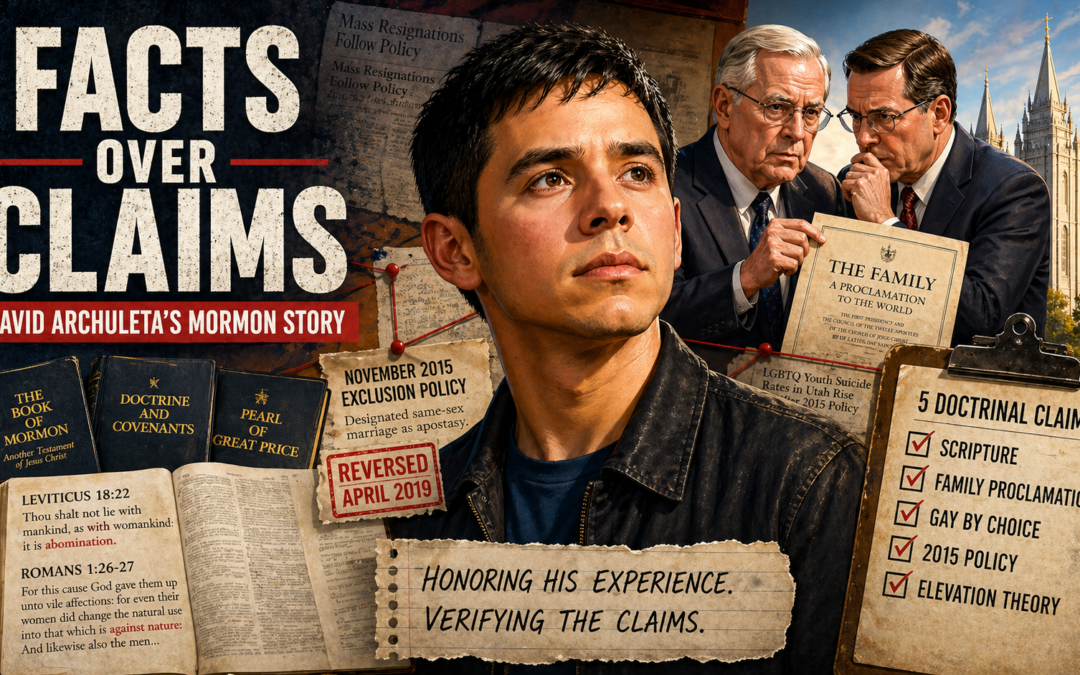
David Archuleta’s Mormon Story: Honouring His Experience While Fact-Checking Five Doctrinal Claims
David Archuleta shares a real and painful story. His experience as a gay Latter-day Saint—the shame, the scrupulosity, and the silence—deserves to be heard. However, several historical and doctrinal claims in this episode need correction. Truth matters to everyone, especially people navigating faith transitions.
A Note Before We Begin
David Archuleta’s story is real, and it is painful. The shame he carried, the scrupulosity he developed, the silence he lived inside — these are documented experiences shared by many LGBT Latter-day Saints. His courage in telling this story serves people who have lived something similar and need to feel less alone.
This rebuttal does not dispute his personal experience. Instead, it examines five doctrinal and historical claims from the episode that are inaccurate or imprecise. Truth matters, and inaccuracy helps no one. Readers processing their own faith transition deserve both compassion and accuracy.
About This Episode
Mormon Stories Episode 2114 (January 2026) features an hour-long conversation between host John Dehlin and singer David Archuleta, discussing Archuleta’s memoir Devout: Losing My Faith to Find Myself. Archuleta describes growing up gay in the LDS Church, his mission, his encounters with Elder M. Russell Ballard, and his eventual departure from the Church in 2022.
Much of the episode contains personal testimony. Archuleta owns that lived experience, and this article does not challenge it. What we address are five specific doctrinal or historical claims that, as stated, are either inaccurate or present a misleadingly simple picture of what the LDS Church actually teaches or has taught.
What the Episode Gets Right
Conceded — Historically Accurate
Earlier Church leaders taught homosexuality was a choice, could be overcome, and was among the gravest sins
✓ Historically Accurate
Archuleta describes being taught as a youth — through Spencer W. Kimball’s writings and from the pulpit — that homosexuality was a choice, was sinful, was comparable to grievous crimes, and could be overcome through righteousness. This accurately reflects Church teaching and culture from the Kimball era through the early 2000s. Kimball’s The Miracle of Forgiveness (1969) did teach these things, and it was widely circulated. Local leaders taught these messages.
The scrupulosity David Archuleta describes — becoming obsessively obedient as a way to “compensate” for or “cure” same-sex attraction — is a documented clinical pattern among LGBT Latter-day Saints of his generation, well-supported in research and consistent with what a Mormon therapist identified in his own case.
The historical Church teaching David experienced was real. His suffering was real. Acknowledging this honestly is essential — and does not require overstating what the Church currently teaches.
The Claims — and the Full Picture
Claim 1 of 5
LDS scripture is “100% silent on homosexuality” — the Book of Mormon, D&C, Pearl of Great Price, all completely silent
⚖️ Partially Accurate — Requires Precision
— David Archuleta, ~00:16:14
This claim needs an important distinction. Archuleta is right that the unique Restoration scriptures — the Book of Mormon, Doctrine and Covenants, and Pearl of Great Price — contain no explicit reference to same-sex sexual conduct. That observation is accurate and important.
However, the full LDS scriptural canon includes the Bible as one of the four “standard works.” The Bible does contain passages that the LDS Church — like most traditional Christian denominations — interprets as addressing same-sex sexual conduct (Leviticus 18:22, Romans 1:26–27, and others). The Church’s law of chastity is grounded in its interpretation of the whole scriptural canon, including these biblical texts.
The statement becomes inaccurate when the full LDS canon includes the Bible. The more precise and defensible statement is that the Restoration scriptures are silent — which is notable and worth discussing on its own terms.
Direct Answer
Claim 2 of 5
The Family Proclamation “was just a legal brief that was developed for legal reasons” and was never really a revelation
⚠️ Misleading — Mischaracterises Origins and Status
— John Dehlin (not disputed by Archuleta), ~01:14:18
This is John Dehlin’s claim, not Archuleta’s, but it goes unchallenged and functions as a factual assertion in the episode. It is not accurate.
What is true: The Family Proclamation was issued in September 1995 during a period of active legal challenges to traditional marriage definitions. It was subsequently included in an amicus brief to the Hawaii Supreme Court in 1997 and in at least six other court cases over the following decades. The document emerged in a context where LDS leaders were closely watching same-sex marriage litigation.
What is false: Characterising it as “just a legal brief” erases its clear doctrinal origin. President Gordon B. Hinckley prefaced the Proclamation by saying it was “a declaration and reaffirmation of standards, doctrines, and practices relative to the family which the prophets, seers, and revelators of this church have repeatedly stated throughout its history.” President Russell M. Nelson has described the year-long deliberative and prayerful process that preceded its drafting. It has been cited more than 250 times in General Conference addresses. Apostle Boyd K. Packer stated it “qualifies according to the definition as a revelation.” President Nelson presented a copy to Pope Francis as one of two gifts when they first met.
One can disagree with the Proclamation’s doctrinal claims and believe the legal context influenced its timing — that is a legitimate discussion. But “just a legal brief” is a rhetorical dismissal, not an accurate description of its origin, process, or reception in LDS theology.
Direct Answer
Claim 3 of 5
The Church still teaches that being gay is a choice and that same-sex attraction can be prayed away
🕐 Historically Accurate — No Longer Current Teaching
— David Archuleta, ~00:30:00
Archuleta’s account of what he was taught is accurate for the period he describes — his childhood and young adulthood in the late 1990s and 2000s. Church culture and local leaders regularly taught that same-sex attraction was a choice and could be overcome. This is historically documented and not in dispute.
However, the episode does not clearly distinguish this as historical — leaving listeners to infer it is still the current position. The Church’s teaching has shifted substantially. By 2012, the Church’s official “MormonsAndGays” website explicitly stated that same-sex attraction is not a choice. By 2016, the Church affirmed that conversion therapy aimed at changing sexual orientation is unethical. The current official LDS position states that the Church takes no position on the cause of same-sex attraction. It also states that individuals do not choose such attractions. The Church now states that “Identifying as gay, lesbian, or bisexual or experiencing same-sex attraction is not a sin.”
The shift from “choice that must be overcome” to “not a choice, not a sin” is significant — and truth seekers deserve to know when it happened and where the Church now stands, not only where it stood during Archuleta’s youth.
Direct Answer
Claim 4 of 5
The November 2015 policy “put same-sex marriage worse than pedophilia or rape” — mandatory excommunication for the former, never mandatory for the latter
⚖️ Partially Accurate — Framing Overstated
— John Dehlin, ~00:59:58
The November 2015 policy was genuinely harmful and has been widely criticised, including by many faithful Latter-day Saints. The reversal in 2019 was widely welcomed. These are not contested points.
However, the specific framing deserves examination. The 2015 policy classified members in same-sex marriages as “apostates” — which did carry a presumption of formal disciplinary council. Sexual sins including serious assault are handled under the Church’s General Handbook through formal disciplinary councils as well, and have historically resulted in excommunication when adjudicated. The claim that rape and pedophilia “had never been mandatory excommunicable offenses” requires nuance — the Church’s approach to both has been inconsistent and has drawn serious criticism, but it is not accurate that these categories have been systematically treated more leniently than same-sex marriage by the institution’s formal rules.
What is true and important: the 2015 policy singled out same-sex marriage specifically for apostasy status — a category above ordinary serious sin — and this asymmetry was widely experienced as unjust. The reversal in 2019 was attributed by Church leaders to “continuing revelation.” As Elder Ballard reportedly told Archuleta privately, it was a mistake — though the Church did not use that word publicly.
Direct Answer
Claim 5 of 5
The Church promoted the “elevation theory” to deny a link between its policies and LGBT youth suicide rates in Utah
⚖️ Nuanced — The Church’s Role in This Debate Requires Precision
— David Archuleta, ~01:27:27
Archuleta describes believing an explanation — circulated in some Church-adjacent contexts — that elevated altitude, not religious culture, explained higher suicide rates in Utah. He now recognises this as inadequate given his own experience.
This requires care. The altitude/suicide correlation is a real peer-reviewed finding documented by researchers at the University of Utah and elsewhere — higher altitude is associated with lower serotonin levels and increased suicide risk. This finding predates and is independent of LDS Church policy debates. The research exists and has been discussed by physicians and public health officials, not only as Church PR.
However, altitude does not explain everything — particularly the documented spike in LGBT youth suicides and membership resignations following the November 2015 policy. The broader question of whether Church teachings contribute to higher suicide risk among LGBT members is supported by research, and the Church’s response to that research has been widely criticised as inadequate. Archuleta’s rejection of the altitude explanation as a complete answer is reasonable — the problem is treating a real (if partial) scientific finding as inherently a bad-faith deflection.
Direct Answer
Frequently Asked Questions About David Archuleta and LDS Church Teachings
Is LDS scripture completely silent on homosexuality?
Partially. The unique Restoration scriptures — the Book of Mormon, Doctrine and Covenants, and Pearl of Great Price — contain no explicit reference to same-sex sexual conduct. This is accurate and notable.
However, the full LDS scriptural canon includes the Bible as one of four “standard works.” The Bible contains passages (including in Leviticus and Romans) that the Church interprets as addressing same-sex conduct. The more precise claim is that the Restoration scriptures are silent — not “all of Mormon scripture.”
Was the Family Proclamation just a legal brief?
No. “The Family: A Proclamation to the World” was issued on September 23, 1995 as a formal doctrinal statement by the First Presidency and Quorum of the Twelve Apostles. President Hinckley described it as “a declaration and reaffirmation of standards, doctrines, and practices.” President Nelson has described a year-long prayerful drafting process.
It was subsequently included in legal amicus briefs (beginning with the Hawaii Supreme Court in 1997) and used in political advocacy contexts. This legal use is real, but it followed — rather than constituted — the Proclamation’s origin. The claim that it “was never really a revelation” contradicts the stated experience of its drafters.
Does the LDS Church currently teach that being gay is a choice?
No — not since 2012. The Church’s earlier teachings did present same-sex attraction as a choice that could be overcome. But in 2012, the Church explicitly stated on its official website that same-sex attraction is not a choice. In 2019, it stated that conversion therapy aimed at changing sexual orientation is unethical. The current official position is: “Individuals do not choose to have such attractions” and “Identifying as gay, lesbian, or bisexual or experiencing same-sex attraction is not a sin.”
David Archuleta’s account of what he was taught during his youth (late 1990s–2000s) accurately reflects the teaching of that period. It does not reflect what the Church officially teaches today.
What was the November 2015 LDS policy and what happened to it?
In November 2015, the LDS Church updated its Handbook designating members in same-sex marriages as “apostates” subject to mandatory disciplinary councils, and barring children of same-sex couples from baptism until age 18 unless they denounced their parents’ relationship. The policy was immediately controversial and led to mass resignations.
In April 2019, the Church reversed both elements of the policy. Children of LGBT parents could again be baptised, and same-sex marriage was reclassified from apostasy to “a serious transgression.” The Church attributed the reversal to “continuing revelation.” Church leaders did not publicly describe it as a mistake, though Archuleta’s memoir describes Apostle Ballard privately acknowledging it as one.
What is scrupulosity and how does it affect LGBT Mormons?
Scrupulosity is a religious subtype of OCD characterised by intrusive fears of sin, excessive rituals of repentance or obedience, and a chronic sense of unworthiness that persists regardless of compliance. It is a recognised clinical condition distinct from healthy religious devotion.
Researchers and clinicians have documented elevated rates of scrupulosity among LGBT Latter-day Saints — particularly those who internalised the teaching that same-sex attraction was sinful and could be overcome through sufficient righteousness. The pattern David Archuleta describes — becoming obsessively compliant as a way to compensate for or neutralise same-sex attraction — is consistent with this documented clinical picture. A Mormon therapist he worked with identified it in his own case.
What does the LDS Church currently teach about LGBT members?
The current official LDS position: same-sex attraction is not a sin and is not a choice. Identifying as gay, lesbian, or bisexual does not prevent full participation in the Church. Conversion therapy is unethical. The Church does not take a position on the cause of same-sex attraction.
However: same-sex sexual activity and same-sex marriage remain violations of the law of chastity and are subject to Church discipline. Members in same-sex marriages can attend services but cannot hold callings, temple recommends, or other ordinances. The theological framework — that exaltation requires an eternal heterosexual marriage — remains unchanged. Same-sex marriage is classified as “a serious transgression” rather than apostasy (since the 2019 reversal).
The Honest Summary
David Archuleta’s story deserves to be told, heard, and taken seriously. The shame he carried, the scrupulosity he developed, the silence he maintained — these were real consequences of real Church teaching from a real era. The suffering of LGBT Latter-day Saints is documented, significant, and must not be dismissed.
But compassion for a person’s story does not require abandoning accuracy about doctrine. Several specific claims in this episode need correction. The Restoration scriptures are silent on same-sex conduct — but the LDS canon includes the Bible, which is not. The Family Proclamation was not “just a legal brief” — it was a formal doctrinal statement that was subsequently used in legal contexts. The Church’s teaching on same-sex attraction as a choice was historically accurate for Archuleta’s youth but has been officially reversed since 2012. The 2015 policy was genuinely harmful and was reversed in 2019. And the altitude-suicide research is real science, even if it cannot fully explain the specific harms Church policy has caused.
Truth seekers—whether questioning members, former members, or curious observers—deserve two things: compassion and accuracy. David Archuleta’s experience matters. Historical and doctrinal facts matter as well. Readers can hold both truths at the same time.