
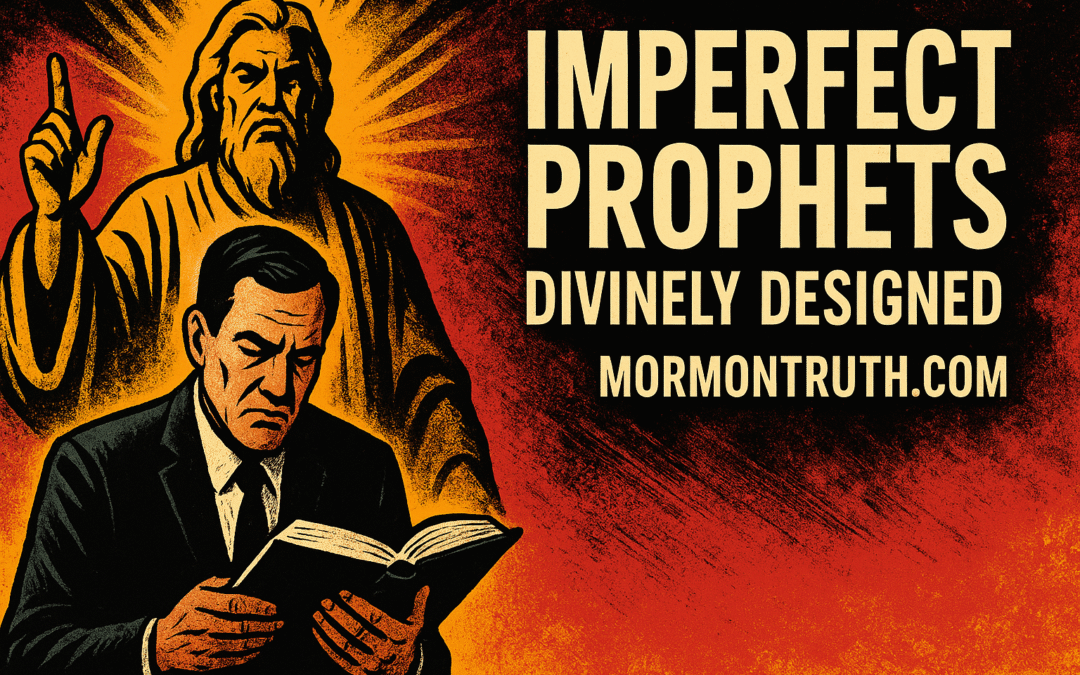
Prophetic Fallibility in the Bible and in the Last Days
Preface
The Bible presents a candid portrait of its prophets and prophetic figures: despite their divine calling, they are unmistakably human. Across the Old and New Testaments, prophets and apostles exhibit personal moral weaknesses, occasional doctrinal misunderstandings, and even instances of prophetic pronouncements that did not materialize as expected. Rather than diminish their prophetic stature, these fallibilities underscore a key thesis: Biblical prophets were fallible servants of God – righteous and inspired, yet prone to error – a pattern that Latter-day Saints understand to apply to modern prophets as well.
This paper will demonstrate this thesis in depth. We will survey numerous prophetic figures in scripture (organized roughly in chronological order), examining each prophet’s moral or character flaws alongside any notable prophetic inaccuracies or revisions associated with them. By reviewing scholarly and scriptural evidence – with explicit citations from the Bible, academic commentary, and Latter-day Saint teachings – we will
see that the “treasure” of prophecy has indeed come “in earthen vessels” (cf. 2 Corinthians 4:7). In conclusion, we will relate these findings to Latter-day Saint perspectives: just as ancient prophets could make mistakes yet still be God’s chosen mouthpieces, so modern LDS prophets are believed to be inspired leaders who remain human and imperfect. The cumulative evidence will affirm that prophetic fallibility is a consistent biblical principle, and that accepting human fallibility in prophets is fully compatible with faith in their divine calling.
Fallibility of Old Testament Prophets and Leaders
The Patriarchs: Noble Callings Amid Human Weaknesses
Even the venerable patriarchs of Israel – founders of the covenant lineage – are portrayed as imperfect. Abraham, for example, revered as a prophet and “friend of God,” nevertheless lapsed into deception on multiple
occasions. Fearing for his life, he misrepresented his wife Sarah as his sister to foreign kings. In one instance, King Abimelech took Sarah into his house based on Abraham’s lie, until God intervened (Genesis 20:2) biblehub.com. Abraham’s dishonesty (“She is my sister”) biblehub.com was a moral failing inconsistent with the absolute honesty one might expect of a prophet – yet the Bible does not shy away from reporting it. Similarly, Jacob (Israel), who received divine covenants, engaged in deceit to obtain his father Isaac’s blessing. Disguising himself as his elder brother, Jacob outright lied to his blind father: “I am Esau thy firstborn,” he claimed in order to steal Esau’s blessing biblehub.com. This act of trickery (Genesis 27:19) biblehub.com, though it fulfilled God’s earlier prophecy of the younger son prevailing, is plainly depicted as deception. These episodes illustrate that being chosen by God did not exempt the patriarchs from moral error. They were men of great faith who also succumbed to fear, impatience, or cunning – traits that the biblical record neither excuses nor whitewashes answersingenesis.org answersingenesis.org.
Notably, while Abraham and Jacob are called prophets (cf. Genesis 20:7) and received divine revelations, we have no record of their own prophetic pronouncements failing in the way later prophetic oracles sometimes did. Their fallibility is seen in conduct rather than failed prophecy. In Abraham’s case, one might point to his impatience in begetting Ishmael – essentially acting on a misunderstanding of God’s promise – which brought household discord. Yet God patiently corrected and continued to guide him. In Jacob’s case, his youthful deception led to years of exile and family strife. The Old Testament’s candid treatment of these patriarchs affirms that having the Spirit of prophecy did not eliminate personal weakness fairlatterdaysaints.org. As one commentator observed, God’s inspiration “did not involve a suspension of [prophets’] natural faculties; it did not even make them free from earthly passion…it left them men” whose knowledge could still be limited fairlatterdaysaints.org.
Moses: Prophet, Lawgiver – and Not Without Fault
Moses stands as the preeminent prophet of the Old Testament, yet his humanity is evident in several failings. In his early life, Moses committed a grave act of violence: seeing an Egyptian beating a Hebrew slave, an enraged Moses killed the Egyptian and hid the body in the sand (Exodus 2:11–12) biblehub.com. This impulsive manslaughter was not sanctioned by God; in fact, Moses fled into exile once the deed became known. The Bible makes no attempt to justify Moses’ vigilante justice, recording straightforwardly that “he slew the Egyptian, and hid him in the sand” biblehub.com. This incident underscores that even a future prophet chosen to redeem Israel began with an act of serious wrongdoing.
Later, during the Exodus, Moses’ leadership was marked by tremendous faith but also moments of anger and disobedience. The most famous incident occurred at Meribah. God instructed Moses to speak to a
rock to miraculously bring forth water, but Moses, exasperated with the rebellious Israelites, instead struck the rock twice with his staff and spoke as if the power were his own (“Must we fetch you water out of this rock?”). Water gushed out, but the Lord immediately censured Moses and Aaron for their failure to uphold God’s sanctity. Because Moses “believed [God] not” and did not sanctify God in the eyes of the people, the Lord declared that Moses would not bring Israel into the Promised Land (Numbers 20:7–12) churchofjesuschrist.org. The text makes clear that Moses’ actions constituted a serious breach of obedience: “Because ye believed me not…therefore ye shall not bring this congregation into the land” God said to Moses churchofjesuschrist.org. Thus, even at the height of his prophetic career, Moses erred by losing his temper and departing from God’s command. This failing had real consequences – an exemplary prophet was barred from his life’s goal. Importantly, Moses’ mistake did not negate his prophetic calling; immediately after this episode, he
continued to lead Israel and receive revelation (Numbers 20–27). But it showed no prophet, not even Moses, is immune to error or above divine reproof fairlatterdaysaints.org fairlatterdaysaints.org. Latterday Saint scholars often point to Moses at the rock as a scriptural proof that prophets can make mistakes while still being entrusted with God’s work fairlatterdaysaints.org.
It might be noted that Moses’ recorded prophecies and teachings themselves do not include explicit “failed predictions” – Moses conveyed God’s law and instructions, and foretold general blessings and curses contingent on Israel’s obedience (Deuteronomy 28), which indeed came to pass over time. One episode approaching prophetic “error” is when Moses, out of frustration, questioned God’s plan by insisting he was unfit to speak (Exodus 4:10–14); God corrected him by providing Aaron as a spokesman. Another is Moses’ initial assumption that the Israelites would understand his divine mandate after he slew the Egyptian, which they did not (Exodus 2:14, Acts 7:25). These are less formal prophecies than they are misunderstandings born of Moses’ human perspective. In sum, Moses’ life exemplifies a towering prophet who nevertheless “was not…free from earthly passion” fairlatterdaysaints.org – he succumbed to anger and suffered the consequences, reinforcing that prophets “are not perfect” fairlatterdaysaints.org. As a later LDS commentary concludes: “a prophet’s weakness or mistakes do not make him any less a prophet, called of God to do His work” fairlatterdaysaints.org.
Aaron and Miriam: Supporting Prophets Who Stumbled
Moses’ siblings, Aaron and Miriam, shared in his prophetic ministry (Exodus 7:1; Micah 6:4) and likewise showed fallibility. Aaron, the High Priest, was instrumental in mighty miracles, yet he infamously yielded to Israel’s idolatry at Sinai. When Moses tarried on the mountain, Aaron crafted the golden calf – an act of gross apostasy (Exodus 32:2–6). Confronted by Moses, Aaron tried to deflect blame with an almost comical
excuse: the people gave me their gold, “then I cast it into the fire, and there came out this calf” biblehub.com. This disingenuous explanation (“out came this calf”) biblehub.com highlights Aaron’s human weakness under pressure. Aaron’s lapse had severe repercussions: the Levites executed a purge of the idolaters and the Lord plagued the people (Exodus 32:25–35). Though Aaron later repented and served faithfully, the golden calf incident stands as a stark example of a prophet-priest sinning gravely. Aaron received no specific predictive prophecy that failed; rather, his failing was moral – succumbing to popular demand and then lying about it biblehub.com. The Bible’s frankness about Aaron (“Aaron had let the people get completely out of control” says one analysis kenwinter.org) again underlines that prophetic calling did not equate to flawless character.
Miriam, called a prophetess (Exodus 15:20), likewise had a moment of rebellion. She (and Aaron) spoke against Moses out of jealousy and perhaps racism, objecting to Moses’ Cushite wife and questioning his unique prophetic status (Numbers 12:1-2). The Lord Himself rebuked Miriam and Aaron, affirming Moses’ authority, and struck Miriam with leprosy for a week (Numbers 12:5-10). Miriam’s error was essentially pride and murmuring against God’s chosen leader, for which she was sharply corrected. Here again, we see a prophet (Miriam) who erred in doctrine or attitude – failing to “sustain” the presiding prophet – and suffering
consequences. Yet after her repentance and cleansing, Miriam continued to be honored (the Israelites waited for her recovery, Numbers 12:15, and later mourned her death, Numbers 20:1). The incident shows that even those who receive revelation (Miriam had led Israel in inspired song) can misunderstand God’s order and face divine discipline.
David and Solomon: Anointed Leaders with Moral Failings
While King David is not typically labeled “prophet” in the same sense as Isaiah or Jeremiah, the Bible credits him with inspired psalms and prophetic utterances (Acts 2:30). David in fact functioned as a prophet-king,
foreshadowing the Messiah. Yet his personal life vividly illustrates prophetic fallibility in the moral realm. David’s sins of adultery and murder are among the most notorious in scripture. Despite his close relationship with God, David committed adultery with Bathsheba, the wife of Uriah, and then, in an attempt to cover the resulting pregnancy, arranged Uriah’s death in battle. The narrative in 2 Samuel 11 spares no details: David “sent messengers, and took her; and she came in unto him, and he lay with her” biblehub.com. After Bathsheba conceived, David orchestrated Uriah’s demise by writing to his general: “Set ye Uriah in the forefront of the hottest battle…and retire ye from him, that he may be smitten and die” biblehub.com. This treacherous command was carried out, as David intended biblehub.com. For a prophet and “man after God’s own heart” to sink to such moral depths is jarring, and the Bible does not minimize the gravity of it. The prophet Nathan confronted David with a scathing parable and pronounced God’s judgment: the sword would never depart from David’s house (2 Samuel 12:7–10). David deeply repented (Psalm 51), but the consequences – turmoil and tragedy in his family – unfolded painfully, fulfilling Nathan’s words.
In David’s case, his prophetic gift did not prevent him from abusing kingly power and violating God’s law. There is no record of David uttering a prophecy that “failed” (his recorded oracles, such as messianic psalms, are seen as fulfilled or yet to be fulfilled). His fallibility lies in ethical weakness rather than doctrinal or predictive error. Yet it is instructive that God’s chosen ruler, author of inspired scripture, could err so grievously. David’s story thus powerfully supports the principle that a prophet or anointed leader may sin and be corrected, yet retain his divine mandate after sincere repentance – though not without enduring the bitter fruits of his mistakes (see 2 Samuel 12:13-14). Latter-day Saint perspectives often cite David as a cautionary example: the gift of the Spirit can depart when one chooses evil, and some consequences (in David’s case, the loss of joy and ultimately a limitation on his eternal blessing) may be irreparable. David’s life, however, also demonstrates God’s mercy to the penitent and His ability to continue using an imperfect instrument to advance the divine plan (e.g., David was still inspired to prepare psalms and plan the temple, even after his fall, though he was barred from building the temple himself).
Solomon, David’s son and successor, was renowned for his God-given wisdom and likely possessed prophetic insight (he received divine revelations: 1 Kings 3:5–14, 1 Kings 9:2–9). Yet Solomon, too, succumbed to moral and spiritual failings. In his old age, Solomon’s many foreign wives “turned his heart after other gods,” leading him into idolatry (1 Kings 11:4) biblehub.com. The biblical historian explicitly states that Solomon’s heart was “not perfect with the LORD his God” biblehub.com. The wise prophet-king who built Jehovah’s Temple tragically built pagan shrines as well, doing “evil in the sight of the LORD” (1 Kings 11:6–7). This apostasy
brought about God’s judgment: the kingdom would be torn apart after Solomon’s death (1 Kings 11:1113). Once again, the lesson is clear – no amount of prophetic wisdom or past spiritual experiences can make a man infallible. Solomon allowed political polygamy and personal pride to undermine his fidelity to God, demonstrating fallibility in both conduct and understanding. He may well have rationalized that accommodating his wives’ religions was a prudent or tolerant approach, but this proved a grave doctrinal error. There is an implicit “prophetic failure” in Solomon’s story: God had appeared to him twice to warn against idolatry (1 Kings 9:6-9, 11:9-10), yet Solomon did not heed the prophetic word given to him. In other words, Solomon failed to follow his own earlier God-inspired counsel, as recorded in Proverbs and his temple dedicatory prayer, to remain faithful. Thus, Solomon’s life shows a prophet falling into doctrinal apostasy by degrees – something that serves as a sobering warning in both biblical and LDS teachings. The Lord’s patience with Solomon (not ripping away the kingdom in Solomon’s lifetime, for David’s sake) also shows God’s forbearance with an erring prophet until justice can be executed in due course (1 Kings 11:12-13).
“Prophets Are Fallible, Even in Prophecy”: Examples of Prophetic Inaccuracies or Revisions
Thus far we have focused on moral and leadership weaknesses. We now turn to a startling fact: some Old Testament prophets – true prophets of God – delivered prophecies that were not fulfilled as originally spoken, or that had to be revised in light of new circumstances. This does not imply God fails to keep promises; rather, it illustrates the conditional nature of much prophecy and the human element in prophetic interpretation. The Bible itself preserves these cases, allowing us to see prophets learning and refining their understanding. As the Protestant theologian Peter Enns notes, “the Bible itself does not support [the idea of infallible prophets]; their knowledge was sometimes no higher than that of their contemporaries” fairlatterdaysaints.org. We examine several examples below:
Nathan’s Temple Prophecy: Prophet Nathan initially encouraged King David to proceed with building a temple, telling the king, “Do all that is in thine heart; for God is with thee” (see 2 Samuel 7:3 and 1 Chronicles 17:2). This, in effect, was a prophetic endorsement of David’s plan. However, that very night God corrected Nathan, instructing him to tell David not to build the temple – it would be built by David’s son instead (2 Samuel 7:4-13). Nathan faithfully delivered the revised message the next day. Here we have a case of a well-intentioned prophet speaking presumptuously. Nathan assumed the temple project had God’s approval, but he was wrong fairlatterdaysaints.org. Importantly, once the Lord revealed the correct counsel, Nathan didn’t stubbornly defend his prior words; he retracted them and conveyed God’s true will. Latterday Saint writers often cite this incident to show that a prophet may give personal counsel in good faith that is not wholly accurate, and subsequent revelation can amend it fairlatterdaysaints.org. Nathan remained a true prophet – his mistake did not “disqualify” him, but it demonstrates the principle that “whether by [God’s] voice or the voice of [His] servants” (D&C 1:38) requires that the servants indeed speak God’s voice, which sometimes means their own ideas must yield to new revelation. In LDS commentary, Nathan’s example is likened to instances in modern Church history where leaders offered opinions later corrected by further light fairlatterdaysaints.org.
Jonah’s Conditional Prophecy of Nineveh: Perhaps the clearest biblical instance of a prophecy that did not come to pass is Jonah’s warning to Nineveh. Jonah entered that Assyrian city with a blunt oracle: “Yet forty days, and Nineveh shall be overthrown” (Jonah 3:4) biblehub.com. This prophecy was unambiguous and apparently unconditional – Jonah gave no explicit call to repentance in the proclamation recorded, nor any caveat that destruction could be averted. And yet, as the book of Jonah records, the doom did not occur. The people of Nineveh heeded the warning, repented in sackcloth and ashes, and God in His mercy “repented of the evil that He had said He would do unto them; and He did it not.” (Jonah 3:10, KJV) biblehub.com. In other words, the prophecy of imminent destruction failed to materialize. Far from hiding this, scripture emphasizes it and even shows Jonah himself was furious at this outcome, precisely because it made him appear a false prophet: “But it displeased Jonah exceedingly, and he was very angry” that Nineveh was spared biblehub.com. Jonah complained to God, “O Lord…was not this my saying, when I was yet in my country? Therefore I fled…for I knew that thou art a gracious God… and repentest thee of the evil” (Jonah 4:2). Jonah’s grievance reveals that he knew the prophecy was conditional on repentance, but he had hoped God’s mercy would not spare Israel’s enemy biblehub.com. The episode brilliantly highlights the concept of conditional prophecy: as God explained to Jeremiah, “If that nation…turn from their evil, I will repent of the disaster that I thought to do unto them” (Jeremiah 18:8) perspectivedigest.org perspectivedigest.org. Jonah’s prophecy “failed” in literal terms, yet Jonah was still a true prophet – indeed, his mission’s success was that Nineveh repented. The fallibility on display was Jonah’s human attitude, not receiving a false revelation. Jonah’s story ends with God
correcting the prophet’s vindictive mindset (Jonah 4:5-11). This case affirms that a prophet can deliver a genuine warning from God and the outcome may change due to human response, effectively nullifying the initial prophetic statement. The lack of fulfillment does not make Jonah a “false prophet” under the biblical understanding, because the purpose of the prophecy (to induce repentance) was achieved perspectivedigest.org perspectivedigest.org. Modern LDS teachings often invoke Jonah to illustrate why not every prophetic statement is irrevocable – many of God’s promises or warnings are explicitly or implicitly conditional (see Jeremiah 18:7–10) perspectivedigest.org. As one LDS scholar notes, Jonah’s aborted prophecy “explains, at least partly, [Jonah’s] strong reaction…fulfillment of prophecy was one important indicator…How would he stand before the Ninevites…if the word of the Lord…was not fulfilled?” perspectivedigest.org. In other words, Jonah feared the stigma of a “failed prediction,” yet God was more concerned with mercy and moral outcomes than Jonah’s pride. The lesson: prophetic declarations may be adjusted by God’s sovereign will – which a true prophet must humbly accept, even at the cost of personal credibility perspectivedigest.org perspectivedigest.org.
Jeremiah and Ezekiel: Prophecies Revised and Unfulfilled – The major prophets Jeremiah and Ezekiel provide intriguing examples of apparent prophetic failures and subsequent clarifications. During the
tumultuous 6th century BC, these prophets uttered very specific oracles about nations and individuals, some of which did not unfold as initially stated. For instance, Jeremiah foretold a positive end for King Zedekiah of Judah: “thou shalt not die by the sword: But thou shalt die in peace; and with the burnings of thy fathers…so shall they burn odours for thee; and they will lament thee” (Jeremiah 34:4-5). Yet the actual end of Zedekiah, as recorded, was brutal – he was blinded and hauled to Babylon in chains, dying a prisoner (Jeremiah 52:1011, 2 Kings 25:7). He certainly did not receive the honor of a peaceful royal burial with spices and laments. This stark discrepancy has long puzzled readers. Some harmonize it by suggesting “die in peace” meant only he would die not by battle but in captivity (which technically happened), or propose that perhaps Babylon did treat his corpse with some honor. But the text of Kings and Jeremiah offers no evidence of the elaborate funeral Jeremiah prophesied. It appears to be an example of prophetic words overtaken by events – possibly conditional on Zedekiah’s actions (he had vacillated in obeying Jeremiah’s counsel). Another case: Jeremiah pronounced that Jehoiakim, Zedekiah’s predecessor, would “have no one to sit on the throne of David” and that his corpse would be cast out unburied (Jeremiah 36:30, Jeremiah 22:19). Yet Jehoiakim’s son did briefly succeed him (Jehoiachin reigned three months) and Chronicles implies Jehoiakim received a normal burial (“slept with his fathers” – 2 Kings 24:6). Some scholars conclude these prophecies failed in literal detail pthu.nlpthu.nl. Others argue partial fulfillment (Jehoiachin’s reign was short, and Jehoiakim’s burial may have been ignominious despite the terse biblical notice). Either way, the Bible preserves the tension between Jeremiah’s words and the historical outcome, with no attempt by later editors to “fix” the record. This suggests the biblical authors were aware that prophetic utterances might be contingent or misinterpreted, and they did not see this as invalidating Jeremiah’s calling. Indeed, Jeremiah himself taught the principle of conditional prophecy at the potter’s house (Jeremiah 18:7-10) – God explicitly says He might “repent of the good” spoken to a nation if it does evil, or of the evil predicted if it repents perspectivedigest.org. This framework likely explains many such instances.
Ezekiel offers a dramatic example of a prophecy that did not materialize as initially given: his oracle against the city of Tyre in Ezekiel 26. Ezekiel, speaking around 587 BC, proclaimed that King Nebuchadnezzar of Babylon would utterly destroy the wealthy island city of Tyre – “I will bring upon Tyre Nebuchadnezzar…he shall slay thy people…break down thy walls…make a spoil of thy riches…And I will make thee like the top of a rock: thou shalt be a place to spread nets upon; thou shalt be built no more” (Ezekiel 26:7-14). This prophecy is very specific in naming Nebuchadnezzar as the agent of Tyre’s final destruction pthu.nl pthu.nl. However, historical evidence (including Ezekiel’s own later reflections) shows that Nebuchadnezzar’s 13year siege of Tyre did not result in the city’s fall. Tyre’s mainland suburbs were wrecked, but the island citadel held out and negotiated a compromise. Tyre continued to exist and even prospered for centuries (it was only fully destroyed by Alexander the Great in 332 BC, and even that city was later rebuilt). Remarkably, Ezekiel 29:17-20 – dated about 571 BC, years after the siege – contains a “revision” of the Tyre prophecy. There, God says “Nebuchadnezzar made his army labor hard against Tyre…yet had no wages, nor his army, for Tyre, for the
service that he had served against it: therefore…I will give him the land of Egypt as [payment]” pthu.nl pthu.nl. In this later word, Ezekiel essentially acknowledges that Nebuchadnezzar’s attack on Tyre did not yield the expected plunder or result. To compensate, Ezekiel prophesies, God would let Babylon conquer Egypt. (That, too, is historically ambiguous – Babylon invaded Egypt but did not permanently occupy it, and there
is no record of a 40-year desolation of Egypt as Ezekiel 29:12 predicted pthu.nl.) The critical point is that the Bible transparently records a prophet adjusting his prophecy when events unfolded differently than initially foreseen pthu.nl pthu.nl. As Dr. Paul Sanders observes, Ezekiel 26 “assumes” Nebuchadnezzar will sack Tyre, but chapter 29, Ezekiel’s final prophecy, implicitly “assumes it did not come to pass” and thus “revises” the outcome by shifting Nebuchadnezzar’s target to Egypt pthu.nl pthu.nl. Indeed, Ezekiel 26’s bold declaration “Tyre…shall never be rebuilt” was not fulfilled in the short term – Tyre was still thriving in Ezekiel’s own era decades later (the post-exilic prophet Zechariah in 518 BC speaks of Tyre’s wealth and prophesies anew that Tyre would be devastated someday – Zechariah 9:3-4) pthu.nl. How do we make sense of this apparent prophetic “failure”? The Protestant Theological University’s Bible blog puts it plainly: “things unfolded differently. Tyre still exists today…Ezekiel’s prophecies contain many aspects that are difficult to reconcile with what happened later” pthu.nl pthu.nl. Some conservative interpreters suggest Ezekiel’s words were fulfilled later by Alexander or have a long-term spiritual fulfillment, but the text itself ties them to Nebuchadnezzar, “missing the point” if we try to swap in a different fulfillment centuries later pthu.nl. The straightforward explanation, as many scholars (and likely Ezekiel himself) understood, is that prophecy is not always simple prediction of inevitable future events pthu.nl pthu.nl. Ezekiel 26–29 teaches that prophecy often carries an implicit “if/then” clause based on human behavior and God’s purposes. God did intend judgment on Tyre, but the mechanism and timing differed from Ezekiel’s original public oracle. Rather than suppress this discrepancy, the compilers of Ezekiel preserved both the original prophecy and the later clarification side by side, “with little or no issue with the tension between the two” pthu.nl pthu.nl. This suggests the Hebrew editors understood that God’s word through prophets could be revised by God without invalidating the prophetic gift. Ezekiel himself remained a trusted prophet – his overall message of Tyre’s pride and eventual fall was still “true” in essence (Tyre did fall, though to Alexander long after Nebuchadnezzar), even if the immediate details proved otherwise pthu.nl pthu.nl.
Ezekiel’s Tyre prophecy and its aftermath thus illustrate prophetic fallibility in predictive matters. As a recent scholarly article notes, “both prophecies [Ezek. 26 and 29] are presented as messages from God…and God is said to ensure their fulfillment. It is a surprising turn of events” that one had to be adjusted pthu.nl pthu.nl. The article continues: “It is striking that the compilers…didn’t feel the need to explain why God had revised His plans” pthu.nl pthu.nl. The likely theological rationale is the one given in Jeremiah 18 – that God’s promises of destruction or blessing are often conditional on circumstances, especially the responses of people. In Tyre’s case, perhaps the city humbled itself or simply did not present the opportunity Ezekiel assumed. In any event, Bible acknowledges that a prophet can “get some things wrong” (to quote the PThU blog) in terms of outcome, yet still be delivering God’s message pthu.nl pthu.nl. As another commentator puts it, “Prophecy primarily aims to communicate God’s response to events…The focus is on God’s decision…not on [the prophet’s prediction of] Nebuchadnezzar” pthu.nl pthu.nl. Ezekiel’s prophecy retained “great value, despite its factual inaccuracy” pthu.nl, because it conveyed the divine principle that Tyre’s hubris would meet divine judgment – a fate that did eventually befall Tyre, albeit later than Ezekiel originally envisioned.
In summary, the Old Testament provides multiple witnesses that prophets are not infallible, either in personal conduct or in the details of their prophetic foresight. They could misjudge situations (Nathan), they could deliver warnings or promises that God Himself later altered (Jonah, Ezekiel, Jeremiah), and they certainly could fall into sins of pride, fear, anger, or lust (Moses, Aaron, Miriam, David, Solomon, etc.). Yet in each case, the prophetic calling continued or God’s work moved forward: the prophet humbled him or herself and learned, or new prophets were raised up to continue the Lord’s message. This dynamic view of prophecy refutes any notion that biblical prophets were perfect or all-knowing. As the LDS Bible Dictionary wisely notes, “prophets are righteous, but not sinless, men.” And as LDS apologist Allen Wyatt observes, “the Bible itself does not teach that its prophets were free from error…they often ‘spoke as men’ with cultural or personal bias, later corrected by further revelation” fairlatterdaysaints.org fairlatterdaysaints.org.
Before turning to New Testament figures, it is worth highlighting how these Old Testament insights bolster Latter-day Saint understanding. One LDS commentary explicitly compares biblical and modern prophets, concluding: “Biblical prophets and modern prophets are divinely called, but clearly are not perfect” fairlatterdaysaints.org. The scriptural record “does not support” the idea of prophetic infallibility fairlatterdaysaints.org. For example, the comparison is made that Moses erred at Meribah and was chastised churchofjesuschrist.org, just as a modern LDS prophet (President Brigham Young, for instance) might err in moments of personal bias and later be corrected fairlatterdaysaints.org. Joshua was deceived by the Gibeonites (Joshua 9) fairlatterdaysaints.org, akin to how modern Church leaders have been deceived by frauds like Mark Hofmann fairlatterdaysaints.org. Gideon’s weakness in seeking signs (Judges 6:36-39) fairlatterdaysaints.org is likened to human weaknesses today. Jonah’s prejudice fairlatterdaysaints.org is bluntly paralleled to personal prejudices of later leaders (e.g. 19thcentury racial biases) fairlatterdaysaints.org. The willingness of the biblical text to display prophetic flaws has even been cited as evidence of the Bible’s authenticity: unlike pious legends that whitewash their heroes, the Bible “includes major moral failings of its heroes” answersingenesis.org, indicating it wasn’t merely propaganda.
All these points reinforce a consistent theme: the Lord accomplishes His work through imperfect servants. As a result, sometimes their personal weakness creeps into their actions or speech – requiring either divine correction (Nathan, Jonah, etc.) or merciful forgiveness (David, Moses, etc.). The Old Testament establishes that expectation, and the New Testament continues it, as will explore next.
Fallibility of New Testament Apostles and Prophets
The New Testament Church, led by Jesus’ apostles and prophets, was built on the foundation of continuing revelation – yet its leaders, too, were fallible men. In LDS perspective, only Jesus Christ lived a perfect, infallible life; all other Church leaders, ancient or modern, are “subject to human frailties” fairlatterdaysaints.org mormonr.org. The New Testament narrative amply demonstrates this truth.
Peter: Chief Apostle, Capable of Error
Peter, the chief Apostle, is a prime example of prophetic authority mixed with human weakness. On the very night Peter received the sacred keys of the kingdom, he infamously succumbed to fear and denied knowing Jesus – not once, but three times (Luke 22:54-62). Despite Jesus’ explicit warning that this would happen, Peter’s courage failed under pressure. The Gospels record the painful moment of realization: “Immediately, while he yet spake, the cock crew. And the Lord turned, and looked upon Peter….And Peter went out, and wept bitterly” (Luke 22:6062; cf. Matthew 26:75) biblehub.com biblehub.com. Peter’s denial – essentially a public lie to save himself – was a serious moral lapse. It did not nullify his apostolic calling (the resurrected Christ lovingly rehabilitated Peter in John 21), but it stands as a permanent reminder that the very rock upon whom Christ built His Church was “subject to like passions as we are.” Indeed, the Epistle of James later notes “Elijah was a man subject to like passions as we are” (James 5:17), and by extension so were all apostles – Peter included fairlatterdaysaints.org.
Even after Pentecost, when Peter was filled with the Holy Spirit and spoke as an inspired prophet, he was not beyond making mistakes. The Apostle Paul recounts a noteworthy incident: years into the growth of the Church, Peter visited Antioch and, under pressure from conservative Jewish-Christians, withdrew from eating with Gentile converts – implying that Gentiles were inferior unless they kept Jewish customs. This was a betrayal of the revelation Peter himself had received (in Acts 10) that God accepted Gentiles by faith without the Law. Paul, seeing the hypocrisy, “withstood [Peter] to the face, because he was to be blamed” (Galatians 2:11) biblehub.com. Paul publicly rebuked Peter for “not acting in line with the truth of the gospel” (Gal. 2:14). In Paul’s words, Peter “stood condemned” in that behavior biblehub.com biblehub.com. This must have been a tense confrontation – a junior apostle correcting the chief apostle – yet it was evidently necessary. To Peter’s credit, it seems he accepted the correction (the New Testament does not record any dispute afterward, and Peter later speaks respectfully of “our beloved brother Paul,” 2 Peter 3:15-16). The Antioch incident proves that apostolic leaders could err in policy and practice. Peter’s lapse was not in doctrine per se – he did not preach false doctrine – but his personal conduct sent a false doctrinal message (implying Christ’s grace was not sufficient for Gentiles). Paul and Barnabas recognized this as a critical error and opposed it. Significantly, this event took place after the monumental Jerusalem Council (Acts 15) where Peter had boldly defended Gentile inclusion. It shows that even a prophet who knows the right principle can, under social fear, act
inconsistently with it. In LDS discussions, Peter’s behavior at
Antioch is often cited to comfort those troubled by mistakes of modern Church leaders: if even Peter showed prejudice or fear after receiving clear revelation, we should not be surprised if today’s might occasionally express personal biases or need correction from their inspired peers fairlatterdaysaints.org fairlatterdaysaints.org. The New Testament candidly shows apostolic fallibility and the internal checks and balances among them. As one LDS scholar put it, “Paul’s accounts even contain a contradictory account of [his visionary] experience…Peter and Paul also criticized each other’s behavior regarding the Church” fairlatterdaysaints.org fairlatterdaysaints.org. Those observations (referring to Acts 9:7 vs 22:9, and Galatians 2:11-14) underscore that the early Church did not operate under the assumption of apostolic inerrancy.
Beyond these major episodes, Peter’s general personality in the Gospels – impetuous, sometimes misunderstanding Jesus – illustrates prophetic growth through trial and error. He at first could not comprehend that Jesus must suffer (earning a rebuke, “Get thee behind me, Satan,” in Matthew 16:22-23). On the Mount of Transfiguration, Peter spoke out of turn, “not knowing what he said” (Luke 9:33). He fell asleep in Gethsemane
when the Lord asked for vigilant prayer. All told, Peter’s example is simultaneously encouraging and sobering: encouraging because God worked wonders through him despite his flaws, sobering because being prophetically chosen did not eliminate the need for personal improvement and occasional reproof. It is noteworthy that the Latter-day Saint view of prophets mirrors this – President Dieter F. Uchtdorf taught that Church leaders “have simply made mistakes” and said of the Church, “if it were run by perfect beings it would be perfect. But He (God) works through us – His imperfect children – and imperfect people make mistakes” churchofjesuschrist.org.
Other Apostles: Human Imperfections in Word and Deed
All of Jesus’ original apostles had shortcomings. James and John, for instance, ambitiously sought positions of honor in Christ’s kingdom (Mark 10:35-41) and once, in a zealot moment, asked Jesus for permission to call down fire on a Samaritan village that rejected them. Jesus rebuked them, saying “Ye know not what manner of spirit ye are of” (Luke 9:54-56). This earned them the nickname “Boanerges” (Sons of Thunder), implying a fiery, perhaps overzealous temperament. Clearly, their judgment was not infallible; they had to learn Christ’s way of patience and love over vengeance. Later, the apostles as a group argued over who among them was greatest – even during the Last Supper (Luke 22:24). Jesus gently corrected them, teaching humility and service (Luke 22:25-27). The very presence of such an argument among the Twelve shows they
were still maturing; they were not always “perfectly humble or modest” fairlatterdaysaints.org. As a FAIR LDS commentary wryly notes, “Jesus’ apostles were not always perfectly humble or modest. They once disputed over which of them would be the greatest in heaven” fairlatterdaysaints.org – an episode recorded in Mark 9:33-34. The New Testament does not hide these foibles, which again aligns with the premise that scripture intentionally demonstrates prophetic fallibility answersingenesis.org.
Thomas famously doubted the Lord’s resurrection until granted physical proof (John 20:24-28). His skepticism earned a mild correction from Jesus (“be not faithless, but believing”). While not a leadership decision, Thomas’s doubt is a reminder that even eyewitnesses and disciples could have crises of faith or limited vision. Jesus did not expel Thomas from apostleship for this, but gently helped him overcome it – thereby
strengthening Thomas to testify boldly later.
Paul the Apostle, though not one of the Twelve, is another towering prophetic figure of the New Testament who showed personal limitations. We have already seen how Paul had to correct Peter; conversely, Paul himself had a sharp disagreement with Barnabas (another prophet/church leader) over whether to give John Mark a second chance on their missions. Acts 15:39 reports that “the contention was so sharp between
them, that they departed asunder one from the other” – Paul and Barnabas split up their companionship over this personnel dispute biblehub.com biblehub.com. This does not suggest either man sinned grievously, but it reveals a failure to fully reconcile differing opinions, resulting in organizational division. Later, Paul speaks highly of Mark (2 Timothy 4:11), implying that perhaps Paul eventually conceded Barnabas had been right to see Mark’s potential. In any case, the Holy Spirit still guided both missionary parties separately – demonstrating that God can work through His servants even when they don’t see eye to eye. Latter-day Saints see a parallel in how church councils today allow for discussion and even disagreement until unity is achieved, under the principle that “in the multitude of counselors there is safety.” The Acts 15:39 incident shows even apostles may need time and separate effort to resolve issues; it’s another scriptural antidote to any notion of prophet-worship or assumption that everything an apostle does will be in perfect harmony with every other apostle.
Paul’s writings also hint at possible prophetic miscalculation in expectation. In several early letters (like 1 Thessalonians 4:15-17, written ~50 AD), Paul speaks as if he might be among those alive at Christ’s return: “We who are alive and remain unto the coming of the Lord…” – implying he believed the Second Coming could happen in his lifetime. Later, facing imminent martyrdom, Paul acknowledged his departure (2 Timothy 4:6-8) and urged the Church to plan for future generations (e.g., 2 Timothy 2:2). This shift suggests that the apostles initially expected an earlier fulfillment of end-times prophecies – expectation that had to be adjusted as time went on. To be clear, they never gave a false formal prophecy about the date of Christ’s return (indeed, Paul cautioned against those who claimed the day of Christ was at hand – 2 Thess. 2:2). But their personal expectations and sense of timing were human and subject to recalibration. Jesus had told them “it is not for you to know times or seasons” (Acts 1:7), yet naturally they hoped for a prompt culmination. This is analogous to how modern Church leaders or members might earnestly but mistakenly assume a prophecy’s timing, then later realize it will be longer – a benign type of fallibility in understanding prophetic timelines.
Another New Testament prophetic figure is Agabus, who in Acts 11:28 correctly foretold a coming famine (which occurred under Claudius Caesar) heidelblog.net. Later, in Acts 21:10-11, Agabus prophesied that the Jews in Jerusalem would bind Paul and deliver him to the Gentiles.
What happened when Paul went to Jerusalem? He was attacked by a Jewish mob, but it was Roman soldiers who bound him in chains and took custody (Acts 21:30-33). Some readers see a minor discrepancy: Agabus said “the Jews shall bind the man… and hand him over” thegospelcoalition.org, whereas in fact the Romans bound Paul (to rescue him from the crowd). One could interpret that the Jews “delivered” Paul by forcing the Romans’ hand, or that Agabus was speaking generally that Paul would be arrested due to Jewish opposition. In any case, early Christian commentators did not doubt Agabus’ prophetic gift – the core of his prophecy
(Paul would be seized by Gentiles as a result of Jewish hostility) came true. But modern scholars sometimes cite this as an example that New Testament prophecy, while genuine, was not always verbatim exact in
every detail thegospelcoalition.org thegospelcoalition.org. This perspective suggests Agabus got the overall message from the Spirit, but perhaps in the human transmission some detail (who exactly would do the
binding) was expressed inexactly. Such a view is debated among theologians, but it aligns with the broader theme we have seen: prophecy can be true in substance even if the human vessel’s expression or assumptions around it are imperfect. The key takeaway is that the New Testament does not present Christian prophets as mechanically infallible transmitters of oracles, but rather as inspired speakers who still operate within human limitations and perspectives.
Finally, consider John the Baptist, revered by Jesus as more than a prophet (Luke 7:26-28). John’s ministry was prophetically foretold, and he powerfully proclaimed the coming Messiah. Yet even John had a moment of doubt or misunderstanding. While imprisoned by Herod, hearing of Jesus’ works that did not fit the expected mold of a conquering king, John sent disciples to ask Jesus plainly, “Art thou he that should come, or do we look for another?” (Matthew 11:3) biblehub.com biblehub.com. This poignant query shows that John’s expectations about the Messiah’s mission were incomplete. He, like many, expected the Messiah to bring swift judgment and liberation (Matthew 3:10-12). Jesus was indeed doing messianic miracles – healing, raising the dead – but not (yet) overthrowing oppressors. Jesus sent back a gentle answer highlighting the miracles and beatitude for those not offended in Him (Matt. 11:4-6), effectively reassuring John. Thereafter, Jesus praised John to the crowds, which indicates that John’s momentary doubt did not diminish his prophetic stature in Jesus’ eyes. It was a human reaction to prolonged trial and unmet expectations hermeneutics.stackexchange.com hermeneutics.stackexchange.com. Latter-day Saints might liken this to modern prophets not always knowing how or when prophecy will be fulfilled, or being surprised by the manner of the Lord’s work. They remain true prophets, even if they have to “search and inquire diligently” (1 Peter 1:10) about the meaning of
their own prophecies at times. John’s experience shows a prophet can question and seek further confirmation – a form of fallibility born of incomplete understanding, not rebellion. Importantly, Jesus did not condemn John’s question; rather He honored John and clarified the bigger picture.
Summary of New Testament Evidence
From the New Testament, we glean that apostles and prophets in the early Church demonstrated moral fallibility (e.g. Peter’s denial), susceptibility to misunderstand doctrine or God’s plans (e.g. Peter’s behavior toward Gentiles, John the Baptist’s expectations), and the need for correction and growth (e.g. the Paul-Peter confrontation, the Apostles’ arguments over status). They sometimes held differing opinions (Paul and Barnabas), and their personal weaknesses (temper, fear, prejudice, doubt) occasionally seeped through. Yet under the tutelage of Christ and the Holy Spirit, these weaknesses were gradually overcome or turned to good. The very existence of books like 1 Corinthians or Galatians – letters where an apostle corrects false doctrines and bad behaviors among members – also implies that early saints sometimes
misunderstood or misapplied prophetic teachings, requiring clarification. The New Testament Church was dynamic, not static; revelation was a process, and course corrections (individual and collective) were part of its prophetic leadership.
It is instructive that the Apostle Paul openly acknowledged human fallibility in leadership. “We have this treasure in earthen vessels,” he wrote, “that the excellency of the power may be of God, and not of us” (2 Corinthians 4:7). The image of an “earthen vessel” – a clay pot, prone to cracks – is a powerful metaphor for prophetic fallibility. The gospel treasure is perfect, but it is carried by mortals who have weaknesses. Paul also rebuked a cult of personality at Corinth, where some were elevating one apostle over another: “Let no one boast in men…Whether Paul or Apollos or Cephas…all are yours, and ye are Christ’s, and Christ is God’s” (1 Cor. 3:21-23). In other words, do not place faith in the infallibility of the men who lead the Church; recognize their role, but worship God who alone is perfect. This resonates strongly with modern LDS counsel that we must not put prophets on a pedestal of inerrancy – “to trust in the arm of flesh” even if that flesh is anointed is cautioned against mormonr.org. Prophets are to be followed, but not idolized; their words and actions are subject to confirmation by the Holy Ghost and alignment with established truth mormonr.org mormonr.org.
In sum, the New Testament corroborates the Old Testament pattern: prophets and apostles are inspired yet fallible individuals. Their flaws and occasional errors are not hidden but are often integral to the biblical narrative. This honesty serves to glorify God’s grace (for using imperfect people) and to keep believers’ focus on the true cornerstone, Jesus Christ.
“Divinely Called, Yet Human”: Fallible Prophets in the Latter-day Saint Tradition
The evidence from scripture is overwhelming that prophetic calling does not equal personal perfection or inerrancy. The Church of Jesus Christ of Latter-day Saints (LDS) embraces this biblical reality and teaches it explicitly regarding both ancient and modern prophets. In LDS doctrine, there has only ever been one perfect, sinless individual – Jesus Christ. All others called as prophets, from Adam to today, “have been mortals and not immune from error” mormonr.org mormonr.org. This section will briefly show how LDS leaders and scholars have articulated this principle, seeing continuity with the biblical record we have detailed above.
Latter-day Saint scripture itself affirms prophetic fallibility. The Book of Mormon title page famously declares of that record, “if there are faults they are the mistakes of men; wherefore, condemn not the things of God” churchofjesuschrist.org. Joseph Smith, the founding prophet of the Restoration, taught candidly, “I told them plainly that I was but a man, and they must not expect me to be perfect” (History of the Church 5:181). On another occasion, he remarked, “a prophet [is] a prophet only when he [is] acting as such” mormonr.org, implying that at other times he spoke merely as a man with personal opinions. This is entirely in harmony with how Nathan first spoke his own feeling about the temple before receiving the word of the Lord fairlatterdaysaints.org. Joseph Smith’s statement inoculates against the idea that everything a prophet says is automatically God’s mind and will. Latter-day Saints are taught that prophets can have personal views or make administrative decisions that are not infallible or immutable – especially in non-doctrinal matters.
In fact, a survey of LDS leadership statements over two centuries shows consistent acknowledgment of fallibility. President Brigham Young said in 1867: “I am more afraid that this people have so much confidence in their leaders that they will not inquire…for themselves…Let every man and woman know…God and [the spirit] of God, so that…if [I] should get out of the way, [you] would know it” (JD 9:150). In 1898, Lorenzo Snow taught that each member is entitled to discern by the Spirit if leaders are acting correctly mormonr.org mormonr.org. In 1940, Joseph F. Merrill of the Quorum of the Twelve stated: “The President is not infallible…He makes no claims to infallibility” mormonr.org. In 1978, Elder Bruce R. McConkie – after the monumental revelation reversing the priesthood ban – urged members regarding past speculative teachings: “Forget everything that I have said, or what President Brigham Young or…others have said…that is contrary to the present revelation. We spoke with limited understanding…God will yet reveal many great and important things” (All Are Alike Unto God, 1978) fairlatterdaysaints.org fairlatterdaysaints.org. This remarkable statement directly invites the Saints to recognize that even high Church leaders (including McConkie himself) had taught some incorrect notions (in this case, theories about race) due to “limited understanding,” and that new revelation can correct old views. It is a living example of how Nathan’s early counsel about the temple was superseded by new instruction fairlatterdaysaints.org, or how Peter’s reluctance toward Gentiles was overcome by the vision of the sheet (Acts 10) – except in modern times.
Perhaps one of the most concise LDS affirmations came from Apostle James E. Faust in 1989: “We make no claim of infallibility or perfection in the prophets, seers, and revelators” mormonr.org. He reassured members that while these leaders are not infallible, their overarching desire is to do God’s will mormonr.org. More recently, President Dieter F. Uchtdorf, in a landmark 2013 address, openly
acknowledged historical missteps: “To be perfectly frank, there have been times when members or leaders in the Church have simply made mistakes. There may have been things said or done that were not in harmony with our values, principles, or doctrine” churchofjesuschrist.org. He added, “It is unfortunate that some have stumbled because of mistakes…made by men. But in spite of this, the eternal truth of the gospel…is not tarnished” churchofjesuschrist.org churchofjesuschrist.org. This captures the LDS view succinctly: the gospel (God’s truth) remains pure even though delivered through imperfect channels. It echoes the Pauline idea of
treasure in earthen vessels biblehub.com biblehub.com, and it resonates with the biblical pattern of God accomplishing His work despite and sometimes through the foibles of His servants. President Uchtdorf further taught that expecting perfection in Church leaders will lead to disappointment, because God “allows us to learn as we go” and deliberately “uses imperfect people to run His Church” fairlatterdaysaints.org fairlatterdaysaints.org. Another Apostle, Elder Jeffrey R. Holland, quipped in 2017 that there have been no flawless prophets: “Except the Prophet Joseph Smith – I hold a special place for him – and the rest of the prophets were not perfect. Joseph Smith wasn’t perfect either” (mixing humor with a point that even Joseph had errors). In other words, LDS leaders freely concede their non-inerrancy.
Crucially, LDS doctrine also emphasizes that while prophets can err, God will not allow the prophetic institution as a whole to lead the Church astray in fundamental matters. This is based on a famous statement by Wilford Woodruff (1890) that God would remove a prophet rather than permit him to permanently misdirect the Church fairlatterdaysaints.org fairlatterdaysaints.org. This creates a distinction between individual mistakes (which are possible and expected) and authoritative, united teachings of the First Presidency and Twelve, which members trust God to uphold. As Elder D. Todd Christofferson explained, there is “an assurance that the Lord will not let His Church drift into apostasy through the error of one man” – yet this “does not mean that Church leaders will never make mistakes” fairlatterdaysaints.org fairlatterdaysaints.org. Thus, the LDS paradigm is that prophets can be fallible in personal and even some official capacities, but the Lord’s overarching guidance prevents collective, enduring error in doctrine. This is analogous to how we see biblical course corrections: errors might occur, but God sends correction (through another prophet, or revelation, or consequences) to right the course of His people. For example, King David’s moral failures did not negate the Davidic covenant, but they did bring chastening and a temporary disruption in blessings; Peter’s mistake in Antioch did not derail the Church’s inclusion of Gentiles because Paul was inspired to correct it. Similarly, Latter-day Saints trust that while a prophet might teach a speculative idea (e.g., Brigham Young’s Adam-God theory, or various past statements now considered folk doctrine), eventually either that idea will be corrected by later prophets or quietly left aside as policy/doctrine evolves. This has indeed happened, as seen with the 1978 revelation on priesthood nullifying earlier speculative teachings on race fairlatterdaysaints.org. Modern Church curriculum even acknowledges past leaders were products of their time and made statements not in line with current doctrine, urging members to “focus on the living prophet” and core scriptures rather than every utterance of past leaders fairlatterdaysaints.org.
In light of all the above, Latter-day Saints see a strong mirror between ancient and modern prophetic ministry. Both operate under the principle that God is perfect and His work is true, but He accomplishes it through imperfect individuals. The humility required in following a living prophet is not in assuming he is omniscient or impeccable, but in sustaining him despite his humanity, trusting that God is at the helm. Members are counseled to support their leaders and also seek personal confirmation of their teachings (as per D&C 1:37-38; D&C 8:2). Critically, LDS teaching allows that disagreement or concern can be handled faithfully: President Henry B. Eyring noted that when prophets and apostles councils make decisions, they counseled together and consider differing viewpoints precisely to avoid errors, invoking the precedent of Acts 15’s council (see Acts 15 footnotes, LDS edition) fairlatterdaysaints.org fairlatterdaysaints.org.
Finally, it is worth noting that the LDS approach to scripture itself reflects belief in prophetic fallibility. Unlike some fundamentalist views that every word of the Bible must be historically or scientifically infallible, LDS doctrine holds that Bible (and Book of Mormon) prophets recorded truth “as far as it is translated [and transmitted] correctly” (Articles of Faith 1:8). We saw earlier that the Book of Mormon explicitly attests to the possibility of human error in scripture writing churchofjesuschrist.org. TheLDS Doctrine and Covenants 1:24 says the Lord’s revelations to His servants come “after the manner of their language” – i.e., couched in human language and cultural idioms, which are inherently imperfect. This is analogous to what we saw James R. Dummelow observe about the Bible: that each prophet’s peculiar manner and worldview is still evident fairlatterdaysaints.org. In short, LDS theology is very comfortable with the idea that prophets can err in grammar, in assumptions, even in some teachings, yet still be authentic prophets. This does not relativize truth; rather, it requires discernment to know what is of God and what is a “mistake of men” churchofjesuschrist.org. The expectation is not blind faith in a flawless prophet, but faith that God’s purposes will prevail despite human weakness.
This LDS view is encapsulated well by Elder Dieter F. Uchtdorf’s reassurance: “The prophets and apostles…are not perfect. Remember the words of Moroni: ‘Condemn me not because of mine imperfection, neither my father, because of his imperfection, neither them who have written before him’…God’s grace flows through the humble, broken, and flawed – the earthen vessels – in astonishing ways”. Thus, the fallibility of prophets is not a detriment to God’s work; it is, in a sense, part of the divine design to demonstrate that God’s strength is made perfect in weakness (2 Cor. 12:9). As President Uchtdorf beautifully put it, “This is the way it has always been and will be until the perfect day when Christ Himself reigns personally upon the earth” churchofjesuschrist.org. In the meantime, we walk by faith, not by sight – appreciating our prophets’ inspired leadership, forgiving their missteps, and acknowledging that infallibility belongs to God alone.
Conclusion
From Abraham in Genesis to Peter in the Gospels, from Jonah’s spared Nineveh to modern prophetic counsel that has evolved over time, the record consistently testifies that God’s prophets are fallible, mortal agents – divinely called, yet human. Their lives and words, as preserved in scripture and history, serve not to idolize human beings, but to direct us to trust God, who achieves His purposes through imperfect servants. This comprehensive review has shown that the Bible itself refutes any claim of prophetic inerrancy: Moses lost his temper and spoke unadvisedly churchofjesuschrist.org; Nathan spoke too soon and had to retract fairlatterdaysaints.org; Elijah grew fearful and depressed; David sinned egregiously biblehub.com biblehub.com; Jonah delivered a prophecy that God did not fulfill as uttered biblehub.com biblehub.com; Peter denied Christ and later erred in practice biblehub.com biblehub.com; and the list goes on. These instances are not aberrations – they are part and parcel of the prophetic experience. Rather than undermining faith, they invite us to a more mature faith: one that can distinguish between God’s perfect gospel and the imperfect people through whom He chooses to work.
For members of the Church of Jesus Christ of Latter-day Saints, this understanding is fundamental. It allows them to sustain modern prophets wholeheartedly while not expecting them to never err in judgment or never express a personal opinion. It provides context for historical issues (such as past statements on science, culture, or policy that have since been revised) – seeing them in the same light as Jonah’s conditional warning or Peter’s need for Paul’s correction. It teaches patience and forgiveness towards leaders, just as leaders teach patience and forgiveness towards members. As President Henry B. Eyring said, if we have that realistic expectation, “when a mistake is made – by us or by a leader – it is quickly acknowledged and corrected, and we move on in faith” fairlatterdaysaints.org fairlatterdaysaints.org. Indeed, LDS doctrine asserts that the Church is guided by councils and the Holy Ghost to mitigate individual fallibility mormonr.org mormonr.org, much as the early apostles counseled together in Acts 15 to resolve doctrine, and as multiple prophetic voices in the Bible provided balance (e.g., Gad and Nathan alongside David, Paul alongside Peter).
In closing, one might ask: Why does God choose fallible prophets at all? Why not use angels or always speak from a cloud? The Apostle Paul gives a profound answer: to ensure our faith rests in God, not in the arm of flesh (1 Cor. 2:5). If prophets were superhuman and never erred, followers might put their trust in the prophet instead of in Christ. But when we see that a prophet is a fellow mortal – albeit an ordained spokesman – we are compelled to seek the ultimate source of truth, God, and gain our own witness of prophetic teachings (see D&C 1:37-38). The prophets’ fallibility, paradoxically, helps keep the Church anchored to Christ’s perfection. As one commentary notes, “to hold the Lord accountable for mistakes made by mortals…opens a can of worms” – rather, we acknowledge those mistakes as human, not divine archive.timesandseasons.org.
The cumulative evidence presented here – scriptural, scholarly, and prophetic – leads to one coherent conclusion: Biblical prophets were fallible, and this in no way negates their prophetic authority; likewise, modern Latter-day Saint prophets are respected as inspired leaders but are not considered infallible. President James E. Faust’s words echo our thesis: “We make no claim of infallibility or perfection…Yet … I have seen these men’s greatest desire is to know and do the will of God.” mormonr.org In that spirit, Latter-day Saints continue to “give heed unto all [the prophet’s] words and commandments” (D&C 21:4-5) – not because the prophet is incapable of error, but because God’s power and promises uphold the prophetic office despite error mormonr.org mormonr.org. They do so “in all patience and faith” fairlatterdaysaints.org,
understanding that if even prophets must sometimes correct course, patience and faith are requisite for all disciples.
Ultimately, the fallibility of prophets testifies of the condescension and mercy of God. He lets His work be done by earthly hands so that we might grow, participate, and not be compelled by undiluted divinity. In every prophetic weakness overcome, we see God’s strength. In every delayed or altered prophecy, we see God’s greater wisdom and compassion at work (as in Nineveh’s salvation perspectivedigest.org biblehub.com). In every modern instance of the Church adjusting a practice or clarifying a doctrine, we see the continuing process of revelation – the same process evident in Acts or in the Old Testament. Far from challenging faith, these
things build faith in a living God who patiently works with us, His error-prone children. In the words of Elder Jeffrey R. Holland: “Be kind regarding human frailty – your own as well as those who serve with you…except in the case of His only perfect Begotten Son, imperfect people are all God has ever had to work with.… When you see imperfection, remember that the limitation is not in the divinity of the work” (Conference Report, Oct.
2013). This perspective encapsulates why Latter-day Saints both honor their prophets and do not shy away from acknowledging their prophets’ humanity. It is a perspective richly vindicated by the scriptures examined in this paper.
In conclusion, the fallibility of prophets – ancient and modern – is not a flaw in God’s plan, but a feature of it. It casts our dependence wholly upon Jesus Christ, “the author and finisher of our faith” (Hebrews 12:2), while allowing us to receive the blessings of guidance, counsel, and authorized administration through men who are like us in nature. The prophets’ lives are object lessons in humility and repentance, as much as they are in faith and obedience. For those who struggle with the concept of imperfect prophets, the counsel of President Uchtdorf offers reassurance: “God is perfect, and His doctrine is pure. But He works through us—His imperfect children—and imperfect people make mistakes….This is the way it has always been” churchofjesuschrist.org churchofjesuschrist.org. Indeed, it has ever been so, from Adam to Noah, Moses to Peter, Joseph Smith to the living prophet today. And yet, through those “earthen vessels” God has consistently advanced His divine purposes. Knowing this, we can simultaneously sustain our prophets and place our ultimate trust in the Lord who called them, confident that He will “not suffer [His] words to be frustrated” (D&C 3:1) even when His servants falter momentarily. Thus the pattern of prophetic fallibility, far from being an indictment of revelation, stands as a powerful witness of God’s power to achieve His work with ordinary, imperfect instruments – a witness seen in scripture, confirmed in modern experience, and cherished in Latter-day Saint theology.
Sources
Cited: The Holy Bible (KJV); FAIR Latter-day Saints apologetics on prophetic fallibility fairlatterdaysaints.org fairlatterdaysaints.org;
Perspective Digest on conditional prophecy perspectivedigest.org perspectivedigest.org;
Protestant Theological University Bible
Blog on Ezekiel’s Tyre prophecy pthu.nl pthu.nl;
General Conference address by Dieter F. Uchtdorf, “Come, Join with Us,” Oct. 2013 churchofjesuschrist.org churchofjesuschrist.org;
James E. Faust, Ensign, Nov. 1989 mormonr.org;
Prophetic Fallibility timeline at mormonr.org mormonr.org mormonr.org; and
other LDS commentary as noted throughout.