
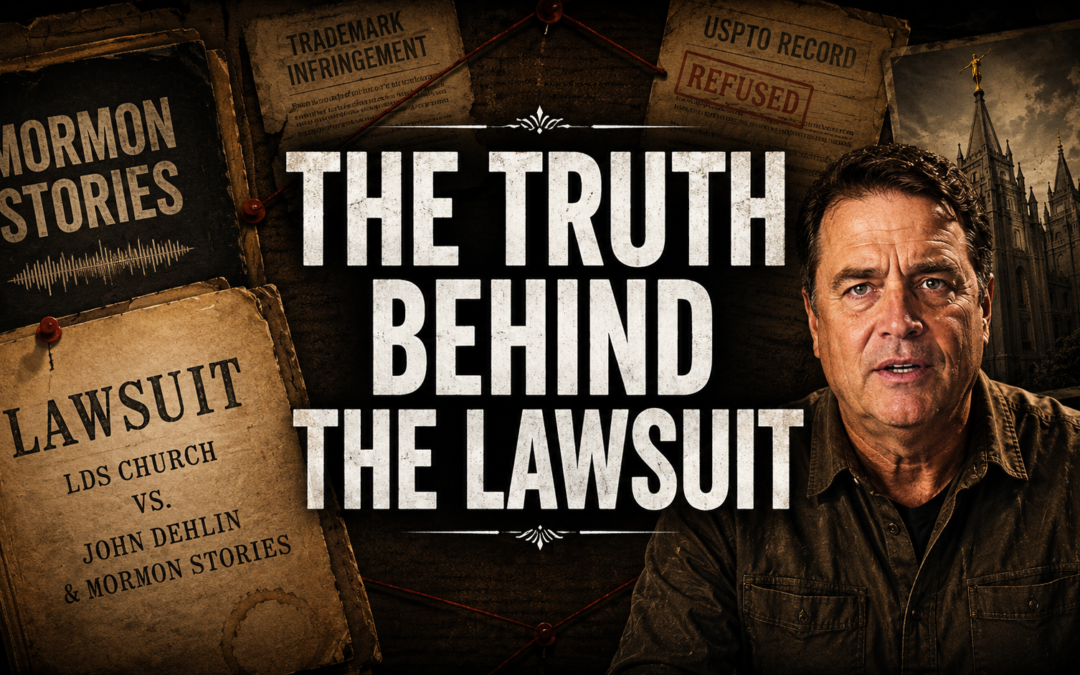
The LDS Church vs. Mormon Stories Trademark Lawsuit: What the Filings Actually Show, What They Don’t Prove, and Five Things the Mormon Newscast Gets Wrong
John Dehlin lawsuit is the focus of this analysis of the LDS Church’s federal trademark and copyright case against Mormon Stories. RFM, Bill Reel, and Rebecca spend four hours examining Dehlin’s 125-page Answer and Counter-Claims.They accurately explain key legal doctrines, including laches, abandonment, genericness, and alleged USPTO fraud. However, the episode also contains one-sided framing. It includes a factually inaccurate attack on Kirton McConkie, omits Dehlin’s reported $236,000 financial interest, and reaches conclusions that extend beyond the court filings.
About This Episode
Rebecca Biblioteka, Bill Reel, and Radio Free Mormon (RFM) aired a four-hour Mormon Newscast special on June 22, 2026. They examined John Dehlin’s 125-page Answer and Counter-Claims, which responded to the LDS Church’s federal trademark and copyright lawsuit. RFM, who identifies himself as a former attorney, serves as the episode’s legal analyst. In addition, the panel briefly reviews the separately filed Motion to Dismiss.
By contrast, this analysis is different from most in this series. Instead, the episode is not primarily about LDS history or doctrine— it is a legal analysis of one side of an active federal lawsuit. Overall, RFM accurately identifies most of the legal doctrines discussed in the episode. However, the episode’s problems involve framing, disclosure, and inferential leaps from specific legal allegations to sweeping institutional claims.
The Essential Context Before Evaluating This Episode
The hosts analyze John Dehlin’s legal filing and explicitly describe themselves as running “a very similar entity” to Mormon Stories. For example, Bill Reel says at the episode’s opening: “I’m certainly watching this from afar and maybe not quite as far as I’d like to be.” Likewise, RFM describes Dehlin as a colleague. As a result, the four-hour episode presents Dehlin’s lawyers’ allegations uniformly favorably, never once acknowledging what the Church’s response might say or what legitimate arguments exist on the other side.
Instead, this is not neutral legal analysis. It is a celebration of a colleague’s legal filing by people with direct financial and ideological interests in its success. Therefore, truth seekers deserve to know that context before evaluating anything the episode presents as legal expertise.
The Undisclosed Financial Conflict — Both Sides
Dehlin earns approximately $236,000 per year from the Open Stories Foundation per the organization’s publicly filed 2024 IRS Form 990, reported by Religion News Service. The Mormon Stories brand name — specifically the phrase “Mormon Stories” — is the primary commercial identity driving that revenue. Consequently, a favorable ruling in this case directly protects Dehlin’s livelihood. Similarly, the Mormon Newscast hosts, who run podcasts using “Mormon” in their titles, have a parallel financial interest. Nevertheless, the hosts never disclose either conflict during the four-hour analysis. However, this doesn’t make Dehlin’s legal arguments wrong. It is still a relevant fact that a podcast asking its audience to assess one side of a financial dispute is legally obligated to disclose.
What the Episode Gets Right — The Core Legal Analysis Is Sound
Confirmed: The Legal Doctrines Are Accurately Identified.
Laches, abandonment, genericness, and the USPTO fraud allegations are real doctrines properly applied to real documented facts in the filing
The Core Legal Framework Is Accurate.
Laches:
RFM correctly identifies that a 20-year period of non-enforcement, combined with the Church’s affirmative 2018 abandonment campaign, is a strong basis for a laches defense. For example, courts have found delays as short as 12 years sufficient for laches in trademark cases. The filing documents the Church’s knowledge of Mormon Stories through Oaks’ 1992–2002 letters, Jensen’s meetings, and Uchtdorf’s survey briefing. Consequently, these records address the “knew or should have known” element. Overall, this is the episode’s strongest legal analysis.
Abandonment:
The Church’s 2018 rebrand was extensive. The filing documents the renaming of the Mormon Tabernacle Choir and Mormon.org. It also details updates to more than 1,000 products, 300 web applications, and 800 domain names. Moreover, President Nelson’s declaration that using “Mormon” is “a major victory for Satan” further strengthens the abandonment argument.
Genericness:
The filing correctly cites the USPTO’s 2002-2007 refusal to register “Mormon” for religious services on genericness grounds. As a result, the Church failed to appeal, and the USPTO issued a formal notice of abandonment. The filing documents this point, making it significant. Likewise, the USPTO and TTAB have found “Mormon” comparable to “Catholic” — a term denoting a religion, not a commercial source identifier.
The documented Church contacts with Dehlin:
The filing reproduces actual letters from Dallin Oaks to Dehlin (1992, 1993, 2002) and details of meetings with senior Church leaders. In addition, the filing includes photographs of these documents, and they directly undermine any claim the Church was unaware of Dehlin or Mormon Stories. Furthermore, the 2015 internal Church slide identifying Dehlin’s podcast as a “major cause” of member loss is particularly significant evidence that the Church treated Mormon Stories as a known entity.
The consumer confusion evidence problems:
The filing’s analysis of the Church’s 15 comments submitted as evidence of consumer confusion — The Church gathered most of them from faithful YouTube comment sections after the announcement instead of from Mormon Stories’ own pages — is a legitimate and documented critique of the Church’s complaint. Therefore, people who already believed their co-religionists’ claims that Mormon Stories is “anti-Mormon” do not provide a reliable sample of organic consumer confusion.
Dehlin’s filing accurately describes laches, abandonment, genericness, and the consumer confusion analysis and the filing documents the underlying facts. Dehlin’s lawyers have constructed a substantive case on well-recognized legal grounds.
Five Major Problems With the Mormon Newscast’s Analysis
1. Kirton McConkie is NOT “the McDonald’s of Utah law firms” — it is Utah’s largest law firm, 170+ attorneys, ranked 300th nationally
Factually Inaccurate — Requires Specific Correction.
Kirton McConkie’s Size and Trademark Law Experience
This is factually wrong on every dimension. Kirton McConkie is Utah’s largest law firm by headcount. It has more than 170 attorneys, five office locations, and was ranked 300th in the nation by the National Law Journal in 2022. Moreover, it was founded in 1964 — 62 years ago. In addition, it has a dedicated intellectual property section with experienced IP attorneys. It has handled federal litigation, international cases, religious liberty cases, and complex transactions including the $1.5 billion City Creek Center development. It has represented clients in 150+ countries and all 50 U.S. states.
Kirton McConkie’s IP section regularly handles trademark disputes like this one. Elder Lance B. Wickman, the firm’s General Counsel for the LDS Church, dedicated the City Creek building. During the dedication, he described the relationship as representing “the church of Jesus Christ himself.” Nevertheless, whatever the merits of the underlying case, calling this firm a beginner-lawyer apprenticeship program is both inaccurate and a transparent attempt to preemptively discredit legitimate legal arguments the firm may make in its response to Dehlin’s filings.
To be clear, RFM is free to argue that the Church’s complaint was poorly constructed — and the filing presents specific examples of omissions and potentially misleading characterizations that a court will evaluate. But impugning the competence of opposing counsel with false factual claims is a rhetorical move that does not serve the audience’s ability to assess the case accurately.
Kirton McConkie is Utah’s largest law firm. The characterization as a beginner-lawyer training ground has no factual basis and is contradicted by readily available public information.
2. The episode repeatedly treats Dehlin’s lawyers’ allegations as proven facts — particularly the USPTO fraud claim and the press release characterization
Allegations Are Not Adjudicated Facts. The Distinction Matters.
Throughout the four hours, the hosts describe the contents of Dehlin’s counter-claims as though they are established facts: “They lied.” “The church is lying again.” “This is lying to the federal government.” “It’s a flat-out lie.” The hosts apply these characterizations to Dehlin’s allegations — legal pleadings that must be adjudicated before they constitute proven facts.
The USPTO fraud claim is serious. If proven, it could lead to the cancellation of those trademark registrations. Dehlin alleges that the Church renewed trademarks despite publicly abandoning them and may have altered evidence submitted to the USPTO. However, the Church has not yet responded to these specific counterclaims. Meanwhile, courts evaluate evidence from both sides. The Church may have explanations, contextual facts, or legal arguments that neither the filing nor the episode address.
Furthermore, the press release characterization illustrates this precisely. The hosts call the Church’s “Getting It Right” press release “a flat-out lie” because it stated Dehlin refused to adopt a disclaimer when he had in fact adopted one. Dehlin’s filing documents this. What the filing doesn’t address — and the episode never asks — is whether the Church’s characterization was technically accurate in some respect, whether the disclaimer adopted was materially different from the one proposed, or whether the Church’s lawyers had a colorable basis for their framing. Courts distinguish between factual misrepresentations, spin, and legitimate advocacy characterizations. The episode never does.
Nevertheless, Dehlin’s counter-claims raise serious allegations that deserve to be taken seriously. They are not proven facts until a court rules on them. Presenting them as established truth prevents the audience from assessing the case accurately.
3. RFM’s theory that Oaks was “sending lawyers behind Nelson’s back” to renew patents is pure speculation with no factual basis in the filing
Speculation. Not Supported by the Filing or Any Other Evidence.
Nothing in Dehlin’s 125-page filing supports this specific claim. The filing documents that the Church renewed Mormon-branded trademarks at the USPTO while publicly abandoning the word “Mormon” — that is documented. But the filing says nothing about whether Nelson knew about these renewals, whether Oaks directed them without Nelson’s knowledge, or whether there was any internal conflict between the two over trademark strategy. RFM offers an imaginative reconstruction rather than legal analysis.
Consequently, the speculation matters because the hosts present it as legal analysis, giving it unwarranted authority. The filing supports “the Church renewed trademarks while publicly abandoning the word.” It does not support “Oaks did this secretly against Nelson’s wishes.” These are meaningfully different claims with meaningfully different evidentiary requirements.
At this stage, internal Church leadership dynamics on this question remain unknown. The filing documents the trademark renewals; it says nothing about who directed them or whether Nelson knew.
4. “$300 billion is going to get its ass kicked out of court” — the episode’s outcome certainty exceeds what even strong legal arguments establish
The Case Is Strong for Dehlin, But Certainty About Court Outcomes Is Never Warranted.
RFM and the hosts repeatedly predict that Dehlin will prevail, that the Church will lose, that the motion to dismiss will succeed, and that the abandonment and laches arguments are “insurmountable.” The legal analysis underlying these predictions is sound — the laches argument is genuinely strong, the abandonment documentation is extensive, and the genericness history is favorable to Dehlin. But experienced litigators will note that predicting court outcomes with this level of certainty is something no responsible lawyer does.
Meanwhile, the Church has a fully briefed response to file. Judge Shelby will evaluate both sides. The Tenth Circuit has its own case law on laches and trademark abandonment that may not align precisely with the cases Dehlin’s filing cites. Discovery may surface facts favorable to the Church. The Supreme Court’s Jack Daniel’s precedent may influence the case differently than Dehlin’s filing argues. Courts are unpredictable, and that is why lawyers do not guarantee outcomes.
More specifically: even if the motion to dismiss is denied and the case proceeds to discovery, that does not mean the Church will lose. It means the parties will exchange documents and depositions. The Church’s internal communications about the trademark strategy, the Nelson/Oaks relationship, and the specific USPTO filings may look different in discovery than they do in Dehlin’s counter-claims — or they may look much worse. We do not know yet.
Even so, strong arguments do not guarantee victories. The episode’s outcome confidence serves the audience’s emotional satisfaction but not its ability to assess the situation accurately.
5. “The Mormon church lying is not a bug, it’s a feature” — using specific contested legal allegations to characterize the entire institution’s nature
The Exact Overgeneralization Pattern This Series Has Documented Throughout.
The specific allegations in this filing — if proven — would represent serious institutional misconduct: fraudulent USPTO filings, misleading court pleadings, a deceptive press release. The filing specifically documents these allegations, and they are serious. They deserve the scrutiny the episode provides.
From Individual Conduct to Institutional Claims
But this series has consistently documented what happens when specific institutional failures are extrapolated into comprehensive institutional indictments: it produces false impressions of base rates. The LDS Church is a 17+ million member institution operating across 180 countries. Specific lawyers making specific decisions in a specific lawsuit do not establish that the entire institution’s defining characteristic is systematic lying. This series identified the same pattern in Rebuttal #20 (TrevAnon). There, the hosts extended individual institutional failures into church-wide character claims. They repeat that pattern here.
Why This Distinction Matters
Furthermore, this distinction matters because it comes at the end of four hours of legal analysis in which the hosts have genuinely identified serious documented problems in the Church’s legal filings. Those specific problems are strong enough to stand on their own. Wrapping them in “the Church always lies” rhetoric doesn’t strengthen them — it invites the audience to accept a conclusion that goes significantly beyond what even the strongest reading of the filing establishes.
If the Church’s lawyers made misleading filings and false USPTO declarations, that is serious and worth documenting. It does not establish that institutional lying is the Church’s defining feature any more than Patrick Bucknum’s fraud established that all LDS stake presidents commit financial crimes.
Frequently Asked Questions
What is the LDS Church’s trademark lawsuit against Mormon Stories about?
The Church of Jesus Christ of Latter-day Saints, through Intellectual Reserve Inc., sued John Dehlin and the Open Stories Foundation in April 2026. The lawsuit was filed in the U.S. District Court for the District of Utah. It alleges trademark and copyright infringement. The Church claims that Mormon Stories’ use of the word “Mormon,” its blue logo, light-ray design, and Church-copyrighted images infringes Church intellectual property. Dehlin filed a 125-page Answer and Counter-Claims in June 2026, denying the infringement claims and counter-claiming that the Church’s Mormon trademarks should be cancelled on grounds of abandonment (the 2018 rebrand), fraud on the USPTO, and genericness. Judge Robert J. Shelby is overseeing the case.
What is the laches defense and why is it strong here?
Laches bars a plaintiff who has unreasonably delayed in enforcing rights when that delay has prejudiced the defendant. Dehlin’s filing argues the Church knew about Mormon Stories through extensive direct contact since 2005 — including letters from Dallin Oaks, meetings with Elder Jensen, and a briefing to President Uchtdorf — and never raised trademark or copyright concerns for 20 years. Courts have found 12-year delays sufficient for laches in trademark cases. Dehlin has invested 20 years building the Mormon Stories brand, constituting demonstrable prejudice. Combined with the Church’s affirmative 2018 abandonment of “Mormon” in all its public branding, the laches argument is the filing’s strongest ground.
Did the Church commit fraud on the USPTO?
Dehlin’s counter-claims allege the Church did — by renewing Mormon-branded trademarks (Mormon Tabernacle Choir, Mormon Channel, Mormon Messages) with sworn declarations of continued use while simultaneously conducting a years-long public campaign to eliminate “Mormon” from all its branding. The filing also specifically alleges the Church submitted a 2005 CD cover as a trademark use specimen in 2024 when the current Deseret Book website for the same album now shows “Tabernacle Choir at Temple Square.” These are Dehlin’s allegations. They are serious and documented in the filing. No court has ruled on these allegations yet. The Church has not filed its response to these specific counter-claims as of publication.
Is Kirton McConkie a reputable law firm?
Yes. Kirton McConkie is Utah’s largest law firm, with more than 170 attorneys, founded in 1964, ranked 300th nationally by the National Law Journal, representing clients in 150+ countries and all 50 states, with a dedicated intellectual property section. It is nationally recognized for religious liberty legal issues. The Mormon Newscast’s characterization of it as a beginner-lawyer training ground is factually wrong. Whatever the merits of the underlying case, experienced IP attorneys at Kirton McConkie represent the Church — not “pimply-faced kids” as RFM characterized them.
What are Dehlin’s chances of winning?
Overall, Dehlin presents a strong case based on the legal arguments in his filings. The laches argument (20 years of non-enforcement plus affirmative abandonment) is strong. The genericness history at the USPTO (4 refusals, failed appeal, notice of abandonment on “Mormon” for religious services) is favorable. The abandonment documentation is extensive and well-evidenced. But predicting court outcomes with certainty is irresponsible legal analysis regardless of how strong the arguments are. The Church has experienced IP counsel, will file a full response, and may surface facts or arguments in discovery that look different from what the filing shows. The motion to dismiss hearing will be the first significant development to watch.
Does John Dehlin have a financial stake in this lawsuit?
Yes. Dehlin earns approximately $236,000 per year from the Open Stories Foundation per its 2024 IRS Form 990, with OSF reporting approximately $1.12 million in annual revenue. The Mormon Stories brand identity — specifically the name “Mormon Stories” — is the primary commercial driver of that revenue. A favorable ruling directly protects his livelihood and brand. The Mormon Newscast hosts similarly run Mormon-named podcasts and have a parallel financial interest in the outcome. Neither conflict is disclosed in the four-hour episode despite the hosts presenting Dehlin’s legal case in uniformly favorable terms.
The Honest Summary
What the Court Filings Support
John Dehlin’s attorneys produced a substantive 125-page Answer and Counter-Claims. The laches argument — 20 years of non-enforcement plus the Church’s affirmative 2018 abandonment of “Mormon” as satanic — is genuinely strong. The USPTO history showing four refusals to register “Mormon” for religious services on genericness grounds is significant. The documented contacts between Dehlin and Church leadership over two decades directly undermine any claim the Church was unaware of Mormon Stories. The filing thoroughly documents the problems with the consumer confusion evidence. And if the USPTO fraud allegations are proven — particularly the alleged alteration of a 2005 CD cover as a 2024 use specimen — the Church faces potential cancellation of its Mormon-branded trademark portfolio. Ultimately, these are real legal arguments worth taking seriously.
Where the Episode Goes Too Far
Five specific problems require correction. Kirton McConkie is Utah’s largest law firm — RFM’s characterization of it as a beginner training ground is factually inaccurate and should be corrected. The episode treats Dehlin’s allegations as proven facts throughout, including the press release characterization and the USPTO fraud claim — allegations require adjudication before becoming established facts. RFM’s theory that Oaks was secretly directing trademark renewals without Nelson’s knowledge finds no support in the filing. The episode’s outcome predictions exceed what even strong legal arguments can establish — courts are unpredictable. And the leap from specific legal misconduct allegations to “the Mormon church lying is not a bug, it’s a feature” is the precise overgeneralization pattern this series has documented throughout — using specific institutional failures to make comprehensive institutional character claims that the evidence doesn’t support.
Final Takeaway
The episode’s genuine contribution is documenting the legal arguments in Dehlin’s filing in accessible terms for a lay audience. Those arguments are strong enough to stand on their own without the embellishments. Judge Shelby and the motion to dismiss hearing will be the story’s next chapter. Until courts rule, both sides have made allegations — and the hosts analyze only one side’s allegations in this episode.