
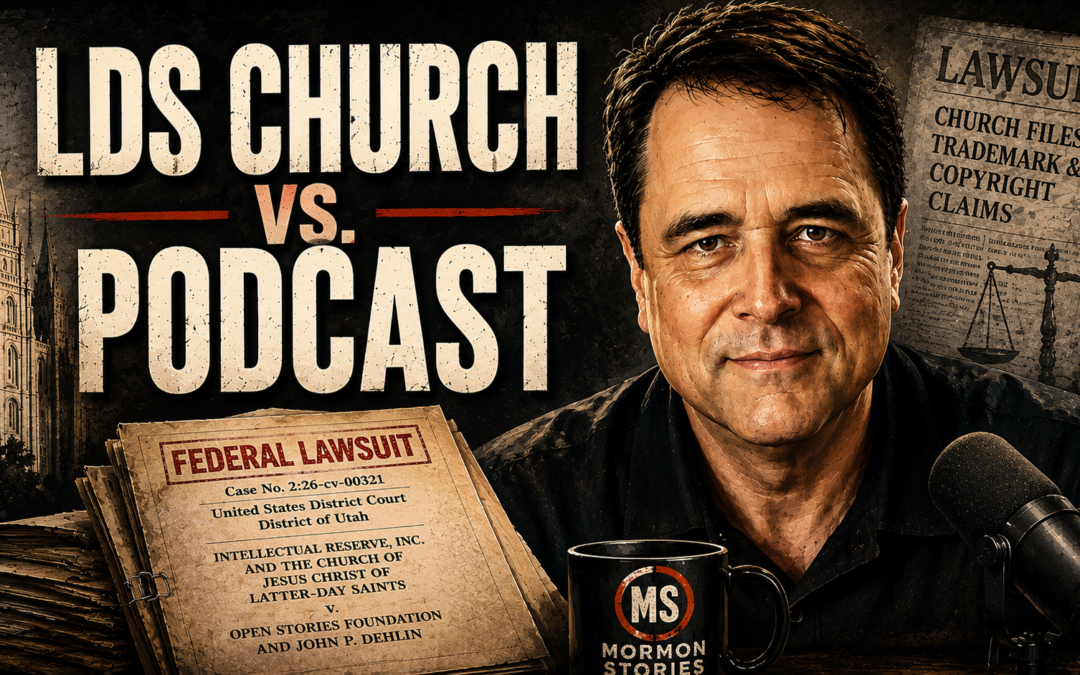
Why Is the LDS Church Suing Mormon Stories? The Complete Legal Analysis — Updated May 2026
Radio Free Mormon Ep. 455 + ongoing coverage
The LDS Church suing Mormon Stories became a major legal story on April 17, 2026, when the Church filed federal trademark and copyright claims against John Dehlin. Since the original Radio Free Mormon analysis, the case has evolved significantly. New developments include documented Streisand Effect evidence. They also include a temple image allegation, Dehlin’s fair-use defense, LDS scholar commentary, and confirmed rebranding proposals. As a result, the legal and public-relations dimensions of the dispute have become considerably more complex. This updated analysis reviews what the public record currently shows.
LDS Church Suing Mormon Stories: Case Overview
Case: Intellectual Reserve, Inc. and The Church of Jesus Christ of Latter-day Saints v. Open Stories Foundation and John P. Dehlin — No. 2:26-cv-00321, U.S. District Court for the District of Utah, filed April 17, 2026
Claims: Federal trademark infringement · False designation of origin (Lanham Act) · Utah common-law trademark infringement · Copyright infringement.
Plaintiffs’ counsel: Six attorneys — three from Perky Barber PLLC (Utah) and three Texas attorneys admitted pro hac vice.
Relief sought: Permanent injunction barring use of confusingly similar marks, names, and designs · Monetary damages · Attorney’s fees · Jury trial requested.
Mediation timeline: Church first contacted Open Stories November 2025 · Formal mediation approximately February–March 26, 2026 · Lawsuit filed April 17, 2026.
Status as of May 19, 2026: Complaint filed; no answer or counterclaim filed by defendants yet; case is at earliest stage.
Which Parts of RFM’s Original Analysis Were Correct?
Confirmed — RFM Correct
The Church’s public statement was misleading by omission on the disclaimer dispute
✓ Confirmed by Multiple Independent Sources
The Church’s “Getting It Right” statement described the dispute as a disagreement over a disclaimer stating that the podcast was not affiliated with the Church. However, the statement did not specify that the requested disclaimer would appear at the beginning of every episode. Meanwhile, Dehlin had already published written disclaimers across Spotify, Apple Podcasts, YouTube, and Facebook. Consequently, critics argue that the omission changed how readers understood the dispute.
The Deseret News and KSL confirmed this in their coverage: the specific unmet demand was “a written or verbal statement at the beginning of each podcast episode.” Dehlin himself told the Deseret News: “The church wanted us to make the disclaimer more prominent, so it was essentially the primary thing anyone sees in our branding, which we believe is unreasonable.” The omission created a misleading impression. Readers could assume Dehlin rejected all disclaimers. As a result, the statement affected public perception before he responded.
The Church’s public statement omitted the specific requirement that the disclaimer appear at the beginning of every episode. Dehlin had posted platform-wide disclaimers. The omission was consequential.
Confirmed — RFM Correct
The complaint includes discontinued logos — the blue logo was removed during mediation, not currently in use
✓ Confirmed by the Deseret News Timeline
The Deseret News confirmed the timeline: “In December 2022, Mormon Stories changed the color of its logo to blue.” During mediation Dehlin changed it back to orange. The complaint presents both logos together. However, the blue logo was no longer in use. As a result, critics argue this created a broader picture of ongoing infringement. When Dehlin’s answer is filed, the timeline will clarify that the blue logo was discontinued specifically as a mediation concession — a fact that will not reflect well on the Church’s candor in the complaint.
Dehlin removed the blue logo during mediation. Presenting discontinued logos alongside current ones as evidence of ongoing infringement is a legitimate critique of the complaint’s framing.
Four Legal Claims That Still Need Context
Claim 1 of 4 — Still Inaccurate
The Church’s decade of distancing from “Mormon” constitutes trademark abandonment — “they don’t own Mormon anymore”
⚠️ Legally Inaccurate — Church Statement Directly Contradicts This
The Church’s own website now states explicitly: “The Church holds trademarks covering certain uses of the term ‘Mormon,’ including in connection with educational services. Not every use of the word requires permission. But when it is used as part of organizational branding in ways that create confusion about affiliation, the Church has a responsibility to address it.”
Trademark abandonment requires two elements: non-use and intent to abandon. In this case, the Church continued using “Mormon” across multiple properties, including the Book of Mormon, Mormon Messages, and retained trademark assets. Therefore, the legal abandonment argument remains difficult to sustain. President Nelson explicitly stated in 2018 that the Church was not abandoning the mark. The Church won the “Bad Mormon” trademark case against Heather Gay in 2023-24. Axios confirmed the Church has been contacting other podcasts about “Mormon” usage. The abandonment argument is rhetorically powerful but legally unsound — Dunkin’ Donuts did not abandon “Dunkin’ Donuts” by rebranding to “Dunkin’.”
The Church’s own statement, active trademark registrations, and recent enforcement actions against other parties confirm “Mormon” has not been legally abandoned. RFM’s abandonment argument is one of the weakest claims in his analysis.
Claim 2 of 4 — Still Needs Context
Laches will likely defeat the Church’s trademark claim on “Mormon Stories”
⚖️ Real Defence — But More Complex Than Presented, and New Temple Image Breach Complicates It
Laches requires both unreasonable delay AND prejudice to the defendant.Dehlin used “Mormon Stories” for 21 years without enforcement. The Church also knew about the podcast. Critics point to his 2015 excommunication and internal references as evidence of awareness. The Chicago Sun-Times quotes Dehlin directly: “I think it’s a fair question to ask them: After 21 years, why now?”
New complication: The Church alleges Dehlin broke a mediation agreement by later using a temple image to advertise an episode after agreeing to remove Church imagery. If true, this creates a new triggering event that partially resets the laches clock on at least some claims and undermines Dehlin’s “good faith compliance” narrative. This was not in RFM’s original analysis.
Additionally: the copyright claims have their own three-year statute of limitations and are not subject to laches. The blue logo redesign was December 2022 — only three years before the lawsuit, weakening laches on that specific claim. The laches defence remains strongest on the 21-year use of the name itself.
Laches on the 21-year name use is a real and potentially strong defence. The temple image breach allegation — new since RFM’s episode — and the 2022 logo escalation both work against the laches argument on specific claims.
Claim 3 of 4 — Updated
The copyright claims are essentially already resolved since Dehlin removed the photos
⚠️ Still Inaccurate — Past Infringement Creates Ongoing Liability; Breach Allegation Adds New Exposure
RFM’s original suggestion that the copyright claims are “already resolved” by removal of the photos remains legally incorrect — copyright infringement is complete at the moment of unauthorized use. Removal does not eliminate liability for past infringement. Statutory damages run from $750 to $30,000 per infringed work and up to $150,000 for willful infringement under 17 U.S.C. § 504.
New development: The Church alleges Dehlin later used a temple image in promotional material. According to the complaint, this action violated the mediation agreement. If true, this creates new copyright exposure on top of the original claims. Dehlin’s stated position — “We believe our use qualifies as fair use” — is his first public articulation of a defence, but an IP attorney writing in the Deseret News (April 23, 2026) called the copyright claims the most legally straightforward element of the complaint: using copyrighted press photographs in commercial promotion “is rarely considered fair use.”
The copyright claims remain the Church’s clearest legal ground — the one element of this case where both sides’ lawyers likely agree the Church has a strong position.
Past copyright infringement creates ongoing liability. The temple image breach allegation — new since RFM’s episode — adds further exposure. “We believe our use qualifies as fair use” is a defence, not a resolution.
Claim 4 of 4 — Updated with New Evidence
The Church is “badly positioned” and will likely lose if the case goes to trial
⚖️ Still Overconfident — New Evidence Cuts Both Ways
RFM’s confident prediction that the Church will likely lose has not been borne out by subsequent analysis from neutral observers. Slate, which covered the case sympathetically toward Dehlin, nevertheless noted the Streisand Effect risk rather than predicting a Church loss. The KUER Radio West discussion with LDS scholars Matthew Bowman (Claremont’s Howard W. Hunter Chair of Mormon Studies) and Patrick Mason engaged the merits on both sides without predicting an outcome.
New evidence cuts both ways: The Streisand Effect and audience spike do help Dehlin’s narrative — but they do not constitute legal evidence. The temple image breach allegation, if proven, strengthens the Church’s case. Dehlin’s $1.12 million annual revenue and $236,000 salary are relevant to whether Open Stories Foundation is a commercial operation in the trademark context. The complaint documents initial confusion. However, readers also recognized the podcast’s critical position quickly. Initial confusion still matters under trademark law.
Neither side has a clear advantage. The case will turn on judicial findings that cannot be predicted from outside the courtroom.
RFM’s prediction remains overconfident. The Church has legitimate legal claims, particularly on copyright and the 2022 logo. Dehlin has real defences, particularly on laches for the name. Neither side should expect an easy outcome.
Each Side’s Strongest Arguments — Updated
Church’s Strongest Positions
- Copyright infringement on photos — legally straightforward; removal does not eliminate past liability
- Temple image breach allegation — new exposure if proven
- December 2022 blue logo — documented independently by Facebook commenters as resembling Church branding
- “Mormon” trademark never legally abandoned — active registrations, won the Bad Mormon case, Nelson’s own statement
- Actual confusion documented in complaint — even if quickly resolved, initial confusion is what the standard requires
- Open Stories Foundation is a $1.12M commercial operation — weakens “innocent small podcast” framing
Dehlin’s Strongest Positions
- Laches on 21 years of the name “Mormon Stories” — Church knew, did nothing; substantial investment and prejudice
- Platform-wide written disclaimers were posted — the Church’s public statement falsely implied he refused all disclaimers
- Confusion quickly resolved — complaint’s own evidence shows people immediately recognized the podcast’s critical stance
- Church’s 10-year public distancing from “Mormon” relevant to likelihood of confusion even if not legal abandonment
- Mediation demands unusually broad — renouncing all rights to “Mormon,” never using it in future projects
- Fair use argument on photographs — editorial/critical use of press photos has some precedent
- Streisand Effect — lawsuit itself is the most effective possible advertisement for the podcast
What Does This Lawsuit Reveal Beyond the Legal Dispute?
New Section — Not in Original Analysis
The lawsuit represents a documented shift in how the Church responds to prominent critics — and LDS scholars are saying so publicly
★ New Development Since Original Episode
Slate noted: “The filing marks a shift in how the church has dealt with its critics, attempting to both discredit him and substantially alter how he defines and promotes his platform.” The Church famously bought ad space in the Book of Mormon Musical programme — “The book is always better.” It issued press statements rather than legal threats against Hulu’s Under the Banner of Heaven and The Secret Lives of Mormon Wives.
The lawsuit came approximately two months after Mormon Stories hosted Edward Nachel — a former Chicago-area resident who revealed he had been part of an alleged child sexual abuse network involving an LDS leader. The Chicago Sun-Times noted this timing without asserting a direct connection. Dehlin has explicitly asked: “After 21 years, why now?” The Church’s official position is that the lawsuit is solely about branding.
LDS scholars Matthew Bowman and Patrick Mason — both credentialed, currently teaching at major universities — agreed to discuss the lawsuit publicly on KUER Radio West, reflecting the seriousness with which the case is being taken within LDS intellectual circles. Bowman holds the Howard W. Hunter Chair of Mormon Studies at Claremont Graduate University — the most distinguished endowed chair in Mormon studies in the country.
The timing, the escalation from the Church’s historically more tolerant posture toward critics, and the breadth of the mediation demands all raise questions that the legal proceedings will not answer. Both the Church’s stated rationale (branding confusion) and Dehlin’s stated rationale (silencing a critic) may be partially correct simultaneously.
Frequently Asked Questions
The LDS Church suing Mormon Stories has also raised broader questions about Church criticism, branding rights, and media strategy.
Why is the LDS Church suing Mormon Stories in 2026?
The Church filed a federal trademark and copyright complaint (Case No. 2:26-cv-00321) on April 17, 2026 after five months of mediation failed. The four claims are: federal trademark infringement, false designation of origin under the Lanham Act, Utah common-law trademark infringement, and copyright infringement. The Church alleges Dehlin’s podcast used a blue logo with a light-rays design similar to its own, copyrighted photographs of Church leaders without permission, and the word “Mormon” in branding that causes confusion about affiliation.
The Church states the lawsuit is not about the podcast’s content. Dehlin disagrees, noting the mediation demands went well beyond branding — including demands he never use “Mormon” in any future project and agree the Church owns all rights to the word.
What did Dehlin agree to and refuse during mediation?
Agreed to: Changed logo from blue to orange; removed light-rays design; removed copyrighted Church photographs from headers and thumbnails; posted written disclaimers on Spotify, Apple Podcasts, YouTube, and Facebook.
Refused: A verbal or written disclaimer at the beginning of every episode; removing “Mormon” from “Mormon Stories”; renaming to “Ex-Mormon Stories” or “Post-Mormon Stories With Dr. John Dehlin”; renouncing trademark rights to “Mormon Stories”; agreeing never to use “Mormon” in future projects; and agreeing the Church owns all rights to “Mormon.”
New allegation: The Church also alleges Dehlin broke the mediation agreement by later using a temple image to advertise an episode after agreeing to remove Church imagery.
What is the Streisand Effect and has it happened here?
The Streisand Effect describes the phenomenon where attempting to suppress information or a platform instead generates exponentially more attention to it. In this case: Dehlin’s response episode (Ep. 2139) garnered 135,000–140,000 views in approximately one week, compared to his normal range of 5,000–50,000 views. He reports 800,000 subscribers across platforms. LGBTQ Nation (May 15, 2026) reported a “huge spike in audience since the lawsuit.” Slate, Salon, the Chicago Sun-Times, and LGBTQ Nation all published substantial national coverage that introduced Dehlin’s podcast to millions of new readers who had never heard of it.
Does laches apply — has the Church “slept on its rights” for 21 years?
Laches is a real and potentially strong defence, but it is more complex than it first appears. It requires both unreasonable delay and prejudice. Dehlin’s 21-year investment in building the “Mormon Stories” brand constitutes strong prejudice. However: the blue logo redesign was December 2022 — only three years before the lawsuit; copyright infringement claims have their own statute of limitations and are not subject to laches; the Church actively enforced “Mormon” trademarks against others during this period; and the new temple image breach allegation may create a new triggering event. The laches defence is strongest on the 21-year use of the name itself and weakest on the 2022 logo and copyright claims.
Is Dehlin’s use of Church photographs protected by fair use?
Dehlin has stated “We believe our use qualifies as fair use.” Fair use is evaluated on four factors: purpose and character of the use, nature of the copyrighted work, amount used, and market effect. Editorial and critical use of press photographs can be transformative. However, an IP attorney writing in the Deseret News called the copyright claims the most legally straightforward element of the complaint, noting that using copyrighted images in commercial promotion “is rarely considered fair use.” The Church also alleges Dehlin broke a mediation agreement by later using a temple image after agreeing to remove Church imagery — creating additional exposure. Fair use is a defence Dehlin can raise, not a guaranteed win.
What does the Church mean when it says it owns the “Mormon” trademark?
The Church’s own website now states: “The Church holds trademarks covering certain uses of the term ‘Mormon,’ including in connection with educational services. Not every use of the word requires permission. But when it is used as part of organizational branding in ways that create confusion about affiliation, the Church has a responsibility to address it.” This is a narrower claim than “we own all uses of ‘Mormon'” — it is specifically about branding contexts that create confusion about Church affiliation.
Informational use of “Mormon,” individual use of the word, and use in contexts that cannot create affiliation confusion are not what the Church is suing over. The lawsuit is specifically about Dehlin’s podcast branding, not about the word itself in ordinary usage.
Why does the timing of the lawsuit matter?
Dehlin has asked publicly: “After 21 years, why now?” Several factors in the timing are noted by journalists covering the case. The Church filed the lawsuit about two months after Mormon Stories hosted Edward Nachel. He revealed alleged child sexual abuse involving an LDS leader in the Chicago area — one of the most sensitive stories the podcast has covered. The case is also the first major intellectual property enforcement action taken under President Dallin H. Oaks’s leadership (Nelson’s successor, who is named in the complaint’s copyright claims). The Church’s official position is that the lawsuit is solely about branding and the December 2022 logo change. Dehlin and outside observers have noted the timing as potentially significant. The legal proceedings are unlikely to resolve this question.
The Honest Summary — Updated May 2026
The central picture remains largely unchanged; however, new evidence adds important context. Independent outlets confirmed the controversy surrounding the disclaimer dispute, while the documented Streisand Effect expanded public attention around the case. At the same time, the temple image allegation introduced additional legal complexity and potentially strengthened part of the Church’s position. The mediation demands — including proposing “Ex-Mormon Stories With Dr. John Dehlin” as the new name — are confirmed and give context for why settlement was impossible.
The four analytical points from the original rebuttal stand: RFM’s trademark abandonment argument is legally weak; laches is a genuine defence but more complex than presented; the copyright claims are not “already resolved” by photo removal; and neither side has a clear advantage overall. The Church has its strongest ground on copyright and the 2022 logo. Dehlin has his strongest ground on laches for the 21-year name, the misleading public statement, and the breadth of mediation demands.
What this lawsuit reveals beyond its legal merits is a documented shift in how the Church responds to prominent critics — from the “the book is always better” posture toward aggressive intellectual property enforcement. LDS scholars Matthew Bowman and Patrick Mason have engaged this publicly. Whether the Church’s stated rationale (branding confusion) fully explains the decision to sue a 21-year-old podcast after excommunicating its host in 2015 is a question the legal proceedings will not answer. The LDS Church suing Mormon Stories remains one of the most discussed LDS legal disputes of 2026. Truth seekers following this case deserve to understand both sides’ strongest arguments — and the genuine uncertainty about how it ends.