
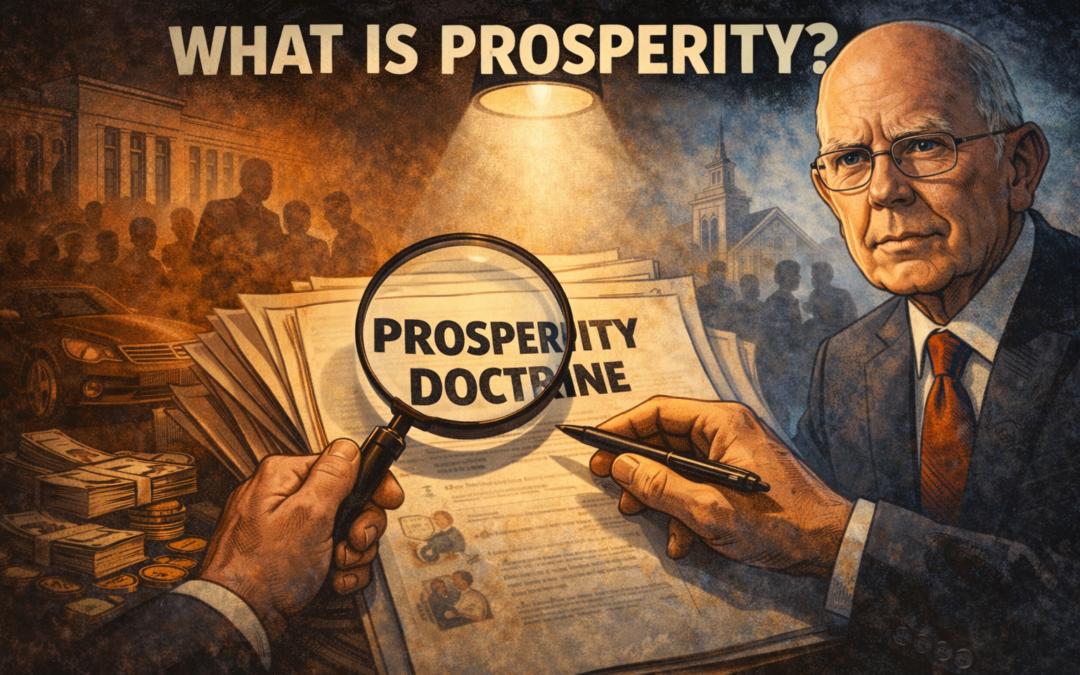
The True Prosperity Doctrine of The Church of Jesus Christ of Latter-day Saints
Seeking God first, then using riches righteously
Why Prosperity Is Often Misunderstood
In religious discussions today, few ideas are more misunderstood than “prosperity.”
Some assume that righteousness guarantees wealth and success.
However, others believe hardship must signal divine disfavor.
In reality, this assumption misrepresents what Latter-day Saint scripture actually teaches.
A careful study of the Standard Works reveals a deeper, covenant-centered truth.
Instead, prosperity is not primarily about wealth—it is about alignment with God.
Any material blessings are meant to serve divine purposes.
The Scriptural Foundation: A Covenant Pattern
The Book of Mormon famously teaches:
“Inasmuch as ye shall keep my commandments ye shall prosper in the land”
(1 Nephi 2:20)
However, across the narrative, prosperity consistently includes:
- Spiritual strength and guidance
- Protection and preservation
- Peace and stability
- Capacity to fulfill God’s purposes
At times, material wealth accompanies righteousness—but it is never the defining measure of prosperity.
Jacob’s Clarifying Doctrine: Seek God First
One of the clearest correctives to confusion comes from the prophet Jacob:
“But before ye seek for riches, seek ye for the kingdom of God.
And after ye have obtained a hope in Christ ye shall obtain riches, if ye seek them;
and ye will seek them for the intent to do good…”
(Jacob 2:18–19)
This passage outlines a clear pattern for understanding righteous prosperity:
- Seek the kingdom of God first
- Obtain a hope in Christ—a spiritually transformed heart centered in Him
- Then, if desired, seek riches
- Use those riches only for righteous purposes
Jacob immediately defines those purposes:
“…to clothe the naked, and to feed the hungry, and to liberate the captive,
and administer relief to the sick and the afflicted.”
(Jacob 2:19)
before God, using wealth for pride, and allowing prosperity to produce inequality and spiritual blindness.
Material Wealth Can Be a Blessing When It Serves God and Neighbor
Importantly, scripture does not teach that material blessings are inherently wrong.
Instead, it teaches that wealth becomes good or harmful depending on its priority and use.
When wealth is sought after one has placed God first, and when it is used to bless others,
it can become a meaningful stewardship. In Jacob’s framework, riches may be desired
if they are pursued with the intent to do good.
That means material prosperity can be a blessing when it helps us:
- Feed the hungry and care for the poor
- Relieve suffering and bless the sick and afflicted
- Strengthen families and communities
- Support the work of God and advance righteous causes
- Live generously rather than selfishly
In this sense, wealth is not meant to be a badge of spiritual superiority. It is meant to be a tool of discipleship.
Doctrine and Covenants: Blessings Governed by Law
Modern revelation reinforces the same principle:
“There is a law, irrevocably decreed in heaven… upon which all blessings are predicated”
(Doctrine and Covenants 130:20–21)
“I, the Lord, am bound when ye do what I say”
(Doctrine and Covenants 82:10)
At the same time, these passages teach that God blesses obedience.
However, the nature and timing of those blessings remain in His wisdom.
Not every blessing is material.
Not every righteous person will experience visible abundance in mortality.
Biblical Harmony: Treasure and Priority
Likewise, Jesus Christ taught the same principle:
“Seek ye first the kingdom of God…”
(Matthew 6:33)
“Where your treasure is, there will your heart be also”
(Matthew 6:21)
The order matters. When God is first, material blessings can be received in humility and used well.
When wealth is first, the heart is drawn away from God.
The Old Testament also presents prosperity in a covenant context:
“Then thou shalt make thy way prosperous, and then thou shalt have good success”
(Joshua 1:8)
In scripture, prosperity is not merely accumulation. It is covenantal flourishing under God’s favor.
The Book of Mormon Warning Cycle
The Book of Mormon repeatedly warns that prosperity can become spiritually dangerous if it leads to pride.
Helaman summarizes the pattern:
The people remember God in affliction, but in prosperity they often harden their hearts
(Helaman 12:1–3)
Jacob also warns against judging others because of wealth, status, or costly apparel
(Jacob 2:13).
In other words, material blessing is never a license for pride. It is a test of whether disciples will remain humble,
generous, and centered in Christ.
Correcting Common Misunderstandings
Misconception 1: “Righteous people become wealthy”
Scripture never teaches that all righteous people will become materially rich.
Many faithful servants of God suffer poverty, illness, persecution, or loss.
Misconception 2: “Poverty indicates unrighteousness”
This idea is rejected in Jacob 2, which condemn contempt for the poor
and pride rooted in worldly status
(Jacob 2:13).
Misconception 3: “Wealth is inherently evil”
Jacob explicitly leaves room for seeking riches—after seeking Christ first,
and only for the purpose of doing good
(Jacob 2:18–19).
The True Prosperity Formula
Bringing these teachings together, the pattern looks like this:
Seek God first →
Be transformed in Christ →
Receive blessings →
Use them to serve others →
Progress toward eternal life
That is the true prosperity doctrine taught in Latter-day Saint scripture.
The Ultimate Prosperity
True prosperity is not financial.
- The companionship of the Holy Ghost
- A covenant relationship with God
- A Christlike heart
- Faithful stewardship
- Eternal life through Jesus Christ
All temporal blessings are secondary to that greater end.
Conclusion
The doctrine of prosperity in The Church of Jesus Christ of Latter-day Saints is clearer—and more demanding—than many assume.
It does not promise wealth—instead, it teaches priority.
Likewise, it does not celebrate accumulation; it teaches stewardship.
More importantly, it does not measure success by possessions but by faithfulness to Christ.
Jacob’s teaching resolves the confusion:
seek God first; then, if riches come, use them to bless others.
In that light, prosperity is not about what we accumulate, but about how faithfully we align with God
and use every blessing to build His kingdom and serve His children.
Quick Links
- Jacob 2:18–19 — seek the kingdom first, then riches for good
- 1 Nephi 2:20 — “prosper in the land”
- Doctrine and Covenants 130:20–21 — blessings are predicated on law
- Doctrine and Covenants 82:10 — the Lord is bound when we obey
- Matthew 6:21, 33 — treasure and seeking God first
- Helaman 12:1–3 — the pride cycle of prosperity
- Jacob 2:13 — warning against pride because of costly apparel and status
- Joshua 1:8 — covenant success and prosperity