
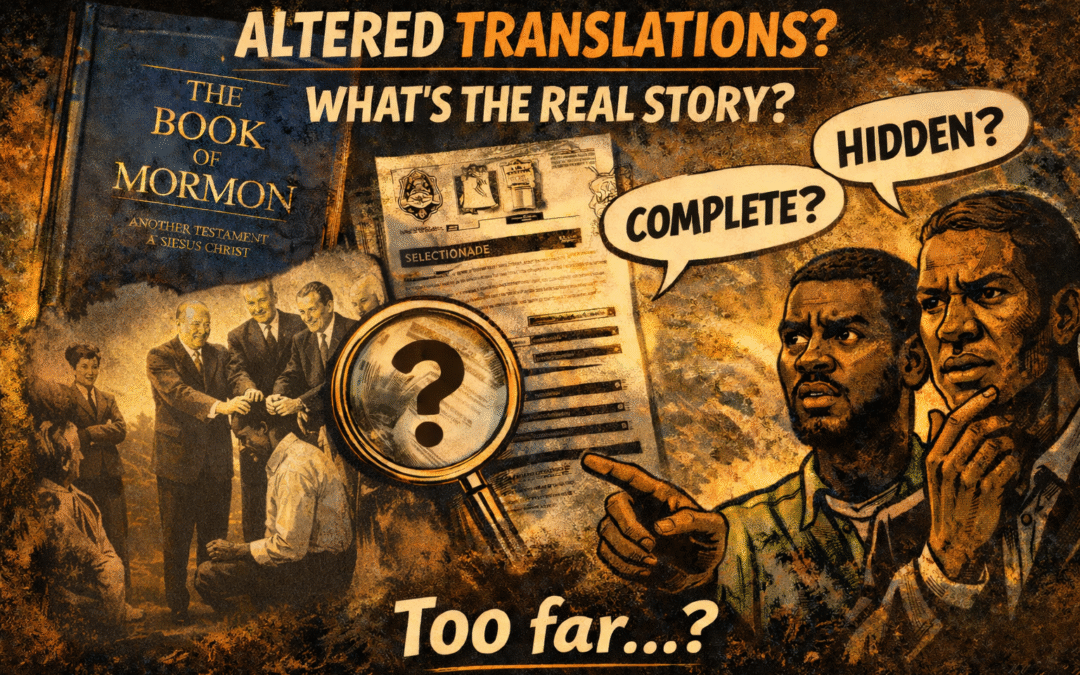
Podcast: Radio Free Mormon • Episode: #434 • Category: Doctrinal / Historical / Reputational • Prepared: January 7, 2026
Summary (Bottom Line Up Front)
The transcript alleges (1) the Church “systematically” changes African-language Book of Mormon passages to remove “skin of blackness,” and (2) Selections-editions intentionally omit 2 Nephi 5:21 to “hide” racism. Word-for-word checks against the Church’s Gospel Library show that complete African translations (e.g., Yorùbá and Twi) do include 2 Nephi 5:21 and render “skin of blackness/darkness” unambiguously. Core verdict: Claims about altered wording in complete African translations are False; concerns about Selections stopping at v.20 are Accurate as to fact but misleading in motive attribution. See the Evaluation tables per segment below for detail.
Segment 1
Claim: The Church is “systematically changing” African-language translations to remove 2 Nephi 5:21
“…make it so it didn’t say skin of darkness… whether this is the church doing this intentionally in order to fool black people into joining the Mormon church… What would you think if I told you the LDS church is systematically changing the language of the Book of Mormon in African languages to remove the teaching that black skin is a curse from God?”
Core Claim
The Church intentionally alters wording in African-language complete translations (not just Selections) so that 2 Nephi 5:21 no longer states “skin of blackness/darkness.”
Logical Questions
- Do current complete African translations include 2 Nephi 5:21?
- How do Yorùbá and Twi actually render the key phrase?
- Is there evidence of systematic avoidance in the complete (non‑Selections) editions?
Core Rebuttal (Textual Checks)
- Yorùbá (Nigeria, full translation): 2 Nephi 5 shows v.21 and reads “àwọ̀ ara dúdú” (“black skin/skin of blackness”). See chapter page, v.21 line.
- Twi (Akuapem) (Ghana, full translation): 2 Nephi 5 shows v.21 with the clause that their flesh/skin became black.
- These complete translations retain the contested phrase. The transcript itself ultimately concedes the rumor about complete African translations “appears to be false.”
Doctrinal anchor: The Church’s Gospel Topics materials reaffirm that God “denieth none … black and white … all are alike unto God” (2 Nephi 26:33), directly rejecting any racist soteriology.
Evaluation Table
| Start | End | Claim Summary | Category | Evaluation | Sources |
|---|---|---|---|---|---|
| 00:02:16 | 00:03:24 | Church “systematically changing” African translations to remove “skin of blackness.” | False | Complete African translations (Yorùbá, Twi) include 2 Nephi 5:21 with the “blackness” wording; transcript later concedes rumor is false. | Yorùbá 2 Nephi 5:21; Twi 2 Nephi 5:21; Transcript admission. |
Bottom Line
The allegation of systematic alteration in complete African translations is refuted by the texts themselves and by the presenter’s own later correction.
Claim: Selections editions uniquely stop 2 Nephi 5 at v.20 to avoid v.21 (“skin of blackness”)
“…there’s only one exception in the selections version where they do not translate an entire chapter. That one exception is 2 Nephi 5… when you get to verse 20, everything’s fine… it’s right at verse 20 that the selections versions … stop immediately. It doesn’t go to verse 21 or anything beyond…”
Core Claim
Selections editions in certain languages publish 2 Nephi 5 only up to v.20, omitting v.21 and following.
What the record shows
- Ekegusii (Gusii, Kenya) — Gospel Library page for 2 Nephi 5 in the Selections edition displays verses through v.20; no v.21 is present.
- Quiché/K’iche’ (Guatemala) — Identified historically as a Selections language; 2 Nephi 5 shown through v.20.
Core Rebuttal (Intent vs. Format)
- The fact of stopping at v.20 in certain Selections is accurate (e.g., Ekegusii).
- The motive (intentional deception) is not proven. The Church’s published translation program describes Selections as provisional, not doctrinally redacted, and many languages later receive full editions including the contested verses.
Evaluation Table
| Start | End | Claim Summary | Category | Evaluation | Sources |
|---|---|---|---|---|---|
| 00:03:24 | 00:04:23 | Selections editions stop at 2 Nephi 5:20, omitting v.21. | True (Fact) / Not Provable (Intent) | Demonstrated in Ekegusii page; however, the broader inference of deceptive intent lacks evidence given the stated purpose of Selections and subsequent full translations. | Ekegusii 2 Nephi 5 (to v.20); Translation program overview. |
Bottom Line
The stopping point at v.20 in certain Selections is real, but standing alone it does not establish deceptive intent. The same Church system simultaneously publishes full African translations that include v.21 (e.g., Yorùbá, Twi).
Claim: Twi/Yorùbá “change” 2 Nephi 5:21 to avoid “skin of blackness” (e.g., “flesh cut off,” “dark,” etc.)
“…in Yorùbá… it says that the Lord God did cause a blackness to come upon them… in Twi … the translation … says that… the Lord God caused that their flesh should be cut off… red alert… Let’s look closer…”
Core Claim
Complete African translations (Twi, Yorùbá) avoid the “skin of blackness” language by rendering it differently or nonsensically.
Textual Check
- Yorùbá: v.21 contains “àwọ̀ ara dúdú” (black skin).
- Twi (Akuapem): v.21 includes wording that, when properly parsed (not via whole‑verse machine translation), expresses that their flesh/skin became black (not “cut off”).
Core Rebuttal
- Machine‑translation of entire complex verses produced spurious outputs (e.g., “hack your skin off”). The transcript later acknowledges the “complete translations in African languages” rumor “appears to be false.”
- Therefore, no evidence shows that complete Twi/Yorùbá editions “change” the doctrine by removing “skin of blackness/darkness.”
Evaluation Table
| Claim Summary | Category | Evaluation | Sources |
|---|---|---|---|
| Twi/Yorùbá avoid “skin of blackness.” | False | Both complete editions carry 2 Nephi 5:21 with the key idea intact (see the actual chapter pages). | Yorùbá 2 Nephi 5:21; Twi 2 Nephi 5:21; Transcript correction. |
Bottom Line
The claim fails on the primary sources. Misreadings came from machine translation of whole verses, not from LDS translation policy or textual manipulation.
Claim: The Church’s use of Selections and language choices show intent to hide racism
“…the fact this is the only chapter not completely translated, coupled with the fact it stops precisely at 2 Nephi 5:20… indicates strongly the church is committed to keeping this information from certain language‑speaking populations… but… the rumor that the church in its complete Book of Mormon translations in African languages appears to be false.”
Core Claim
Stopping at v.20 proves deceptive motive.
Assessment
- Selections editions are publicly described as preliminary and partial (often ⅓–½) and are common across regions/languages, not targeted to “hide” one doctrine.
- Simultaneously, the Church publishes full African translations (e.g., Twi, Yorùbá) that include v.21—contradicting a theory of systematic concealment.
Core Rebuttal
- Doctrinal stance: The Church explicitly rejects racial discrimination as doctrine; see Gospel Topics “Priesthood and Race / Race and the Church…,” and 2 Nephi 26:33.
- Historical clarity: The 1978 revelation (OD‑2) ended prior restrictions; Church history and Gospel Topics pages present this transparently.
Evaluation Table
| Claim Summary | Category | Evaluation | Sources |
|---|---|---|---|
| Stopping at v.20 proves intent to hide racism. | Misleading | Fact pattern (v.20 stop) is accurate in some Selections, but motive attribution is speculative and contradicted by the existence of full African translations including v.21 and by official doctrine repudiating racism. | Selections program context; Doctrinal resources. |
Bottom Line
Evidence supports a translation‑pipeline explanation (Selections → Full), not a deception thesis.
Legal & Logic Analysis
Rhetorical Tactics & Fallacies
- Confirmation bias / motive leap: An observed editorial cutoff (v.20) in some Selections is used to imply malintent without corroborating evidence.
- Machine‑translation reliance: Using whole‑verse outputs as determinative evidence produced false linguistic conclusions later retracted by the speaker.
Defamation / False‑Light Check
- 🟠 Moderate false‑light risk: Suggesting the Church “systematically” manipulates complete African translations to “fool black people” could place the organization in a false light if asserted as fact. The transcript ultimately disclaims the charge for complete translations, which mitigates risk but does not erase the interim insinuation.
- Reference framework (not legal advice): actionable defamation requires false statements of fact made with at least negligence; public‑figure claims require “actual malice.” Milkovich clarifies that assertions implying provable facts are not shielded by “opinion.”
Doctrinal Anchors
- Stewardship Doctrine: Translation sequencing (Selections → Full) reflects stewardship with finite resources, not concealment; stewardship is visible in the Church’s global rollout and transparent language lists.
- Authorized Priesthood Use: The 1978 revelation (OD‑2) and subsequent policies demonstrate authorized correction and unity, not racial preference.
- Covenant Layering: 2 Nephi 26:33 centers equality before God—covenantal identity supersedes ethnicity (“black and white… all are alike unto God”).
Sources
- Transcript (user‑provided): Radio Free Mormon #434 — “Black Skin a Curse from God?” — time‑coded excerpts as cited throughout.
- Gospel Library — Book of Mormon (English / Equality text): 2 Nephi 26, esp. v.33 (“…he denieth none… black and white… all are alike unto God”).
- Gospel Library — Book of Mormon (Complete African translations)
- Yorùbá 2 Nephi 5 (see v.21: “àwọ̀ ara dúdú”).
- Twi (Akuapem) 2 Nephi 5 (see v.21).
- Gospel Library — Book of Mormon (Selections example)
- Ekegusii (Gusii) 2 Nephi 5 (stops at v.20).
- Program Context: Overview of translations and Selections vs full editions; language timelines for African translations.
- Gospel Topics (Doctrine):
- “Priesthood and Race.”
- “Race and The Church of Jesus Christ of Latter‑day Saints.”
- “Priesthood and Temple Restriction” (history topic).
- Defamation Framework (for false‑light/defamation analysis):
- New York Times Co. v. Sullivan (1964) — public‑figure “actual malice” standard.
- Milkovich v. Lorain Journal (1990) — “opinion” that implies verifiable fact can be actionable.
- U.S. Constitution Annotated — defamation overview.