
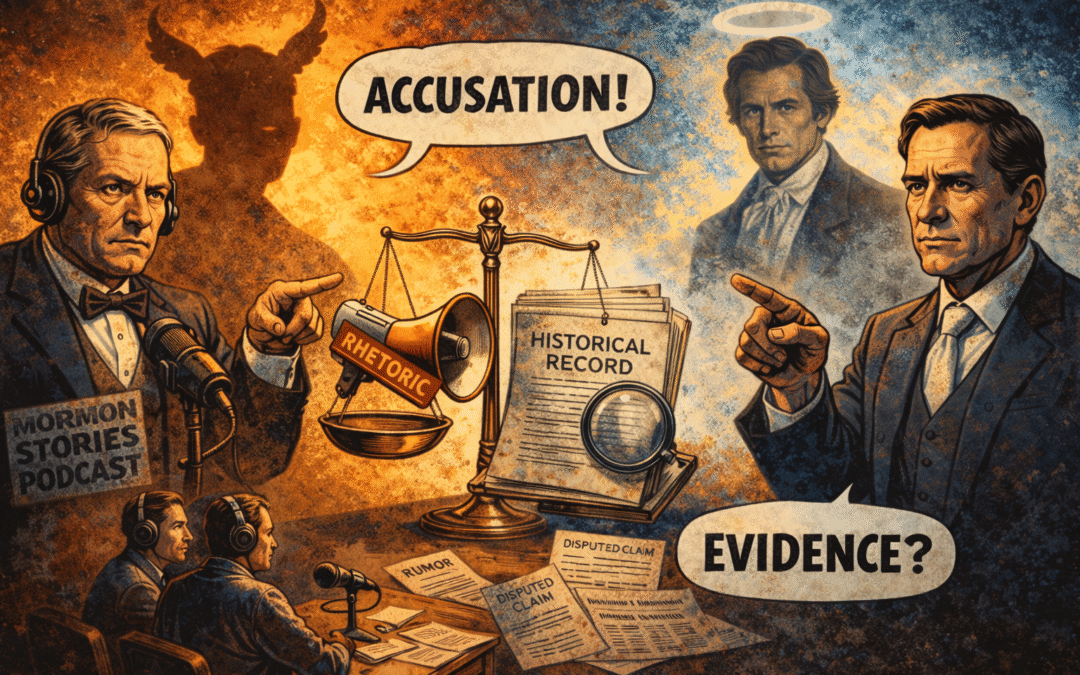
Mormon Stories Podcast – Episode 2112
Five Places the Podcast Turns “Spiritual Wifery” Evidence into Assumption
Podcast: Mormon Stories — Joseph Smith Podcast
Episode: 2112 Series Part 31
Primary topic: John C. Bennett, “spiritual wifery,” Nauvoo scandal framing
Tone intent: Critical of overreach, open to evidence either way
The episode raises real historical questions. Nauvoo in 1841–1843 includes documented secrecy, allegations of sexual misconduct, reputational warfare, and deep human cost. Those are not things we should sanitize.
But the podcast also makes several highly subjective leaps—moves where the audience is nudged to treat a plausible interpretation as settled fact, or where modern criminal/abuse categories are pasted onto messy 1840s disputes without careful definitions.
Below are five of the most substantive “subjective overreach” moments—each paired with a tighter, more evidence-disciplined way to read the record.
1) “It seems impossible Bennett wasn’t told by Joseph…”
Why this matters: suspicion is not proof
Timestamp: 00:11:13–00:11:52
Speaker: John Dehlin
“my opinion is it seems impossible that John C. Bennett wasn’t at least told by Joseph Smith about eternal polygamy and began practicing it, you know, after Joseph told him about it.”
“it just it’s it’s too coincidental… he’s going to get accused of spiritual wiferey, but somehow that emerged completely independent and unaware of Joseph’s own polygamy. It just seems impossible.”
Core claim
Because Joseph was privately teaching plural marriage, Bennett’s “spiritual wifery” accusations almost certainly trace back to Joseph’s disclosure/approval.
Claim type
Probability argument / inference presented as near-certainty
Objective analysis
This is a reasonable question—but it’s still a probability claim, not a demonstrated fact.
A more disciplined way to frame it:
-
Yes, Bennett plausibly had awareness of rumors and/or insider knowledge about plural marriage. The episode itself has Turner concede Bennett had “detailed information,” and the historical documentary record shows “spiritual wifery” accusations swirling in that period.
-
No, awareness does not equal authorization—especially not authorization for Bennett-style promiscuity framed as “permission if kept secret.” The Joseph Smith Papers editorial framing explicitly distinguishes Bennett’s “spiritual wife” accusations from what Joseph and insiders considered their (separate) plural-marriage practice—and notes that participants did not even use “spiritual wife/wifery” as their own term.
-
The record also preserves an episode where Bennett publicly denied—strongly—that Joseph ever authorized “illicit intercourse.” That denial doesn’t prove Bennett was truthful forever (he later attacked Joseph), but it does prove the episode is more complicated than “impossible.”
Spiritual framework
You can interpret Nauvoo two very different ways:
-
Counterfeit-permission framework: “Spiritual wifery” functions as a predatory spiritual pretext—men claiming religious permission for sex while demanding secrecy.
-
Covenant-layering framework: plural marriage (however controversial) was presented among insiders as a covenant practice under claimed authority—distinct (in their minds) from seduction tactics.
The key point: the podcast often collapses these frameworks into one story, then treats the collapse as proven.
Bottom line
“It seems impossible” is not evidence. A fair conclusion is: Bennett likely knew something—by rumor or disclosure—but the leap to ‘therefore Joseph approved Bennett’s system’ is not proven by the best documentary framing.
MTOPS Evaluation Table — Segment 1
| Claim summary | Category | Evaluation | Sources |
|---|---|---|---|
| “Impossible” Bennett wasn’t told/approved by Joseph | Not Provable (Speculative) | Plausible question, but not demonstrated; documentary framing distinguishes terms and practices; Bennett denial exists | Transcript ; JSP intro on terminology and corroboration limits ; Bennett denial in Times & Seasons publication |
Rhetorical tactic tag: certainty inflation (“impossible”) from incomplete data.
2) “This is where the Church’s long history of coverups of sexual abuse begins”
Why this matters: anacty into indictment
Word-for-word quote
Timestamp: 01:13:58–01:15:36
Speaker: John Dehlin
Transcript lines: 317, 320
“this is where the Mormon church’s super long history of coverups”
“of sexual uh, abuse scandals begins… the playbook… begins in in 1842 Nauvoo”
Core claim
A Nauvoo-era caution about publicity is the origin point of modern institutional sexual-abuse coverups.
Claim type
Institutional motive attribution + modern scandal backcasting
Objective analysis
This is one of the episode’s biggest interpretive leaps:
-
The transcript segment is triggered by language about public scandal management (“don’t make everything public…”). That is not automatically a “sexual k.” It can be (and often is) general crisis containment—sometimes wise, sometimes cowardly, soming on what is being concealed and why.
-
The Relief Society minutes and Church Historian’s Press material show the same era also includes women and leaders emphasizing moral reform and “putting down iniquity.” That complicates any simple “coverup origin story.”
-
Even the Church’s own modern historical synthesis acknowledges a dilemma in the 1842 public denials: leaders wanted to refute Bennett’s accusations without publicly explaining confidential plural marriage. That’s not flattering—but it’s not identical to “covering sexual abuse.”
Bottom line
The podcast is right that Nauvoo leaders engaged in reputation management. It is not shown that this equals the “beginning” of modern sexual-abuse coverup systems. That claim is too categorical for the evidence being discussed.
Evaluation Table — Segment 2
| Claim summary | Category | Evaluation | Sources |
|---|---|---|---|
| “1842 Nauvoo = origin of LDS abuse-coverup playbook” | Misleading (Anachronism) | Evidence supports scandal-avoidance language and confidentiality dilemmas, not a proven causal origin of modern abuse coverups | Transcript ; Relief Society minutes context (Church Historians Press) ; Church Historian’s Press on denial dilemma ; Gospel Topics essay framing “spiritual wifery” + denials |
Rhetorical tactic tag: category collapse (scandal management → abuse coverup).
3) “Lies to smear truthful whistleblowers”
Why this matters: labeling someone “truthful” is itself a factual claim
Word-for-word quote
Timestamp: 01:25:01–01:25:47
Speaker: John Dehlin (with Turner affirming)
Transcript line: 362
“the smearing, the use of lies to smear uh truthful whistleblowers. Is that fair to say?”
“I think that’s certainly fair to say in this context… yes.”
Core claim
Joseph/Church used deliberate lies to smear women who were truth-tellers and “whistleblowers.”
Claim type
Defamassertion (“lies,” “truthful”) presented as settled
Objective analysis
There are two separate questions the podcast merges into one:
-
Were there public conflicts and reputational attacks?
Yes—Nauvoo’s Bennett crisis produced dueling claims, affidavits, public statements, and deep polarization. -
Were the targeted women “truthful whistleblowers,” and were the counterclaims “lies”?
That is not something you get to assert as a premise. It requires case-by-case evidence and careful weighting of sources, timing, incentives, and corroboration.
Even Church Historian’s Press framing makes clear that public denials were shaped by a dilemma: refuting Bennett while not publicly disclosing confidential plural marriage. That context can generate misleading public messaging—but “misleading under a confidentiality dilemma” is not automatically identical to “knowing lies to smear truthful whistleblowers.”
The episode’s moral outrage may be understandable, but the language “lies” and “truthful whistleblowers” fun delivered before the evidentiary trial.
Evaluation Table — Segment 3
| 01:25:01 | 01:25:47 | “Lies used to smear truthful whistleblowers” | Not Provable (Overstated) | Conflict and reputation warfare are documented; calling one side “truthful” and the other “lying” requires claim-by-claim proof not provided here | Transcript ; Times & Seasons contextual framing (JSP) ; Church Historian’s Press: public denials dilemma |
Rhetorical tactic tag: verdict language (“truthful,” “lies”) without evidentiary scaffolding.
4) The Whitney letter: “I need sex… bring your daughter” + “trafficking”
Why this matters: you can be morally critical without making claims the text doesn’t make
Word-for-word quotes
A) Letter read aloud, then reinterpreted
Timestamp: 01:57:43–01:59:00
Speaker: John Dehlin (reading and then paraphrasing)
“I take this opportunity to communicate some of my feelings privately…”
“…it would afford me great relief… now is the time to afford me sucker in the days of exile.”
“I wanna I need some sex. Can you bring your daughter?”
B) Criminal-label escalation
Timestamp: 02:00:56
Speaker: John Dehlin
“they’re complicit in not only trafficking their daughter to Joseph Smith”
C) Turner’s own corrective—spiritual motivation claim
Timestamp: 02:10:02
Speaker: John Turner
“trafficking. Well, first of all, they believe what Joseph is telling them theologically…”
Core claims
-
The letter’s “succor” language is basically a request for sex with a teenager.
-
The parents “trafficked” their daughter.
retive paraphrase → asserted as meaning; then criminal-label rhetoric
Objective analysis
This is where precision matters most.
What the transcript does establish
-
The letter (as read in the episode) is emotionally intense, requests a visit, and includes secrecy cues (the episode discusses burning the letter and hiding from Emma). That is legitimate evidence of a clandestine relationship and concealment—at minimum.
-
“Succor” in early English usage means help/aid/relief, not inherently sex. The podcast’s phrase “sexual sucker” is not an evidentiary translation; it’s an interpretation layered onto the word.
-
The letter is a known historical document (the Joseph Smith Papers hosts it).
What the transcript does not establish
-
The paraphrase “I need some sex” is not the text. It may reflect Dehlin’s impression of the implications, but it is still an inference—and should
-
“Trafficking” is a modern criminal term with defined elements (force, fraud, coercion, exploitation frameworks,h-century clandestine sealing arrangement “trafficking” is rhetorically explodoes not match the legal definition** as used by major authorities.
A more honest critical phrasing
If someone wants to be ethically critical without overclaiming, a tighe:
-
“The letter strongly suggests secrecy and a clandestine relationship involving a 17-year-old. That is ethically disturbing to many modern readers, and the concealment from Emma raises serious moral questions.”
That’s strong criticism—without imbel the evidence in this segment doesn’t establish.
The Whitney letter is serious evidence of secrecy and relationship complexity. But “I need sex” and “trafficking” are interpretive escalations, not direct textual conclusions.
Evaluation Table — Segment 4
| Claim summary | Category | Evaluation | Sources |
|---|---|---|---|
| “Succor” letter = “I need sex” | Misleading (Interpretation stated as text) | The episode reads the letter, then inserts sexual paraphrase; secrecy is evidenced, but sex is not explicitly stated in the quoted wording | Transcript ; Webster 1828 on “succor” meaning aid/relief ; JSP hosts the letter |
| Parents “trafficked” their daughter | False / Defamatory Label (as used here) | The term “trafficking” has defined elements; this segment does not establish those elements; better to use accurate moral language without criminal claims | Transcript ; U.S. State Dept definition overview ; UN Palermo Protocol definition framework |
Rhetorical tactic tag: prosecutorial labeling (high emotional impact, low evidentiary fit).
Risk flag: 🔴 High false-light risk for “trafficking.”
5) “The difference between Joseph and Epstein/Jeffs is indistinguishable”
Why this matters: disgust-transfer is not historiography
Word-for-word quote
Timestamp: 01:32:22–01:33:04
Speaker: John Dehlin
“the difference between him and Jeffrey Epstein and Warren Jeffs is indistinguishable”
Core claim
Joseph Smith is morally indistinguishable from modern, infamous sexual predators.
Claim type
Analogy as verdict
Objective analysis
Analogies can be useful when they clarify a mechanism. This one mostly does something else: it imports moral certainty from modern criminal cases into a historically contested, differently documented context.
Even if one concludes Joseph behaved grievously, “indistinguishable” is still an overreach because:
-
Modern predator cases often involve documented criminal patterns, victims, corroboration structures, and legal adjudication that are not parallel to how 1840s records function.
-
The analogy short-circuits evidence: it pressures the listener to feel that the conclusion is already morally decided, so source analysis becomes almost irrelevant.
A more evidence-open approach would be:
-
“Some patterns of secrecy, authority, and sexual access claims raise ethical concerns. But we should still evaluate each Nauvoo allegation on its own documents rather than collapsing everything into type.”
This analogy is emotionally potent but evidentially weak. It functions as rhetorical “verdict language,” not careful historical reasoning.
Evaluation Table — Segment 5
| Claim summary | Category | Evaluation | Sources |
|---|---|---|---|
| Joseph “indistinguishable” from Epstein/Jeffs | Misleading (False Equivalence) | Emotional comparison substitutes for documentary argument; doesn’t adjudicate specific Nauvoo claims | Transcript |
Rhetorical tactic tag: guilt-by-association / disgust transfer.
**Risk flag:*false-light risk (implied equivalence to child sex abuse).
What we can responsibly say after these five corrections
If we’re trying to be critical and evidence-based:
-
The episode is right to treat Nauvoo as morally and historically complex.
-
But it repeatedly blurs three categories:
-
documented secrecy and scandal-control,
-
documented public controversy/affidavits/dueling claims, and
-
proven criminal abuse systems (a modern category with defined terms).
-
Keeping those separate doesn’t “exonerate” anyone. It just keeps us honest.
Sources consulted for this blog
(Only transcript quotes above are quoted; sources below are used for documentary framing and definitions.)
-
Joseph Smith Papers — Introduction to Journals: Volume 3 (terminology + corroboration cautions reery”)
-
Joseph Smith Papers — Times and Seasons, 1 Oct. 1842 (“On Marriage”) (distinguishes Bennett’s “secret wife system” from insider plural marriage framing)
-
Joseph Smith Papers — Letter to the Church and Others… as published (Bennett denial episode in the record)
-
Joseph Smith Papers — Letter to the Whitneys, 18 Aug. 1842 (document hosting)
-
Webster’s 1828 — “succor” (meaning as aid/relief)
-
Church Historian’s Press — Relief Society minutes entry containing “little tale will set the world on fire” context
-
Church Historian’s Press — Statement context on public denials dilemma (Doc 1.6)
-
Gospel Topics Essay — Plural Marriage in Kirtland and Nauvoo (mentions rumors, “spiritual wifery,” and carefully worded denials)
-
U.S. Dept. of State — “What is trafficking in persons?” overview definition framework
-
OHCHR (UN) — Palermo Protocol trafficking definition framework