
April 2026
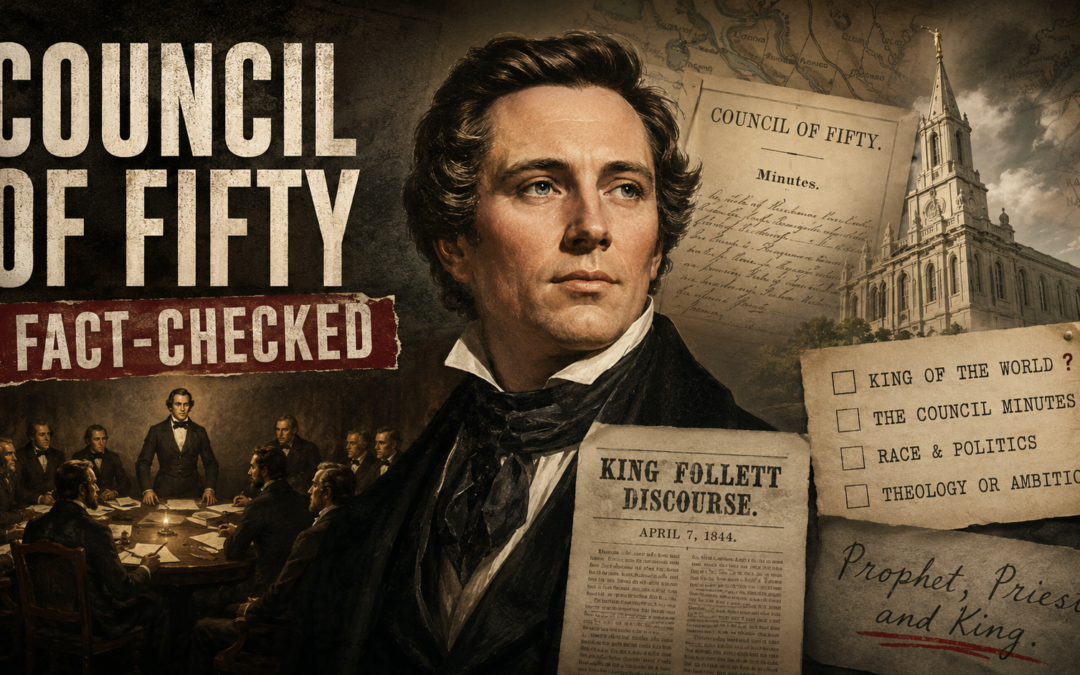
“Joseph Smith Ordained King of the World”: Five Claims About the Council of 50, the King Follett Discourse, and 1844 Politics — Fact-Checked
Mormon Stories covers Chapter 30 of John Turner’s landmark biography with care and scholarly depth. Much of the episode is historically accurate and valuable. However, five specific claims — from Joseph’s supposed “coronation” to his views on race and the meaning of the Council of 50 minutes — need additional context or factual clarification.
About This Episode
Mormon Stories Episode 2140 features host John Dehlin and Dr. John Turner, professor of religious studies at George Mason University and author of Joseph Smith: The Rise and Fall of an American Prophet (Yale University Press).
In this episode, they discuss Chapter 30 of Turner’s book, titled The Kingdom, 1844. Topics include:
- Joseph Smith’s presidential campaign
- The Council of Fifty
- The King Follett discourse
- The Nauvoo polygamy controversy
- Emma Smith’s public role in denouncing polygamy
Turner is a careful and highly credentialed historian. His biography is widely regarded as one of the most rigorously sourced single-volume studies of Joseph Smith.
Overall, the episode is substantially accurate. Still, several claims are overstated or missing critical context. In one case, a claim is simply incorrect. The historical record provides a more precise picture.
📖
Note on the Source
This episode stands out in our rebuttal series because the guest — Dr. John Turner — directly corrects several of John Dehlin’s overstatements during the interview itself.
Where Turner corrects Dehlin, we note it. Where Dehlin’s framing remains unchallenged despite Turner’s nuance, we address it.
Turner’s book is recommended for readers seeking the full scholarly context.
What the Episode Gets Right
Conceded — Historically Accurate
The Council of Fifty was a real, secret theocratic body with ambitions to replace American governance
✓ Documented by the Joseph Smith Papers
The Council of Fifty minutes, published for the first time by the Joseph Smith Papers in September 2016, confirm the episode’s central claims.
The council was organized on March 11, 1844, as the political arm of the Kingdom of God. It aimed to establish a “theodemocracy” in western territories outside the United States. Members took strict oaths of secrecy, and Joseph Smith served as the presiding head.
The council also coordinated Joseph’s presidential campaign and discussed cooperation with Native Americans.
Turner’s description of the council’s ambitions is well supported by the minutes. These include:
- Aspirational theocracy
- Growing Mormon frustration with the U.S. Constitution
- Joseph Smith symbolically breaking a ruler while criticizing existing governments
The Church History Department has also published an official overview confirming these facts.
Bottom Line
The Council of Fifty was real, secret, and politically ambitious. It aimed to establish governance outside existing American structures. The Joseph Smith Papers support the episode’s core description of the council.
sources
LDS Church History — Council of Fifty (official overview)
Joseph Smith Papers — Council of Fifty Minutes
Five Claims That Need Precision
Claim 1 of 5
“Joseph Smith ordained king of the world”
⚠️ Overstated — Turner Corrects This Twice in the Episode
“I took away from this chapter that Joseph Smith basically wants to be his followers’ God… was he crowned king of the world?”
— John Dehlin
To his credit, Turner directly corrects this claim twice during the interview.
He explains:
“I would not say he’s ordained king of the world… I would say he is acclaimed as prophet, priest, and king.”
That distinction matters.
What Actually Happened
On April 11, 1844, Erastus Snow proposed that the Council of Fifty receive Joseph Smith as their “prophet, priest, and king.”
This phrase comes from biblical theology. In Christian tradition, Jesus Christ fulfills the roles of prophet, priest, and king simultaneously.
Council members responded with shouts of “hosanna.” Other members praised Joseph using comparisons to Moses and Enoch.
Important Context
Joseph Smith Papers editors and LDS historians confirm that inaccurate rumors later circulated claiming Joseph had crowned himself “king of the world.”
However, the actual council minutes present something more limited. Joseph was recognized as the presiding head of a preparatory earthly kingdom that remained subordinate to Jesus Christ, who was still considered “King of Kings.”
The event was politically provocative and theologically bold. Still, it was not a literal claim to global political rule.
Direct Answer
Joseph Smith was acclaimed “Prophet, Priest, and King” within the Council of Fifty. He was not literally crowned king of the world.
Turner explicitly corrects this framing in the episode itself.
sources
LDS Church History — Council of Fifty Minutes ·
FAIR LDS — Council of Fifty (prophet, priest, king context) ·
Claim 2 of 5
Joseph “declared himself God”
⚖️ Partially Accurate — Missing the Theological Framework
The episode accurately quotes several provocative statements made by Joseph Smith in spring 1844.
These include:
- “God has made me the people’s king and God”
- “Ye are my constitution and I am your God”
- Claims that he had “done more than any man that ever lived,” including Jesus, except for Christ’s atoning death
These statements are documented.
What’s Missing
The episode often omits the LDS theological framework behind these claims.
The King Follett discourse teaches that:
- God was once a man
- Humans can become gods through exaltation
Within this theology, calling oneself “your God” does not necessarily mean claiming to be the Supreme Being.
Joseph consistently taught that Jesus Christ remained above him. The Council of Fifty minutes also describe Christ as the true “King of Kings.”
Turner explains this nuance during the episode, though Dehlin’s framing sometimes strips away that context.
Direct Answer
Joseph Smith used provocative religious language in 1844. However, the broader LDS theological framework changes how those statements are understood.
Turner’s analysis in the episode is more careful and nuanced than some of the framing suggests.
Sources
LDS Gospel Topics Essay — Becoming Like God ·
Wikipedia — King Follett Discourse
Claim 3 of 5
The Council of Fifty minutes “fundamentally changed Mormon history”
⚖️ Overstated — Turner Corrects This Too
John Dehlin describes the release of the Council of Fifty minutes as potentially explosive.
Turner disagrees.
He states clearly:
“I would say there’s nothing in the Council of Fifty minutes that fundamentally changes our understanding of the last several months of Joseph Smith’s life.”
He also says:
“The mystique and the rumors were overblown.”
The Joseph Smith Papers editors Matthew Grow and R. Eric Smith similarly explained that the minutes were valuable and historically rich, but expectations had become exaggerated over decades of secrecy.
What the Minutes Actually Added
The minutes:
- Confirmed Joseph’s acclamation as prophet, priest, and king
- Revealed additional statements from Joseph and Brigham Young
- Expanded understanding of the council’s theodemocratic goals
However, they did not overturn the existing historical picture.
Direct Answer
The Council of Fifty minutes were historically significant but not revolutionary.
Turner himself says they did not fundamentally change historical understanding.
Sources
FromTheDesk.org — Q&A with JSP editors Grow and Smith ·
Joseph Smith Papers — Council of Fifty Minutes
Claim 4 of 5
Joseph Smith as an abolitionist and racial progressive
⚖️ Overstated — Turner Emphasizes the Complexity
Turner acknowledges that Joseph Smith’s 1844 presidential platform was strongly anti-slavery for its time.
It called for ending slavery by 1850.
However, Turner also explains that Joseph was not a racial egalitarian.
Historical evidence shows that Joseph:
- Referenced the “curse of Ham”
- Supported restrictions on Black civic participation in Nauvoo
- Opposed interracial marriage
- Reflected racial assumptions common among white Americans of his era
Turner describes these attitudes as “pretty typical” for the period.
Direct Answer
Joseph Smith’s political platform opposed slavery. However, his racial views remained deeply shaped by nineteenth-century racial attitudes.
The historical record is more complex than either a simple “abolitionist hero” narrative or a straightforward “racial progressive” interpretation.
Sources ·
Wikipedia — Joseph Smith and Race ·
LDS Gospel Topics Essay — Race and the Priesthood
Claim 5 of 5
The King Follett discourse was mainly political self-promotion
🔷 Reductive — The Discourse Was Theologically Significant
John Dehlin frames the King Follett discourse largely as political crisis management during a period of scandal.
That interpretation contains some truth. Turner also notes Joseph needed to deliver a powerful sermon during a tense moment.
However, the discourse was also one of Joseph Smith’s most important theological statements.
Key Teachings of the King Follett Discourse
The sermon taught that:
- God was once a man
- Humans can become gods
- Matter is eternal
- Death is part of eternal progression
Turner describes the sermon as:
“Classic, vintage Joseph Smith”
He also calls it:
“A pretty good distillation of Joseph’s theological vision.”
BYU’s Religious Studies Center has published a full scholarly volume on it.
The discourse continues to attract serious attention from scholars and theologians across traditions.
Direct Answer
The King Follett discourse served both political and theological purposes.
Reducing it to political theatre alone overlooks why it remains one of Joseph Smith’s most influential teachings.
sources
Wikipedia — King Follett Discourse ·
BYU RSC — Perspectives on the King Follett Discourse ·
LDS Gospel Topics Essay — Becoming Like God
Frequently Asked Questions
Was Joseph Smith ordained king of the world?
No. John Turner directly rejects that characterization in the episode.
Joseph Smith was acclaimed “Prophet, Priest, and King” within the Council of Fifty, not literally crowned ruler of the world.
The Joseph Smith Papers editors also confirmed that later rumors exaggerated what actually occurred.
What did the Council of Fifty minutes reveal?
The minutes confirmed that the council functioned as the political arm of the Kingdom of God and supported Joseph Smith’s presidential campaign.
They also documented secrecy oaths, theodemocratic ambitions, and discussions involving Native Americans.
However, the release of the minutes did not fundamentally rewrite Mormon history.
What does the King Follett discourse teach?
The discourse teaches that:
- God was once a man
- Humans may become gods through exaltation
- Matter is eternal
- Faithful believers can inherit divine glory
These teachings became foundational to LDS theology.
Was Joseph Smith an abolitionist?
Joseph Smith’s 1844 platform opposed slavery and proposed emancipation by 1850.
At the same time, his racial attitudes reflected many of the assumptions common among white Americans in the nineteenth century.
Why did Joseph Smith run for president?
After failing to receive political support from major presidential candidates regarding Mormon losses in Missouri, Joseph launched his own campaign.
His platform included anti-slavery proposals, territorial expansion, and government reforms.
What role did Emma Smith play in the polygamy controversy?
Emma publicly denounced polygamy during Relief Society meetings in 1844, even while privately aware that plural marriage was being practiced by church leaders.
Turner notes that this created significant emotional and political tension within Nauvoo.
The Honest Summary
Mormon Stories Episode 2140 is one of the stronger entries in the Joseph Smith series.
John Turner is a careful historian, and his corrections of John Dehlin’s overstatements improve the discussion rather than weaken it.
The episode accurately presents the Council of Fifty as real, secretive, and politically ambitious. It also correctly portrays the seriousness of the Nauvoo polygamy crisis.
Still, five important areas require additional precision:
- Joseph Smith was not literally crowned king of the world
- His statements about divinity existed within LDS theology about exaltation
- The Council of Fifty minutes were significant but not explosive revelations
- His racial views were more complex than simple abolitionism
- The King Follett discourse deserves recognition as serious theology, not merely political theatre
Readers exploring early Mormon history deserve both honesty and precision. Joseph Smith’s final months were dramatic, controversial, and historically significant. But careful distinctions still matter.
Content is for educational purposes. Sources are cited. Corrections are welcome.