
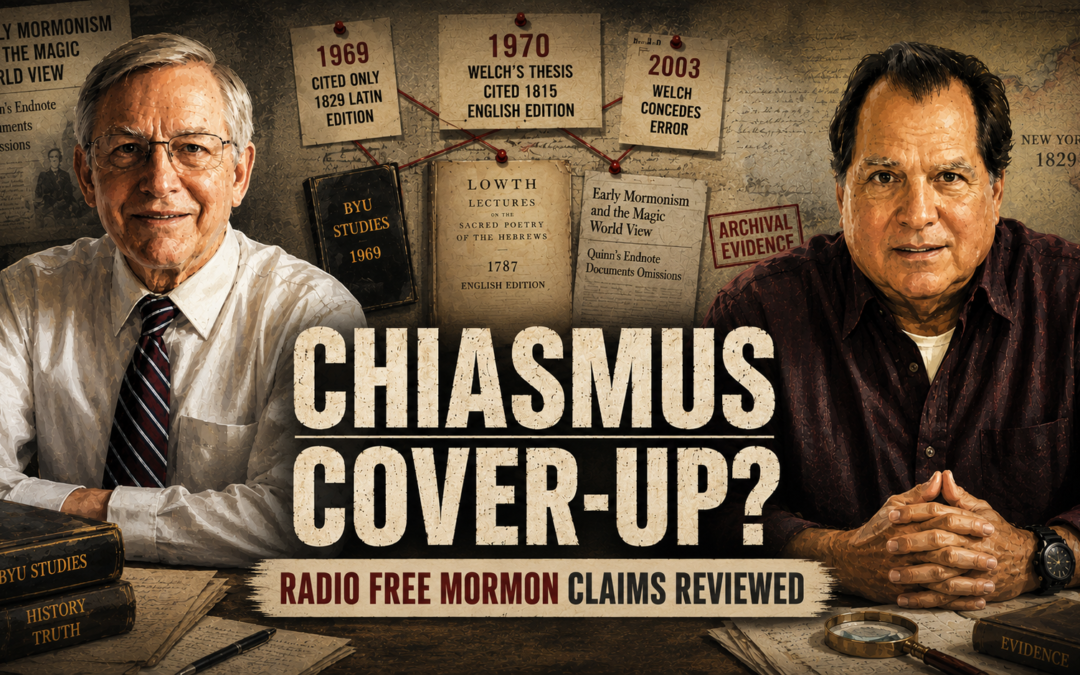
Chiasmus Cover-Up? Quinn’s Allegations Against John Welch — What the Evidence Actually Shows
D. Michael Quinn documented significant citation omissions in John Welch’s early chiasmus scholarship. However, Welch later acknowledged several errors, revised key claims, and narrowed his position. As a result, the evidence weakens the original apologetic argument but does not fully settle the debate over Book of Mormon chiasmus.
D. Michael Quinn’s five-page endnote presents detailed archival research that documents a concerning pattern in John Welch’s citations. However, RFM’s framing leaves several important questions unresolved. For example, what did Welch later concede? How did LDS scholars respond to the pre-1830 availability problem? And does chiasmus still retain evidential value after Quinn’s corrections?
This article examines those questions directly while preserving Quinn’s findings and adding missing historical context.
About This Episode
Radio Free Mormon Episode 458 examines D. Michael Quinn’s five-page endnote (footnote 108, chapter 6) from the revised edition of Early Mormonism and the Magic World View (1998). Quinn argues that John Welch understated the availability of English-language publications on biblical parallelism before 1829. He further described this pattern as “escalating intentional concealment.”
RFM brings personal weight to this: he describes grabbing hold of chiasmus as a “last lifeline” during the Mark Hofmann forgery crisis in the mid-1980s, relying specifically on Welch’s assurances that no pre-1830 American had access to the concept. The episode is emotionally authentic and the scholarship it draws on is real. This rebuttal focuses on four specific questions the episode does not fully answer.
Why This Episode Is Different
This is not a doctrinal debate or a straightforward claims episode. It is a close reading of archival scholarship — Quinn’s endnote — which itself is a close reading of John Welch’s citation patterns across 30 years of publications. The primary question is not what the Book of Mormon says but what was available in print in upstate New York in 1829. This requires engaging the actual bibliographic evidence Quinn documents, not just accepting or rejecting his conclusion.
RFM presents the episode as strongly weighted toward Quinn’s conclusions. According to that framing, Quinn’s scholarship is accurate, Welch’s omissions are damaging, and the evidence appears overwhelming. However, the episode gives less attention to several important issues: Welch’s 2003 response and concessions, the strongest remaining LDS arguments for chiasmus, and the distinction between “the concept existed before 1830” and “chiasmus still retains evidential value.”
Where Quinn’s Documentation Is Accurate
Quinn’s Documentation — Confirmed
Welch’s 1969 BYU Studies article cited only Lowth’s 1829 Latin edition while his own 1970 thesis cited Lowth’s 1815 American English edition — the timeline is damning
✓ Documented and Confirmed by Welch’s Own 2003 Concession
— John Welch, BYU Studies, Autumn 1969 (available at byustudies.byu.edu)
Lowth’s Earlier English Editions
Quinn’s endnote documents a specific and consequential bibliographic anomaly. In his 1969 BYU Studies article, Welch cited Robert Lowth as one of three scholars who “rediscovered” chiasmus — but cited only Lowth’s 1829 Latin edition, which was published the same year as the Book of Mormon and was therefore too late and in the wrong language to be accessible to Joseph Smith. This framing created the impression that Lowth’s only publication on the subject was in Latin in 1829.
However, Lowth (1710–1787) had published his Lectures on the Sacred Poetry of the Hebrews in English in London in 1787 — 42 years before the Book of Mormon. American editions followed in 1815 and 1829. Quinn’s research in the British Museum General Catalog and National Union Catalog documented these editions explicitly. The 1787 English edition alone preceded the Book of Mormon by four decades.
Why the Timeline Matters
The strongest evidence against Welch comes from his own master’s thesis. Welch submitted and approved the thesis in April 1970, only months after the BYU Studies article appeared. This means Welch knew about the earlier English-language source at the same time he was writing the article that cited only the 1829 Latin edition. Quinn characterises this as deceptive, and Welch’s 2003 FARMS Review paper did not convincingly explain the discrepancy. He acknowledged the error. He also stated “I regret the previous point of misinformation” but attributed it to following other scholars’ characterisations rather than independently verifying the primary sources.
The timeline contradiction between the BYU Studies article and the master’s thesis is real, documented, and conceded by Welch in 2003. Whether it represents intentional concealment or motivated non-investigation — as Quinn alleges — or an inadvertent inconsistency is the point of ongoing debate. What is not debated is that the omission was consequential and directionally favourable to the apologetic argument.
Quinn’s Documentation — Confirmed
Horne’s 1825 American edition discussing inverted parallelism was advertised in the Palmyra newspaper and available 9 miles from Joseph Smith’s home — Welch dropped all references to Horne in his 1982 reprint
✓ Documented by Quinn; Conceded by Welch in 2003
— John Welch, BYU Studies, 1969 (as quoted by Quinn)
Horne’s 1825 Edition and Local Availability
Quinn’s second major finding is about Thomas Hartwell Horne (1780–1862), whose Introduction to the Critical Study and Knowledge of the Holy Scriptures discussed inverted parallelism, diagrammed examples from Isaiah and Psalms, and cited Bishops Lowth and Jebb as principal sources. According to Quinn’s research in the National Union Catalog, Horne’s first American edition was published in Philadelphia in 1825 — and was advertised for sale in the Wayne Sentinel (a Palmyra-area newspaper) in April 1825, August 1826, and January 1827. The 1818 London edition was available at the Canandaigua bookstore, nine miles from Joseph Smith’s home, from 1820.
Welch’s 1969 article stated that a section on chiasmus was “finally added” to Horne’s work only in the 11th edition of 1860. This claim requires having examined prior editions to know what they did and did not contain. Yet Welch’s own 1970 master’s thesis cited Horne’s 1836 American edition — meaning Welch knew by 1970 that Horne’s work had American editions well before 1860. In the 1981 bibliography he edited, Chiasmus in Antiquity, Welch acknowledged Horne’s work had “numerous editions printed in US and England for over 50 years following the first edition.”
Removal of Horne References
When Welch reprinted his 1969 BYU Studies article in Noel Reynolds’ 1982 Book of Mormon Authorship, he dropped all references to Horne entirely — not updating them, not correcting them, but removing them. Quinn argues this is because Welch had by then discovered or been informed that Horne’s 1825 American edition discussed chiasmus, making his “finally added in 1860” claim untenable.
In his 2003 response, Welch conceded: “contrary to what I had previously thought and as Michael Quinn has shown, Thomas Hartwell Horne adopted Jebb’s basic terminology and presented a few of Jebb’s examples of introverted parallelism in Horne’s 1825 edition.” He stated “I regret the previous point of misinformation” and acknowledged the 1825 Philadelphia edition was available in Joseph Smith’s neighbourhood.
The Horne documentation is Quinn’s strongest finding. The 1825 American edition was locally available to Joseph Smith, and Welch’s claim that chiasmus was not in Horne until his 1860 11th edition was false — as his own citations in other contexts demonstrate he had reason to investigate. The 2003 concession, though qualified, confirmed the essential point.
A Careful Examination — Quinn footnote 108 full text (Horne documentation) ·
FAIR LDS — Pre-1830 chiasmus knowledge discussion
What RFM’s Analysis Does Not Fully Address
Missing Context 1 of 2
Welch’s 2003 partial concession substantially narrows the original claim — and his adjusted position is more defensible than the original
RFM Acknowledges This But Underweights It
RFM covers Welch’s 2003 FARMS Review paper — “How Much Was Known about Chiasmus in 1829 When the Book of Mormon Was Translated?” — and does acknowledge some concessions within it. However, the episode largely frames the paper as an exercise in damage control that “doesn’t cover the ground.” A closer reading suggests something more nuanced. In reality, Welch made several substantive concessions that significantly changed the evidential landscape.
Welch conceded: (1) Horne’s 1825 Philadelphia edition was available in Joseph Smith’s neighbourhood; (2) “information was available in the 1820s on various forms of parallelism in the Hebrew Bible”; (3) “I regret the previous point of misinformation”; and (4) his adjusted claim moved from “no chance” to “a very low probability” — a significant qualification. He attributed the error to following other scholars’ characterisations without independently verifying earlier editions.
Whether this explanation is adequate is a fair question. Quinn’s documentation suggests Welch had reason to verify (he cited Horne’s 1836 edition in his thesis; if the 5th edition exists, earlier editions should have been checked). But the 2003 paper does represent a genuine, if belated, correction of the record — published in a venue readable by LDS scholars and members, not buried or hidden. RFM’s framing that the paper “more looks like excuses” underweights how significantly the concessions narrow Welch’s original claims.
The shift from “no chance / statistically insignificant” to “low probability, and the sources were available” is a meaningful correction. It doesn’t erase the problematic citation pattern Quinn documents, but it demonstrates Welch’s willingness to update his position when confronted with evidence — even if the update came 34 years after the original claim.
Missing Context 2 of 2
Chiasmus retains meaningful evidential value even after Quinn’s corrections — the pre-1830 availability of simple parallelism descriptions does not explain Alma 36
🔷 A Critical Distinction the Episode Does Not Draw
RFM’s analysis focuses primarily on pre-1830 availability. However, this approach combines two separate questions that should remain distinct.
Question 1: Was chiasmus available before 1829?
Yes. Following Quinn’s research and Welch’s later concessions, the answer is clear: descriptions of biblical parallelism existed in English and were locally accessible.
Question 2: Does Book of Mormon chiasmus still retain evidential value?
This question remains debated. LDS scholars argue that the strongest evidence never depended solely on Joseph Smith being unaware of chiasmus.
Why Alma 36 Remains Central
This distinction matters for an important reason. The strongest LDS argument never relied only on Joseph Smith being unaware of chiasmus. Instead, supporters point to the complexity of specific structures, particularly Alma 36. That 30-verse chapter is structured as a complete, precisely inverted chiasm with its theological centrepoint (Christ’s atoning power) at the exact structural centre of the chapter. LDS scholars argue this level of composition — not a casual awareness of general parallelism — would require either divine origin or deliberate, sophisticated construction of a kind that goes far beyond knowing that Hebrew poetry used mirrored structures.
Complexity Versus Awareness
Knowing that Hebrew poetry used parallel structures differs from intentionally creating a 30-verse theological chiasm. Supporters argue that Alma 36 reflects deliberate literary design rather than simple awareness. The evangelical Institute for Religious Research, writing critically of LDS claims, acknowledges: “The question of whether chiasmus proves the Book of Mormon is ancient is a legitimate scholarly debate, not a closed question.” The pre-1830 availability of Horne’s book does reduce but does not eliminate the evidential weight of complex chiasmus — and the episode does not make this distinction.
Quinn’s documentation corrects Welch’s overstated certainty about pre-1830 ignorance. It does not demonstrate that Joseph Smith consciously used Horne’s diagrams to construct Alma 36. The pre-1830 availability of simple parallelism descriptions weakens but does not eliminate chiasmus as evidence for ancient composition. RFM does not draw this distinction.
Alma 36 — The primary example of complex Book of Mormon chiasmus ·
Scripture Central — Chiasmus discovery and 50-year retrospective ·
Institute for Religious Research — Chiasmus in the Book of Mormon (critical analysis)
Quick Answers
Did John Welch conceal pre-1830 chiasmus sources?
Quinn documented multiple omissions involving Robert Lowth and Thomas Hartwell Horne. Welch later acknowledged several errors but denied intentional concealment.
Was chiasmus available before 1829?
Yes. Quinn documented English-language works discussing biblical parallelism that were available before publication of the Book of Mormon.
Does Alma 36 remain evidence for ancient composition?
The issue remains debated. Critics argue cultural exposure explains the structure, while LDS scholars maintain Alma 36 reflects sophisticated literary design.
Frequently Asked Questions
Citation Questions
Did John Welch intentionally hide pre-1830 publications about chiasmus?
Quinn’s scholarship documents a troubling pattern. Welch’s 1969 BYU Studies article cited only Lowth’s 1829 Latin edition. However, his 1970 master’s thesis cited Lowth’s 1815 American English edition. Welch also claimed that chiasmus appeared in Horne only in the 1860 edition. However, his 1981 bibliography acknowledged multiple earlier editions. Between 1969 and 1982, Welch dropped all references to Horne entirely from his republished article.
Quinn concluded this represented “escalating intentional concealment.” Welch’s 2003 response attributed the errors to following other scholars’ characterisations without independent verification. What is not debated: the omissions were real, they were consistent in one direction (making Joseph Smith’s access to chiasmus concepts seem less likely), and Welch knew about at least some of the omitted sources at the time of writing.
Evidential Questions
Does chiasmus still serve as evidence for the Book of Mormon being an ancient text?
The evidential value is reduced but not eliminated by Quinn’s corrections. The availability of Horne’s 1825 book means Joseph Smith could theoretically have absorbed the concept of Hebrew parallelism from his cultural environment. However, LDS scholars focus on the complexity of specific structures, especially Alma 36. That chapter contains a precise inverted chiasm. Supporters also note that Christ’s atonement appears at the structural center. The difference between knowing “Hebrew poetry uses parallel structures” and deliberately constructing that level of composition is significant.
Scholars continue to debate Alma 36. Some see ancient Hebrew composition. Others argue for literary construction or unconscious pattern formation. Quinn’s corrections change the framing of the pre-1830 availability argument but do not settle the compositional question.
What did Welch concede in his 2003 response to Quinn?
Welch’s 2003 FARMS Review paper made several important concessions. He acknowledged that Horne’s 1825 edition was available near Joseph Smith. He also stated, “I regret the previous point of misinformation.” In addition, he admitted that information about biblical parallelism existed in the 1820s. Finally, he shifted from “no chance” to “very low probability.” He maintained that people in Joseph Smith’s environment could have known about chiasmus but doubted Joseph Smith actually did. The 2003 paper acknowledged Quinn by name and cited his endnote.
Background Questions
Who was D. Michael Quinn and is his scholarship reliable?
D. Michael Quinn (1944–2021) was a historian and former BYU professor who was excommunicated from the LDS Church in 1993 after publishing scholarship critical of LDS institutional history. Despite his excommunication, Quinn maintained rigorous academic standards throughout his career. Early Mormonism and the Magic World View (first edition 1987, revised edition 1998) is extensively footnoted, draws on primary archival sources, and has been engaged — not dismissed — by serious LDS scholars including Welch himself. His footnote 108 represents original archival research in major bibliographic catalogues that was sufficiently well-documented that Welch conceded its core findings in 2003, eight years before Quinn’s death.
What is chiasmus and why does it matter for the Book of Mormon?
Chiasmus (or inverted parallelism) is a literary structure in which a series of ideas (A-B-C) is stated and then restated in reverse order (C-B-A), creating a mirrored structure. It appears extensively in the Hebrew Bible. John Welch discovered it in the Book of Mormon during his mission in 1967 and published his findings in BYU Studies in 1969. The evidential claim: (1) chiasmus is characteristically ancient Hebrew; (2) the Book of Mormon contains sophisticated, multi-element examples; and (3) the concept was unknown to 19th-century Americans, so Joseph Smith couldn’t have deliberately inserted it. Quinn’s scholarship challenged point (3) by demonstrating that English-language descriptions of biblical parallelism were available in Joseph Smith’s neighbourhood. Points (1) and (2) remain part of the ongoing scholarly debate.
The Honest Summary
Quinn’s Findings
D. Michael Quinn’s five-page endnote documents a real and troubling citation pattern. The evidence supports several core findings. Lowth’s earlier English editions were omitted. Horne’s 1825 American edition was also absent from later references.
These omissions are consistent in direction and consequential in effect. Quinn’s characterisation of the pattern as “escalating intentional concealment” is one reasonable interpretation of the evidence. Whether it was deliberate concealment or motivated non-investigation may never be definitively settled.
Remaining Debate
RFM’s episode gives limited attention to Welch’s 2003 FARMS Review paper. However, the paper included genuine concessions. Welch acknowledged pre-1830 American access to chiasmus descriptions. He also retracted stronger claims about Joseph Smith having “no chance” of exposure. In addition, the availability of Horne’s diagrams does not automatically explain Alma 36. The broader question remains open. Did Joseph Smith absorb the idea culturally, or does the text reflect deliberate chiastic composition? Quinn’s corrections address access to the concept. However, they do not fully settle the compositional debate.
Truth seekers engaging with chiasmus as Book of Mormon evidence deserve both the full weight of Quinn’s scholarship — which is significant — and the honest acknowledgement that “the concept was available in print” and “the composition cannot be explained without divine origin” are not the same claim, and the latter is not refuted by the former.