
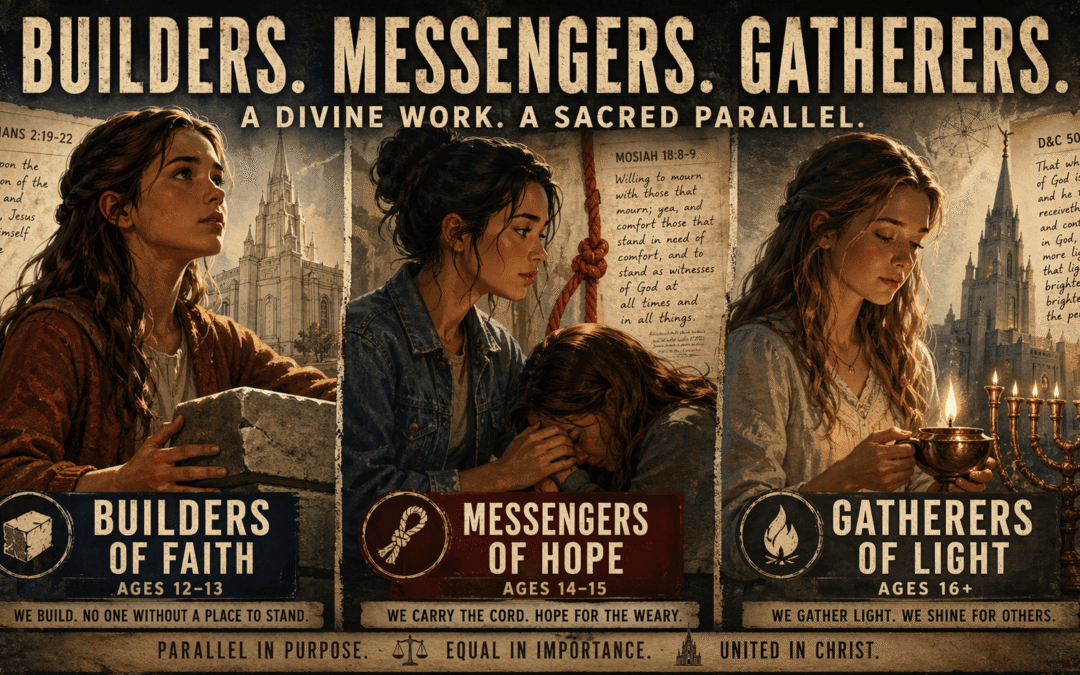
Builders, Messengers, and Gatherers: What We May Be Missing
Builders. Messengers. Gatherers.
A Spiritual, Symbolic, and Scriptural Reading of
the New Young Women Age-Group Names —
and Their Parallels to the Aaronic Priesthood
the New Young Women Age-Group Names —
and Their Parallels to the Aaronic Priesthood
Faith is built. Hope is carried. Light is gathered.
Together, these three ideas form a progression that shapes the entire structure of the program.
On April 20, 2026, the First Presidency of The Church of Jesus Christ of Latter-day Saints announced the new Young Women age-group names: Builders of Faith, Messengers of Hope, and Gatherers of Light. These new names apply to young women ages 12 and older and are designed to help them understand their divine identity, spiritual progression, and role in God’s work.
More specifically, this document is a meditation on the depth of these names — their scriptural foundations, their ancient linguistic and symbolic roots, and the way they parallel the work of the Aaronic Priesthood offices that young men hold at the same ages. It is offered as a resource for leaders, parents, teachers, and the young women themselves. It is not an official Church publication, but a faithful exploration of what the Church has given us.
To begin, what are the new Young Women age-group names?
The new Young Women age-group names in The Church of Jesus Christ of Latter-day Saints are:
- Builders of Faith (ages 12–13)
- Messengers of Hope (ages 14–15)
- Gatherers of Light (ages 16+)
These names emphasize spiritual growth, covenant identity, and discipleship.
Before going deeper, a quick orientation to what follows: First, Part One reads each name deeply, tracing its scriptural anchor and its ancient symbolic resonance. Second, Part Two sets the Young Women progression beside the Aaronic Priesthood progression and shows how the two were designed to mirror each other. Third, Part Three offers concrete, weekly, repeatable action ideas so that each name can become lived identity. Fourth, Part Four closes with reflection, and lastly Part Five provides a sources and scripture index for further study.
Part One: The Names, Read Deeply
Why These New Young Women Names Matter
Before examining each name individually, however, it is important to understand the overall structure of the three names. Together, they form a clear spiritual progression. The Church has chosen faith, hope, and light — not the classical Pauline triad of faith, hope, and charity (1 Corinthians 13; see also Moroni 7:45–48). Church leaders placed light where charity would be. Why?
Ultimately, then, charity is the destination. In fact, Relief Society is explicitly described by President Freeman as “a lifelong sisterhood of charity,” and the Young Women progression is the preparation for that sisterhood. From there, the path is: Faith → Hope → Light → (Charity).
Therefore, light becomes the bridge between hope and charity — the medium through which charity itself becomes possible. You cannot love as Christ loves until you have first gathered enough of His light to see as He sees. Seen this way, the Gatherer of Light is not merely the third stage; she is the threshold stage, the one who stands at the door of covenant womanhood.
Another important detail is that each name is a verb in participial form: Builders, Messengers, Gatherers. These describe what a young woman does, not what she passively is. Contrast this with the retired names — Beehive, Mia Maid, and Laurel — which were metaphors of identity (an industrious insect, a maiden, a victor’s wreath). These names carry a theological shift: identity is formed through action and covenant, not inherited through symbol.
More Than a Name Change
At the same time, this is also — we should say plainly — a structure that mirrors how young men have been named for over a century. A deacon is not a symbol; he is the one who does deacon-things. A teacher teaches. A priest performs priestly acts. The new Young Women names finally give girls names of the same grammatical and theological kind: names that describe their work.
One more framing note. President Emily Belle Freeman has said the inspiration for the names came during a For the Strength of Youth conference in Tahiti in late 2025, as young women sang “As Sisters in Zion,” and she saw the three themes — building faith, sharing hope, gathering and reflecting light — in the verses of the hymn. The names therefore carry a double anchor: the printed scriptures the Church has assigned to them, and the sung scripture of a beloved Latter-day Saint hymn. Both are worth holding as you read what follows.
✦ ✦ ✦
Builders of Faith (ages 12–13)
“And are built upon the foundation of the apostles and prophets, Jesus Christ himself being the chief corner stone.” — Ephesians 2:20
Reading the whole passage, not just the verse
The First Presidency anchored this name in a single verse, but that verse only fully opens when you read it with the two verses around it. Ephesians 2:19–22 reads: “Now therefore ye are no more strangers and foreigners, but fellowcitizens with the saints, and of the household of God; and are built upon the foundation of the apostles and prophets, Jesus Christ himself being the chief corner stone; in whom all the building fitly framed together groweth unto an holy temple in the Lord: in whom ye also are builded together for an habitation of God through the Spirit.”
In fact, it is temple language.
Here, Paul describes the household of God as a temple being built up — a dwelling place for the Spirit, constructed out of people who were once strangers.
For a Latter-day Saint 12-year-old, however, this is not an abstract metaphor. Temple-building sits at the literal and symbolic center of the faith.
So when she is called a Builder of Faith at age 12, she is being named directly into that work.
The Hebrew wordplay: children and builders
There is a rabbinic tradition — recorded in the Talmud, Berakhot 64a — that reads Isaiah 54:13 (“and all thy children shall be taught of the Lord”) with a wordplay. In Hebrew, the word for “your children” is banayikh. The word for “your builders” is bonayikh. The two words are written with the same consonants — only the vowels differ. The Sages said: “Do not read banayikh (your children) but bonayikh (your builders).”
What follows is a striking theological claim: the children of the covenant are its builders. To be a child of God is to be a builder of God’s house. The two roles are not sequential; they are the same role. A 12- or 13-year-old Builder of Faith is not waiting to become a builder someday. She is a builder, now, by virtue of being a covenant child of God.
Moreover, this wordplay also illuminates why Isaiah 54 matters so deeply for Latter-day Saint women specifically. The chapter is addressed to a barren woman who is promised she will have more children than she can count. It is the chapter Christ quotes to His sisters in 3 Nephi. It is a chapter about women being promised the work of building up a covenant people. Placing 12-year-old girls in the bonayikh lineage means placing them in Isaiah’s prophecy of Zion’s daughters rebuilding a nation.
The chief cornerstone: what it meant in the ancient world
The phrase “chief corner stone” points back to Psalm 118:22 (“The stone which the builders refused is become the head stone of the corner”) and Isaiah 28:16 (“Behold, I lay in Zion for a foundation a stone, a tried stone, a precious corner stone, a sure foundation”). In the ancient Near East, the cornerstone was the first stone laid at the corner of a structure. Every other stone was measured and aligned to it. If the cornerstone was off by a fraction of a degree, the entire building would be out of true by the time it reached the top. The cornerstone held the two perpendicular walls in right relationship to each other.
Practically speaking, Christ as the cornerstone means: every other stone — every other person in the household of God — takes its orientation from Him. A Builder of Faith is not the architect. Nor is she the cornerstone. Instead, she is a living stone and a hand that lays other stones — always measuring to Christ, always drawing others into alignment with Him.
Worth noting: in some ancient Near Eastern traditions, the foundation deposit — the ritual objects placed beneath the cornerstone — was laid by the queen or by high-status women. The cornerstone marked the beginning of the building’s life, and that beginning was often entrusted to women. Placing the youngest group of Young Women in the foundation-laying role echoes this ancient pattern: the beginning of the structure is given to those just entering their covenant lives.
What the name actually promises her
In addition, the Church’s own description, from the Newsroom release, says Builders of Faith “can help to build God’s kingdom through faith in Christ and uplifting actions.” Notice the two prepositions: through faith and through actions. Faith is not abstract; it is built into the lives of others by what she does. Each act of faithful kindness is a stone laid into the house of God.
✦ ✦ ✦
Messengers of Hope (ages 14–15)
“Willing to mourn with those that mourn; yea, and comfort those that stand in need of comfort, and to stand as witnesses of God at all times and in all things.” — Mosiah 18:8–9
The Hebrew and Greek of ‘messenger’
In Hebrew, the word malakh (מַלְאָךְ) means messenger. In Greek, the word angelos (ἄγγελος) also means messenger.
Both words are used for angels throughout scripture. As the Hebrew lexical scholarship notes, in the Hebrew Bible malakh refers to divine messengers in 124 cases and to human messengers in 88 cases — and the text rarely draws a sharp line between them. Scripture treats human messengers and angelic ones as doing essentially the same work.
Malachi’s — whose book closes the Old Testament — very name means “my messenger.” (Malachi 3:1 uses the same word for his name and his calling). John the Baptist is introduced in Luke 1:17 as one who comes “in the spirit and power of Elias” — language Malachi prophesied. In scripture, a malakh often fulfills a prophetic role in miniature.: one sent by God with a message that prepares the way.
Calling a 14-year-old a Messenger of Hope places her within a scriptural continuum that includes Gabriel, John the Baptist, and the prophets.
In other words, this is not decorative language — it is covenantal.
Mourning with those that mourn: the messenger’s actual work
Importantly, notice what kind of messenger the scripture assigns her. Nor is it a proclamation-style messenger — trumpet on a wall, announcing doom or victory. The Mosiah 18 charge is a ministering-style messenger: one who sits beside the grieving, comforts those who need comfort, and stands as witness of God in everyday settings.
In practice, this becomes even clearer: it maps precisely onto an ancient Near Eastern role that women specifically held. In Jeremiah 9:17–20, God commands: “Call for the mourning women, that they may come; and send for cunning women, that they may come … let them take up a wailing for us.” Professional mourning was a women’s office in ancient Israel. Similarly, 2 Samuel 14 describes a “wise woman” sent from Tekoah to speak parabolic truth to the king. These women were not peripheral figures. They were the designated messengers through whom the community carried its grief into ritual form and its truth into the halls of power.
The Messenger of Hope steps into a lineage of ancient women who held the community’s sorrow and spoke its deepest truths. Mosiah 18’s baptismal covenant — to mourn with those who mourn and stand as witness — is the spiritual DNA of that lineage.
Hope as a cord: tikvah and the scarlet thread
In English, “hope” often sounds like wishful thinking. The Hebrew tikvah (תִּקְוָה) means something very different. Its root, qavah, means to bind together, to twist into a cord, to wait with tension. Tikvah literally means a cord or rope — the kind made by twisting many fibers together until they become something strong enough to hold a body’s weight.
The first time the word tikvah appears in the Hebrew Bible, it is not translated “hope” at all. It appears in Joshua 2:18 — Rahab’s scarlet cord. The spies tell her to tie a tikvat shani (cord of scarlet thread) in her window, so that when the city falls, her household will be spared. That rope is her hope. It is the literal object she clings to. It is the sign that ties her fate to the covenant of the God of Israel. Every other time tikvah appears in scripture — Proverbs 23:18, Jeremiah 31:17 — it carries this image: a cord that connects the present to a promised future.
A Messenger of Hope is someone who carries the rope.
She brings the tether that connects someone in darkness to the promise of deliverance.
Taken together, this reframes the name entirely. In other words, she is not merely a girl carrying a sunny thought. She is a girl holding a lifeline. At times, she becomes Rahab tying the cord. Often, her text message, whose presence, whose note, whose sitting-beside becomes the scarlet thread in another person’s window when their city is falling. By extension, she becomes, a participant in the same work the Savior does when He stands at the door and knocks — except she stands at the window and throws the rope down.
The national anthem of modern Israel is called HaTikvah — “The Hope.” For a people who endured exile and the Holocaust to choose “our hope is not yet lost” as their song says something about what biblical hope is: not optimism, but a cord that refuses to break. That is the hope a 14-year-old Messenger is asked to carry.
The ordinance echo: baptismal covenant
Mosiah 18 is the baptismal covenant chapter of the Book of Mormon. Alma is baptizing believers at the waters of Mormon. The verses given to the Messengers of Hope are the words the baptized agreed to live by. This is a deliberate choice. A 14-year-old Young Woman has been baptized for roughly two years at this point. Her age-group name is the living-out of her baptismal covenant. It is the scripture she committed to when she went under the water. Now the Church is calling her by it.
✦ ✦ ✦
Gatherers of Light (ages 16 and older)
“That which is of God is light; and he that receiveth light, and continueth in God, receiveth more light; and that light groweth brighter and brighter until the perfect day.” — Doctrine and Covenants 50:24
Gathering: the verb of the Lord Himself
“Gathering” is one of the central verbs of Latter-day Saint theology. The Church’s ninth Article of Faith speaks of “the literal gathering of Israel.” The Savior uses the word of Himself in some of His most tender scriptural moments. In Matthew 23:37 He says: “How often would I have gathered thy children together, even as a hen gathereth her chickens under her wings, and ye would not.” He repeats this to His sisters on the American continent in 3 Nephi 10:4–6.
Significantly, the verb used of the oldest Young Women is the verb the Savior uses of Himself. To be a Gatherer is to participate in the work Christ has claimed as His own. This is not a small naming. It is assigning her the Savior’s own grammar.
In D&C 115:5, the Lord tells the Saints: “Arise and shine forth, that thy light may be a standard for the nations.” The imagery of a gathered, shining Zion to which the nations come is also the imagery of Isaiah 60:1–3: “Arise, shine; for thy light is come … and the Gentiles shall come to thy light.” Therefore, the Gatherer of Light is not gathering for herself; she is helping Zion shine so that others can come.
The menorah and the daily tending of light
The temple resonance of this name is deep and specific. In the ancient Israelite tabernacle and temple, the menorah — the seven-branched lampstand described in Exodus 25:31–40 — had to be tended daily. Leviticus 24:1–4 describes the ner tamid (the “continual lamp”) that had to burn “from evening to morning before the Lord.” Priests gathered and kept the light — trimming wicks, replenishing pure olive oil, ensuring the flame never died. The light was never self-sustaining; it required the daily labor of the faithful.
In the same way, a Gatherer of Light steps into a priestly role of tending that light. Combined with the fact that 16 is the age when temple recommend interviews begin and endowment preparation deepens, this is not an accidental echo. It is the same work translated into a new dispensation. She is not tending a brass menorah — she is tending this light of Christ, in her own life and in others’.
And here the parable she has heard all her life comes into new focus. Matthew 25 adds another layer through the parable of the ten virgins who are all waiting for the Bridegroom. Five are wise because they have gathered oil for their lamps. Instead, it is the parable of a 16-year-old’s covenant life. At this stage, she is also being asked to be among the wise — to gather oil now, in daily small acts, so her lamp will burn when the Bridegroom comes. President Emily Belle Freeman’s bestselling book is, in fact, titled The Ten Virgins — another signal that this imagery is deeply in the mind of the presidency that chose these names.
D&C 50:24 and the trajectory of exaltation
The phrase “brighter and brighter until the perfect day” is not incidental language. It is the scriptural formula for the path of eternal progression itself. It appears again in D&C 88:67: “And if your eye be single to my glory, your whole bodies shall be filled with light … and that body which is filled with light comprehendeth all things.” This name points beyond youth for a stage of youth. She is named for the trajectory of exaltation itself. Her work at 16 and her work at 86 are the same work — gather more light, receive more light, grow brighter until the perfect day.
The parallel passage in D&C 88:6–13 describes the light of Christ as the light “which is in all things, which giveth life to all things, which is the law by which all things are governed.” It proceeds from the presence of God and fills the immensity of space. It is everywhere — waiting to be recognized and received. In many ways, she lives in a universe already saturated with the thing she is gathering. Her work is perception and reception as much as seeking.
Charity, deferred and prepared for
At this point, remember the earlier observation: the classical triad is faith, hope, and charity — but the new names give us faith, hope, and light. Church leaders intentionally reserve charity for Relief Society. Why?
Because charity — the pure love of Christ, which Moroni 7 describes and which D&C 18:10 grounds in the infinite worth of souls — is the endowment-level gift. It is what flows from covenant temple worship, not what precedes it. The Gatherer of Light is being prepared for charity. Her light-gathering work becomes charity the moment she is endowed and enters Relief Society as the sisterhood of charity. She is not falling short of charity; she is being readied for it with the exact gift it requires — light enough to see as Christ sees.
Taken together, a Builder lays stones.
Then, a Messenger carries cords.
Finally, a Gatherer tends fire. All three are preparing the temple of her life for the day the Lord fills it with His glory.
Then, a Messenger carries cords.
Finally, a Gatherer tends fire. All three are preparing the temple of her life for the day the Lord fills it with His glory.
Part Two: The Aaronic Priesthood Parallel
Why the parallel matters
The Aaronic Priesthood offices in the Church — described in D&C 20:46–60 and D&C 107:85–89, and elaborated in the General Handbook, chapter 30 — are not primarily titles. They are weekly, visible, repeatable actions that become a young man’s identity over time. A deacon is not a boy who has been given a label; he is the one who passes the sacrament every Sunday. After two years of doing it, that verb is him. The office shapes the soul by repetition.
This is, frankly, something the Young Men’s program has long enjoyed that the Young Women’s program has not. Young women have had lessons about virtue, faith, and service — but not a regular, bodily, visible act that the whole ward could see and that a girl would come to know as her own. The 2019 retirement of the old names left a six-year gap with no age-group names at all. The new names close that gap — and if they are to function like the Aaronic Priesthood offices, they need to be paired with actions, not just identities.
What follows is the parallel architecture. The Young Men’s actions are based on scripture and the General Handbook; the Young Women’s parallels are proposed, rooted in the scriptures already given to each age group, and drawn from the spirit of the names themselves.
The three Aaronic Priesthood offices
Deacons (12–13). Pass the sacrament. Collect fast offerings. Care for the meetinghouse. Assist the bishop. The theme is distribution. They carry the emblems of Christ’s body and blood from the sacrament table out to every person in the room. No one in the congregation is reached without them.
Teachers (14–15). All of the above, plus prepare the sacrament — setting the table, breaking the bread, pouring the water. Home ministering. The theme is preparation and accompaniment. They ready the sacred emblems and they go into homes with a companion.
Priests (16–18). All of the above, plus bless the sacrament, baptize, and ordain others to the Aaronic Priesthood. The theme is consecration and covenant. Their words sanctify the emblems; their hands bring others into covenant.
Notice the progression: carry → prepare → sanctify. Each age builds on the last. Each corresponds to a stage in how the sacrament reaches the congregation.
How the New Young Women Names Parallel the Aaronic Priesthood
Builders of Faith (12–13). The deacon makes sure no one is missed as the emblems pass. At this age, she begins to makes sure no one is without a place to stand. Both are foundational, distributive acts: the deacon distributes the emblems of Christ; the Builder distributes belonging in Christ’s house.
Messengers of Hope (14–15). The teacher prepares what the deacon will distribute, and goes into homes. The Messenger of Hope prepares, too — she prepares comfort — and she also goes. Where the teacher breaks bread at the sacrament table, she breaks bread at kitchen tables where grief sits. The covenant of Mosiah 18 is the ministering covenant made visible.
Gatherers of Light (16+). Priests sanctify emblems and bring others into covenant. The Gatherer of Light cannot perform ordinances, but she does something structurally parallel: she prepares herself and others for the temple, which is the fullness of covenant. At 16, temple recommend interviews change, baptisms for the dead deepen, endowment is on the horizon. Her work is covenant-preparation — her own and others’. And through family history and indexing, she does something priests cannot yet do alone: she gathers the names of the dead for whom ordinances will be performed. She is the scout of the covenant.
For clarity, the parallel at a glance
| Age | Young Men (Aaronic Priesthood) | Young Women (New Age-Group Names) |
|---|---|---|
| 12–13 | DeaconsDistribute the emblems of Christ’s body. Collect fast offerings. Care for the meetinghouse. | Builders of FaithDistribute belonging and presence. Build the foundation — no one without a place to stand. |
| 14–15 | TeachersPrepare the emblems. Minister in homes. Accompany. | Messengers of HopePrepare comfort. Carry the tikvah-cord. Go into lives of the grieving. |
| 16–18 | PriestsSanctify the emblems. Baptize. Ordain. Bring others into covenant. | Gatherers of LightGather light in self and others. Tend the flame. Prepare self and others for temple covenant. |
| Arc | Carry → Prepare → Sanctify | Build → Comfort → Gather |
Both young men and young women are doing priestly work in the broadest scriptural sense — one through ordinance, the other through ministry, witness, and covenant-preparation. Both are indispensable to the life of the ward. Neither is complete without the other. This is not a consolation prize for the girls; it is the other half of the covenant community.
Part Three: Weekly, Visible, Repeatable Actions
The deepest parallel between the Young Men’s and Young Women’s programs is this: both roles become identity only through repetition. A deacon becomes who he is by passing the sacrament every Sunday for two years. If the new Young Women names are to function the same way, each age group needs one or two weekly, visible, repeatable actions — not a lesson about building, but actually building, every week.
The actions below are proposals, not a program. Leaders, parents, and the young women themselves should pick one or two per age group and make them consistent. A girl who greets someone new every Sunday for two years will be a Builder of Faith when she graduates to Messenger. The girl who writes a note of comfort every week for two years will be a Messenger of Hope. A girl who names three places she saw light every week for two years will be a Gatherer of Light.
Builders of Faith (12–13) ↔ Deacons
The Young Men theme is to carry Christ’s body to every person.
Meanwhile, the Young Women theme is to build the foundation that holds the community.
Ordinance parallel: the deacon passes bread; she passes presence.
Action ideas
- The Cornerstone Greeting. Every Sunday, each Builder is assigned one person (rotating) to personally greet and sit near — especially someone new, visiting, struggling, or alone. The deacon’s tray reaches every row; her presence reaches every person. This is her weekly ordinance-parallel.
- Meetinghouse care. She participates in meetinghouse care alongside the deacons — setting up chairs, cleaning classrooms, preparing the foyer. Ephesians 2 is literally about building a house for God. She helps build the literal house, too.
- The foundation note. Each week she writes one short note — to a ministering sister her family watches over, to a Primary child, to a Relief Society sister, to a grandparent. The deacon’s tray reaches every row on Sunday; her notes reach someone every week.
- Pre-class setup. She arrives early and sets up the Young Women room — chairs arranged, lesson materials ready, a welcoming space for whoever walks in. Builders arrive before the building is used.
- Fast offering accompaniment. In wards where fast offerings are still collected in person, she walks with the deacons at an appropriate distance and helps afterward with organizing what was given. The deacon collects what sustains the poor; she witnesses and participates in that sacred accounting.
- Primary partner. Pair each Builder of Faith with a Primary child — she sits with them in Primary once a month, brings them to Young Women for a visit, writes them birthday notes. She is literally building up the next generation beneath her.
- The builder’s journal. She keeps a small, simple journal titled “The House I’m Building” — one sentence each Sunday about one thing she did to build the kingdom. Two years of Sundays is 104 stones.
Spiritual logic: Ephesians 2 is about making the stranger into a household member. Her weekly act is turning strangers into household.
Messengers of Hope (14–15) ↔ Teachers
Young Men theme: prepare the emblems; go into homes.
Young Women theme: prepare comfort; sit with the sorrowing; carry the cord.
Ordinance parallel: the teacher breaks bread at the altar; she breaks bread at kitchen tables where grief sits.
Action ideas
-
They can serve in real ministering partnerships, visiting or contacting specific sisters in the ward alongside an adult Relief Society sister. Like teachers who go into homes, they bring comfort and connection.
-
Also, they can carry the tikvah thread by keeping a list of people facing hardship—illness, loss, stress, or transition—and doing one tangible act each week: sending a text, writing a note, bringing a meal, or simply showing up. In this way, they become a lifeline of hope.
-
Instead of only receiving comfort, they can prepare it. Just as teachers prepare the sacrament, Messengers of Hope can prepare meals or small acts of care for families in need, “breaking bread” in homes where sorrow lives.
-
They can also serve during funerals by setting up, serving meals, greeting family members, or helping with children. These moments make the Mosiah 18 covenant visible.
-
A witness notebook can help them record moments they see God’s hand in someone’s life and then share that witness. This turns ministering into testimony.
-
They may welcome new move-ins with Relief Society sisters, helping others feel at home quickly. They can also minister to a younger Builder of Faith, offering friendship, encouragement, and example.
-
Finally, they can practice a hidden fast once a month for someone they serve—quietly standing as a witness before God.
-
Just as teachers prepare the sacrament so grace can be distributed, Messengers of Hope prepare comfort so burdens can be shared and hope can grow.
Spiritual logic: A teacher prepares the sacrament so grace can be distributed. She prepares the conditions under which grief can be borne.
Gatherers of Light (16+) ↔ Priests
- The Young Men theme: bless, baptize, bring others into covenant.
- Young Women theme: seek, gather, and reflect the light; draw strength from sacred covenants; prepare self and others for the temple.
Ordinance parallel: the priest sanctifies the emblems so others can partake. She sanctifies her own life so others can gather light.
Action ideas
-
They can attend the temple regularly with purpose—bringing family names, helping with baptisms for the dead, and inviting younger girls when appropriate. Through family history, indexing, and using FamilySearch, they literally gather scattered souls across generations and help prepare ordinances for the dead.
-
Also, they can mentor younger Young Women, offering weekly or bi-weekly encouragement and guidance. In addition, they may lead scripture studies, share devotionals, or teach younger groups, becoming examples through both testimony and action.
-
As public witnesses, they can speak in sacrament meeting, bear testimony at youth events, and share their spiritual experiences openly. Each week, they might keep a “light inventory,” writing down moments they saw God’s light in scripture, prayer, or in others, then sharing one of those moments.
-
Preparation for future covenants is also central. They can intentionally study the temple and sacred covenants with a parent or mentor. Likewise, they can prepare for missionary service through language study, service, gospel study, and learning practical discipleship skills.
-
Two symbolic practices can make discipleship tangible. The oil jar—a journal or list of faithful acts—helps them “gather oil” like the wise virgins in Matthew 25. The menorah practice invites one daily habit that tends the flame, such as prayer, scripture study, journaling, or ministering.
Spiritual logic: Priests sanctify the emblems so others can partake. She sanctifies her own life so others can see — and gather — light.
Part Four: Reflection
What’s gained, what’s lost
It is worth naming, honestly, the tradeoffs. The older names — Beehive, Mia Maid, Laurel — had deep personal and heritage meaning for generations of Latter-day Saint women. The beehive especially tied to Deseret, to the pioneer founding story, to a specific Latter-day Saint aesthetic rooted in American-western soil. The new names are more universal but less particular. They will translate better in Tahiti, in Ghana, in Brazil — but they do not evoke the specific soil of the Restoration the way the old ones did. Something real is lost there, and it is appropriate to honor that.
What’s gained is significant. Action-oriented identity (doing rather than being). International translatability (Beehive was a very American symbol; Gatherer is not culturally bound). Scriptural density (each name carries an assigned scripture the old names did not). Clearer progression (each name builds on the last rather than being three parallel metaphors). And — perhaps most importantly — structural alignment with the priesthood, so that young women and young men now share a naming logic: you are what you do, in covenant.
A tension worth sitting with
President Freeman has said that “finding identity is one of the greatest desires of young women of this generation.” The new names answer that by assigning identity through role and action. A thoughtful observer might ask: does identity-by-assignment (“you are a Messenger of Hope because you turned 14”) function the same as identity-by-discovery?
The Latter-day Saint answer, if we take our theology seriously, is: covenantal identity is always received, not self-generated. That’s the whole point. A deacon does not choose to be a deacon; he is called, set apart, and given a work. The work then becomes him. That same structure now applies to the young women. This is not diminishment — it is the same grammar of covenant that scripture has always used.
The absence of charity
The triad stops short of charity. This is deliberate. The Young Women progression is preparatory to the fullness of covenantal womanhood — and charity, as Moroni 7:47 defines it, is the pure love of Christ, the gift bestowed upon “all who are true followers of his Son, Jesus Christ.” Charity is what she graduates into when she enters Relief Society — the sisterhood named for it.
Think of it this way: a Builder lays stones, a Messenger carries cords, a Gatherer tends fire. All three are preparing the temple of her own life for the day the Lord fills it with His glory — for the day she receives her endowment, enters the sisterhood of charity, and the gift of love becomes the air she lives in.
One final thought
Young men have long been allowed to see themselves not as symbols of virtue but as people whose lives have a shape and a job. Deacons pass. Teachers prepare. Priests sanctify. The new Young Women names finally offer the same clarity. Builders build. Messengers carry. Gatherers gather. Both halves of the covenant community are now named for what they do — and both are doing the work of Christ.
Give the young women something to do every week that matches their name,
and the name will become who they are.
and the name will become who they are.
$
Part Five: Sources and Scripture Index
Primary Latter-day Saint sources
1. Church Newsroom, “New Young Women Age-Group Names Emphasize Faith, Hope, and Light” (April 20, 2026). Official announcement and FAQ.
2. First Presidency letter, summarized in Church News, “First Presidency announces new names for Young Women groups” (April 20, 2026).
3. Deseret News, “Q&A: New Young Women age-group names” (April 20, 2026). Five key clarifications about how the new names function in wards.
4. Church Historian’s Press, Carry On: The Latter-day Saint Young Women Organization, 1870–2024 (2025). Comprehensive history of the Young Women organization and its previous class names.
5. “As Sisters in Zion,” Hymn 309. The hymn President Emily Belle Freeman identified as the inspiration for the three names during the 2025 For the Strength of Youth conference in Tahiti.
Scripture index
Primary scriptural anchors
7. Ephesians 2:19–22 — cornerstone, household of God as temple. Builders of Faith.
8. Mosiah 18:8–10 — baptismal covenant, mourning with those that mourn. Messengers of Hope.
9. Doctrine and Covenants 50:24 — light brighter and brighter until the perfect day. Gatherers of Light.
Light and the path of exaltation
10. Doctrine and Covenants 88:6–13 — the light of Christ filling the immensity of space.
11. Doctrine and Covenants 88:67 — the eye single to God’s glory, the body filled with light.
12. Matthew 5:14–16 — ye are the light of the world, a city set on a hill.
13. John 8:12 — “I am the light of the world.”
14. Isaiah 60:1–3 — “Arise, shine; for thy light is come.”
15. Doctrine and Covenants 115:5 — “Arise and shine forth, that thy light may be a standard for the nations.”
16. Matthew 25:1–13 — the ten virgins and the gathered oil.
17. Exodus 25:31–40 — pattern of the menorah in the tabernacle.
18. Leviticus 24:1–4 — the daily tending of the continual lamp.
Gathering and covenant
19. Matthew 23:37 — the Savior’s “how oft would I have gathered.”
20. 3 Nephi 10:4–6 — the same language spoken to the Nephites.
21. Doctrine and Covenants 18:10 — “the worth of souls is great.”
22. Doctrine and Covenants 20:46–60 — duties of the Aaronic Priesthood offices.
23. Doctrine and Covenants 107:85–89 — the offices of deacon, teacher, priest, and bishop.
Cornerstones and foundations
24. Isaiah 28:16 — the tried and precious corner stone.
25. Psalm 118:22 — the stone the builders refused.
Hope as tikvah
26. Joshua 2:18 — Rahab’s scarlet cord (tikvat shani). First biblical appearance of tikvah.
27. Proverbs 23:18 — “thy hope (tikvah) shall not be cut off.”
28. Jeremiah 31:17 — “there is hope (tikvah) in thine end.”
29. Hebrews 11:31 — Rahab’s faith remembered in the New Testament.
Messengers and mourning women
30. Jeremiah 9:17–20 — the cunning (wise) mourning women of Israel.
31. 2 Samuel 14 — the wise woman of Tekoah sent as messenger to the king.
32. Malachi 3:1 — “Behold, I will send my messenger (malakh).”
33. Luke 1:17 — John the Baptist in the spirit and power of Elias.
Charity as the Relief Society destination
34. 1 Corinthians 13 — Paul on charity.
35. Moroni 7:45–48 — Mormon on charity, the pure love of Christ.
36. Doctrine and Covenants 25 — revelation to Emma Smith on the role of an elect lady in Zion.
37. Isaiah 54:13 — “All thy children shall be taught of the Lord.”
Secondary and scholarly sources
Rabbinic and ancient Hebrew context
38. Talmud, Berakhot 64a:13–14 (Sefaria). The rabbinic wordplay banayikh / bonayikh — “do not read your children, but your builders.” Source of the builders/children homily.
39. Isaiah 54:13 with Jewish Thought (Sefaria). Jewish interpretive tradition on Isaiah 54:13 and the covenant-builder motif.
40. Joshua 2:18 (Hebrew text with commentaries) (Sefaria). The first biblical appearance of tikvah as scarlet cord.
Hebrew word studies
41. “Tikvah: Cling to Hope — A Hebrew Word Study,” International Christian Embassy Jerusalem. On the Hebrew root qavah (to bind, twist, wait) and tikvah as a woven cord of hope.
42. “Malakh and Angel,” Balashon (Hebrew Language Detective). On the Hebrew malakh (messenger) and its relationship to angelos in Greek. Documents the 124 divine / 88 human messenger split in the Hebrew Bible.
43. “Angels in Judaism,” Wikipedia (well-sourced overview). On mal’akh as the standard Hebrew word for messenger — human or divine.
Temple and menorah background
44. “Menorah (Temple),” Wikipedia. On the daily priestly tending of the temple menorah — wicks, oil, and the ner tamid (continual lamp).
For further reflection
A few threads worth pulling on further, each of which could be the subject of its own study:
- First, the parallel between the tikvah-cord (a cord that binds to covenant) and the temple garments (a covering that marks covenant). Both are things worn or held that signal belonging.
- Second, consider the theology of Isaiah 54—the barren woman whose children will be more than the stars — as the matriarchal subtext of the Builders of Faith. She builds because Zion is promised children she cannot yet see.
- Another question worth exploring is why the Church has moved from identity-as-symbol (Beehive, Laurel) to identity-as-action (Builder, Gatherer) in an era when young women’s identities are most contested in the broader culture.
- One more thing is the explicit temple resonance — cornerstones, menorahs, covenants — in all three names, read against the age progression of temple recommend interviews from 11 to 16 and beyond.
- Finally, the structural theology of charity being held back until Relief Society: what does it mean to be in training for love?
May these reflections be useful in helping young women — and all of us — see the depth of what the Lord is doing in calling His daughters Builders. Messengers. Gatherers. May the names become lives. And may the lives become the house, the cord, and the light.