
May 2026
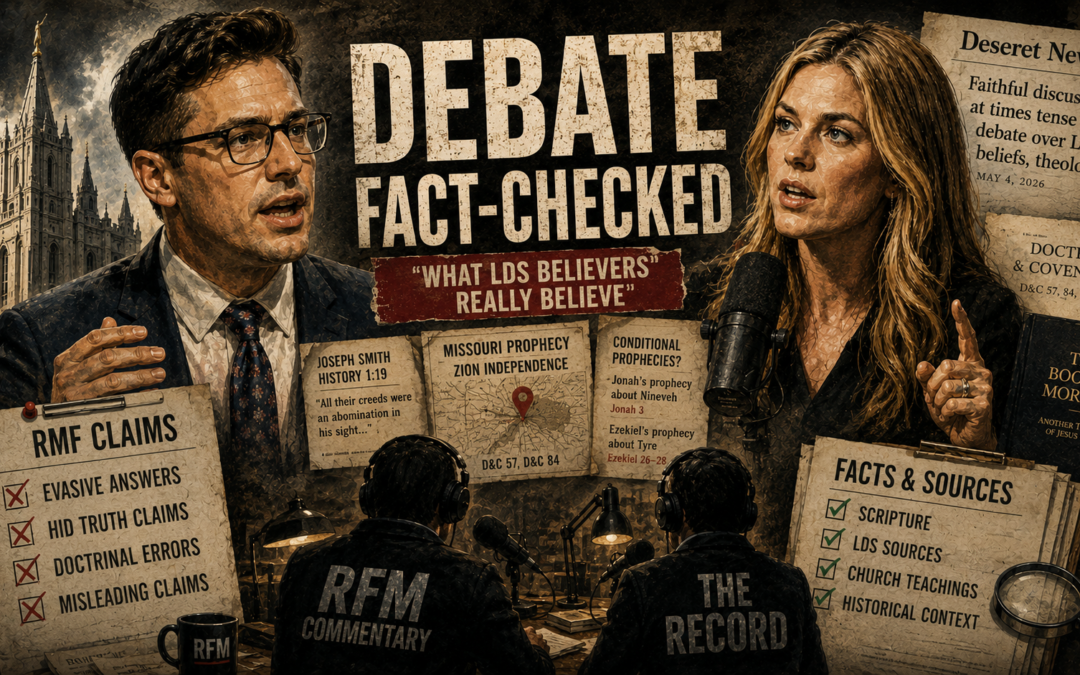
“Mormon Gets Creamed in Debate”: RFM’s Commentary on Jacob Hansen vs. Allie Beth Stuckey — Six Claims Fact-Checked
Radio Free Mormon is correct that Jacob Hansen spent much of the debate avoiding full disclosure of distinctive LDS truth claims until he was pressed directly. However, several of RFM’s own characterisations — including what Hansen should have said and what LDS doctrine actually teaches — also need clarification.
This article examines the actual LDS sources, the debate transcript, and the strongest arguments from both sides.
About This Episode
Radio Free Mormon Episode “Mormon Gets Creamed in Debate” features RFM and co-host Colby Reddish reacting to the April 27, 2026, debate between LDS apologist Jacob Hansen of Thoughtful Faith and Baptist evangelical commentator Allie Beth Stuckey.
The episode analyzes 22 debate clips and argues that Hansen repeatedly compressed or softened distinctive LDS truth claims in response to the rhetorical pressure of the moment. RFM describes this as an “accordion” strategy — expanding and contracting LDS claims when convenient.
The debate itself was real, recent, and widely discussed. Deseret News covered it on May 4, 2026. Both Hansen and Stuckey later released follow-up commentary.
This rebuttal focuses specifically on RFM and Reddish’s factual claims about:
- Hansen’s doctrinal accuracy
- LDS theology
- How LDS beliefs should honestly be represented publicly
⚖️
This episode differs from a standard claims-based podcast because RFM and Reddish are not debating Hansen directly. Instead, they are offering commentary on his debate performance.
That means the fact-check centers on three questions:
- Was Hansen being dishonest?
- What does LDS doctrine actually teach?
- How should LDS beliefs be represented accurately?
Some of RFM’s critiques are well-supported. Others are overstated or imprecise.
What RFM Gets Right
Conceded — RFM Correct
The “accordion” strategy was real and visible throughout the debate
✓ Accurately Identified and Timestamped
“Jacob Hansen came there to talk about anything and everything other than what Mormons believe… He would rather sail through this debate without disclosing any of his truth claims that can be challenged.”
— RFM
RFM’s central criticism is strongly supported by the debate transcript.
Hansen initially described the Restoration as involving only “the fullness of the ecclesiastical structure.” At first, he avoided discussing:
- The LDS view of God
- Human exaltation
- Temple ordinances
- Priesthood exclusivity
- Distinctive cosmological claims
Each point emerged only after sustained questioning from Allie Beth Stuckey.
Deseret News confirmed this dynamic. The article noted that Stuckey repeatedly pressed Hansen on:
- The nature of God
- Priesthood authority
- Salvation and heaven
- Whether evangelicals and Latter-day Saints believe in the same Jesus
The coverage also notes Hansen eventually invited listeners to LDS baptism, showing that he ultimately did discuss distinctive LDS claims — but only after prolonged cross-examination.
RFM’s criticism here is fair. A public debate about whether LDS believers are Christians should not require 30 minutes of questioning before core LDS claims are fully stated.
Assessment: RFM Correct — The Pattern Was Real
Hansen revealed the broader scope of LDS theology incrementally rather than proactively. Whether intentional or not, the approach made him appear evasive.
Sources
Deseret News — Coverage of the Hansen–Stuckey debate ·
YouTube — Full debate video (Relatable with Allie Beth Stuckey, Ep. 1338)
Conceded — RFM Correct
Dan McClellan’s critique of LDS theosis comparisons is accurate
✓ Confirmed by LDS Scholar McClellan
“Bringing up patristic appeals to theosis is not going to be very effective…”
— Dan McClellan
This criticism comes from an LDS scholar, not from critics of Mormonism.
The early church fathers did teach forms of theosis or deification. The LDS Gospel Topics Essay on “Becoming Like God” references several of them.
However, there is still a major theological difference.
In traditional Christian theology, theosis means participating in God’s divine nature through grace while remaining eternally distinct from God Himself.
In LDS theology, exaltation involves literal progression to godhood, including divine inheritance and eternal increase.
These ideas use similar language but describe fundamentally different concepts.
McClellan made this argument long before the debate happened. That makes Hansen’s use of patristic quotes especially vulnerable to criticism in an evangelical setting.
Assessment: RFM Correct — and Supported by LDS Scholarship
The comparison between patristic theosis and LDS exaltation is more complicated than Hansen suggested.
Sources
LDS Gospel Topics Essay — Becoming Like God ·
Wikipedia — Theosis (Eastern Christianity) — for comparison with LDS exaltation
Where RFM’s Characterisations Need Precision
Claim 1 of 4
Hansen was hiding LDS exclusivity
🔷 Partly Valid — But Missing an Important LDS Distinction
“Finally, she gets him to admit… salvation is available only through the Mormon church.”
— RFM
RFM frames Hansen’s eventual answer as a reluctant confession.
But Hansen was attempting — admittedly imperfectly — to explain a genuine LDS theological distinction between salvation and exaltation.
The LDS Distinction
LDS theology teaches:
- Salvation through resurrection is universal
- Exaltation requires LDS ordinances and priesthood authority
That distinction matters.
According to the Gospel Topics Essay on Becoming Like God, nearly all people inherit some degree of glory after resurrection. Only “sons of perdition” face outer darkness.
This makes LDS theology more universalist than many evangelical frameworks.
At the same time, Hansen delayed acknowledging the exclusivity of exaltation long enough that the audience understandably perceived evasiveness.
Both criticisms contain truth.
Assessment: Both Sides Have a Point
The salvation/exaltation distinction is real LDS theology. However, Hansen’s delayed disclosure still damaged credibility.
Sources
LDS Gospel Topics Essay — Becoming Like God (salvation vs. exaltation)
D&C 76 — Three degrees of glory
Claim 2 of 4
The Restoration was not merely about “ecclesiastical structure.”
✓ RFM Correct — Joseph Smith History Is Explicit
“All their creeds were an abomination in his sight…”
— Joseph Smith History 1:19
RFM is correct that Hansen’s opening framing understated Joseph Smith’s own claims.
Joseph Smith History 1:19 describes existing Christian creeds as corrupt and spiritually unacceptable. That goes far beyond institutional reform.
The Restoration, according to Joseph Smith’s own account, was not simply about restoring church structure. It involved rejecting existing Christian theology altogether.
Notably, Allie Beth Stuckey — not Hansen — quoted the passage directly during the debate.
That moment reinforced RFM’s criticism that Hansen appeared hesitant to fully own LDS scripture in front of an evangelical audience.
Assessment: RFM Correct
Hansen’s framing softened the actual language of Joseph Smith History 1:19.
Sources
Joseph Smith History 1:19 — Official LDS scripture ·
D&C 93 — Jesus growing “from grace to grace” (contradicts Hansen’s “always fully divine” claim)
Claim 3 of 4
The Missouri prophecy controversy
⚖️ Partially Valid — Conditional Prophecy Has Biblical Precedent
RFM criticizes Hansen for hedging on prophecies about Missouri and Zion.
D&C 57 and D&C 84 clearly identify Independence, Missouri, as the center place of Zion.
RFM is correct that Hansen relied heavily on prophetic certainty when defending Mormonism,m but appealed to conditional prophecy once difficult predictions came into focus.
However, the broader theological argument Hansen used is not invented.
Jonah’s prophecy about Nineveh changed after repentance. Ezekiel’s prophecy about Tyre is also debated among scholars because events unfolded differently from what was described.
Deseret News confirmed Hansen appealed to these examples during the debate.
The concept of conditional prophecy exists throughout biblical theology, not only in LDS apologetics.
Assessment: RFM Identifies a Real Inconsistency
Conditional prophecy is a legitimate theological category. The issue is Hansen’s selective use of it depending on rhetorical need.
Sources
D&C 57 — Missouri identified as the centre place of Zion ·
Jonah 3 — Nineveh repents; prophecy not fulfilled as delivered ·
Deseret News — Hansen’s Ezekiel/Jonah argument confirmed
Claim 4 of 4
The Book of Mormon presents a simpler gospel than modern Mormonism
✓ Valid and Important Observation
“If you and I wake up and all we have is a Book of Mormon… it would look nothing like contemporary Mormonism.”
— Colby Reddish
This is one of the strongest observations in the episode.
The Book of Mormon focuses primarily on:
- Faith in Christ
- Repentance
- Baptism
- Receiving the Holy Ghost
It does not describe:
- Temple endowments
- Celestial marriage
- The three degrees of glory
- Detailed exaltation theology
- The full Nauvoo temple system
Most distinctly LDS doctrines developed later through the Doctrine and Covenants, Joseph Smith’s sermons, and later prophetic teachings.
This does not automatically invalidate LDS theology. LDS believers typically explain the difference through progressive revelation.
Still, the gap between Book of Mormon simplicity and modern LDS theology is real.
Assessment: A Genuine Internal Tension
A religion built only from the Book of Mormon would look significantly different from contemporary Mormonism.
Sources
3 Nephi 27 — Christ’s simple gospel statement to the Nephites ·
D&C 76 — Three degrees of glory (not in the Book of Mormon) ·
Wikipedia — King Follett Discourse (progressive theology from a 1844 sermon, not BoM)
Frequently Asked Questions
Did Jacob Hansen misrepresent LDS doctrine?
Partially.
Most of Hansen’s final answers aligned with LDS teaching. The problem was how slowly and reluctantly the full picture emerged during questioning.
The strongest criticism involves his softened framing of core LDS distinctives and his hesitation to directly quote Joseph Smith History 1:19.
Is LDS salvation exclusive?
For exaltation, yes.
Standard LDS theology teaches that exaltation requires LDS ordinances performed through priesthood authority.
However, LDS theology also teaches a nearly universal resurrection and degrees of glory for almost all humanity.
Do Mormons believe Jesus will return to Missouri?
Yes. D&C 57 identifies Independence, Missouri, as the center place of Zion.
At the same time, LDS theology also teaches multiple future appearances of Christ, including events connected to D&C 45.
Is the Book of Mormon simpler than modern LDS theology?
Yes.
The Book of Mormon presents a relatively simple gospel framework compared to the more developed theology found in later LDS revelations and Nauvoo-era teachings.
The Honest Summary
Radio Free Mormon’s central argument is substantially correct: Jacob Hansen often delayed or softened distinctive LDS claims until direct questioning forced greater clarity.
The “accordion” description fits the debate well.
RFM is also correct that patristic theosis is not identical to LDS exaltation and that comparisons between the two can become misleading.
At the same time, several parts of RFM’s analysis need additional nuance.
The salvation/exaltation distinction is a genuine LDS theological category, not merely rhetorical spin. Conditional prophecy also has real biblical precedent, even if Hansen applied it inconsistently.
Perhaps the most important observation in the entire episode is Colby Reddish’s point about the gap between the Book of Mormon and contemporary Mormon theology.
That tension is real, historically significant, and central to understanding why debates like this become so difficult for LDS apologists to navigate publicly.
Content is for educational purposes. Sources are cited. Corrections are welcome.