
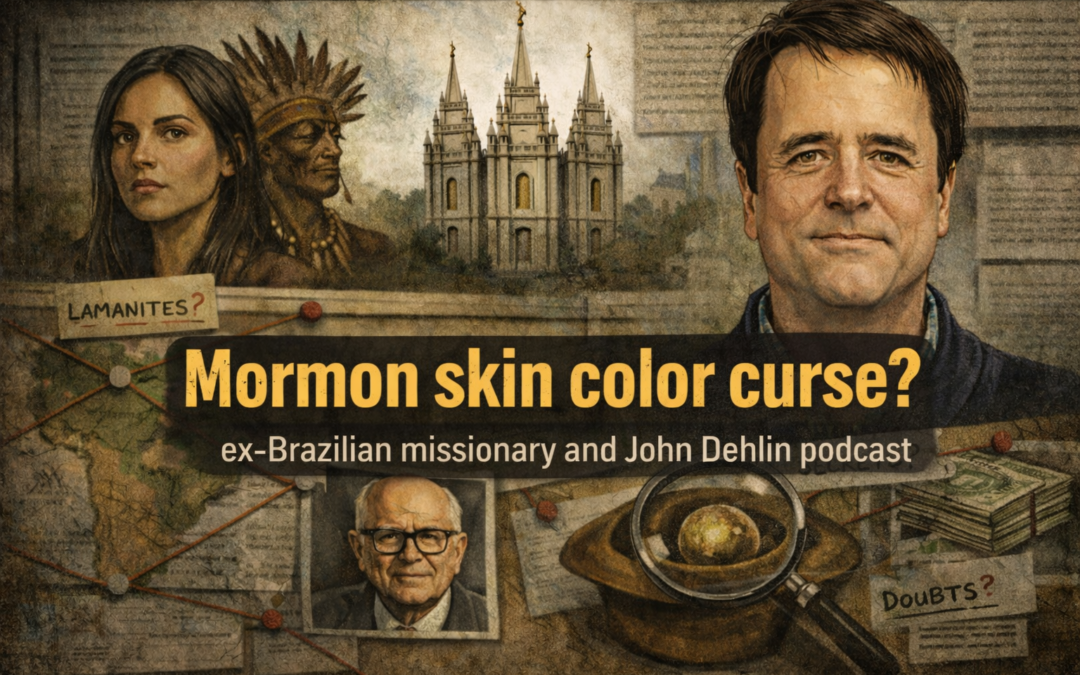
Mormon Stories Podcast Ep. 2128
Podcast / Episode / Title: Mormon Stories Podcast — “Perfectionistic Mormon Missionary Sent Home Early From Brazil – Debora Meireles Ling” (Ep. 2128)
A recurring issue in this section is the lack of clear distinctions between historical LDS culture, current official doctrine, local anecdote, and speculative motive claims. Different categories of information are often blended together, which weakens analytical clarity.
It also relies heavily on loaded framing. While it references real historical challenges, it often presents the most critical interpretations as if they were already proven conclusions. This approach reduces nuance and makes it harder for readers to separate fact from interpretation.
Evaluation Table
| # | Claim Summary | Category |
|---|---|---|
| 1 | Latin American/Brazilian members were framed as Lamanite descendants; dark skin is treated as a curse in current LDS belief | Partial Truth / Misleading |
| 2 | Brazil’s mixed ancestry and São Paulo temple pressures were a main reason the 1978 restriction ended | Mostly True / Oversimplified |
| 3 | LDS girls as young as 7 were effectively expected to dress at garment level | Partial Truth / Misleading Generalization |
| 4 | Brazil’s LDS self-identification numbers prove a 15–20% activity rate | Mixed: True premise / Weak inference |
| 5 | The Church does not prepare youth for hard questions and uses “thought stopping” | Misleading |
| 6 | Missions are generally “inhumane” and not for missionaries’ well-being | Overgeneralized / Not Provable |
| 7 | A mission president may have tried to block an interracial marriage | Historical background true / motive claim not provable |
| 8 | 2015 policy was reversed because of blowback, and the Church hid the 2019 reversal | Mixed: policy change true / motive & concealment claims misleading |
| 9 | The Church pushed vaccines for profit, hid wealth, and was not helping the poor directly | Mixed |
| 10 | Book of Mormon changes, archaeology, “rock in hat,” and unseen plates collapse the truth claim | Mixed |
| 11 | Joseph Smith polygamy was sold as widow-care; in reality wives were as young as 12 and coerced | Misleading |
| 12 | The Church teaches people are broken and only organized religion makes children moral | Misleading / Opinion |
A recurring issue throughout this section is the failure to clearly distinguish between historical LDS culture, current official doctrine, local anecdote, and speculative motive claims. In addition, it relies heavily on loaded framing. Frequently, he presents real historical difficulties in their strongest anti-LDS interpretation as if that interpretation were already proven.
1) Lamanite identity and the “dark-skinned cursed people” framing
“your ward or stake did or did not uh self-identify as Lammonites or descendants of the dark skinned cursed people basically according to the Book of Mormon.”
“I think I do know that in my family we we did talk about how we were descendants of the Lamonites.”
Evaluation: Partial Truth on older LDS culture, Misleading as a statement of current doctrine.
While the scriptural language is indeed troubling, the Book of Mormon does contain passages referring to the Lamanites and a “skin of blackness.” That part is not invented. However, current Church materials explicitly reject the idea that dark skin represents a curse or divine disfavor… and it says the nature of the mark is “not fully understood.” The same page says standing before God is not determined by skin color. Also, the Book of Mormon introduction was revised in 2006 from calling Lamanites the “principal ancestors” of American Indians to saying they were “among the ancestors,” which cuts against sweeping modern ethnicity-to-Lamanite claims. See 2 Nephi 5, Race and The Church of Jesus Christ of Latter-day Saints, Book of Mormon Introduction, and Book of Mormon and DNA Studies.
This raises an important question: Is the speaker referring to historical LDS cultural framing, the raw scriptural text, or current official doctrine?
However, it also turns a real historical factor into a one-note cynical explanation.
2) Brazil and the 1978 priesthood/temple restriction
“One of the main motivations for it being lifted was that Spencer Kimble, the prophet at the time, loved the Brazilian people and kept…”
Evaluation: Mostly True, but oversimplified.
Official Church history clearly shows that Brazil played a meaningful role. Church sources say Spencer W. Kimball recognized the practical and spiritual difficulty created by the restriction in a country with widespread mixed ancestry, and the São Paulo temple sharpened that problem. Official sources also say the worldwide growth of the Church made the restriction increasingly incompatible with its mission. However, the historical record does not support reducing the 1978 revelation to a simple growth strategy or demographic workaround. The Church’s own historical materials present Brazil as one major factor among several that moved leaders toward united prayer and revelation, and the Church now explicitly disavows past racist explanations for the restriction. See The Revelation on the Priesthood, How a 1978 Revelation and a Temple Changed Everything in Brazil, and Race and The Church of Jesus Christ of Latter-day Saints.
3) Child modesty as “garment-level” dress
“it was not allowed to do that. I had to always cover up…”
“… had to dress modestly because first off, that’s a sign of respect for your body cuz your body is a temple. And also because I needed to already be be prepared for when I did go to the temple.”
Evaluation: Partial Truth as culture, misleading if generalized as a universal Church rule.
Church materials do teach modest dress, and older Church family guidance even said children can begin dressing modestly at a young age. But there is no Church-wide policy that seven-year-old girls must dress at endowed-garment cut lines. That is a family-level application of modesty rhetoric, not an official universal mandate. So Deborah’s memory is credible as lived experience, but the extrapolation to a formal Church requirement is too broad. See Modesty, Dress and Appearance, and Teaching Modesty to Our Children.
4) Brazil membership numbers and “activity rate”
“Apparently, the Church of Jesus Christ of Latter-day Saints reports 1.5 million Mormons in Brazil.”
“…only about 226,000 Brazilians self-identify as Mormon.”
“So, there’s about a 15 to 20% activity rate…”
Evaluation: True premise, weak inference.
The Church currently reports over 1.5 million members in Brazil. A scholarly summary of 2010 Brazilian census data reported about 226,509 self-identified Latter-day Saints. These figures clearly demonstrate a significant gap between recorded membership and self-identification. However, converting this directly into a 15–20% “activity rate” is methodologically weak. Census self-identification, ward records, and weekly sacrament attendance are different things. The broad point—attrition and inactivity are a serious issue in Brazil—is fair; The numbers given do not firmly support the claim. See News for Temples in Brazil and Indonesia and Mormonism in Brazil (Springer).
5) “The Church doesn’t prepare youth” and uses “thought stopping”
“Just bear your testimony and walk away. That’s what we were told.”
“…the church hasn’t and doesn’t really choose to prepare its youth and young adults for those types of very common engagements.”
“I think that’s might be sometimes referred to as thought stopping.”
Evaluation: Misleading.
Deborah’s local MTC or mission culture may indeed have been simplistic. But the stronger church-wide claim does not match the Church’s own published guidance. Official Church materials now say members should seek learning “by study and also by faith,” ask questions, analyze information, weigh reliability, and place facts in context. That does not prove every leader handles questions well. It does disprove the broad claim that the Church’s official stance is to suppress inquiry because it fears truth. See Answering Gospel Questions and Guiding Principles to Help Answer Gospel Questions.
Logic issue: local anecdote is being converted into a universal institutional motive claim.
6) “Missions in general have a really inhumane quality”
Margie : “missions in general have a really inhumane quality about them. They they exist for a certain outcome, but they’re not for the well-being, let’s say, of the missionaries themselves.”
Evaluation: Overgeneralized / Not Provable.
This statement reflects rhetoric rather than a demonstrable universal fact. Hard missions, immature leadership, exhaustion, and bad local decisions are all real possibilities, and Deborah’s suffering should not be minimized. But the Church’s own missionary standards explicitly include rest, nutrition, refocusing, and emotional, physical, and spiritual well-being. However, this does not mean that all missions consistently meet that standard. It does mean the categorical description “missions in general are inhumane” overshoots what the evidence can bear. See Physical Well-Being and Missionary Organization and Activities.
7) Speculation that a mission president may have tried to block an interracial marriage
“…that was taught by the Mormon church for 100 plus years and was still being taught in I don’t know 2014 2015 for sure.”
“Do you think that might have been where your second mission president was coming from?”
Evaluation: Historical background true; motive claim not provable.
Older LDS teaching materials really did at times recommend marrying within the same racial background. But moving from that history to “this specific mission president was probably trying to prevent an interracial marriage” is speculation. The current Church topic page explicitly says interracial marriage is not wrong and is not discouraged. So there are two separate judgments here: the historical backdrop is real; the accusation about this particular man’s motive is not established. See Race and The Church of Jesus Christ of Latter-day Saints.
Risk flag: 🟠 Moderate false-light risk.
An identifiable leader is assigned a racially suspect motive without evidence.
8) The 2015 same-sex parent policy, the 2019 reversal, and the “sneaky” framing
“…when the church backtracked and cancelled the 2015 revelation?”
“…that isn’t that sneaky that they would tell everyone that it it was in play over the pulpit and then when they take it away they don’t tell everyone. That’s not super honest…”
Evaluation: Mixed.
The policy change itself is real. In 2015 the Church formally restricted baptism and certain ordinances for children in certain same-sex parent situations, and in April 2019 the Church publicly reversed the baptismal restriction. The 2019 change was announced openly in Church leadership communications and public newsroom coverage. Therefore, the claim that the Church “didn’t tell anyone” or intentionally “hid” the change is misleading. While many members may not have heard the announcement at the local level, the change was publicly communicated through official channels. Likewise, “they reversed it because of blowback” may be an understandable inference, but it is still an inference; the official explanation was extended counseling and prayer. See Context on Handbook Changes Affecting Same-Sex Marriages, First Presidency Clarifies Church Handbook Changes, April 2019 Leadership Session Announcement, and Love Motivated Policy Changes Toward LGBT Parents and Children.
Risk flag: 🟠 Moderate false-light / dishonesty framing.
Public disagreement with the policy is fair; presenting concealment as settled fact is not.
9) Vaccines, pharma stock motive, church wealth, and helping the poor
“…you felt like the church was giving self-interested advice to the members to get the vaccines because they stood to profit…”
“…they used to publish their budget prior to 1960.”
Evaluation: Mixed.
This section combines several distinct claims into a single argument.
It is true that the First Presidency urged members to get vaccinated in August 2021 and tied that counsel to the recommendations of medical experts and government leaders. the Church maintains diversified reserves, and official Church history says annual income/expenditure reports were read in general conference from 1915 to 1959. It is further true that the SEC charged the Church and Ensign Peak over disclosure failures and misstated filings, and the Church publicly said it regretted mistakes. Those are real transparency problems. However, the stronger accusation—that vaccine guidance was driven by financial motives… because of investment interests—is not proved here. The Church’s public rationale was health-based, and CDC sources supported the vaccines as helping protect against severe illness, hospitalization, and death. Likewise, the absolute claim that the Church was not using money to help the poor directly is too broad; the Church reports over $1 billion annually in recent humanitarian/welfare aid, including $1.45 billion in 2024. See The Church Urges More Action to Limit the Spread of COVID-19, SEC Press Release 2023-35, Church Finances, CDC: Benefits of Getting Vaccinated, and 2024 Caring for Those in Need Summary.
10) Book of Mormon revisions, archaeology, the seer stone, and the plates
“I did not know that the Book of Mormon had been edited multiple times, not just for grammatical errors.”
“There were no horses in the time of the Book of Mormon.”
“…he used the rock that he used to scam people out of money for…”
“Nowhere to be found. Nowhere to be seen actually by anybody.”
Evaluation: Mixed.
The seer-stone-in-a-hat point is real and officially acknowledged. Church sources say multiple accounts describe Joseph using either interpreters or a seer stone, and many accounts describe the stone in a hat. That is not “anti-Mormon literature”; it is on the Church’s own site. Also real: the Book of Mormon text was edited between editions. But official Church materials say many of the early changes were grammatical or stylistic, so the implication that the revisions themselves prove collapse is overstated. Calling the seer stone a proven tool to “scam people out of money” also goes too far. Church history acknowledges treasure seeking, but the record remains more complicated than the rhetoric suggests. Finally, “the plates were seen by nobody” is flatly false on LDS evidence: the Book of Mormon still includes the Three and Eight Witnesses, and Church history topics explicitly discuss those witnesses. Archaeological and DNA objections are real pressure points, but the Church’s own essays argue those questions are not decisively settled and do not commit the Church to a single official geography. See Book of Mormon Translation, Seer Stones, Treasure Seeking, Joseph Smith’s 1826 Trial, Witnesses of the Book of Mormon, and Book of Mormon and DNA Studies.
11) Polygamy: widow-care story, coercion, and “as young as 12”
“…they had a lot of men die and so the women couldn’t take care of themselves and so they had to get married so that they would be able to have some sort of support…”
“Mormon polygamous wives were as young as 12 years old.”
Evaluation: Mixed.
The widow-support explanation is not an adequate description of Joseph Smith’s Nauvoo plural marriage. The Church’s own essay roots plural marriage in claimed sealing and religious motives, not mainly economic care for abandoned women. So that simplified defense is weak. But replacing it with “as young as 12” is also inaccurate in this Joseph Smith context. The Church essay says Joseph’s youngest plural wife was Helen Mar Kimball, sealed several months before her fifteenth birthday. That does not remove the moral difficulty. It does mean precision matters. The same is true of “coercion.” Some historical accounts show anguish, pressure, and wrenching sacrifice; the record is morally difficult. But “coercion” should be argued case by case, not simply asserted as a totalizing label for the whole practice. See Plural Marriage in Kirtland and Nauvoo.
12) “The church teaches you that you are broken”
“…the church teaches you that you are broken and that they have the answer to your to for you and they will fix you as long as you do what you’re told.”
Evaluation: Misleading as doctrine; fairer as a report of lived culture.
This is one of the sharpest overstatements in the section. LDS doctrine does teach the Fall, repentance, covenant duty, and the need for Jesus Christ’s grace. But the Church’s own current materials also teach that every person is a child of God with divine nature, eternal destiny, and divine potential. That is not the same message as “you are broken and the institution will fix you if you obey it.” The criticism is much stronger as a description of how some members experience perfectionistic LDS culture than as a summary of the doctrine itself. The added claim that children do not need organized religion to become moral is a philosophical position, not a factual historical claim settled in this section. See Heavenly Parents, Children of God, and Young Women General Presidency: “What’s in a Name?”.
Final assessment
The strongest claims in this section are those grounded in facts that the Church now openly acknowledges: the seer stone, multiple translation complexities, Brazil’s role in 1978, the 2015/2019 policy change, and the existence of large reserves plus real SEC disclosure failures.
In contrast, the weakest claims are those that move from established facts to assumptions about motive or overly broad conclusions: “the Church teaches skin color as divine curse now,” “missions are inhumane,” “the mission president was probably blocking interracial marriage,” “leaders pushed vaccines for profit,” “the Church hid the 2019 change,” or “the Church teaches people they are broken.” Those claims rely on conflation, speculation, and loaded framing rather than disciplined proof.
Sources consulted: uploaded transcript; official Church scripture and Gospel Topics pages; Church history topics; Joseph Smith Papers / Church history material; Church Newsroom; SEC; CDC; Springer reference on Mormonism in Brazil.
Live Sources
- 2 Nephi 5
- Race and The Church of Jesus Christ of Latter-day Saints
- Book of Mormon Introduction
- Book of Mormon and DNA Studies
- The Revelation on the Priesthood
- How a 1978 Revelation and a Temple Changed Everything in Brazil
- Modesty
- Dress and Appearance
- Teaching Modesty to Our Children
- News for Temples in Brazil and Indonesia
- Mormonism in Brazil (Springer)
- Answering Gospel Questions
- Guiding Principles to Help Answer Gospel Questions
- Physical Well-Being
- Missionary Organization and Activities
- Context on Handbook Changes Affecting Same-Sex Marriages
- First Presidency Clarifies Church Handbook Changes
- April 2019 Leadership Session Announcement
- Love Motivated Policy Changes Toward LGBT Parents and Children
- The Church Urges More Action to Limit the Spread of COVID-19
- SEC Press Release 2023-35
- Church Finances
- CDC: Benefits of Getting Vaccinated
- 2024 Caring for Those in Need Summary
- Book of Mormon Translation
- Seer Stones
- Treasure Seeking
- Joseph Smith’s 1826 Trial
- Witnesses of the Book of Mormon
- Plural Marriage in Kirtland and Nauvoo
- Heavenly Parents
- Children of God
- Young Women General Presidency: “What’s in a Name?”