
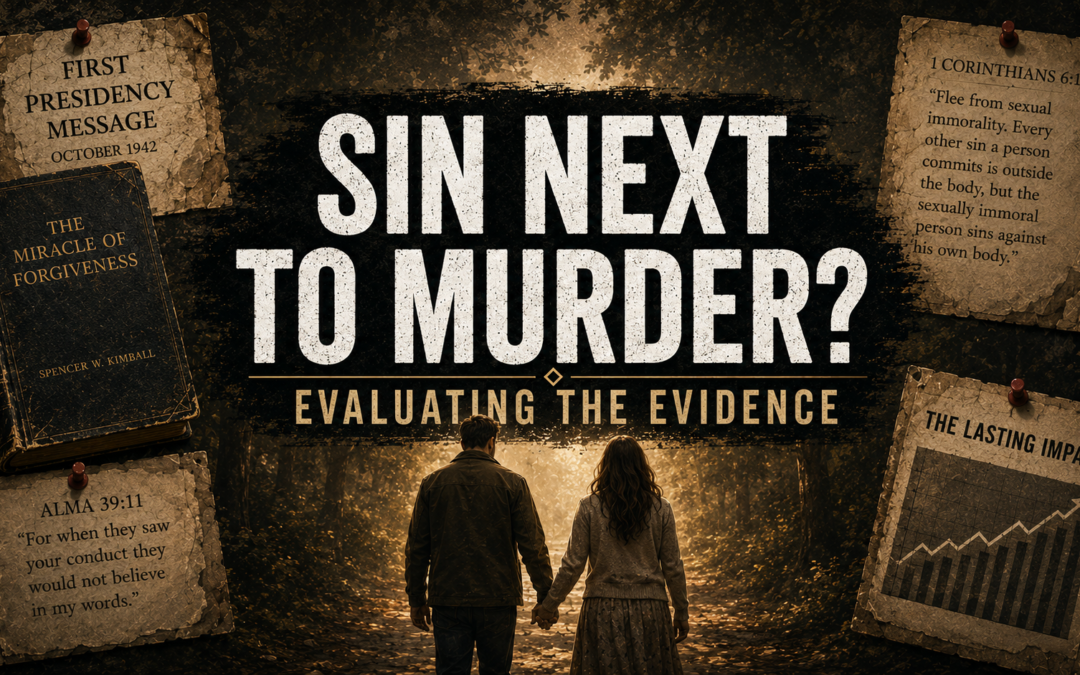
“The Sin Next to Murder”: An Honest Evaluation of LDS Discussions Ep. 76 — What the Episode Gets Right, What It Gets Wrong, and What Both Sides Miss About Jasmine Rapley’s Argument
Sin next to murder is one of the most debated doctrines in Latter-day Saint history. This article evaluates how LDS Discussions Episode 76 presents the doctrine, examines the historical and doctrinal evidence, assesses Jasmine Rapley’s interpretation, and identifies where both sides are accurate and where the historical record tells a more complete story.
Key Takeaways
– Examine the historical development of the LDS “sin next to murder” doctrine.
– Review the 1942 First Presidency Message and other primary sources.
– Compare LDS Discussions Episode 76 with Jasmine Rapley’s interpretation.
– Evaluate where both sides accurately represent the historical and scriptural evidence.
– Explore what the historical record suggests and where genuine disagreements remain.
About This Episode
LDS Discussions Episode 76 features Nemo (Nemo the Mormon) and co-host Julia Sanders (Analyzing Mormonism). It appears on the Mormon Stories Podcast as part of the LDS Discussions series on LDS truth claims and historical topics. This episode responds to a viral short video by Jasmine Rapley — a Latter-day Saint content creator with a large social media following — in which Jasmine reinterprets the “sin next to murder” doctrine, arguing it refers not to sexual sin alone but to compounding sins in specific narrative contexts.
The episode presents historical prophetic quotes establishing the doctrine, critiques Jasmine’s reinterpretation as doctrinally inaccurate and dismissive of member experiences, and discusses the harm caused by how this teaching has been applied. This analysis evaluates both the episode’s claims and Jasmine’s argument. It identifies where each is correct, where each falls short, and what a complete treatment should include.
The Most Important Source Missing from LDS Discussions Episode 76
The episode cites Wilford Woodruff (1883), Melvin J. Ballard (1922), and Spencer W. Kimball’s Miracle of Forgiveness (1969) as evidence that this is established doctrine. All of those are real and documented. But the episode completely omits what is arguably the definitive primary source — a First Presidency Message from October 1942, the highest doctrinal authority in the LDS Church:
This is not an apostle expressing a personal view. This is a formal First Presidency doctrinal statement using the words “the doctrine of this Church.” It explicitly includes fornication and adultery without any qualification about compounding sins. This source answers Jasmine’s argument more completely than any source cited in the episode. Its absence from an hour discussion on this topic is a significant omission.
Favorable Facts — What the Episode Gets Right
The doctrine that sexual immorality is “the sin next to murder” has been taught explicitly and repeatedly by multiple LDS prophets across multiple generations
The episode’s core historical claim is well-documented. The prophetic record on this teaching is extensive, consistent, and spans nearly 150 years of LDS history:
1875: A General Conference address characterizes immoral practices as “the worst possible crime next to shedding blood.”
1883: Wilford Woodruff in the Journal of Discourses: “Adultery [is] one of the greatest crimes any man can commit in this world. It is next to murder.”
1922: Melvin J. Ballard (April General Conference): “Next to murder itself is the crime of sexual impurity. Let that be burned into your hearts and our souls.”
The Doctrine Was Reaffirmed Across Generations
1942: First Presidency Message (the episode omits this): “The doctrine of this Church is that sexual sin… stands, in its enormity, next to murder.”
1969: Spencer W. Kimball, Miracle of Forgiveness, chapter titled “The Sin Next to Murder”: “Your sin is the most serious thing you could have done in your youth this side of murder.”
2011: Elder Boyd K. Packer, General Conference: “Unchastity is next to murder in seriousness.”
The doctrine also appears in the 2017 Book of Mormon seminary teacher manual, the Eternal Marriage Student Manual, and Gospel Principles lessons. This teaching was never officially retracted, reversed, or formally qualified by any First Presidency or Quorum of the Twelve statement.
Why Jasmine Rapley’s Framing Is Misleading
Jasmine’s framing that “some people have this idea from the Book of Mormon” is genuinely problematic — these are not “some people.” These are the First Presidency, multiple prophets, and current seminary curriculum. The gaslighting critique the episode makes on this point is valid.
Jasmine’s framing of this as an interpretive option “some people” hold from their reading of scripture misrepresents a teaching that is in formal First Presidency doctrine, repeated by multiple prophets across generations, and still appearing in current curriculum materials.
The personal testimonies of harm, and the therapist’s report of client trauma, reflect a well-documented pattern connected to this specific teaching
Confirmed by Multiple Independent Sources.
The German Cowgirl’s comment — detailing her bishop using the Miracle of Forgiveness to shame her for sexual thoughts she hadn’t acted on, her hospitalization from stress, and her treatment of her natural sexuality as evidence of demonic possession — represents experiences documented across LDS communities. The episode is right to include and credit this testimony.
A therapist in the live chat stated that “this teaching has caused so much trauma for so many of her clients.” That observation is consistent with a broader documented pattern. Elizabeth Smart’s public account of her kidnapping and rape is an example of this harm. She described not attempting to escape because she had internalized LDS teachings about chastity making her “dirty” and “filthy” after being raped. Smart herself attributed part of her captivity experience to the shame framework around sexual purity that she had absorbed as an LDS member.
Several later accounts claim that Spencer W. Kimball expressed regret about parts of The Miracle of Forgiveness, though the Church continued to recommend it for decades after his presidency ended.
The episode is on solid ground in documenting the harm. The lived experiences shared in the episode reflect a well-documented pattern, and the therapist’s clinical observation is consistent with broader evidence.
The pattern of allowing apologists to quietly reframe uncomfortable teachings without formal retraction is accurately observed
A Pattern This Series Has Documented Across Multiple Episodes.
The episode makes a structural observation that holds up to scrutiny. The LDS Church has often tolerated informal apologetic reinterpretations of uncomfortable teachings. At the same time, it has not formally retracted those teachings or disciplined the apologists promoting those reinterpretations. Examples from this rebuttal series alone: the “own a planet” teaching (covered in passing), the racial theology reframings documented in Rebuttals #17 and #22, and the Adam-God/blood atonement minimizations discussed in Rebuttal #25.
The observation that Jasmine’s reinterpretation serves the Church’s interest in creating distance from an embarrassing teaching without the institutional cost of a formal retraction is analytically sound. Whether this pattern is coordinated or organic remains uncertain. The episode wisely leaves that question open instead of asserting coordination it cannot prove.
The structural dynamic is real. The episode is right to name it while stopping short of asserting deliberate orchestration.
Four Corrections to LDS Discussions Episode 76
The teaching last appeared in General Conference in 2011, not 1993 as the episode states
Nemo states that the “sin next to murder” teaching hasn’t appeared in General Conference since 1993. This is incorrect. Elder Boyd K. Packer repeated the teaching in his April 2011 General Conference address, Guided by the Holy Spirit. He stated that “unchastity is next to murder in seriousness.” At the time, Packer served as Acting President of the Quorum of the Twelve Apostles. That position gave his statement significant institutional weight.
The teaching also appears in For the Strength of Youth, the current standards document distributed to LDS youth, and in 2017 seminary curriculum materials — meaning it was institutionally active within the last decade, not merely a historical artifact.
The episode’s suggestion that this teaching faded from official use after 1993 understates its continuing presence in Church instruction.
The hosts dismiss the Corianton contextual reading too quickly — Alma 39:11 explicitly connects Corianton’s sin to harm done to the Zoramites
The “Spiritual Murder” Label Is a Stretch, But the Underlying Textual Connection Is Real
The hosts repeatedly call Jasmine’s Corianton interpretation “a huge stretch” and say “this man didn’t murder anybody.” While “spiritual murder” is indeed not in the Book of Mormon text and is Jasmine’s gloss rather than Alma’s word, the underlying textual connection she is drawing on is real. Alma 39:11 says directly:
This verse explicitly connects Corianton’s behavior with harm to potential converts. After abandoning his mission to pursue Isabel, the Zoramites observed his conduct and rejected Alma’s message. The text explicitly describes harm to those who would have received the gospel. What is not in the text is calling it “spiritual murder” — that gloss is Jasmine’s addition and the hosts are right to identify it as her own interpretive frame rather than scriptural language.
Does Alma 39 Support Jasmine Rapley’s Interpretation?
The appropriate critique of Jasmine’s Corianton argument is not “there’s no connection to harm in the text”, there clearly is. But rather that Alma 39:5 frames the sexual sin itself as “most abominable above all sins save it be the shedding of innocent blood or denying the Holy Ghost” as an apparently independent statement, not contingent on the compounding harm. And neither the Corianton reading nor the David reading can overcome the 1942 First Presidency Message, which makes no qualification about compounding sins whatsoever.
The hosts would strengthen their critique by engaging the textual connection rather than dismissing it entirely, and then showing why that connection doesn’t rescue the argument from the First Presidency’s unqualified doctrinal statement.
Nemo’s claim that teaching sexual sin next to murder is “anti-biblical” overstates what the New Testament actually says
This overstates what the New Testament record shows. The woman caught in adultery (John 8:1-11) and the woman at the well (John 4) both demonstrate Jesus’s emphasis on mercy, forgiveness, and engagement over condemnation, and the episode is entirely correct in holding these up as a contrast to how bishops used the Miracle of Forgiveness. That contrast is valid and important.
Paul’s Teaching on Sexual Immorality
Paul also treats sexual immorality as uniquely serious in 1 Corinthians 6:18. He writes, “Flee from sexual immorality. Every other sin a person commits is outside the body, but the sexually immoral person sins against his own body.” Paul presents sexual sin as unique character, even though it does not rank it next to murder. Paul also teaches in 1 Corinthians 5–6 and Galatians 5:19 that sexual immorality can warrant church discipline and exclusion from the kingdom of God. The New Testament does not rank sexual sin next to murder — but calling the teaching “anti-biblical” when Paul gives it special status overstates the biblical opposition to the teaching’s severity.
The better argument — which the episode partially makes — is that the LDS application of this teaching has produced the opposite of what Jesus modeled in John 8, where he declined to condemn a woman caught in the very act of adultery while those ready to stone her dispersed. That contrast is powerful and doesn’t require the overstatement.
The contrast between how bishops applied the Miracle of Forgiveness and how Jesus responded to the woman caught in adultery is the right argument. It doesn’t require claiming the entire biblical record opposes the severity of the teaching.
Both hosts raise the possibility that Jasmine is “bordering on apostasy” — this framing is disproportionate to a single reinterpretation video
The Apostasy Standard Requires More Than a Single Reinterpretation.
Both Nemo and Julia suggest at various points that Jasmine’s video is “bordering on apostasy” or represents quasi-apostolic territory. Nemo cites the LDS General Handbook definition of apostasy — which includes “persisting in teaching as church doctrine what is not church doctrine after being corrected by the bishop or stake president” and “repeatedly acting in clear and deliberate public opposition to the church’s doctrine.”
A single reinterpretation video does not meet this standard by any reading. The handbook’s definition explicitly requires repetition after correction, or a pattern of working to undermine faith. Jasmine has offered a reinterpretation; she has not been corrected by a bishop or stake president (that we know of); there is no pattern established from this single video. The apostasy framing, even framed as “bordering on,” invites readers to apply a disciplinary framework to a content creator whose work does not meet the threshold the hosts’ own cited source requires.
The more productive critique — which the episode also makes — is simply that Jasmine’s delivery is dismissive of those who were taught this doctrine explicitly, and that offering a reinterpretation without acknowledging the prophetic record constitutes a form of gaslighting that can itself cause harm. That critique is valid and doesn’t require the apostasy framing.
The legitimate concern about Jasmine’s delivery and historical omissions is better served by the direct critique than by invoking disciplinary terminology.
Frequently Asked Questions
Has the LDS Church officially taught that sexual immorality is the sin next to murder?
Yes, extensively and at the highest levels of Church authority. The clearest statement is a 1942 First Presidency Message which explicitly states: “The doctrine of this Church is that sexual sin… stands, in its enormity, next to murder.” Additional confirmed sources: Wilford Woodruff (1883), Melvin J. Ballard (1922 General Conference), Spencer W. Kimball’s Miracle of Forgiveness chapter titled “The Sin Next to Murder” (1969), Boyd K. Packer (April 2011 General Conference), and the 2017 seminary curriculum. This teaching has never been formally retracted or officially qualified by any First Presidency statement.
Is Jasmine Rapley’s reinterpretation of the Corianton story valid?
Her argument has partial but not complete textual support. Alma 39:11 does explicitly connect Corianton’s behavior to harm done to potential converts among the Zoramites (“when they saw your conduct they would not believe in my words”). This connection is in the text. However, Alma 39:5 frames the sexual sin as “most abominable above all sins save it be the shedding of innocent blood or denying the Holy Ghost” as an apparently independent statement. And the 1942 First Presidency Message makes no qualification about compounding sins, stating directly that sexual sin “stands, in its enormity, next to murder” in connection with fornication, adultery, and prostitution alike. Jasmine’s reinterpretation has more scholarly support than the episode credits — but it cannot overcome the First Presidency’s unqualified doctrinal statement.
When was the last time this teaching appeared in the LDS General Conference?
The episode says 1993, but this is incorrect. Elder Boyd K. Packer, as Acting President of the Quorum of the Twelve Apostles, taught this doctrine in his April 2011 General Conference address “Guided by the Holy Spirit.” The teaching also appears in For the Strength of Youth (the current youth standards document) and in 2017 seminary curriculum materials. The last confirmed General Conference appearance was 2011 — 18 years more recent than the episode claims.
What harm has this teaching caused?
Documented harm includes: Spencer W. Kimball’s Miracle of Forgiveness being used by bishops to intensify shame in members, including LGBTQ members for whom the book’s teachings on homosexuality are documented as severely harmful. Elizabeth Smart’s public account of her kidnapping includes her statement that she did not attempt to escape partly because LDS purity teachings made her feel “dirty” after being raped. Mental health practitioners working with LDS populations have documented high rates of shame and sexual trauma connected to this teaching. Spencer W. Kimball himself was later said to have expressed regret about aspects of the Miracle of Forgiveness, though the book remained in official Church circulation for decades.
Is the “sin next to murder” teaching anti-biblical?
Calling it “anti-biblical” overstates the case, though Jesus’s example is a genuine and powerful contrast. Paul in 1 Corinthians 6:18 frames sexual immorality as uniquely serious — “every other sin a person commits is outside the body, but the sexually immoral person sins against his own body” — and treats it seriously enough to warrant church discipline. The New Testament does not rank sexual sin “next to murder,” but it does give it special categorical weight. The stronger argument is that how LDS bishops applied the Miracle of Forgiveness directly contradicts Jesus’s own example in John 8, where he declined to condemn a woman caught in the act of adultery. That contrast is powerful and doesn’t require the “anti-biblical” claim.
What is the Miracle of Forgiveness and why is it significant here?
The Miracle of Forgiveness is a 1969 book by Spencer W. Kimball, who later became Church President. It includes a chapter titled “The Sin Next to Murder” and was commonly given by bishops to members needing to repent of sexual sin, making it a central instrument through which this teaching was applied at the pastoral level. The book was particularly harmful to LGBTQ members, teaching that same-sex attraction could and should be overcome. Kimball reportedly expressed regret about some aspects of the book’s content later in his life. The Church eventually stopped actively distributing the book, though it was never formally repudiated. Its removal from active recommendation happened quietly rather than through any formal doctrinal correction.
The Honest Summary
Where the Episode Gets It Right
LDS Discussions Episode 76 is engaging legitimate territory. The “sin next to murder” teaching caused documented harm to many people — the testimonies in the episode reflect a genuine pattern of pastoral misuse of this doctrine. The prophetic record is as extensive as the episode claims. And the critique of Jasmine’s delivery — that it dismisses member experiences by framing a formally taught doctrine as “some people’s interpretation” — is valid and important. Those who were taught this doctrine and harmed by it are not wrong to feel gaslit. The 1942 First Presidency Message explicitly called it “the doctrine of this Church.”
What a More Complete Evaluation Requires
Four corrections deserve to be made. The last General Conference appearance of this teaching was 2011 (Boyd K. Packer), not 1993. The episode’s strongest available primary source — the 1942 First Presidency Message explicitly calling it “the doctrine of this Church” for all sexual sin without qualification — is never cited. The episode dismisses Jasmine’s Corianton argument too completely. Alma 39:11 does explicitly connect Corianton’s sin to harm done to the Zoramites, and several LDS scholars have noted this contextual connection. And the apostasy framing, even as speculation, is disproportionate to a single reinterpretation video that does not meet the handbook’s own criteria for apostasy.
A complete evaluation would include several points that neither side fully addresses. The 1942 First Presidency Message as the definitive primary source; an honest acknowledgment that the Corianton contextual reading has partial textual merit even if it can’t overcome the unqualified prophetic statements; a clear explanation of why Jesus’s example in John 8 constitutes a powerful contrast to how this doctrine has been applied — without the overstatement that the whole biblical record opposes the teaching’s severity; and a direct engagement with what a member should do when the most Christlike example they know (John 8) directly contradicts what the First Presidency called “the doctrine of this Church.” That tension is the honest heart of the question, and neither the episode nor Jasmine’s video fully lives inside it.