
April 2026
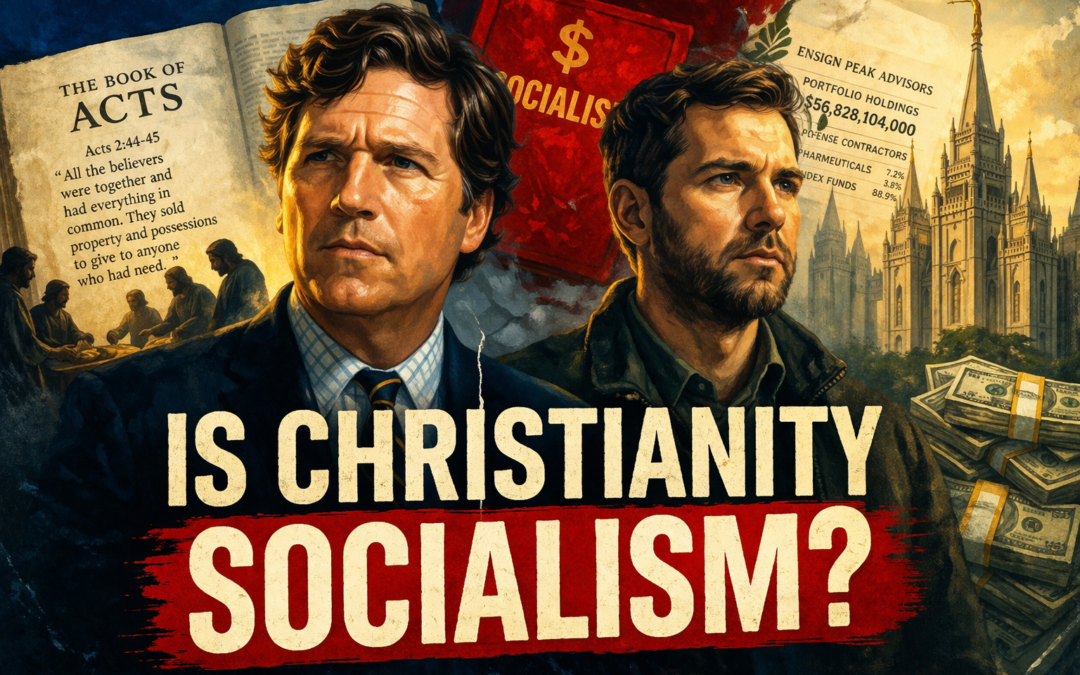
Is Christianity Socialism? Does the LDS Church Misuse Hundreds of Billions? A Fact-Check of Tucker Carlson’s Easter Podcast
Tucker Carlson and guest Nathan Appfeld raise serious concerns about war, exploitation, and institutional corruption —many of them thoughtful and worth engaging. However, two specific claims in the episode contain significant factual and theological errors: first, that Christianity is socialism at its core, and second, that the LDS Church’s finances are as described.
In what follows, we examine both claims carefully and compare them against verifiable evidence and established theology.
About This Episode
In this Easter Sunday episode, Tucker Carlson delivers an extended commentary criticizing President Trump’s social media post about Iranian civilian infrastructure. He then interviews Nathan Appfeld, a documentary filmmaker focused on corruption in religious institutions.
Overall, the conversation offers a serious and often scripturally grounded critique of prosperity gospel leaders and the influence of money in modern Christianity. In that sense, much of the discussion carries real substance.
However, two claims in particular require closer examination. Specifically, Appfeld argues that Christianity is “socialism at its core,” and he presents several assertions about the LDS Church’s wealth and financial behavior.
These points are not minor—they shape how viewers interpret both Christianity and one of the world’s largest religious institutions. Therefore, they deserve careful fact-checking.
The Two Specific Claims We Are Addressing
This rebuttal does not address the episode’s commentary on Trump, Iran, or Paula White. We focus on: (1) Nathan Appfeld’s assertion that “Christianity is socialism at its core” based on Acts 2, and (2) a cluster of claims about the LDS Church — its alleged $350 billion in assets, its defense investments, its COVID vaccine response, and its use of the Joseph-and-Egypt narrative to justify indefinite stockpiling.
Context matters: Unlike most episodes in this series, this is not a podcast hostile to religion. Carlson and Appfeld are sincere Christians. The errors here come from genuine theological imprecision and factual inaccuracy — not anti-religious animus. The goal is to correct specific claims, not to dismiss the episode’s broader concerns, many of which are legitimate.
Before diving into the details, it’s important to clarify scope. This analysis does not address the episode’s political commentary or its critique of individual religious figures. Instead, it focuses strictly on two verifiable areas: theology and financial claims.
Claim 1 — Christianity and Socialism
Claim 1 of 4
“Christianity is socialism at its core” — the early church in Acts proves it
To begin with, Appfeld’s broader concern—that Christianity calls believers to radical generosity and care for the poor—is both valid and deeply rooted in scripture. However, his conclusion that Christianity is “socialism at its core” does not follow from the biblical text.
— Nathan Appfeld, Tucker Carlson Network, ~01:52:19
What Acts 2 Actually Describes
Appfeld’s broader concern — that institutional Christianity has been corrupted by capitalist greed, and that Christians are called to radical care for the poor — is well-taken and scripturally grounded. But his specific claim that Christianity is “socialism at its core,” derived from Acts 2, is a well-documented misreading that scholars across the theological spectrum have rejected.
While Acts 2:44–45 and Acts 4:32–35 do describe believers sharing possessions, the details matter. The Greek verb tenses indicate repeated, voluntary actions over time—not a single, enforced redistribution. In fact, many translations reflect this nuance with phrases like “from time to time.”
Private Property in the Early Church
More importantly, Acts 5:4 explicitly affirms private property. Peter tells Ananias that both the land and its proceeds were fully under his control. This directly contradicts the idea of mandatory economic collectivism.
Therefore, the passage describes voluntary generosity—not a political or economic system. Unlike socialism, there is no state authority, no coercion, and no abolition of ownership.
Socialism as a political-economic system requires state coercion and the abolition of private property. Acts describes neither. What Acts describes is extraordinary, voluntary generosity — which is a more demanding standard than any political system, and an entirely different thing.
How LDS Doctrine Clarifies the Issue
The LDS theological tradition actually provides the most precise framework for this question. The Law of Consecration — revealed through Joseph Smith in Doctrine and Covenants 42 — explicitly preserved private property through the stewardship system. Members consecrated their property, received it back by deed as a personal stewardship, and contributed surplus voluntarily. LDS Church leaders drew a sharp line: in 1942 they stated that “communism and all other similar isms bear no relationship whatever to the United Order.” Joseph Smith himself, after attending a socialist presentation in Nauvoo in 1843, declared he “did not believe the doctrine.”
No — Christianity is not socialism. Acts 2 describes voluntary, periodic, need-based generosity with private property rights intact throughout. Socialism requires state coercion and abolition of private property; neither appears in Acts. LDS doctrine is explicit: the Law of Consecration preserved private property through stewardship, and Joseph Smith personally rejected socialism.
Claims 2–4 — The LDS Church and Ensign Peak
Claim 2 of 4
The LDS Church is “sitting at $350 billion in net assets” and will “hit a trillion in 15 years”
✗ Factually Inaccurate — Number Is Significantly Overstated
— Nathan Appfeld, ~01:18:54
Turning to the financial claims, the assertion that the LDS Church holds $350 billion in net assets is not supported by verified data. While widely circulated online, this number does not come from official disclosures or audited reports.
What Can Actually Be Verified
Ensign Peak Advisors’ publicly disclosed stock portfolio — the portion required by SEC reporting — stood at approximately $56.8 billion as of late 2024, according to Salt Lake Tribune reporting on SEC filings. The broader Widow’s Mite analysis, which includes estimated non-public assets, puts total Church wealth at approximately $265 billion. Even accepting that higher informal estimate, $350 billion is an overstatement. The trillion-dollar projection is speculative extrapolation, not verified data.
The SEC Filing and What It Means
The Church does hold significant financial reserves, and that is a legitimate subject for public discussion. The SEC matter — in which the Church and Ensign Peak were fined $5 million for filing investments through 13 shell LLCs rather than a single consolidated form — was a real regulatory violation, appropriately penalized, and the Church has since filed consolidated reports. But presenting an unverified $350 billion figure as established fact, when the SEC-disclosed portfolio is less than a sixth of that, misrepresents the situation.
No — the LDS Church does not have $350 billion in assets. Ensign Peak’s verified SEC-disclosed stock portfolio is approximately $57 billion. Independent estimates of total Church wealth (including non-public assets) reach approximately $265 billion — not $350 billion. The trillion-dollar figure is speculation.
Claim 3 of 4
The LDS Church “profits from war” — and its COVID vaccine recommendation was financially motivated by Pfizer and Moderna investments
Next, the discussion shifts from total wealth to how those funds are invested.
⚖️ Partially Accurate on Investments — Misleading on Intent and the Vaccine Claim
— Nathan Appfeld, ~01:24:30
Defense Investments in Context
It is accurate that Ensign Peak holds shares in defense contractors such as Northrop Grumman, Raytheon, and General Dynamics. However, context is critical. These holdings largely reflect a broad, index-based investment strategy that mirrors the S&P 500.
In other words, these positions are not unique to the Church—they are common across universities, pension funds, and nonprofit endowments.
Consequently, the claim that the Church “profits from war” overstates intentionality. A diversified portfolio is not the same as a targeted investment strategy
The Vaccine Claim and Causation Error
On the COVID vaccine claim — what’s false reasoning: The implication that the Church recommended COVID-19 vaccination because it was invested in Pfizer and Moderna is conspiracy-level reasoning that mistakes coincidence for causation. The Church encouraged vaccination for the same stated reason as most major global health institutions: to protect member health during a pandemic. Holding index fund shares that include pharmaceutical companies does not constitute a financial motive for health policy, any more than holding S&P 500 shares in a grocery chain creates a financial motive to recommend eating food.
Ensign Peak’s defense contractor holdings are real and verified — a legitimate question for members. But the phrase “profits from war” overstates intent; the investments mirror the S&P 500 index as standard institutional practice. The vaccine-motivation claim conflates owning index shares with institutional policy intent — that’s not how causation works.
Claim 4 of 4
The Church uses the Joseph-and-Egypt story to justify indefinite stockpiling — and “God isn’t there”
Finally, Appfeld raises a more substantive concern: why the LDS Church continues to accumulate large reserves while still requesting tithing from members.
— Nathan Appfeld, ~01:19:28
The Core Question: Why So Much Reserve?
This is the most substantive LDS-related claim in the episode and deserves the most careful response. Appfeld raises a real tension that faithful members should be able to engage honestly: the Church holds enormous reserves relative to its annual operating needs. That is not in dispute, and the question of proportionality is legitimate.
The Church’s Stated Use of Funds
What the Church actually says about its reserves: The Church has been explicit about the purpose of its financial reserves — to fund an unprecedented pace of temple construction (over 360 temples in operation, under construction, or announced), to sustain a global missionary force of over 90,000 full-time missionaries, to fund BYU and other educational institutions, and to support global humanitarian programs that have provided over $1 billion annually in recent years. The Church also teaches members these same financial principles — avoid debt, save for the future, prepare against uncertainty — and treats its reserves as an institutional application of them.
On the Joseph-and-Egypt comparison: The Church’s stated rationale is financial capability during periods of economic disruption, grounded in D&C 104 and the principle of self-sufficiency. Whether current reserves are proportionate to that purpose is a fair question. But characterizing it as straightforward greed misses the theological framework and ignores documented humanitarian spending.
Why Tithing Still Exists
On why tithing is still asked: The LDS Church teaches that tithing is a commandment — a covenant rooted in Malachi 3 and D&C 119 — that members keep as an act of faith regardless of the Church’s institutional financial position. The spiritual purpose of tithing is not primarily fundraising. It is developing in the individual the disposition to consecrate their life to God. The Church could theoretically operate without member tithing from investment returns. But the command to tithe is not an institutional fundraising mechanism — it is a covenant between the individual and God.
The reserve-level question is legitimate. But the Church has explicitly stated its reserves fund 360+ temples, 90,000+ missionaries, universities, and $1B+/year in humanitarian aid — not indefinite self-enrichment. Tithing remains a covenant command for individual spiritual reasons, independent of the Church’s financial position.
Frequently Asked Questions
Is Christianity socialism?
No. The New Testament describes voluntary generosity, not a state-enforced economic system.
Does the LDS Church have $350 billion?
No. Verified public filings show about $57 billion in stocks, with higher estimates remaining unconfirmed.
Does the LDS Church invest in defense companies?
Yes, but primarily through index-based investing common to large institutions.
Was the COVID vaccine recommendation financially motivated?
No evidence supports that claim; it reflects standard public health guidance.
Why does the LDS Church still ask for tithing if it has billions in reserves?
The LDS Church teaches that tithing is a divine commandment — a covenant rooted in Malachi 3 and Doctrine and Covenants 119 — whose primary purpose is spiritual, not institutional fundraising. It develops in members the disposition to consecrate their lives to God. Paying tithing is an act of faith and obedience to God’s law that is independent of the Church’s institutional financial position. The Church’s reserves are designated for specific purposes: 360+ temples, 90,000+ missionaries, universities, and over $1 billion annually in humanitarian aid.
Does the LDS Law of Consecration support socialism?
No. The LDS Law of Consecration explicitly preserved private property through the stewardship system. Members voluntarily consecrated property, received it back by personal deed as a stewardship, and contributed surplus to the bishop’s storehouse. The LDS Church made a formal statement in 1942 that “communism and all other similar isms bear no relationship whatever to the United Order.” Joseph Smith himself, after attending a socialist presentation in Nauvoo in 1843, stated that he “did not believe the doctrine.”
The Honest Summary
In summary, Tucker Carlson’s Easter episode raises important and often valid concerns about corruption, accountability, and the influence of money in religion. Those critiques should not be dismissed.
At the same time, accuracy matters. The claim that Christianity is fundamentally socialist misinterprets key biblical passages, while several financial assertions about the LDS Church rely on overstated or speculative figures.
Ultimately, serious discussions about religion—especially at this scale—require both moral clarity and factual precision. Without both, even well-intentioned critiques risk misleading the very audiences they aim to inform.